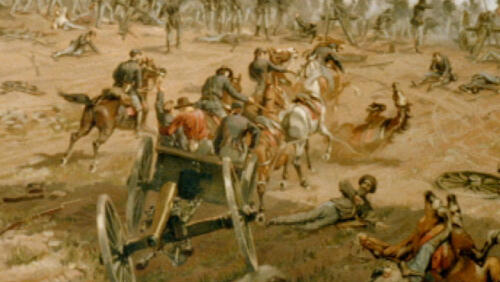
The Battle of Gettysburg remains the defining watershed moment of the American Civil War, a titanic three-day clash that forever altered the trajectory of the United States. Fought between July 1 and July 3, 1863, in the quiet market town of Gettysburg, Pennsylvania, this bloody confrontation pitted General Robert E. Lee’s invading Confederate Army of Northern Virginia against Major General George G. Meade’s Union Army of the Potomac. More than just a military engagement, Gettysburg was an ideological crucible where the survival of the American experiment hung in the balance. The horrific loss of over 51,000 casualties served as a grim prelude to President Abraham Lincoln’s transformative Gettysburg Address, which redefined the war not merely as a struggle to preserve the Union, but as a moral crusade for universal human liberty. Today, understanding this pivotal conflict provides essential insight into how the United States survived its darkest internal crisis and forged a stronger, more unified national identity.
The Road to Gettysburg: Historical Background and Context
By the summer of 1863, the American Civil War had been raging for over two years, leaving both the North and the South exhausted and deeply scarred. Under the audacious leadership of General Robert E. Lee, the Confederate Army of Northern Virginia had recently secured a stunning victory at the Battle of Chancellorsville in May. Emboldened by this success, Lee decided to launch his second invasion of Northern territory, embarking on what would be known as the Gettysburg Campaign. Lee had several strategic objectives. First, he sought to relieve the war-weary farmlands of Virginia from the constant presence of Union and Confederate armies. Second, he aimed to gather critical supplies, such as food, horses, and clothing, from the prosperous agricultural regions of Pennsylvania. Most importantly, Lee hoped that a major Confederate victory on Northern soil would shatter the North’s political will to continue the fight, strengthen the peace movement in the Union, and finally convince European powers like Great Britain and France to officially recognize the Confederacy as an independent nation.
Meanwhile, the Union’s premier fighting force, the Army of the Potomac, was in a state of transition. Frustrated by a succession of cautious and unsuccessful generals, President Abraham Lincoln made a dramatic move just three days before the battle. On June 28, 1863, Lincoln relieved Major General Joseph Hooker of his command and appointed Major General George G. Meade to lead the Union army. Meade was suddenly tasked with coordinating a massive force of over 90,000 soldiers, tracking Lee’s fast-moving army, and defending the vital cities of Washington, D.C., Baltimore, and Philadelphia from immediate threat. The stage was set for a massive collision, which ultimately occurred by accident in the small crossroads town of Gettysburg.
A Chronological Timeline of the Three-Day Clash
Day 1: July 1, 1863 – The Unintentional Collision
The battle began not as a planned offensive, but as an accidental encounter. Elements of Confederate General A.P. Hill’s corps marched toward Gettysburg to investigate reports of supplies. There, they encountered Union cavalry led by Brigadier General John Buford. Recognizing the tactical importance of the high ground surrounding the town, Buford ordered his dismounted troopers to wage a fighting retreat, slowing the Confederate advance until Union infantry could arrive. The battle quickly escalated as both commanders rushed reinforcements to the field. Despite a stubborn defense, the arriving Union forces were eventually overwhelmed and pushed back through the streets of Gettysburg. However, they successfully retreated to the high ground south of town, establishing defensive positions on Cemetery Hill, Culp’s Hill, and Cemetery Ridge. Lee ordered General Richard Ewell to take the Union positions if practicable, but Ewell declined to attack, a decision that would prove to be a costly missed opportunity for the Confederacy.
Day 2: July 2, 1863 – The Assault on the Flanks
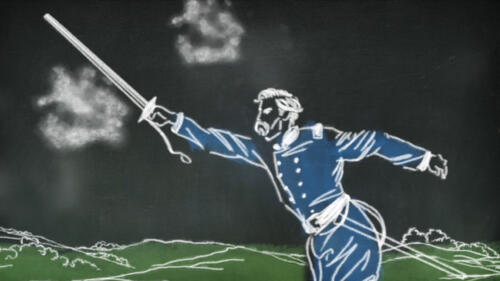
By the second day, both main armies had arrived in full force, forming opposing battle lines. The Union army occupied a formidable defensive position resembling a fishhook, stretching from Culp’s Hill and Cemetery Hill, along Cemetery Ridge, to the rocky hills of Little Round Top and Big Round Top. Recognizing the strength of the Union center, General Lee ordered a massive coordinated assault against the Union flanks. General James Longstreet led the attack on the Union left, sparking brutal, desperate combat in areas that became forever etched in American memory: the Wheatfield, Devil’s Den, and the Peach Orchard. The climax of the day occurred on the extreme Union left at Little Round Top. Recognizing that a Confederate capture of this hill would allow them to rain artillery fire down the entire Union line, Colonel Joshua Lawrence Chamberlain and his 20th Maine Regiment fought a legendary defensive action. Out of ammunition, Chamberlain ordered a daring bayonet charge that successfully repelled the Confederate assault and secured the Union flank.
Day 3: July 3, 1863 – Pickett’s Charge and the High-Water Mark
Believing the Union flanks had been weakened by the previous day’s fighting, General Lee decided to launch a massive, direct assault on the Union center at Cemetery Ridge on the third day. Following a deafening two-hour artillery duel, approximately 12,500 Confederate soldiers, led by Major General George Pickett and other commanders, emerged from the tree line and marched across nearly a mile of open fields under relentless Union artillery and rifle fire. This heroic but catastrophic assault, known as Pickett’s Charge, resulted in devastating casualties. Although a small number of Confederates briefly pierced the Union line at a location known as the Angle, they were quickly repelled or captured. The failure of Pickett’s Charge marked the end of the battle and is often referred to as the High-Water Mark of the Confederacy, representing the closest the South ever came to achieving independence through military victory.
Prominent Figures and Their Lasting Impact
- General Robert E. Lee: As the commander of the Confederate Army of Northern Virginia, Lee’s aggressive tactics had brought him repeated victories. However, his overconfidence in his soldiers’ abilities at Gettysburg led to disastrous tactical errors, most notably ordering Pickett’s Charge. The defeat severely damaged his aura of invincibility.
- Major General George G. Meade: Taking command of the Union Army of the Potomac just days before the battle, Meade demonstrated remarkable poise and strategic competence. He effectively utilized his defensive lines and successfully anticipated Lee’s moves, securing the most critical Union victory of the war.
- Colonel Joshua Lawrence Chamberlain: A former rhetoric and modern languages professor from Bowdoin College in Maine, Chamberlain’s brilliant tactical decision to order a bayonet charge at Little Round Top saved the Union left flank. He was awarded the Medal of Honor for his heroism and went on to become a highly respected statesman.
- General James Longstreet: Lee’s second-in-command, Longstreet was highly skeptical of Lee’s offensive plans at Gettysburg, advocating instead for a defensive strategy. His reluctant execution of the attacks on July 2 and 3 made him a scapegoat for the defeat among post-war Southern writers.
The Post-Battle Withdrawal and Aftermath
On July 4, 1863, as the nation celebrated Independence Day, General Lee began his painful retreat back toward Virginia under the cover of a torrential rainstorm. The wagon train carrying the wounded stretched for miles, a grim testament to the battle’s human cost. While Lee’s withdrawal was not among the most brilliant military retreats in history, it successfully saved the core of the Confederate army from immediate annihilation, prolonging the war for another two agonizing years. President Lincoln was deeply frustrated by General Meade’s cautious pursuit, believing that a more aggressive Union follow-up could have trapped Lee’s army against the flooded Potomac River and brought an immediate end to the war.
Long-Term Impact on the United States
The Union victory at Gettysburg, occurring simultaneously with Major General Ulysses S. Grant’s capture of Vicksburg, Mississippi, completely turned the tide of the American Civil War. The Confederacy was permanently stripped of its offensive capabilities, forced to wage a defensive war of attrition that it could not hope to win. Geopolitically, the defeat ended any realistic prospect of European intervention on behalf of the South, isolating the Confederacy internationally.
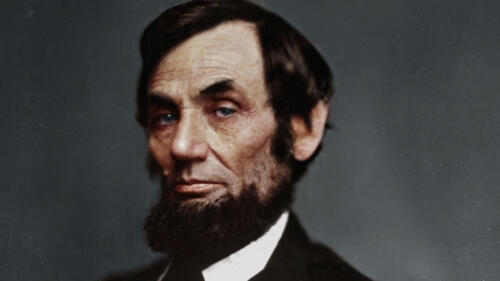
Furthermore, the Union triumph at Gettysburg, followed closely by Lincoln’s formalization of the Emancipation Proclamation’s goals, paved the way for the mobilization of United States Colored Troops. This monumental shift highlighted the courage of black heroes throughout US military history, who fought valiantly to destroy slavery and secure their place in the reconstituted nation. On November 19, 1863, President Lincoln delivered his famous Gettysburg Address at the dedication of the Soldiers’ National Cemetery. In just 272 words, Lincoln redefined the American Civil War as a test of whether a nation founded on the proposition that “all men are created equal” could endure, promising that “government of the people, by the people, for the people, shall not perish from the earth.”
Fascinating and Lesser-Known Facts About Gettysburg
- The Myth of the Shoes: For generations, school textbooks claimed that the battle began because Confederate soldiers marched into Gettysburg looking for a shoe factory. In reality, there was no shoe factory in Gettysburg. The armies clashed because the town was a vital hub where ten major roads converged, making an encounter between moving forces almost inevitable.
- A Single Civilian Casualty: Despite the three days of intense fighting and the exchange of millions of bullets, only one civilian was killed directly during the battle. Twenty-year-old Mary Virginia “Ginnie” Wade was struck by a stray bullet while baking bread in her sister’s kitchen for Union soldiers.
- The Reunion of 1913: On the 50th anniversary of the battle, over 50,000 Union and Confederate veterans gathered in Gettysburg for a massive peace reunion. The climax of the event featured surviving veterans of Pickett’s Charge retracing their steps across the open fields, not to fight, but to shake hands and embrace their former adversaries over the stone wall at the Angle.
Why Gettysburg Still Matters Today
The Battle of Gettysburg is not just a chapter in a history book; it is a foundational pillar of modern American identity. The battlefield itself, now preserved as a National Military Park, serves as a sacred monument to the high cost of division and the profound value of national unity. In an era marked by intense political and social discourse, Gettysburg stands as a powerful reminder of what happens when a nation fails to resolve its differences through democratic means. It challenges modern Americans to continue striving toward the ideals articulated by Lincoln: ensuring that the promises of freedom, equality, and democratic governance are fully realized for every generation.
People Also Ask
Who won the Battle of Gettysburg?
The Union Army of the Potomac, commanded by Major General George G. Meade, won the Battle of Gettysburg, repelling the invading Confederate Army of Northern Virginia led by General Robert E. Lee.
Why was the Battle of Gettysburg a turning point in the Civil War?
Gettysburg was a crucial turning point because it permanently halted General Lee’s invasion of the North, shattered the Confederacy’s offensive capabilities, and prevented European nations from recognizing or supporting the Confederate government.
How many casualties were there in the Battle of Gettysburg?
The battle was the bloodiest of the American Civil War, resulting in an estimated 51,000 total casualties over three days. The Union suffered roughly 23,000 casualties, while the Confederacy lost approximately 28,000 soldiers killed, wounded, or captured.
Conclusion: The Ultimate Historical Takeaways
The Battle of Gettysburg stands as the ultimate testament to the resilience of the American spirit and the heavy price of liberty. It was a conflict of unprecedented scale and violence, yet from its ashes emerged a renewed commitment to the core principles of democracy and human rights. By studying the strategies, the sacrifices, and the enduring legacy of Gettysburg, we gain a deeper appreciation for the fragile nature of democratic institutions and the constant vigilance required to preserve them for future generations.


