The Salem Witch Trials of 1692 stand as one of the most chilling chapters in early American history, a dark period defined by religious extremism, mass hysteria, and the tragic failure of the judicial system. For centuries, historians have pieced together the harrowing events that unfolded in colonial Massachusetts using surviving legal records. In June 2017, the past collided dramatically with the present when an extremely rare, original manuscript of a 1692 deposition went up for auction at Christie’s in New York, selling for an astounding $137,500. This single sheet of paper contains the terrifying testimony of a teenage girl named Mary Daniel, whose claims of spectral torture ultimately condemned Margaret Scott, an impoverished 77-year-old widow, to death on Gallows Hill. Exploring this rare artifact not only sheds light on the tragic fate of a forgotten victim but also exposes the fragile socio-political climate of the Massachusetts Bay Colony, where gossip, personal vendettas, and imaginary apparitions held the power of life and death.
Historical Background: Puritanism, Paranoia, and the Margin of Society
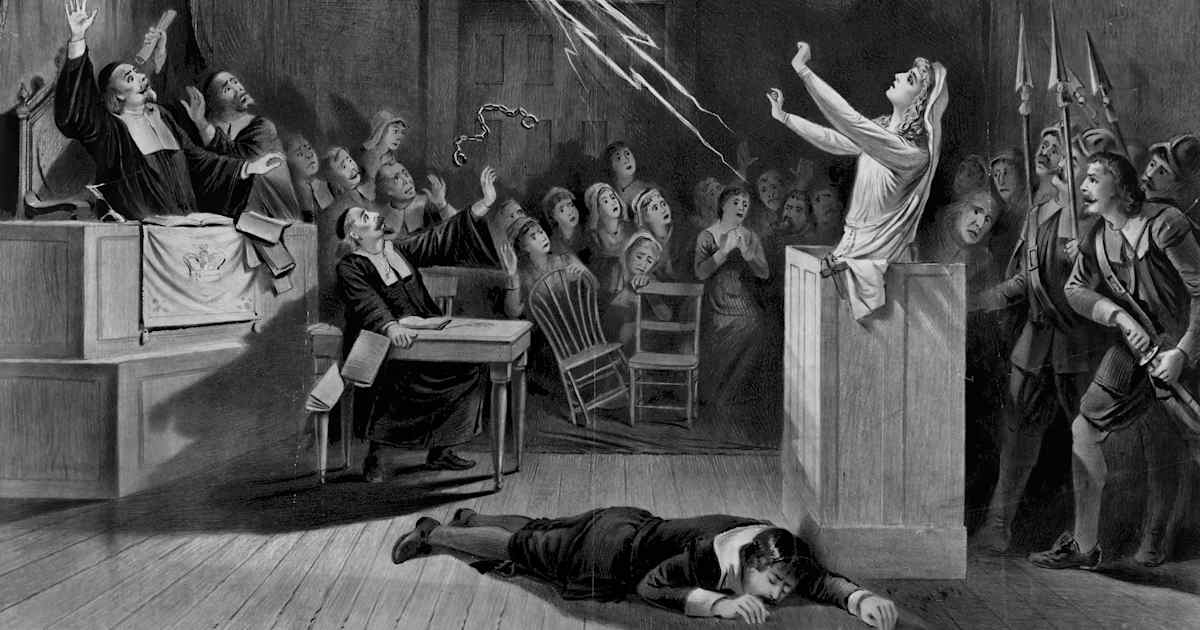
To understand how a single written deposition could carry such lethal weight, one must examine the socio-religious fabric of late 17th-century New England. The Puritans of the Massachusetts Bay Colony lived under a rigid theological worldview. They believed they had established a “City upon a Hill,” a holy covenant with God that was under constant, active siege by the Devil. External threats—such as devastating frontier conflicts with Indigenous tribes, deadly smallpox epidemics, and political instability following the revocation of the colony’s original charter—intensified this collective anxiety. When unexpected tragedies struck, the Puritans did not look for natural explanations; they looked for supernatural culprits.
While Salem Village was the epicenter of this psychological crisis, the paranoia quickly spread to neighboring towns. Though there were earlier witch hunts in colonial America, the 1692 outbreak was unprecedented in its scope and speed. It was within this climate of existential fear that Margaret Scott, a resident of Rowley, Massachusetts, became a target. Born Margaret Stephenson in England around 1616, she had immigrated to the colonies and married Benjamin Scott in 1642. After her husband died in 1671, leaving behind a meager estate, Margaret spent over twenty years in extreme poverty. Left to beg for food and basic necessities, she became a marginalized outsider—the prototypical target for witchcraft accusations in Puritan society.
The Testimony of Mary Daniel: Unpacking Spectral Evidence
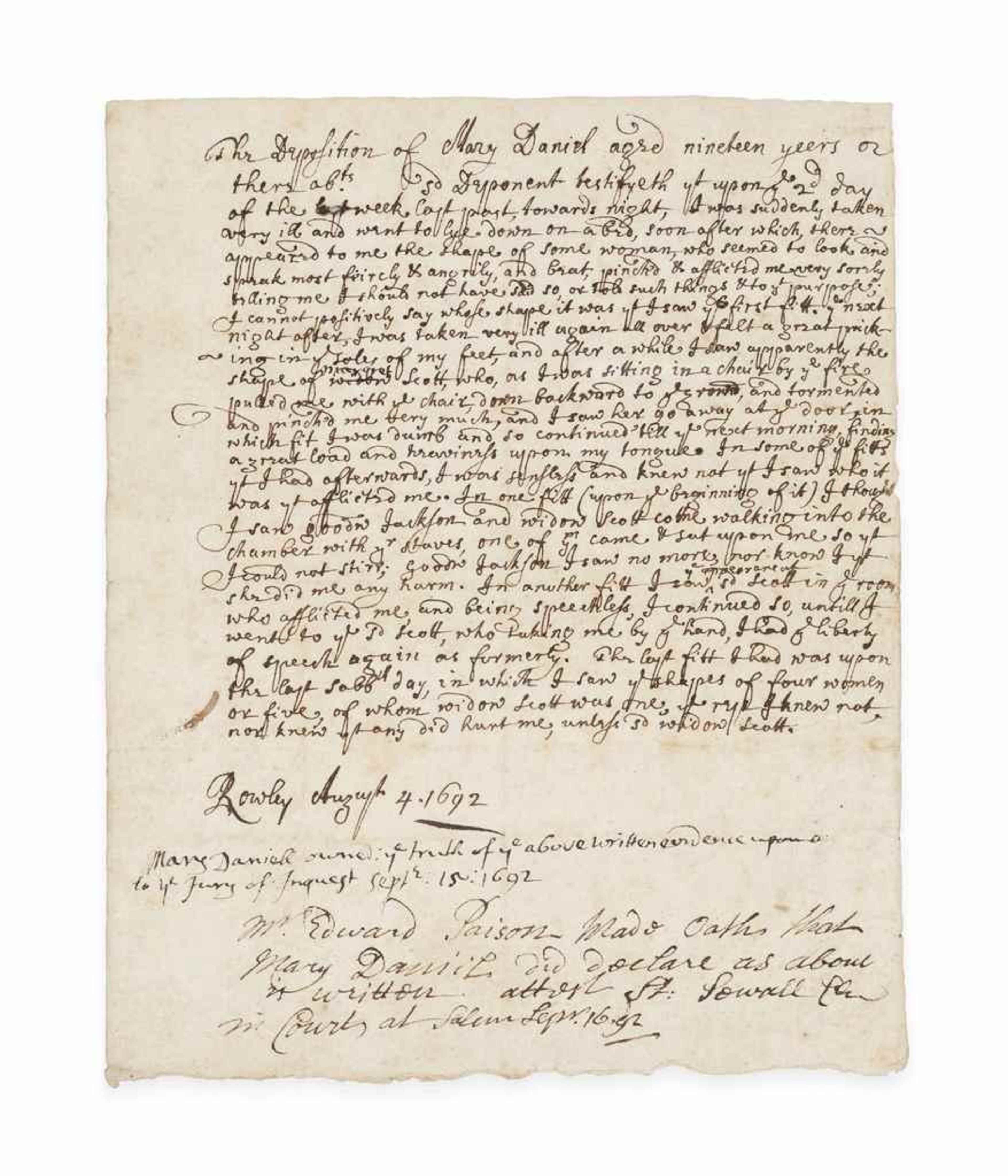
In the summer of 1692, the hysteria reached Rowley. The catalyst for Margaret Scott’s arrest was the sudden, bizarre illness of Mary Daniel, a nineteen-year-old local girl who likely worked as a servant in the household of Rowley’s minister, Reverend Edward Payson. In late July, Daniel began suffering from violent, inexplicable fits. On August 4, 1692, she gave a formal deposition, claiming that her physical torments were caused by the “specter” or “shape” of Margaret Scott.
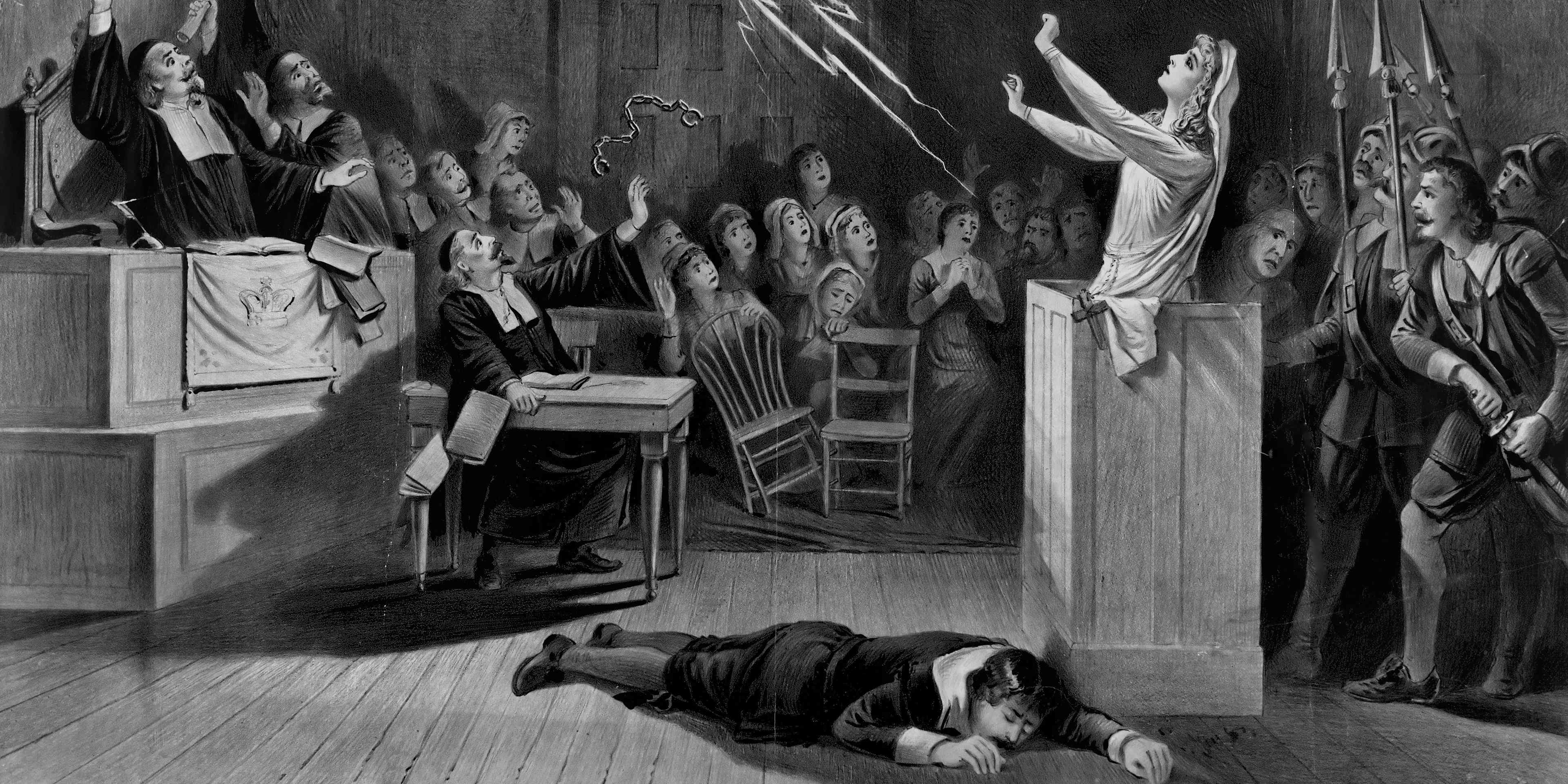
The core of the prosecution’s case relied on what was known as “spectral evidence”—the belief that the Devil could take the shape of an innocent person to afflict others. Because only the victim could see the specter, spectral evidence was virtually impossible to disprove. In her harrowing deposition, Mary Daniel described her tormentors with terrifying specificity:
“I was taken very ill again all over & felt a great pricking in ye soles of my feet, and after a while I saw apparently the shape of Margret Scott, who, as I was sitting in a chair by ye fire pulled me with ye chair, down backward to ye ground, and tormented and pinched me very much, and I saw her go away at ye door, in which fit I was dumb and so continued till ye next morning…”
Daniel went on to claim that the specter of Scott, sometimes accompanied by other local women like “Goody Jackson,” repeatedly beat and choked her. Crucially, she asserted that she lost the “liberty of speech” during these fits, which was only restored when Scott took her by the hand—a classic “touch test” commonly used in witch trials to prove a witch’s guilt.
Key Chronological Timeline of Margaret Scott’s Case (1692)
Unlike some of the more famous trials in Salem, the documentation surrounding Margaret Scott is sparse, making the survival of Mary Daniel’s deposition even more remarkable. The timeline of her tragic undoing unfolded rapidly:
- Late July 1692: Mary Daniel first experiences violent fits and attributes them to the specter of Margaret Scott.
- August 4, 1692: Mary Daniel’s deposition is officially recorded in Rowley, leading immediately to Scott’s arrest and confinement.
- August 5, 1692: Margaret Scott undergoes physical examination. During the examination, accusers such as Frances Wicom experience fits in her presence, cementing the court’s suspicions.
- September 15, 1692: The formal grand jury indictments are finalized, and Mary Daniel’s deposition is officially sworn to in court before Clerk Stephen Sewall.
- September 17, 1692: Margaret Scott is tried, convicted of witchcraft, and sentenced to death.
- September 22, 1692: Margaret Scott is executed by hanging on Gallows Hill in Salem, alongside seven other condemned individuals.
The Powerful Accusers and Their Motives
While Mary Daniel provided the sensational physical symptoms that horrified the courtroom, she was not the only one to testify against the elderly widow. Margaret Scott was the victim of a coordinated campaign by some of Rowley’s most influential citizens. Understanding who these individuals were reveals the socio-economic and personal grudges behind the accusations. In many ways, they mirrored the main accusers of the Salem witch trials who targeted vulnerable community members to settle local disputes.
- Frances Wicom: The 17-year-old daughter of Captain Daniel Wicom, a prominent leader in Rowley. Frances claimed she had been tormented and choked by Margaret Scott’s specter since mid-April of 1692, coinciding with the initial wave of Salem arrests.
- Captain Daniel Wicom: A wealthy and influential local figure who acted as the chief architect of Scott’s prosecution. He testified that Scott had cast a malicious spell on his oxen, rendering them completely immobilized and making it impossible for him to harvest his crops.
- Sarah Coleman: Another local woman who joined the chorus, accusing the elderly widow of torturing her through physical means, including “pricking, pinching, and choaking.”
- Phillip and Sarah Nelson: A wealthy couple who testified that a deceased neighbor, Robert Shilleto, had spent years before his death complaining that Margaret Scott was a witch who was actively harming him.
These testimonies highlight a common pattern in colonial witchcraft cases: the intersection of interpersonal grudges, economic envy, and superstitious fear. To wealthy landowners like the Wicoms, Margaret Scott’s poverty and occasional begging were not just municipal nuisances; they were spiritual threats. It was widely believed that refusing charity to a witch would invite a retaliatory curse, so any subsequent misfortune—such as sick livestock or a failed harvest—was immediately blamed on the beggar.
Major Turning Point: The Last Day of Gallows Hill
The execution of Margaret Scott on September 22, 1692, marked a critical turning point in the history of the Massachusetts Bay Colony. She was hanged alongside Mary Eastey, Martha Corey, Ann Pudeator, Samuel Wardwell, Mary Parker, Alice Parker, and Wilmot Redd. This tragic group would go down in history as the last victims to be executed during the Salem Witch Trials.
By late September, the tides of public opinion were shifting dramatically. The sheer number of accusations—which eventually targeted prominent figures, including the wife of Governor William Phips—forced the colonial elite to reconsider the validity of the proceedings. Influential ministers like Increase Mather began publicly arguing that “It were better that ten suspected witches should escape, than that one innocent person should be condemned.” In October 1692, Governor Phips officially dissolved the Court of Oyer and Terminer, banning the use of spectral evidence in future trials. By May 1693, all remaining accused individuals had been pardoned and released, bringing the terrifying delusion to a definitive end.
The Long-Term Impact on American Justice and Society
The legacy of the Salem Witch Trials and cases like Margaret Scott’s profoundly reshaped the trajectory of American jurisprudence. The devastating consequences of relying on unsubstantiated accusations and spectral evidence led directly to a major overhaul of the legal system. The colonial courts began establishing foundational legal concepts that would later become cornerstones of the U.S. Constitution and the American judicial process, such as the presumption of innocence (“innocent until proven guilty”), the right to legal representation, and strict rules regarding the admissibility of eyewitness testimony and physical evidence.
Furthermore, the trials dealt a permanent blow to the political dominance of the Puritan theocracy. The public’s loss of faith in religious leaders who had championed the prosecutions accelerated the separation of church and state in New England, paving the way for a more secular, rationalist society during the American Enlightenment.
Lesser-Known Facts About Margaret Scott’s Trial
- The Oldest Victim: At 76 or 77 years old, Margaret Scott was the oldest woman executed during the 1692 hysteria. Her advanced age and physical frailty did not spare her from the brutal march to Gallows Hill.
- A Modern Exoneration: It took more than three centuries for Margaret Scott to be officially cleared of her crimes. While the Massachusetts colonial government apologized in the early 18th century, Margaret Scott was not formally exonerated by the state legislature until October 31, 2001—Halloween day—alongside several other remaining victims.
- The Rediscovered Documents: For centuries, Scott’s trial was highly mysterious due to a lack of documentation. However, in 2012, four previously unknown court documents from her trial were discovered tucked away at the Boston Public Library, offering historians invaluable new details about her case.
Why It Still Matters Today
The story of Margaret Scott and the physical survival of Mary Daniel’s deposition serves as a vital reminder of the dangers of institutionalized scapegoating. When society is gripped by fear, uncertainty, or economic stress, the temptation to point fingers at the most vulnerable among us remains a powerful human impulse. Whether analyzing historic events or modern political dynamics, studying the Salem Witch Trials provides crucial lessons on the importance of due process, the defense of civil liberties, and the necessity of critical thinking in the face of mass panic. To dive deeper into the lived experiences of those caught in this crisis, readers can consult several highly researched insightful books on the Salem witch trials that reconstruct these dark days with modern historical precision.
People Also Ask
Who was Margaret Scott in the Salem Witch Trials?
Margaret Scott was an elderly, impoverished widow from Rowley, Massachusetts, who became the only person from her town to be accused, convicted, and executed during the Salem Witch Trials. At 76–77 years old, she was hanged on Gallows Hill on September 22, 1692.
What did Mary Daniel’s deposition accuse Margaret Scott of doing?
In her deposition, 19-year-old Mary Daniel accused Margaret Scott’s specter of tormenting her, pinching her, pricking the soles of her feet, and pulling her chair backward to the ground. This “spectral evidence” was a major factor in Scott’s conviction.
When was Margaret Scott formally exonerated?
Margaret Scott was formally exonerated by an act of the Massachusetts State Legislature on October 31, 2001, exactly 309 years after her wrongful execution.
Conclusion: The Silent Voice of a Paper Artifact
The $137,500 sale of Mary Daniel’s deposition in 2017 underscores the enduring, haunting fascination that the Salem Witch Trials hold in the global imagination. More than just a highly prized collector’s item, this yellowed piece of 17th-century paper represents a literal death sentence. It preserves the terrified, misguided voice of a teenage accuser and the tragic fate of an elderly widow who had no way to defend herself against the invisible forces of spectral paranoia. By studying these fragile records, we keep the memory of victims like Margaret Scott alive, ensuring that the costly lessons of 1692 are never entirely forgotten.


