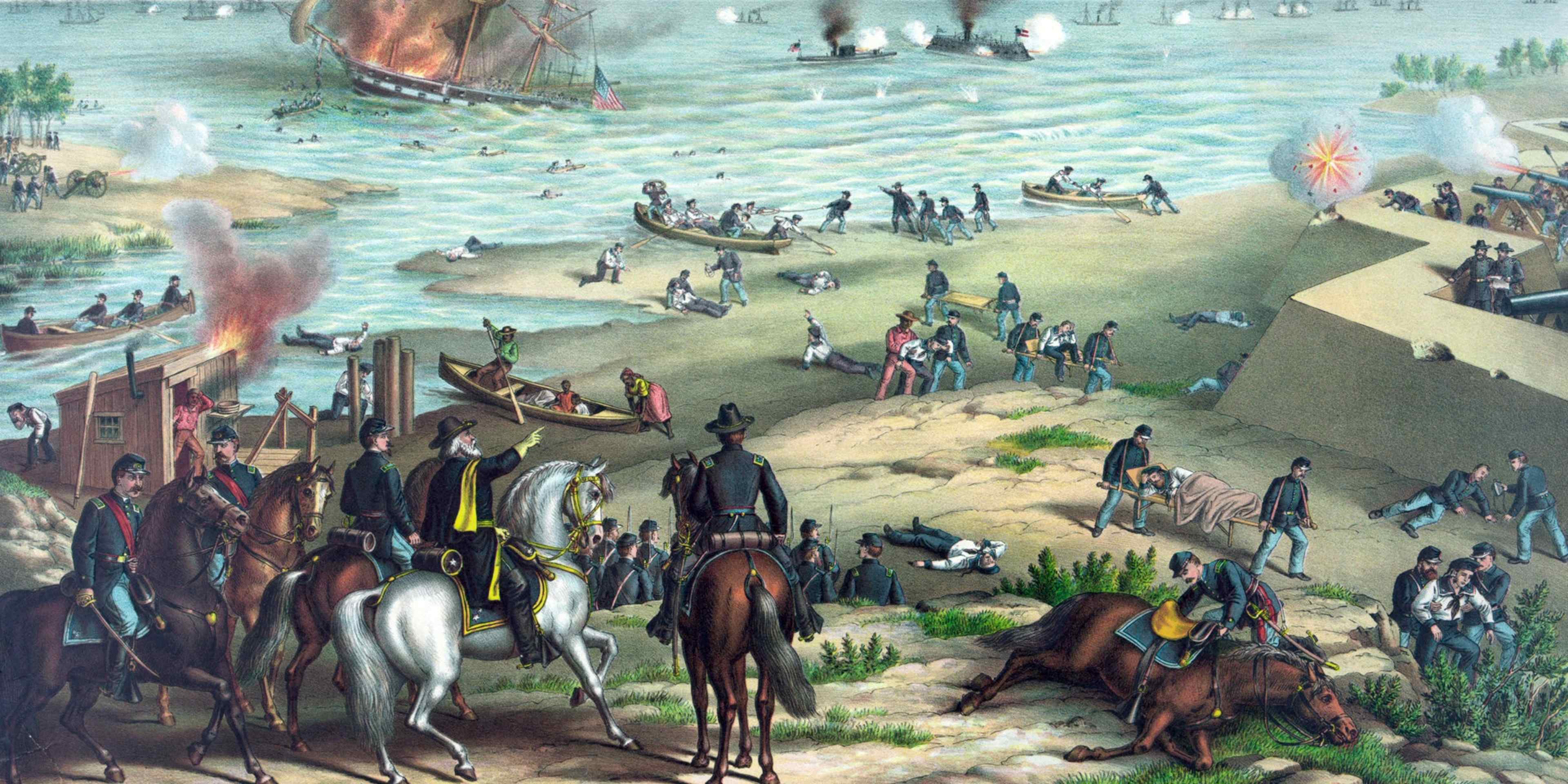
The Battle of Fredericksburg, fought between December 11 and December 15, 1862, stands as one of the most lopsided and tragic engagements of the American Civil War
Historical Background and the Road to Fredericksburg
In late 1862, President Abraham Lincoln was growing increasingly desperate. The costly Union victory at the Battle of Antietam in September had halted Robert E. Lee’s first Northern invasion, but General George B. McClellan’s hesitation to pursue the retreating Confederates infuriated Lincoln. Consequently, on November 7, 1862, Lincoln removed McClellan and appointed Major General Ambrose Burnside to command the Army of the Potomac. Burnside, recognizable by his distinctive facial hair (which spawned the term “sideburns”), was a reluctant leader who had twice refused the command, believing himself unfit for such a massive responsibility.
To prove his detractors wrong, Burnside devised a rapid plan to march southward, cross the Rappahannock River at Fredericksburg, and secure the road to Richmond before Lee could react. However, the plan relied heavily on speed and efficiency—two things that quickly dissolved in the face of bureaucratic delay.
The Prelude: Logistics and the Fatal Pontoon Delay
By mid-November, Burnside’s advance forces had reached Falmouth, directly across the river from Fredericksburg. However, the Rappahannock was too deep to ford. Burnside had to wait for pontoon bridges to arrive from Washington. Due to a major miscommunication between Burnside and General-in-Chief Henry Halleck, the pontoons were delayed by several crucial weeks. This delay stripped the Union of its element of surprise, allowing General Robert E. Lee to rush James Longstreet’s and Thomas “Stonewall” Jackson’s corps to the high ground behind Fredericksburg, constructing formidable defensive positions.
Timeline of the Battle (December 11–15, 1862)
- November 15–20, 1862: Union troops arrive at Falmouth, but find no pontoon bridges. Confederates begin occupying Fredericksburg and the surrounding hills.
- December 11, 1862: The pontoon bridges finally arrive. Under heavy sniper fire from Mississippi brigade defenders in the town, Union engineers construct the bridges. Union forces bombard Fredericksburg, leading to the war’s first major urban combat.
- December 12, 1862: The bulk of the Army of the Potomac crosses the Rappahannock, occupying Fredericksburg and preparing for a massive assault.
- December 13, 1862: The main day of battle. Burnside launches a two-pronged attack: General William B. Franklin strikes Lee’s right flank at Prospect Hill, while General Edwin V. Sumner assaults the Confederate left on Marye’s Heights.
- December 14–15, 1862: A tense truce is held to collect the wounded. Burnside, devastated by the losses, decides against launching further suicidal charges and orders a retreat.
Key Figures and Their Roles
The battle was defined by the decisions—and mistakes—of several key military figures on both sides:
- Ambrose Burnside (Union): The reluctant commander whose rigid adherence to an outdated plan led to disaster. After the battle, he took full responsibility for the defeat.
- Robert E. Lee (Confederacy): The commander of the Army of Northern Virginia. His defensive strategy exploited the natural terrain perfectly, securing one of his most lopsided victories.
- James Longstreet (Confederacy): Supervised the defense at Marye’s Heights. His artillery and infantry mowed down ranks of attacking Union soldiers from an virtually impregnable position.
- Stonewall Jackson (Confederacy): Held the right flank of the Confederate line against a fierce assault by George Meade.
The Battle’s Pivotal Turning Points
Meade’s Temporary Breakthrough at Prospect Hill
On the Union left, Major General George Meade’s division managed to exploit a gap in Jackson’s lines at Prospect Hill. However, due to poor communication and Franklin’s failure to commit his massive reserve of 50,000 troops, Jackson launched a swift counterattack that repulsed the Union advance. This was the Union’s only real chance at victory, and it was lost due to a lack of reinforcement.
The Slaughter at Marye’s Heights
Meanwhile, the assaults on Marye’s Heights were catastrophic. Wave after wave of Union soldiers charged across open ground toward a stone wall defended by Confederates. Not a single Union soldier reached the wall. The Confederate infantry, standing four deep behind the stone wall, poured a relentless hail of lead into the charging Union ranks. It showcased the utter folly of frontal assaults against fortified infantry armed with rifled muskets and well-sighted artillery.
Long-Term Impact on America
Fredericksburg sent shockwaves through the North. Republican senators, frustrated by the lack of progress, attempted to force Lincoln to reorganize his cabinet, targeting Secretary of State William Seward. Lincoln deftly defused this political crisis by refusing the resignations of both Seward and Treasury Secretary Salmon P. Chase. Despite the political maneuvering, Burnside was relieved of command in January 1863, replaced by Joseph Hooker. The victory rejuvenated the Confederacy, setting the stage for Lee’s even greater triumph at Chancellorsville and his fateful second invasion of the North, which culminated at Gettysburg.
Furthermore, the immense sacrifices made by Union soldiers, including many who belonged to marginalized groups, paved the way for broader societal transformations. While we celebrate Black heroes throughout U.S. military history, the terrible losses at Fredericksburg redoubled the North’s commitment to winning the war and enforcing the Emancipation Proclamation.
Lesser-Known Facts about the Battle
The Origin of “Sideburns”
Ambrose Burnside’s famous facial hair style, which consisted of thick whiskers running down his cheeks connected to his mustache, was originally referred to as “burnsides.” Over time, the syllables were flipped to create the modern word “sideburns.”
The Angel of Marye’s Heights
During the freezing night of December 13, wounded Union soldiers lay moaning in the no-man’s-land in front of the stone wall. Confederate Sergeant Richard Kirkland could not bear the suffering and risked his life to carry water to the wounded enemies, earning the nickname “The Angel of Marye’s Heights.”
Louisa May Alcott’s Service
The famous author of Little Women served as a nurse in Georgetown, treating soldiers wounded at Fredericksburg. Her experiences inspired her breakthrough book, Hospital Sketches, which was published in 1863.
Why It Still Matters Today
The Battle of Fredericksburg remains a timeless study in military leadership, communication, and crisis management. It serves as a stark reminder of the human cost of administrative delays and rigid tactical planning. Additionally, the preserved battlefield at Fredericksburg serves as an educational resource, reminding us of the immense sacrifices required to preserve the Union. When evaluating the aftermath of the battle, we can also see how tactical errors forced generals to orchestrate complex retreats, a theme explored in discussions of historical brilliant military retreats.
People Also Ask
Who won the Battle of Fredericksburg?
The Confederate Army of Northern Virginia, led by General Robert E. Lee, won a decisive victory at the Battle of Fredericksburg, repulsing all Union assaults with heavy casualties.
Why did the Union lose the Battle of Fredericksburg?
The Union lost due to delayed pontoon bridges, which allowed the Confederates to dig into strong defensive positions, as well as poor battlefield communication and repetitive, suicidal frontal assaults against Marye’s Heights.
How many casualties occurred at Fredericksburg?
The Union suffered nearly 13,000 casualties (killed, wounded, or missing), while the Confederates suffered fewer than 5,000, making it one of the most lopsided battles of the Civil War.
Conclusion
The Battle of Fredericksburg remains a somber chapter in American military history. It stands as a monument to the bravery of the common soldier, who marched into devastating fire despite the tactical hopelessness of their situation. Ultimately, the lessons of Fredericksburg paved the way for the painful but necessary reorganization of the Union army, eventually leading to victory at Gettysburg and the preservation of the United States.


