On the chilly, moonlit night of February 17, 1864, the dark waters of Charleston Harbor became the stage for a dramatic and terrifying preview of modern naval warfare. As the Union blockading sloop USS Housatonic patrolled the South Carolina coast, a bizarre, metallic shape glided silently just beneath the shimmering surface of the water. It was the Confederate submarine H.L. Hunley, a desperate, hand-cranked vessel built from an iron boiler. When the Hunley successfully detonated its spar torpedo against the Housatonic, it made history as the first submarine to sink an enemy warship in active combat. Though this daring mission did not save the Confederacy from its eventual defeat, it shattered centuries of maritime tradition and laid the technical groundwork for modern undersea warfare. This single, tragic night represented a monumental leap in military innovation, highlighting the lethal risks of experimental technology and the high-stakes naval blockade that choked the Southern war effort during the American Civil War.
Historical Background: A Desperate Quest to Break the Blockade
By late 1863, the American Civil War was reaching a critical, grinding phase. The Union Navy’s blockading squadron, part of General Winfield Scott’s strategic Anaconda Plan, had successfully closed off major Southern ports, denying the Confederacy essential food, ammunition, and trade. Charleston, South Carolina—the symbolic cradle of the secessionist movement—was slowly being strangled. To counter the overwhelming industrial superiority of the Union, Confederate engineers and private investors turned to asymmetric warfare. In Mobile, Alabama, a wealthy lawyer and state legislator named Horace Lawson Hunley joined forces with marine engineers James McClintock and Baxter Watson to develop a secret weapon: a vessel that could travel beneath the ocean waves and strike the blockading ships unnoticed.
The Design and Operations of the H.L. Hunley
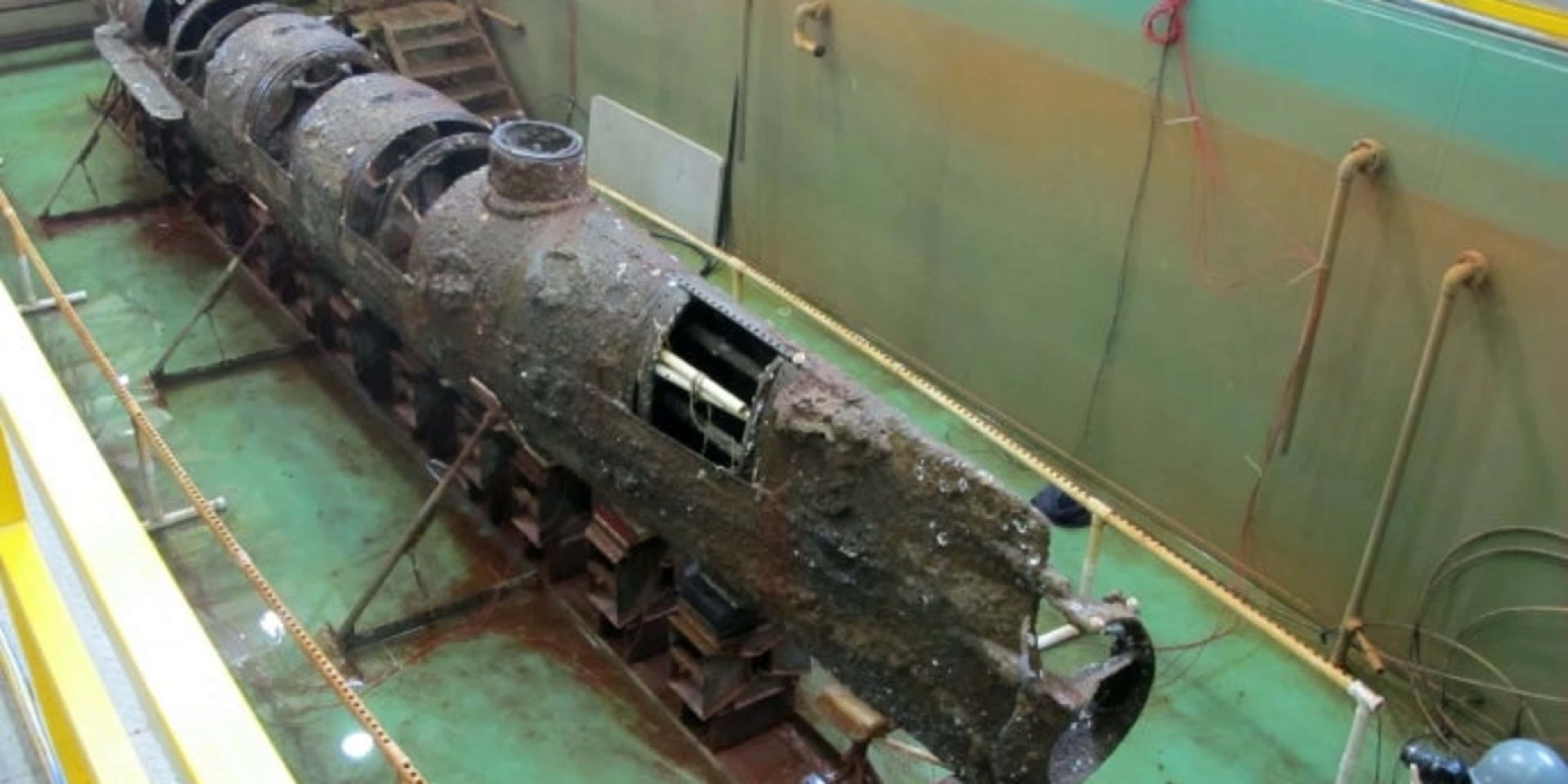
The construction of the submarine was a triumph of improvisation. Lacking the materials for a purpose-built hull, the inventors fashioned the submarine from a 40-foot-long, cylindrical iron steam boiler. They tapered the bow and stern to create a more aerodynamic, whale-like shape. To propel the vessel, seven crewmen sat shoulder-to-shoulder on a narrow wooden bench, manually turning a heavy iron crankshaft connected directly to the propeller. The commander stood at the bow, operating the steering wheel, managing the manual water ballast pumps to dive and surface, and keeping a watchful eye through a tiny, glass-windowed conning tower. The conditions inside were claustrophobic, dark, and suffocating; a single candle was the only source of light, also serving as an warning system—if the flame began to flicker and die, the oxygen levels inside the iron hull were critically low.
A Trial of Blood: The Tragically Lethal Test Runs
Before ever engaging the enemy, the H.L. Hunley earned a reputation as an extremely dangerous machine, often referred to by contemporary observers as an “iron coffin.” The submarine sank twice during training exercises, claiming the lives of thirteen crew members. On August 29, 1863, during a test run in Charleston Harbor, Lieutenant John A. Payne accidentally stepped on the dive lever while the submarine’s hatches were still open, causing it to flood instantly; five of the nine crewmen drowned. Undeterred, Horace Lawson Hunley himself took command of a second trial on October 15, 1863. During a routine dive, the submarine suffered an operational failure and settled on the muddy bottom. All eight crew members, including Hunley himself, perished from suffocation. Despite these tragedies, Confederate General P.G.T. Beauregard reluctantly allowed Lieutenant George Dixon to assemble another crew of courageous volunteers, with the strict condition that the submarine operate only on the water’s surface during the actual attack.
Timeline of the Hunley’s Legacy
- Early 1863: Designed and constructed by Horace Lawson Hunley, James McClintock, and Baxter Watson in Mobile, Alabama.
- August 1863: Transported by train to Charleston, South Carolina, to help break the Union naval blockade.
- August 29, 1863: First fatal training accident occurs in Charleston Harbor, claiming the lives of five crew members.
- October 15, 1863: Second fatal training accident kills all eight crew members, including the inventor, Horace Lawson Hunley.
- November 1863: Lieutenant George Dixon takes command of the repaired vessel and recruits a new team of volunteer sailors.
- February 17, 1864: The Hunley successfully attacks and sinks the USS Housatonic before mysteriously sinking with all hands on deck.
- May 1995: The wreck of the submarine is discovered buried under sand and silt by Clive Cussler’s National Underwater and Marine Agency (NUMA).
- August 8, 2000: The Hunley is raised from the ocean floor and transported to the Warren Lasch Conservation Center for study and preservation.
Key Figures of the Hunley Mission
Horace Lawson Hunley
The primary financier and visionary marine engineer behind the project. Hunley believed passionately in the strategic power of submarine warfare to break blockades. His tragic death inside his own creation solidified his name in naval history but underscored the terrifying perils of early maritime engineering.
Lieutenant George Dixon
An infantry officer from the 21st Alabama Regiment who possessed a keen mechanical mind. Dixon took command of the Hunley in November 1863, knowing full well the vessel’s lethal track record. He was renowned for his leadership and his absolute composure under pressure. Dixon famously carried a $20 gold coin that had saved his life during the Battle of Shiloh by stopping a bullet—a remarkable twist of fate that resembles some of history’s most famous coincidences where personal keepsakes altered the course of human lives.

General P.G.T. Beauregard
The Confederate commander of Charleston’s defenses who authorized the use of the submarine. Beauregard was highly skeptical of the Hunley after its multiple fatal sinkings, noting that the vessel was “more dangerous to those who used it than to the enemy.” However, the desperation of the blockade ultimately forced his hand.
The Fateful Night: The Sinking of the USS Housatonic
On the clear night of February 17, 1864, Lieutenant Dixon and his crew of seven slipped into the harbor. Their target was the USS Housatonic, a powerful 1,240-ton steam-powered sloop-of-war. As the Hunley approached, Union lookout John Crosby spotted a suspicious ripple on the water. Recognizing the threat, the crew of the Housatonic sounded the alarm, but the massive cannons of the warship could not be depressed low enough to hit the low-profile submarine. Union sailors fired rifles and shotguns, but the bullets bounced harmlessly off the Hunley’s iron plating. Dixon drove the submarine forward, ramming its 16-foot spar torpedo—laden with 135 pounds of black powder—directly into the Housatonic’s starboard side. The resulting explosion ripped open the warship. Within five minutes, the Housatonic sank to the bottom of the shallow harbor. Five Union sailors died, while the remaining crew escaped by climbing the rigging or boarding lifeboats.
The Sinking Mystery: What Happened to the Hunley?
Though the attack was a tactical success, the H.L. Hunley never returned to port. For over 130 years, historians debated why the submarine sank on its return journey. Some hypothesized that the vessel was sucked into the vortex of the sinking Housatonic, while others believed it was struck by a lucky shot from a Union sailor. When the submarine was finally raised in 2000, researchers made a shocking discovery: the skeletal remains of the eight crew members were still sitting peacefully at their stations, showing no signs of panic, struggle, or attempts to escape. Modern scientific studies suggest that the shockwave from the submarine’s own black powder explosion traveled through the water and the iron hull, instantly incapacitating or killing the crew through pulmonary blast trauma, leaving the vessel to drift and eventually sink undisturbed.
Long-Term Impact on American and Global Naval History
The sinking of the USS Housatonic changed the face of naval warfare forever. It proved that a small, inexpensive, and stealthy vessel could destroy a massive, heavily armed warship. While the Civil War ultimately concluded with the preservation of the Union and paved the way for monumental great strides for freedom in US history, including the abolition of slavery, the tactical legacy of the Hunley lived on. It inspired the rapid development of submarine technology worldwide, directly influencing naval strategies in World War I and World War II. Modern navies around the globe owe their submarine doctrines to the pioneering, albeit tragic, efforts of the Hunley crew.
Lesser-Known Facts of the H.L. Hunley
- The Missing Escape Plan: Unlike conventional military operations that emphasize strategic withdrawals, the Hunley had virtually no safety margins. The crew knew that any structural failure meant certain death, contrasting sharply with the carefully planned defenses and brilliant military retreats executed by land armies during the Civil War.
- The Inscribed Gold Coin: When archaeologists excavated the wreck, they found Lieutenant Dixon’s lucky gold coin next to his remains. The coin was deeply indented from the bullet that had struck it at Shiloh, and it was inscribed with the initials of his sweetheart and the words: “Shiloh April 6th 1862 My Life Preserver.”
- The Sinking Location: Despite rumors that the submarine sank far from the scene of the battle, the wreck of the Hunley was actually found less than 300 feet away from the resting place of the Housatonic, buried under layers of ocean silt.
Why the Hunley Matters Today
Today, the H.L. Hunley resides at the Warren Lasch Conservation Center in North Charleston, where scientists continue to preserve the iron hull using state-of-the-art chemical baths. The preservation project is one of the most complex maritime archaeological undertakings in human history. The Hunley serves as a fascinating physical time capsule, offering historians unparalleled insights into nineteenth-century metallurgy, engineering, and the daily lives of civil war sailors. It stands as a solemn monument to human ingenuity and the immense sacrifices made in the pursuit of technological innovation.

People Also Ask (PAA)
How many times did the H.L. Hunley sink?
The H.L. Hunley sank a total of three times. The first two sinkings occurred during training exercises in August and October of 1863, killing a combined total of 13 men. The third and final sinking occurred immediately after its successful combat mission on February 17, 1864, claiming the lives of all 8 crew members.
Was the H.L. Hunley ever found?
Yes, the wreck of the H.L. Hunley was discovered in May 1995 by a search team from the National Underwater and Marine Agency (NUMA), led by novelist Clive Cussler. The vessel was successfully raised from the ocean floor on August 8, 2000, and is currently housed at the Warren Lasch Conservation Center in South Carolina.
How was the Hunley powered?
The H.L. Hunley was entirely hand-powered. It lacked an engine, requiring seven crew members to sit in a line and manually turn a large iron crankshaft that ran the length of the vessel’s interior, which was connected directly to the propeller at the stern.
Conclusion
The story of the H.L. Hunley is a powerful narrative of daring innovation, tragic sacrifice, and historic transformation. By successfully executing the first submarine attack in naval history, Lieutenant Dixon and his crew carved their names into the annals of military lore. Though their efforts were born out of the desperation of the Confederate war effort, the technological ripples of that cold February night in Charleston Harbor continue to shape global maritime defense strategies to this very day.


