When we visualize the American Civil War, our minds typically conjure up images of smoke-filled battlefields like Gettysburg or Antietam, where uniformed armies clashed in high-stakes military maneuvers. However, one of the most intense, desperate, and telling confrontations of the war occurred not on a muddy field, but on the cobblestone streets of the Confederate capital. On April 2, 1863, the Richmond Bread Riot erupted, revealing a boiling undercurrent of class anger, economic ruin, and desperate hunger. Driven to the brink of starvation by rampant hyperinflation and a collapsing supply chain, hundreds of working-class Southern women took matters into their own hands, launching a massive civilian uprising that shook the Confederate government to its core. Unlike the organized military efforts that defined the American Revolution decades prior, this civil conflict was born from pure survival, exposing the deep domestic fractures of the South and demonstrating that the fight for survival was waged just as fiercely on the home front as it was on the front lines.
The Grim Reality of the Confederate Home Front: Historical Background
By the spring of 1863, the Confederate States of America was a nation under immense stress. Richmond, Virginia, serving as the political and military capital of the Confederacy, had seen its population swell dramatically. Prior to the war, Richmond was a bustling city of roughly 38,000 residents; by 1863, it had ballooned to over 100,000 people. This population explosion was driven by an influx of government officials, military personnel, industrial workers, and refugees fleeing Union advances. This rapid growth quickly overwhelmed the city’s infrastructure and depleted its food reserves.
At the same time, the Union’s naval blockade successfully choked off Southern ports, crippling international trade and preventing the import of crucial goods. Compounding this supply crisis was the Confederate government’s disastrous fiscal policy. Lacking a stable gold reserve, the government continuously printed paper money to fund the war effort, leading to catastrophic Civil War hyperinflation. The value of the Confederate dollar plummeted daily. Basic household items and food became luxury goods. For instance, a barrel of flour that cost $6 before the war surged to over $100 by early 1863, while a working-class wage remained stagnant.
To make matters worse, the Confederate Congress passed the Impressment Act on March 26, 1863. This law authorized military authorities to seize crops, livestock, and other necessary supplies from local farms at fixed, below-market prices to feed the army. Consequently, farmers withheld their produce, worsening the severe food shortages of 1863 in urban centers. While wealthy, slave-owning families could still afford inflated prices, the families of poor soldiers and laborers faced imminent starvation. This stark divide echoed the legendary grievances of historic colonial uprisings like the Boston Tea Party, where economic injustice sparked outright rebellion.
A Chronological Timeline of the 1863 Uprising
The escalation from quiet desperation to public riot did not happen overnight. Here is how the dramatic events of the Richmond Bread Riot unfolded:
- March 26, 1863: The passage of the Impressment Act legalizes the seizure of farm goods, cutting off vital food channels to Richmond’s markets.
- April 1, 1863: A group of frustrated working-class women meets secretly at the Belvidere Hill Baptist Church to plan a protest. Led by Mary Jackson and Minerva Meredith, they resolve to demand food from the government.
- April 2, 1863 (9:00 AM): Over nine hundred women gather at the George Washington Equestrian Statue in Capitol Square. When Governor John Letcher refuses to offer concrete aid, the peaceful gathering transforms into an angry crowd.
- April 2, 1863 (10:00 AM): Shouting “Bread or Blood!” the protesters march down Richmond’s 9th Street. The crowd swells to over a thousand as bystanders and opportunistic looters join.
- April 2, 1863 (11:00 AM): Rioters ransack government warehouses, commercial grocers, and high-end merchants, confiscating tons of flour, bacon, and general goods.
- April 2, 1863 (12:00 PM): Mayor Joseph Mayo reads the Riot Act, and Confederate President Jefferson Davis directly addresses the crowd, threatening to order troops to open fire if they do not disperse. The crowd reluctantly scatters.
- April 3, 1863: The Confederate Secretary of War orders local newspapers to censor all coverage of the riot to protect Southern morale.
The Leaders and Key Figures of the Riot
The Richmond Bread Riot was a highly organized effort initiated by ordinary citizens who had reached their breaking point. Two prominent women stood at the center of the mobilization:
- Mary Jackson: A 34-year-old mother of four, Jackson worked as a market “huckster” selling groceries in Richmond. Known for her vocal complaints about price gouging, she utilized her community connections to organize the initial planning meeting. Her practical understanding of the food supply chain made her an effective and passionate organizer.
- Minerva Meredith: Described by contemporaries as a tall, robust, and physically imposing woman, Meredith co-led the march alongside Jackson. Her commanding presence helped keep the group organized as they confronted high-ranking political officials.
- Governor John Letcher: The Governor of Virginia who failed to comprehend the severity of the women’s desperation. His dismissive attitude when confronted at Capitol Square served as the immediate spark that turned a protest into a riot.
- Jefferson Davis: The President of the Confederate States of America. Davis took the uprising very seriously. He personally stood on a cart in the middle of the rioting crowd, threw his pocket change to the protesters, and held up his pocket watch, giving the crowd five minutes to disperse before ordering the Public Guard to shoot.
The Riot Erupts: “Bread or Blood!”
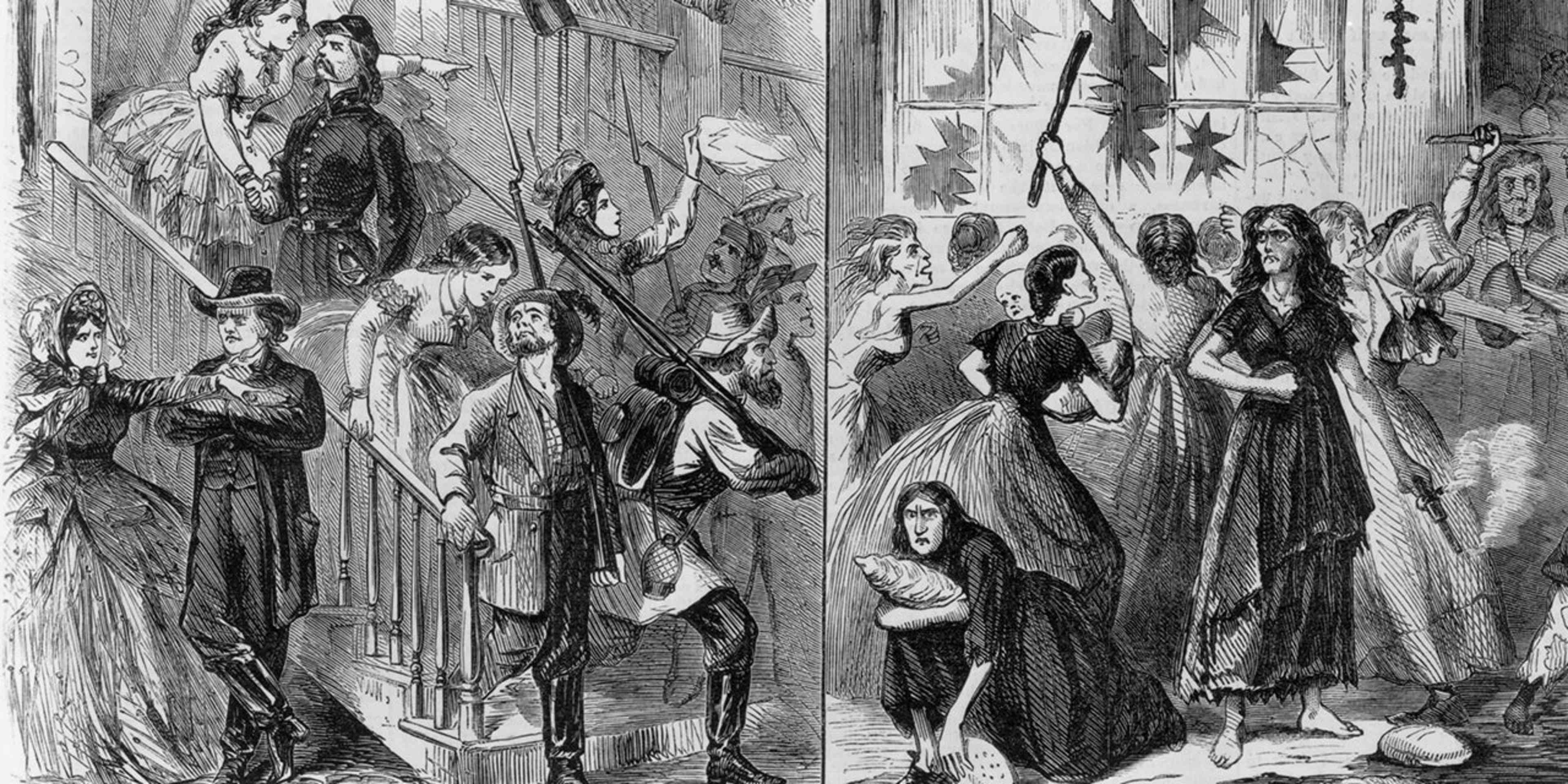
On the morning of April 2, 1863, the air in Richmond was crisp. What began as a peaceful assembly of 200 to 300 women at the George Washington monument quickly transformed. Armed with knives, hatchets, and pocket pistols, the women marched with purpose. As they swept down 9th Street toward the commercial district, their numbers multiplied. Working-class families, suffering under the weight of the war, joined the procession. By the time they reached the business district, the crowd numbered over a thousand.
The women targeted warehouses holding government food supplies, breaking open doors and barrels. They loaded carts with corn, bacon, and flour. The term “Bread Riot” is somewhat of a misnomer; the protesters were not stealing freshly baked loaves of bread, but rather the raw ingredients like flour that would allow them to feed their families for weeks. While the core group focused on food, some men and opportunistic onlookers used the chaos to loot jewelry stores and clothing merchants, much to the frustration of the primary organizers.
These women were acting within a proud, historical tradition of American female political activism. Decades earlier, during the colonial struggles against British overreach, women organized under the banner of the Daughters of Liberty to protest economic injustices. In 1863, these Richmond women revived this spirit of resistance, refusing to watch their children starve while political elites lived in relative comfort.
Long-Term Impact on the Confederacy and the Nation
The Richmond Bread Riot sent shockwaves through the Confederate leadership. It shattered the carefully constructed myth of the elegant, passive Southern lady who quietly sacrificed for the “Lost Cause.” Instead, it revealed that the Southern home front was fractured by deep class divisions. The phrase “a rich man’s war and a poor man’s fight” became a common refrain among the Southern working class, who resented that wealthy slaveholders were largely exempt from military service and insulated from the economic hardships of the war.
To prevent the Union from capitalizing on this sign of domestic weakness, the Confederate government instituted strict wartime censorship. The Secretary of War formally requested that Richmond newspapers suppress any mention of the riot. Despite these efforts, word slipped out, boosting Union morale and encouraging further domestic dissent across the South. Similar, smaller bread riots soon broke out in other Southern cities, including Atlanta, Augusta, and Mobile.
Fascinating Lesser-Known Facts
1. The Censorship Campaign
The Confederate government went to extreme lengths to cover up the event. They threatened to shut down any local newspaper that reported on the riot. While Richmond papers complied, northern reporters eventually obtained the story from travelers, publishing detailed accounts that exposed the Confederacy’s internal decay to the world.
2. Selective Justice
Following the riot, police arrested dozens of participants. However, the legal system treated the rioters differently based on their social standing. Wealthy or younger, well-dressed women caught up in the crowd were generally acquitted or released with a warning. Meanwhile, older, impoverished, and working-class women received heavy fines or prison sentences, further highlighting the deep class divide.
3. Davis’s Dramatic Ultimatums
During his confrontation with the crowd, President Jefferson Davis did not just threaten them; he actively tried to appeal to their patriotism. When that failed, he used his pocket watch to count down the minutes, showing that even the highest levels of Confederate leadership were willing to use military force against their own starving citizens to maintain order.
Why the Richmond Bread Riot Matters Today
The story of the Richmond Bread Riot remains incredibly relevant in modern discussions of crisis management, economic inequality, and social justice. It serves as a stark historical reminder of how rapidly civil society can fracture when basic human needs are ignored by those in power. When governments fail to secure food, stable currency, and equitable distribution of resources, the line between order and chaos thins dramatically. The riot underscores the timeless truth that national stability is directly tied to the welfare of its most vulnerable citizens.
People Also Ask (FAQ)
What was the main cause of the Richmond Bread Riot?
The riot was primarily caused by severe food shortages, extreme inflation of the Confederate currency, and the passage of the Impressment Act, which allowed the Confederate military to seize agricultural goods, leaving working-class families starving.
Who were the leaders of the Richmond Bread Riot?
The primary organizers were Mary Jackson, a 34-year-old market seller, and Minerva Meredith, a tall, commanding local woman. They organized the initial planning meetings and led the march to Capitol Square.
How did the Confederate government handle the riot?
The government responded with a mix of military force and strict censorship. President Jefferson Davis threatened to have troops shoot the rioters, while the Secretary of War successfully pressured local newspapers to suppress news of the uprising to maintain Southern morale.
Conclusion
The Richmond Bread Riot of 1863 stands as a powerful testament to the desperate lengths to which mothers and working-class citizens will go to protect their families. By rising up against the Confederate government, these women challenged the social norms of their era and exposed the deep class fractures that ultimately helped doom the Confederacy from within. Their struggle reminds us that the ultimate cost of war is always paid most heavily by the poorest members of society.


