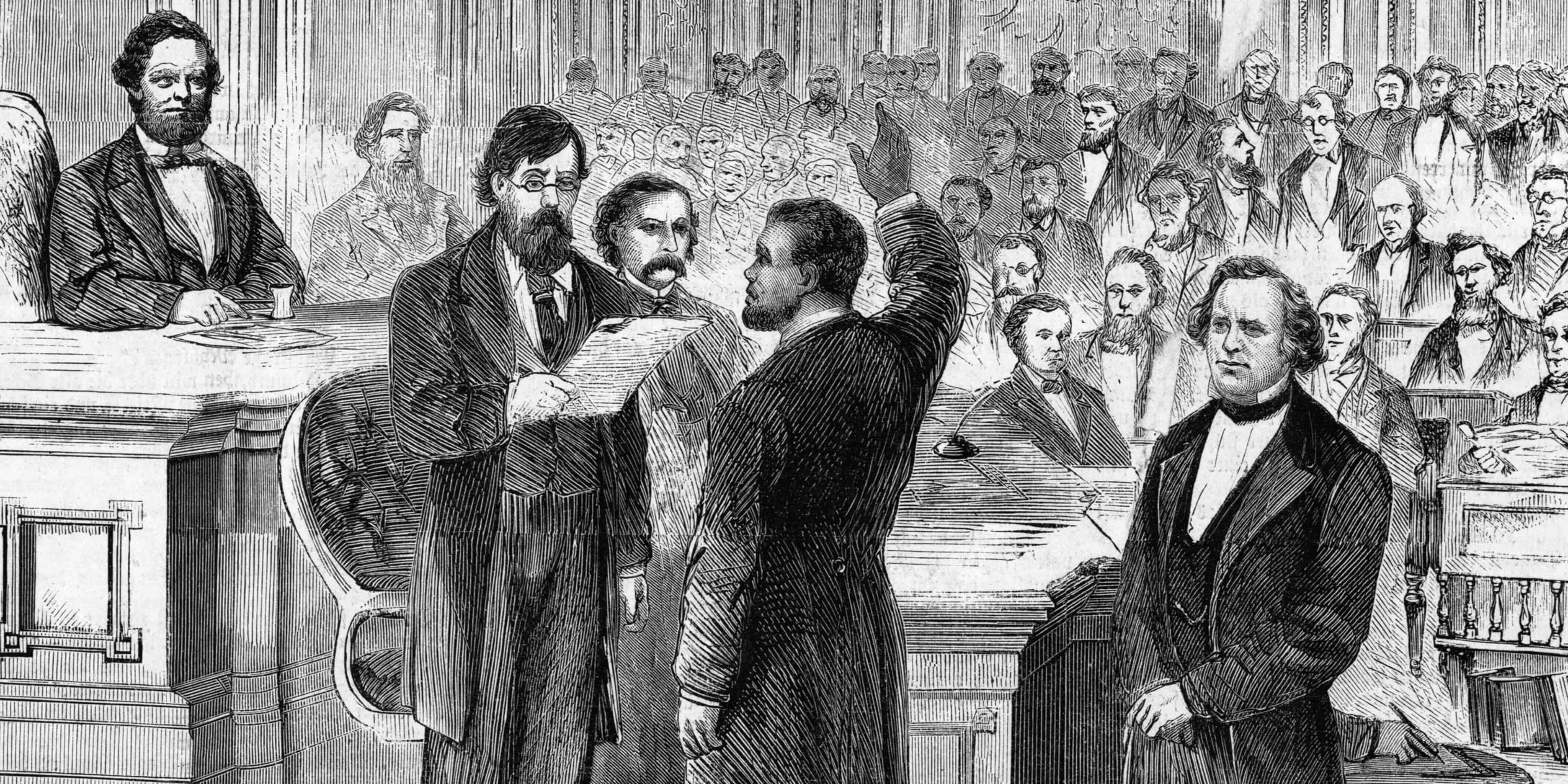
On February 25, 1870, the galleries of the United States Senate were packed to capacity as spectators leaned forward in anticipation of a truly revolutionary moment in American democracy. Hiram Rhodes Revels, an ordained minister and educator from Mississippi, stood ready to be sworn in as the first Black man elected to Congress. His arrival on Capitol Hill marked a momentous shift in the nation’s political landscape, signifying the dawn of the Reconstruction era—a brief yet radical period of transformation where the promises of the Union victory were put to the test. However, before Revels could place his hand on the Bible, he faced a fierce, racially charged campaign by conservative Democrats determined to block him from taking his seat. This historical showdown was not merely a dispute over a Senate seat; it was a profound constitutional debate over who belonged in the American polity and whether the old racial hierarchies of the antebellum South would prevail. In the long history of African Americans fighting for their place in the republic, from the courageous military contributions seen in America’s first Black regiment to those who battled for abolition, political representation was the ultimate, hard-fought frontier.
Historical Background: The Dawn of Reconstruction
The period following the American Civil War, known as Reconstruction (1865–1877), was one of the most volatile and revolutionary eras in United States history. With the Confederacy defeated and the institution of slavery abolished by the Thirteenth Amendment, the federal government faced the monumental task of rebuilding the southern states and integrating millions of newly emancipated Black Americans into the social and political fabric of the nation. In this transitional period, the state legislatures had the constitutional responsibility of electing U.S. Senators, a task that became a highly charged battleground as the nation attempted to redefine itself. While the original Founding Fathers had designed a complex constitutional framework, it was during Reconstruction that the document was radically amended to reflect a multi-racial democracy.
Under the Reconstruction Acts of 1867, Congress placed the former Confederate states under military rule and mandated that they register Black men to vote as a condition for readmission to the Union. This led to a massive surge in Black political participation. In Mississippi, where formerly enslaved people made up a significant majority of the population, a coalition of Black voters and white Republicans swept into local and state offices. When Mississippi was finally readmitted to the Union in early 1870, the state legislature was tasked with filling two vacant U.S. Senate seats. These seats had been empty since 1861, when Mississippi’s senators, including future Confederate President Jefferson Davis, resigned to join the rebellion.
Representing about a quarter of the Mississippi state legislature, Black lawmakers insisted that one of these vacant seats be filled by an African American. They chose Hiram Rhodes Revels, a widely respected community leader, African Methodist Episcopal (AME) minister, and state senator who had deeply impressed his colleagues with a powerful, unifying opening prayer at the legislative session. The legislature voted 81 to 15 to send Revels to Washington to complete the unexpired term of the Senate seat once held by Albert G. Brown.
The Battle on Capitol Hill: The Citizenship Challenge
When Revels arrived in Washington, D.C., in February 1870, his credentials were formally presented to the Senate by Senator Henry Wilson of Massachusetts, a staunch champion of civil rights. Instantly, conservative Democrats launched a coordinated effort to block him from taking his seat. Rather than framing their opposition in explicitly racist terms, they relied on a sophisticated legal technicality rooted in the U.S. Constitution.
Article I, Section 3 of the Constitution stipulates that no person may be a U.S. Senator who has not been a citizen of the United States for at least nine years. The Democrats, led by Senators Garrett Davis of Kentucky and Thomas Bayard of Delaware, argued that Revels did not meet this requirement. They based their bad-faith legal argument on the Supreme Court’s infamous 1857 Dred Scott v. Sandford decision, which had ruled that Black people—whether enslaved or free—were not U.S. citizens and could not claim the rights of citizenship. This cruel manipulation of the law highlighted the deep-seated racial animus of the post-war South, drawing parallels to the tragic historical struggles of Black Americans who, after fighting for their freedom, saw their descendants sold into slavery.
According to the Democrats’ logic, Revels had only gained citizenship with the passage of the Civil Rights Act of 1866 or the ratification of the Fourteenth Amendment in 1868. Consequently, they argued, Revels had only been a citizen for two to four years, far short of the constitutionally mandated nine-year requirement. The Republican majority in 1870, however, was determined to correct this historic injustice and push forward with transitional justice.
Key Events Timeline
- September 27, 1827: Hiram Rhodes Revels is born free in Fayetteville, North Carolina.
- March 6, 1857: The Supreme Court issues the Dred Scott decision, ruling that Black Americans are not citizens.
- 1861–1865: The American Civil War. Revels serves as a Union chaplain and recruits Black soldiers for the war effort.
- April 9, 1866: Congress passes the Civil Rights Act of 1866, declaring all persons born in the United States to be citizens.
- July 9, 1868: The Fourteenth Amendment is officially ratified, guaranteeing birthright citizenship.
- January 20, 1870: The Mississippi state legislature elects Hiram Revels to the U.S. Senate.
- February 23, 1870: Mississippi is formally readmitted to the Union.
- February 23–25, 1870: A fierce three-day debate ensues in the Senate over Revels’ credentials and citizenship.
- February 25, 1870: The Senate votes 48 to 8 to seat Revels, making him the first African American member of Congress.
Major Figures in the Struggle
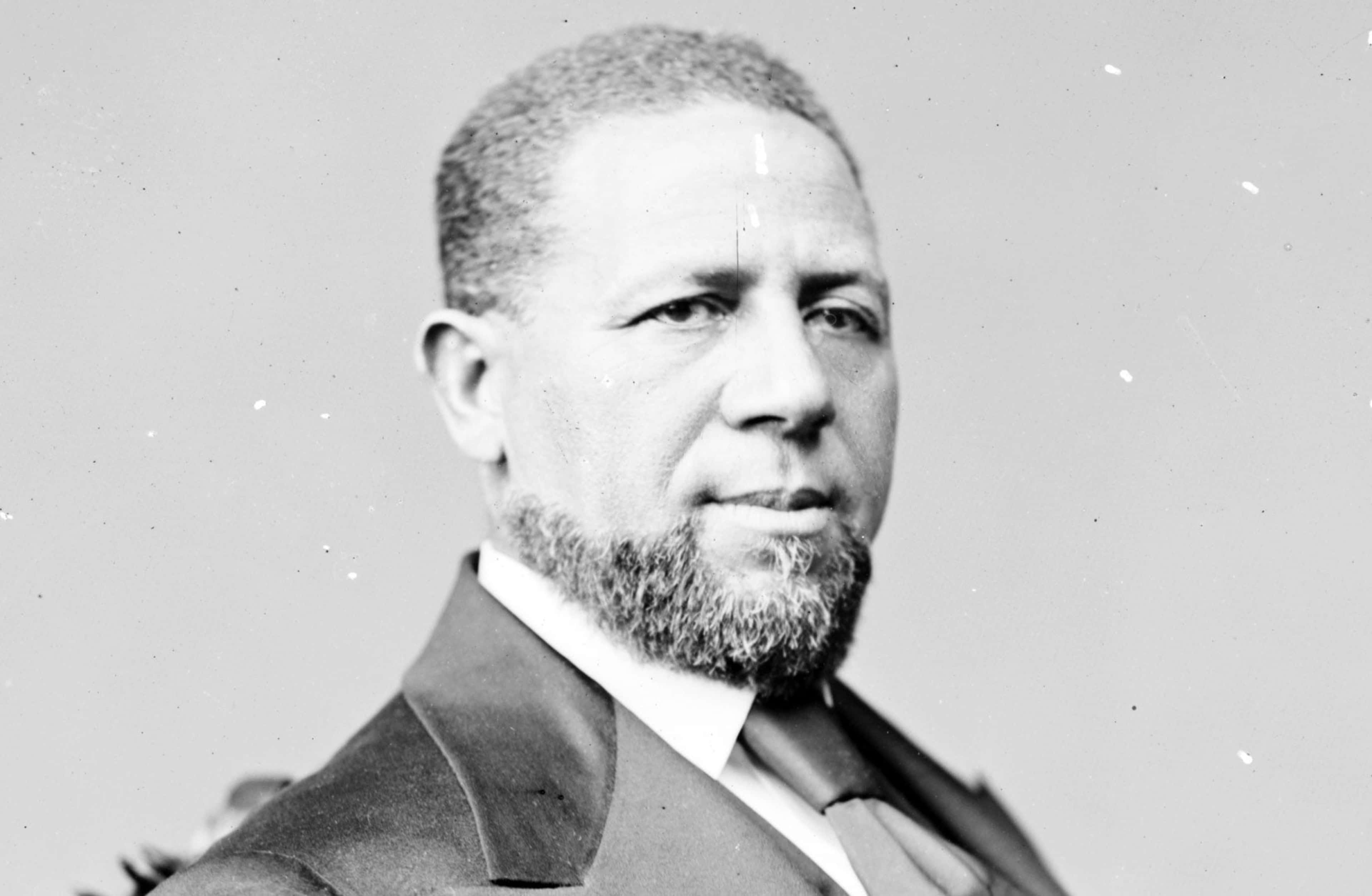
Hiram Rhodes Revels
Born free in North Carolina, Revels was a highly educated man of faith who studied at several seminaries, including Knox College in Illinois. He traveled extensively as an AME preacher, defying laws in slave states that banned free Black ministers. During the Civil War, he organized Union regiments and served as a military chaplain. As a politician, he advocated for moderate Reconstruction policies, educational access, and the integration of public spaces.
Charles Sumner
The powerful Republican Senator from Massachusetts was one of the loudest voices defending Revels on the Senate floor. Sumner argued that the Civil War and the Reconstruction amendments had completely destroyed the validity of the Dred Scott decision, asserting that denying Revels his seat was a continuation of the spirit of slavery.
Garrett Davis
A conservative Democratic Senator from Kentucky, Davis led the opposition against Revels. He argued tenaciously for a strict, literal interpretation of the antebellum Constitution and the Dred Scott ruling, attempting to preserve white supremacy within the halls of federal power.
Turning Points: The Three-Day Constitutional Debate
The debate over Revels’ seat raged for three days, capturing the attention of the entire nation. Newspapers from both the North and the South published sensationalized coverage of the proceedings. Republicans vigorously countered the Democrats’ arguments with a series of compelling legal defenses. They argued that because Revels was born free in the United States and had lived there his entire life, he had always been a de facto citizen. Furthermore, they pointed out that Revels had voted in Ohio years before the Civil War, which legally required citizenship at the state level.
More fundamentally, Republicans asserted that the Civil War had fundamentally altered the American constitutional order. They argued that the Dred Scott decision was a moral and legal abomination that was nullified by the blood of Union soldiers and the ratification of the post-war amendments. Senator Charles Sumner famously brought the debate to a dramatic close, stating, “The time has passed for argument. Nothing more need be said… For a long time it has been clear that colored persons must be senators.” On the afternoon of February 25, 1870, the Senate voted 48 to 8, split strictly along party lines, to admit Hiram Revels to his seat.
Long-Term Impact on America
The seating of Hiram Revels was a revolutionary breakthrough that shattered the color barrier in American governance. Over the next decade, 15 more Black men took their seats in the U.S. House and Senate during Reconstruction, including military heroes like Robert Smalls of South Carolina and Blanche K. Bruce, who became the first Black senator to serve a full six-year term. This period proved that multiracial democracy was not only possible but highly functional.
However, this progressive era was met with a violent, systemic backlash. In the mid-1870s, white supremacist paramilitary groups like the White League and the Red Shirts launched campaigns of terror, voter intimidation, and political assassination to strip Black citizens of their constitutional rights. By the late 1890s, Southern states enacted Jim Crow laws, poll taxes, and literacy tests designed to permanently disenfranchise Black voters. After Representative George White of North Carolina gave his famous “Phoenix Speech” and left office in 1901, no Black representative would be elected to Congress from the original 11 Confederate states for over seven decades, until Andrew Young Jr. and Barbara Jordan took office in 1973.
Lesser-Known Facts About Hiram Revels
- His Indigenous Heritage: Hiram Revels was born to free parents of African, Scottish, and Croatan Indian (Native American) heritage. His multicultural background reflected the complex and deeply interconnected demographic history of early North Carolina.
- The Ultimate Irony: Hiram Revels filled the Senate seat that had been left vacant by Albert G. Brown, but in the popular imagination and political cartoons of the time, he was depicted as taking the seat of Jefferson Davis, the man who led the Confederacy in a war to preserve slavery. Witnessing a Black man represent the state of Mississippi in the Senate was a poetic moment of retributive justice.
- An Early Civil Rights Protest: Years before taking office, while traveling with his family by train, Revels protested segregation. After they were assigned to a cramped, smoky car despite buying first-class tickets, Revels successfully argued with railroad officials until they were moved to the first-class carriage.
- A Defender of Native Americans: During his brief tenure in the Senate, Revels did not just advocate for Black civil rights; he also spoke out in defense of the rights of Native Americans, challenging federal policies that sought to strip them of their lands.
Why It Still Matters Today
The story of Hiram Revels is not merely a historic footnote; it is a vital chapter in the ongoing struggle for voting rights, democratic representation, and the rule of law in America. The bad-faith legal arguments used to block Revels—manipulating technicalities in the Constitution to exclude marginalized groups—reappear in modern debates surrounding voter suppression, birthright citizenship, and the gerrymandering of electoral districts. Understanding how Reconstruction was systematically dismantled serves as a cautionary tale of how easily democratic progress can be reversed if vigilance is lost. Hiram Revels’ triumph reminds us that progress is never linear, and that the fight to perfect the Union requires continuous courage and dedication.
People Also Ask
Who was the first Black man elected to Congress?
Hiram Rhodes Revels was the first Black man to serve in the United States Congress. He was elected by the Mississippi state legislature to the U.S. Senate and took office on February 25, 1870.
How did Democrats try to block Hiram Revels from the Senate?
Democrats argued that under the Constitution, a senator must be a U.S. citizen for nine years. Citing the 1857 Dred Scott decision, they claimed that Revels had only become a citizen with the Civil Rights Act of 1866 or the Fourteenth Amendment in 1868, meaning he had not been a citizen long enough to serve.
Whose seat did Hiram Revels fill?
Hiram Revels was elected to fill the Mississippi Senate seat formerly held by Albert G. Brown. Highly publicized as a historic irony, his election filled a vacancy left since the secession of Mississippi, representing the same state as former Confederate President Jefferson Davis.
How long did Hiram Revels serve in Congress?
Revels served in the U.S. Senate for just over a year, from February 25, 1870, to March 3, 1871, completing the remainder of the unexpired term.
Conclusion
Hiram Rhodes Revels’ journey to the United States Senate stands as a towering testament to the revolutionary, albeit brief, promise of Reconstruction. Facing down deep-seated prejudice, legal manipulation, and political hostility, Revels conducted himself with a quiet dignity that won over the nation. His seating on February 25, 1870, fundamentally redefined American citizenship and proved that the promises of equality could triumph over the dark legacy of the Dred Scott decision. Though the rise of Jim Crow eventually suppressed this progress, the legacy of Hiram Revels continues to inspire and instruct modern generations striving to build a truly inclusive, multi-racial democracy.


