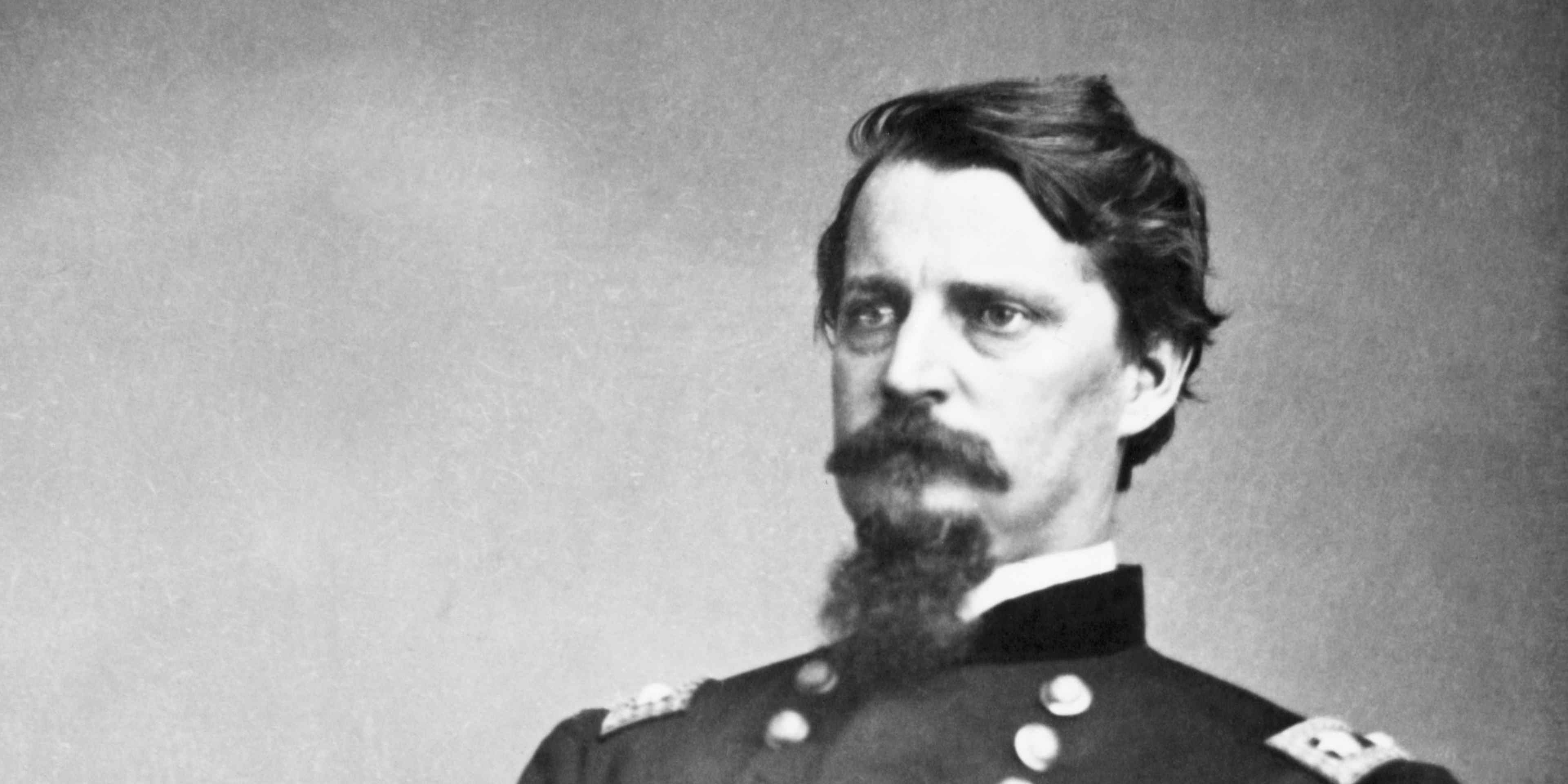
Among the pantheon of military leaders who shaped the destiny of the United States, few figures command as much respect and admiration as Major General Winfield Scott Hancock. Serving as a cornerstone of the Union Army during the American Civil War, Hancock’s tactical brilliance, unwavering poise under fire, and inspiring leadership earned him the immortal moniker “Hancock the Superb.” From the muddy peninsulas of Virginia to the blood-soaked fields of Pennsylvania, his presence on the battlefield consistently altered the course of conflicts. His actions, particularly during the monumental clash at Gettysburg, not only preserved the Union line but also redefined the standards of American military leadership. This comprehensive exploration delves deep into the life, career, and enduring legacy of a man whose devotion to the Constitution and his soldiers cemented his place as one of America’s greatest battlefield commanders.
Historical Background & Early Life
Born on February 14, 1824, in Montgomery County, Pennsylvania, Winfield Scott Hancock was raised in a household deeply appreciative of American democratic ideals. He was born an identical twin alongside his brother, Hilary Baker Hancock. His father, Benjamin Franklin Hancock, named him after Major General Winfield Scott, the prominent hero of the War of 1812 and the commanding general of the U.S. Army. This naming proved prophetic. Hancock attended the Norristown Academy, where he showed an early interest in history and military science. In 1840, he secured an appointment to the United States Military Academy at West Point. Despite his future greatness, Hancock’s time at West Point was marked by academic struggles. He found the rigorous curriculum highly challenging, ultimately graduating 18th in a class of 25 in 1844. Nonetheless, his education laid the vital tactical foundation for his subsequent career. Upon graduation, he was commissioned as a brevet second lieutenant in the 6th U.S. Infantry, initially serving in the Indian Territory—a frontier assignment that highlighted the complex and sensitive geopolitical environment of the expanding American nation and its interactions with Indigenous tribes. The geopolitical landscape of the mid-19th century was rapidly shifting, and Hancock soon found himself thrust into active combat during the Mexican-American War (1846–1848), fighting under his very namesake, General Winfield Scott. He distinguished himself at the Battle of Churubusco, where he was wounded in the leg, and later displayed remarkable bravery at the Battle of Molino del Rey.
The Road to Civil War: Antebellum Service and Crisis
Following the Mexican-American War, Hancock transitioned to various administrative and quartermaster roles. While stationed in St. Louis, Missouri, he met and married Almira (“Allie”) Russell, the daughter of a prominent local merchant, in 1850. The couple had two children, and Allie remained his steadfast supporter throughout his tumultuous career. During the 1850s, the United States was fracturing over the expansion of slavery and states’ rights. Hancock’s duties took him to Florida during the Third Seminole War and to Fort Leavenworth during the violent “Bleeding Kansas” border conflicts. By 1859, he was stationed in southern California as a captain and quartermaster. As the southern states began seceding in late 1860 and early 1861, Hancock, a staunch Democrat who believed in states’ rights but held an unshakeable allegiance to the Union, made his position clear. Unlike many of his Southern-born colleagues who resigned to join the Confederacy, Hancock chose to stand by the flag he had sworn to defend.
The Crucible of Conflict: Key Civil War Engagements
In the autumn of 1861, Hancock was promoted to brigadier general of volunteers and assigned to the newly formed Army of the Potomac under Major General George B. McClellan. His first major opportunity to lead troops in the field came during the Peninsula Campaign in May 1862. At the Battle of Williamsburg, Hancock executed a brilliant, decisive counterattack that shattered the Confederate lines and secured a key victory. McClellan famously telegraphed that “Hancock was superb today,” giving birth to the general’s lifelong nickname. Later that year, during the bloody Battle of Antietam, Hancock was thrust into command of the 1st Division, II Corps, after Major General Israel B. Richardson was mortally wounded. Hancock’s exceptional composure under intense enemy fire solidified his reputation, earning him a promotion to major general of volunteers. The winter of 1862 brought immense tragedy at the Battle of Fredericksburg, where Hancock led his division in a brave but suicidal assault against the heavily fortified Confederate positions on Marye’s Heights, suffering over 1,200 casualties and sustaining a minor wound himself. After another wounding at the Battle of Chancellorsville in May 1863, Hancock was appointed commander of the II Corps, a force he would lead into history’s most critical battle.
The Turning Point: Gettysburg and the Preservation of the Union Center
In July 1863, the Confederate Army of Northern Virginia, led by General Robert E. Lee, invaded Pennsylvania. On July 1, the opening day of the Battle of Gettysburg, Union Major General John F. Reynolds was killed. Army of the Potomac commander Major General George Meade immediately dispatched Hancock to take command of the field. Hancock’s arrival was vital; he organized the retreating Union forces and made the critical decision to establish defensive positions on the high ground of Cemetery Hill and Culp’s Hill, setting the stage for the Union’s eventual defensive victory. Over the next two days, Hancock’s II Corps held the center of the Union line on Cemetery Ridge. On July 3, the battle reached its climax with Pickett’s Charge—a massive, desperate Confederate infantry assault aimed directly at Hancock’s position. Demonstrating extraordinary courage, Hancock rode along the front lines on horseback to inspire his men, refusing to take cover. When warned that he was unnecessarily risking his life, he famously replied, “There are times when a corps commander’s life does not count.” Hancock’s defense held, effectively halting the Confederate advance and marking how the Battle of Gettysburg turned the tide of the Civil War. However, during the height of the combat, a bullet struck his saddle horn, driving wood and a bent nail into his thigh, inflicting a painful wound that would plague him for the rest of his life.
The Overland Campaign and Post-War Assignments
After months of painful recovery, Hancock returned to active command in early 1864 to participate in Lieutenant General Ulysses S. Grant’s relentless Overland Campaign. His II Corps fought with distinction at the Battle of the Wilderness and achieved a spectacular breakthrough at the “Bloody Angle” during the Battle of Spotsylvania Court House. However, the campaign took a devastating physical and psychological toll on his men, culminating in disastrous casualties at Cold Harbor and during the opening phases of the Siege of Petersburg. By November 1864, crippled by the lingering effects of his Gettysburg wound, Hancock reluctantly stepped down from field command. He spent the closing months of the war in administrative roles. Following the assassination of President Abraham Lincoln in April 1865, Hancock was ordered to supervise the military commission and subsequent executions of the conspirators, which famously included the controversial hanging and execution of Mary Surratt. During the post-war Reconstruction era, Hancock remained in the military. In 1867, he was appointed to command the Fifth Military District, which encompassed Texas and Louisiana. As a conservative Democrat, Hancock took a lenient approach to the Southern states, easing martial law and restoring civil courts, which won him great popularity among Southern whites but drew criticism from Radical Republicans.
A Bid for the Presidency and Final Years
Hancock’s high national profile and his moderate stance on Reconstruction made him an attractive political figure. In 1880, he secured the Democratic nomination for the U.S. Presidency. Running against Republican James A. Garfield, Hancock campaigned on a platform of constitutional conservatism, national reconciliation, and tariff reform. The election was one of the closest in American history; although Hancock won the entire South, he lost the popular vote by a mere 10,000 votes and was defeated in the Electoral College. Following his narrow defeat, Hancock gracefully returned to his military duties as commander of the Department of the Atlantic, stationed at Governors Island, New York. He also served as the president of the National Rifle Association (NRA) from 1881 until his death. Winfield Scott Hancock passed away on February 9, 1886, at the age of 61, and was buried in his home state of Pennsylvania.
Lesser-Known Facts about Winfield Scott Hancock
- A Tragic Friendship: Before the war, Hancock was exceptionally close friends with Confederate General Lewis A. Armistead. The two bid a tearful farewell in California in 1861. At Gettysburg, Armistead led his brigade directly against Hancock’s line during Pickett’s Charge. Armistead was mortally wounded within sight of Hancock’s position and sent his personal belongings to Hancock before dying.
- The Origin of the “Superb” Nickname: The moniker “Hancock the Superb” was not coined by his soldiers but by Major General George B. McClellan in an official telegram to Washington praising Hancock’s defensive brilliance at the Battle of Williamsburg.
- NRA Presidency: In his post-military life, Hancock served as the president of the National Rifle Association, reflecting his lifelong commitment to marksman training and military preparedness.
Why Winfield Scott Hancock Still Matters Today
Today, Winfield Scott Hancock is remembered not just as a brilliant military tactician, but as a symbol of duty, constitutional fidelity, and national reconciliation. In an era of extreme political polarization, Hancock’s career demonstrates how a leader can remain intensely loyal to national institutions while showing empathy to political opponents. His legendary defense of Cemetery Ridge at Gettysburg reminds us of the immense personal sacrifices required to protect democratic governance. His legacy teaches contemporary citizens the value of integrity, bravery under pressure, and the profound tragedy of civil division.
People Also Ask (FAQ)
Why was Winfield Scott Hancock called “The Superb”?
He was given this nickname by General George B. McClellan after his stellar performance at the Battle of Williamsburg in 1862, where his decisive tactical maneuver secured a key Union victory.
What was the relationship between Hancock and Lewis Armistead?
Hancock and Armistead were best friends while serving in the pre-war U.S. Army. Their tragic confrontation at Gettysburg, where Armistead was mortally wounded attacking Hancock’s line, remains one of the most poignant symbols of the Civil War’s personal tragedies.
How close was the 1880 presidential election?
The 1880 election was exceptionally close. Winfield Scott Hancock lost the popular vote to James A. Garfield by fewer than 10,000 votes out of over 9 million cast, though Garfield won a clear majority in the Electoral College.
Conclusion
Winfield Scott Hancock stands as an enduring exemplar of American valor and constitutional dedication. From his early days at West Point to his critical actions at Gettysburg and his late-career political endeavors, Hancock consistently prioritized his duty to his country. His life encapsulates both the horrific tragedy and the ultimate triumphs of the Civil War era. By studying Hancock’s legacy, we gain a deeper appreciation for the leaders who held the nation together during its darkest hour.


