The United States Postal Service (USPS) is far more than a simple logistics network; it is one of the most enduring pillars of American democracy, identity, and nation-building. Established even before the United States ratified its Constitution, the post office has served as the vital connective tissue binding a sprawling, diverse continent. From the revolutionary spark of the late 18th century to the digital age, the evolution of how the US Post Office has delivered the mail reflects the technological leaps, territorial expansions, and cultural transformations of the American story. Operating as an agent of westward expansion, a crucial tool during global conflicts, and an incubator for pioneering technologies, the postal system has consistently adapted to keep Americans connected. Understanding this rich history is key to appreciating how a fragile collection of colonies transformed into a globally connected superpower.
The Historical Origins of American Postal Communication
Before the formal establishment of a centralized federal postal system, communication across early American settlements was highly fragmented, informal, and agonizingly slow. Early colonists relied on passing travelers, merchants, and ship captains to carry letters across the Atlantic or between isolated settlements. In local communities, public announcements and word-of-mouth were the primary means of dissemination; indeed, town criers were the original social media, broadcasting news and official decrees in busy village squares. However, as the population grew and trade expanded across the 13 colonies, a structured and secure postal network became an absolute necessity.
Recognizing this need, the British Crown established a colonial post under the Post Office Act of 1711. However, this system was heavily taxed, inefficient, and treated with deep suspicion by colonists, who feared British surveillance of their private correspondences. The turning point came in 1775. As tensions boiled over into the Revolutionary War, the Second Continental Congress recognized the urgent need for a secure, independent network to transmit intelligence, military orders, and political ideas. They established the Post Office Department and appointed Benjamin Franklin as the first Postmaster General. Franklin, who had previously served as a joint postmaster for the Crown, brought unparalleled logistical genius to the role. He surveyed roads, cut delivery times in half by introducing night riders, and laid the foundations for a system designed to serve the citizens rather than a distant monarch.
Key Historical Milestones: A Chronological Timeline
The development of the American postal system is punctuated by several landmark moments that mirrors the nation’s own growth. Below is a chronological breakdown of its most defining eras:
- 1775: The Continental Congress establishes the Post Office Department and appoints Benjamin Franklin as Postmaster General.
- 1792: President George Washington signs the Postal Service Act, which formally establishes the Post Office Department, guarantees the privacy of personal mail, and subsidizes the delivery of newspapers to promote an informed citizenry. This era also coincided with the rapid dissemination of print media, which included famous early publications like America’s first newspaper.
- 1813: Congress authorizes the Postmaster General to contract with steamboat companies, transforming mail delivery along major waterways like the Mississippi River.
- 1847: The Post Office introduces the first official adhesive postage stamps, standardizing prepayments and shifting the cost of mailing from the recipient to the sender.
- 1860: The Pony Express launches, promising to deliver mail from Missouri to California in an unprecedented ten days. Though legendary, it lasted only 19 months.
- 1869: The completion of the Transcontinental Railroad revolutionizes transcontinental mail, giving rise to the highly efficient Railway Mail Service (RMS).
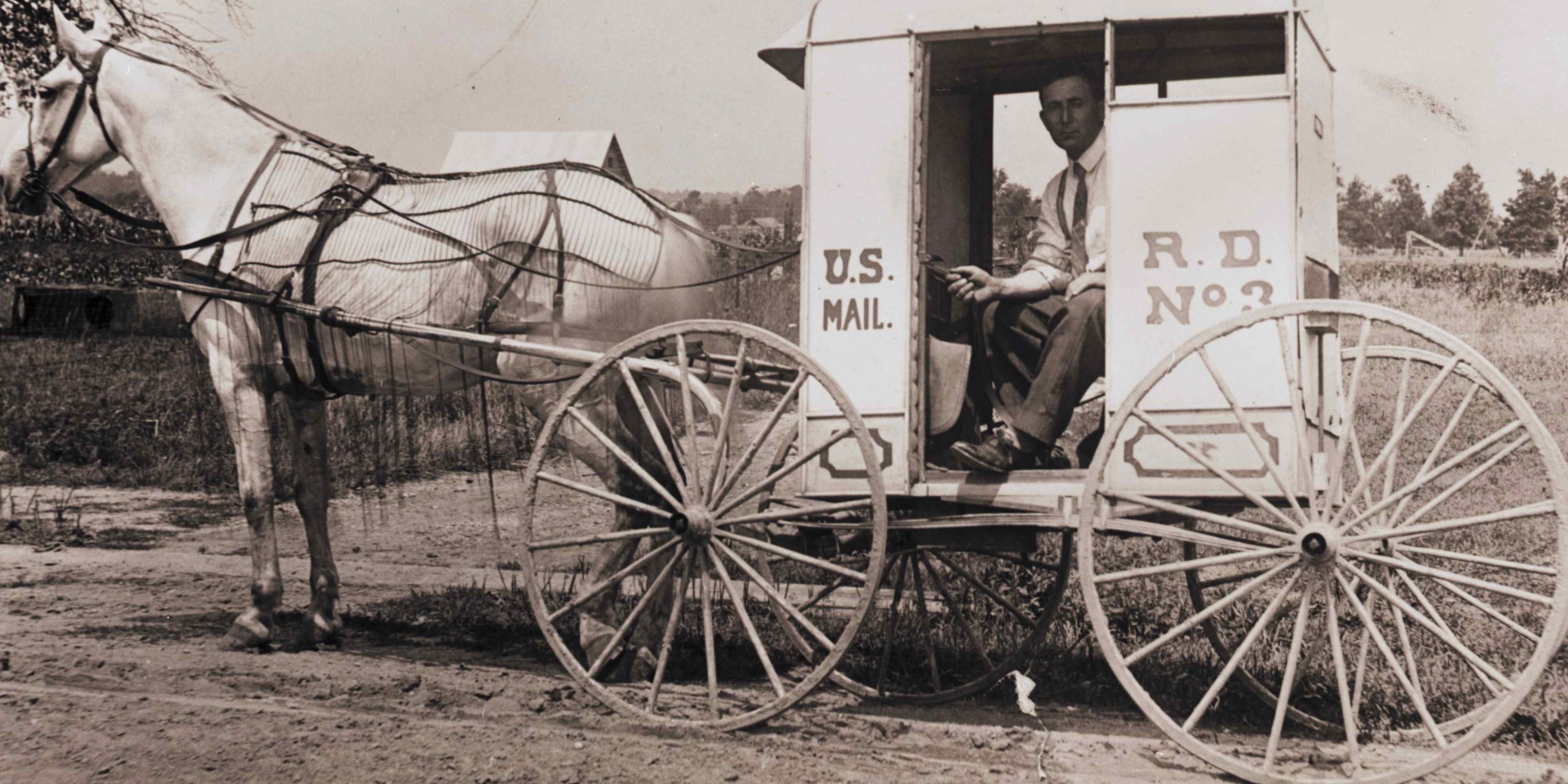
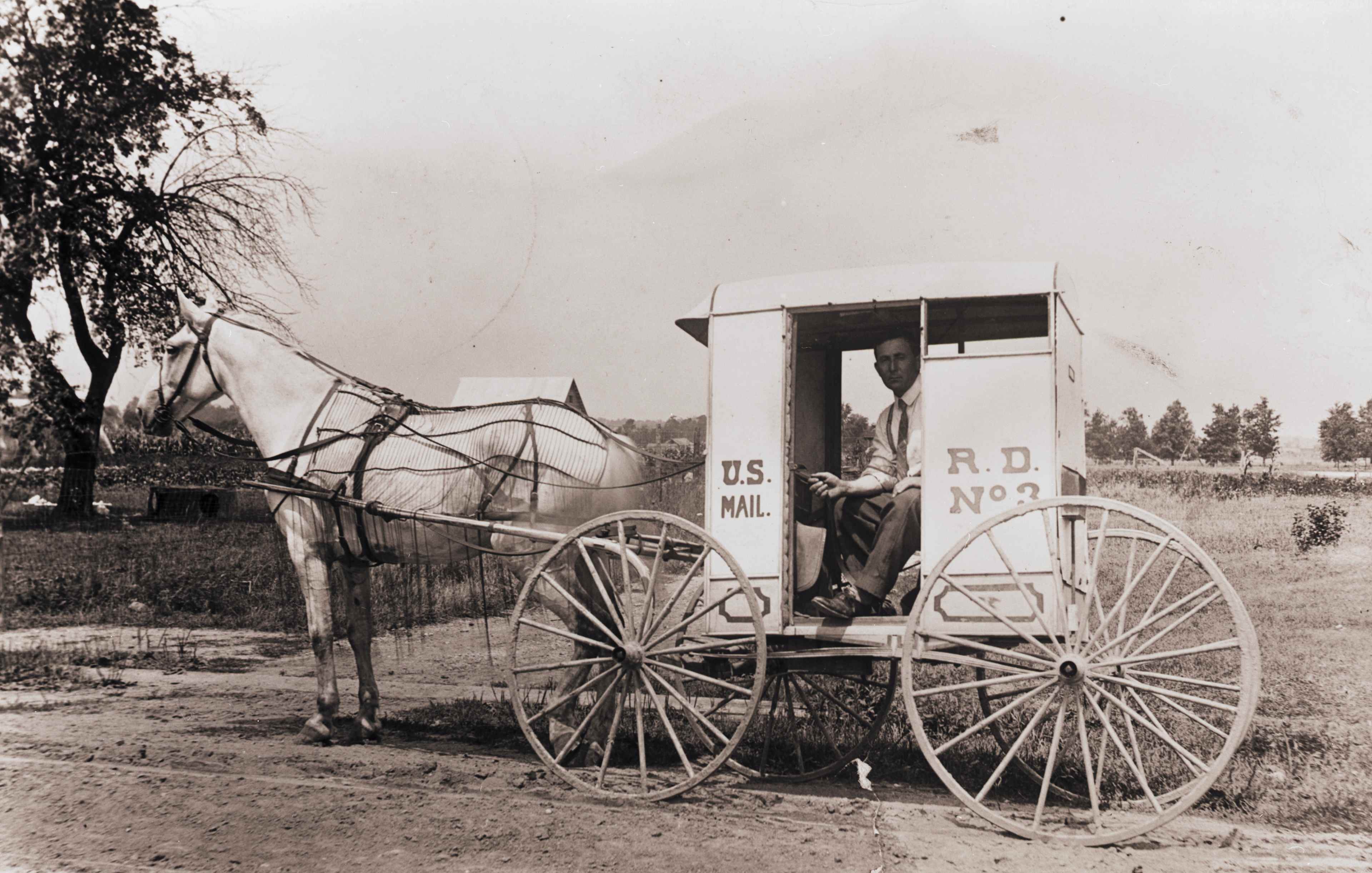
- 1896: Rural Free Delivery (RFD) is introduced, offering free mail delivery directly to rural homes for the first time, breaking the isolation of farming communities.
- 1911: The first authorized airmail flight in the U.S. is completed by pilot Earle Ovington.
- 1913: Parcel Post service begins, allowing the post office to deliver large packages, which drastically altered rural economics and stimulated early catalog shopping.
- 1942: Victory Mail (V-Mail) is introduced during World War II to drastically reduce the physical weight of mail sent to troops stationed overseas.
- 1963: The Zone Improvement Plan (ZIP) Code system is launched, using a five-digit code to streamline the sorting and routing of mail.
- 1970: The Postal Reorganization Act is signed into law by President Richard Nixon, transforming the cabinet-level Post Office Department into the independent, self-supporting United States Postal Service (USPS) we know today.
Key Figures and Their Lasting Legacy
The continuous innovation of the US Post Office was driven by visionaries who recognized that physical communication was essential for national unity. Benjamin Franklin was the primary architect of the system. His administrative reforms created standard routes, introduced the odometer to measure carriage distances, and established a rate structure that made communication affordable. Franklin’s efforts turned the post office into a profitable enterprise that successfully funded early revolutionary communication networks.
Another monumental figure was President George Washington, who actively pushed for the Postal Service Act of 1792. Washington understood that a self-governing republic could not survive without a well-informed electorate. By ensuring that newspapers could be mailed at incredibly low rates, Washington ensured that democratic ideals, local news, and political debates reached the furthest frontiers of the growing nation. In the 20th century, aviators like Earle Ovington and Charles Lindbergh—who famously flew airmail routes between Chicago and St. Louis before his transatlantic flight—pushed the physical boundaries of delivery, proving that the skies were the next frontier for American logistics.

Evolution of Delivery Methods: From Horse Trails to Airwaves
The story of how the post office has delivered the mail is a testament to human ingenuity and mechanical adaptation. In the early days, post riders traveled long, hazardous post roads on horseback, navigating dense forests, swollen rivers, and rough terrain. As roads improved, stagecoaches replaced individual riders, carrying both mail and passengers across vast distances, eventually reaching California during the Gold Rush via overland routes like the Butterfield Overland Mail.
The industrial era brought the “iron horse.” By the mid-19th century, the Railway Mail Service (RMS) transformed trains into rolling post offices. Clerks worked tirelessly inside moving wooden cars, sorting, canceling, and bagging letters while traveling at high speeds. This system was so efficient that, at its peak, it handled nearly 93 percent of all non-local mail in the country. Concurrently, major metropolitan areas experimented with pneumatic tube systems. Beneath the streets of cities like New York, Boston, and Chicago, pressurized brass canisters packed with letters were shot through underground pipes at speeds of 30 miles per hour, bypassing congested city streets entirely.
As the automobile took over, the post office quickly retired horse-drawn carriages in favor of trucks, custom-built Jeeps, and “mailsters.” In the skies, airmail revolutionized global transit times. During the dark days of World War II, the innovative V-Mail system utilized microfilm technology to compress millions of letters, saving vital cargo space on military ships and planes for ammunition and medical supplies, while still keeping families connected to their loved ones on the front lines.
Lesser-Known Historical Facts
Throughout its two-and-a-half-century journey, the postal service has accumulated some truly bizarre and fascinating chapters:
- Mailing Children: When the Parcel Post service was launched in 1913, there were no strict regulations against mailing living beings. A few enterprising parents, realizing that parcel postage was cheaper than a train ticket, actually “mailed” their children to nearby relatives. The children traveled safely in the care of trusted postal workers, but the practice was quickly banned in 1914.
- The Pneumatic Cat: During the grand opening ceremony of New York City’s pneumatic tube system in 1897, postal officials decided to test the system’s durability by sending an unusual cargo. Along with a Bible and a flag, they sent a live, black cat through the pressurized tubes. The feline emerged at the other end slightly dazed but completely unharmed.
- Grand Canyon Mules: To this day, the United States Postal Service operates a mule-train mail route. Every day, a train of mules carries letters, food, and medicine down a steep, eight-mile trail to the Havasupai Indian Reservation, located at the bottom of the Grand Canyon, proving that the post office will use any means necessary to deliver the mail.
Why the Post Office Still Matters Today
In our hyper-connected, digital-first world, the physical post office remains as vital as ever. The USPS is not merely a shipping company; it is a constitutionally mandated public service that ensures equal access to communication for every American, regardless of geographic isolation or socioeconomic status. From delivering lifesaving medications to facilitating secure mail-in voting, the post office remains a cornerstone of American infrastructure and civic trust. It serves as a reminder that even in an era of instant messaging and virtual reality, the physical delivery of a letter carries a weight, a history, and a democratic promise that cannot be replicated online.
People Also Ask
Who was the first Postmaster General of the United States?
Benjamin Franklin was appointed as the nation’s first Postmaster General in 1775 by the Second Continental Congress, establishing the foundations of the modern American postal system.
What was the purpose of V-Mail during World War II?
Victory Mail, or V-Mail, was a process where letters written on special stationery were microfilmed to reduce their weight and size. This allowed the military to save valuable cargo space on transport planes and ships for vital military supplies, while still ensuring soldiers received letters from home.
Are there still places in the US that receive mail via mule?
Yes, the Havasupai Indian Reservation at the bottom of the Grand Canyon still receives its daily mail, food, and supplies via a dedicated USPS mule train, as it is inaccessible by road.
Conclusion
From the rugged post roads of the colonial era to the high-tech automated sorting facilities of today, the history of the United States Post Office is a reflection of the American spirit of innovation, connection, and democracy. By continuously embracing new technologies—whether stagecoaches, railways, airplanes, or modern electric vehicles—the postal service has successfully fulfilled its mission to bind the nation together. As we look to the future, the legacy of the post office stands as a testament to the power of shared communication and the enduring promise to deliver, no matter the distance.


