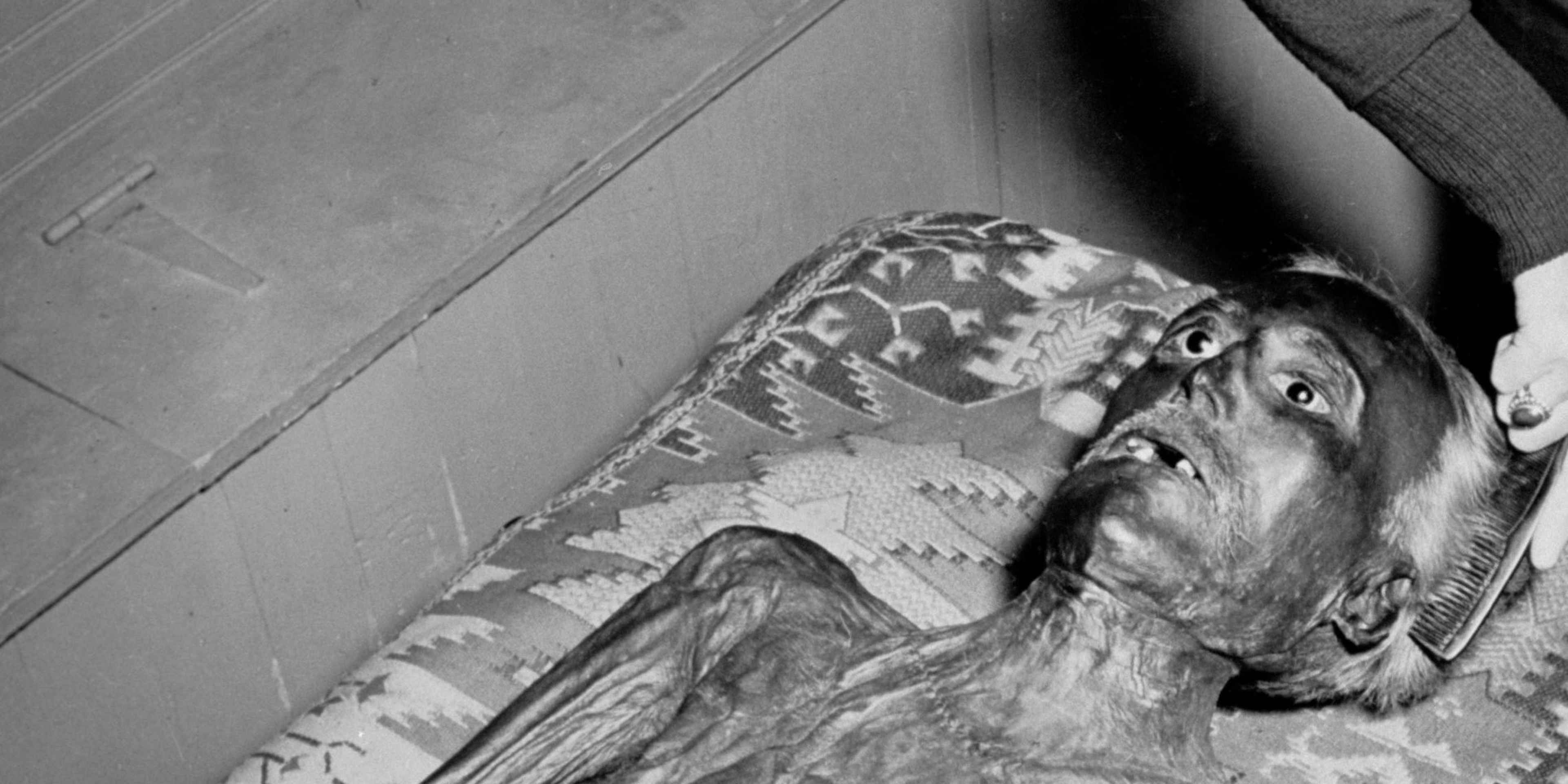
On the fateful night of April 14, 1865, the trajectory of American history changed forever when John Wilkes Booth shot President Abraham Lincoln at Ford’s Theatre. While the official historical record states that Booth was cornered and killed in a Virginia barn twelve days later, a wild alternative narrative emerged that would captivate the public for decades. This strange tale involves deathbed confessions, double identities, and a bizarre, arsenic-preserved corpse that toured the country as a carnival attraction. While the tragic assassination of Abraham Lincoln stands as one of the darkest moments in the nation’s journey, it contrasts sharply with the great strides for freedom in US history that characterized the Reconstruction era and ultimately sought to unite a broken union. Decades after Booth’s reported death, this purported mummy took on a grotesque, second box-office career on the American midway, raising profound questions about national trauma, historical memory, and the enduring power of conspiracy theories.
Historical Background: The Spark of a Conspiracy Theory
The post-Civil War era was a time of immense political division and deep-seated trauma. The unexpected assassination of President Abraham Lincoln plunged a newly reunified nation into chaos. In the immediate aftermath, a massive manhunt was launched to capture John Wilkes Booth and his co-conspirators. On April 26, 1865, Union soldiers cornered Booth in Richard Garrett’s tobacco barn near Port Royal, Virginia. Refusing to surrender, Booth was shot by Sergeant Boston Corbett and died shortly thereafter. His body was identified, autopsied, and eventually buried in a secret unmarked grave before later being moved to the Booth family plot in Baltimore’s Green Mount Cemetery.
However, the chaotic atmosphere of the late 19th century became fertile ground for skepticism. Rumors immediately began to spread that the government had killed the wrong man, and that the real John Wilkes Booth had escaped. This wild frontier culture, where disputes were often settled not in courtrooms but through violent clashes and legendary duels, provided the perfect cover for a man seeking to vanish forever. It was in this environment of distrust and myth-making that the bizarre tale of the Booth mummy was born.
The Legend Begins: John St. Helen’s Deathbed Confession
The story began to take solid shape in 1877 in the small town of Granbury, Texas. A young, ambitious lawyer named Finis L. Bates—who would later become the grandfather of the Academy Award-winning actress Kathy Bates—was summoned to the bedside of a dying acquaintance, a mysterious local bartender named John St. Helen. Believing his final hour had arrived, St. Helen whispered a shocking secret: “I am dying. My name is John Wilkes Booth, and I am the assassin of President Lincoln.”
St. Helen survived that night, but his confession changed the course of Bates’ life. St. Helen claimed that Vice President Andrew Johnson was the mastermind behind the assassination plot, providing him with a secret password to escape Washington. According to St. Helen, a lookalike named Ruddy had been killed in Garrett’s barn instead, allowing the real assassin to flee to the Wild West. Shortly after making this claim, St. Helen fled town, leaving Bates with an obsession that would consume him for the rest of his days.
The Enid Suicide: David E. George Becomes the Mummy
Over a quarter-century later, in January 1903, a drifter named David E. George locked himself in a hotel room in Enid, Oklahoma, and committed suicide by drinking a lethal dose of arsenic. Before his death, George had also confessed to a Methodist minister’s wife that he was John Wilkes Booth, famously stating: “I am not David Elihu George. I am the one who killed the best man that ever lived.”
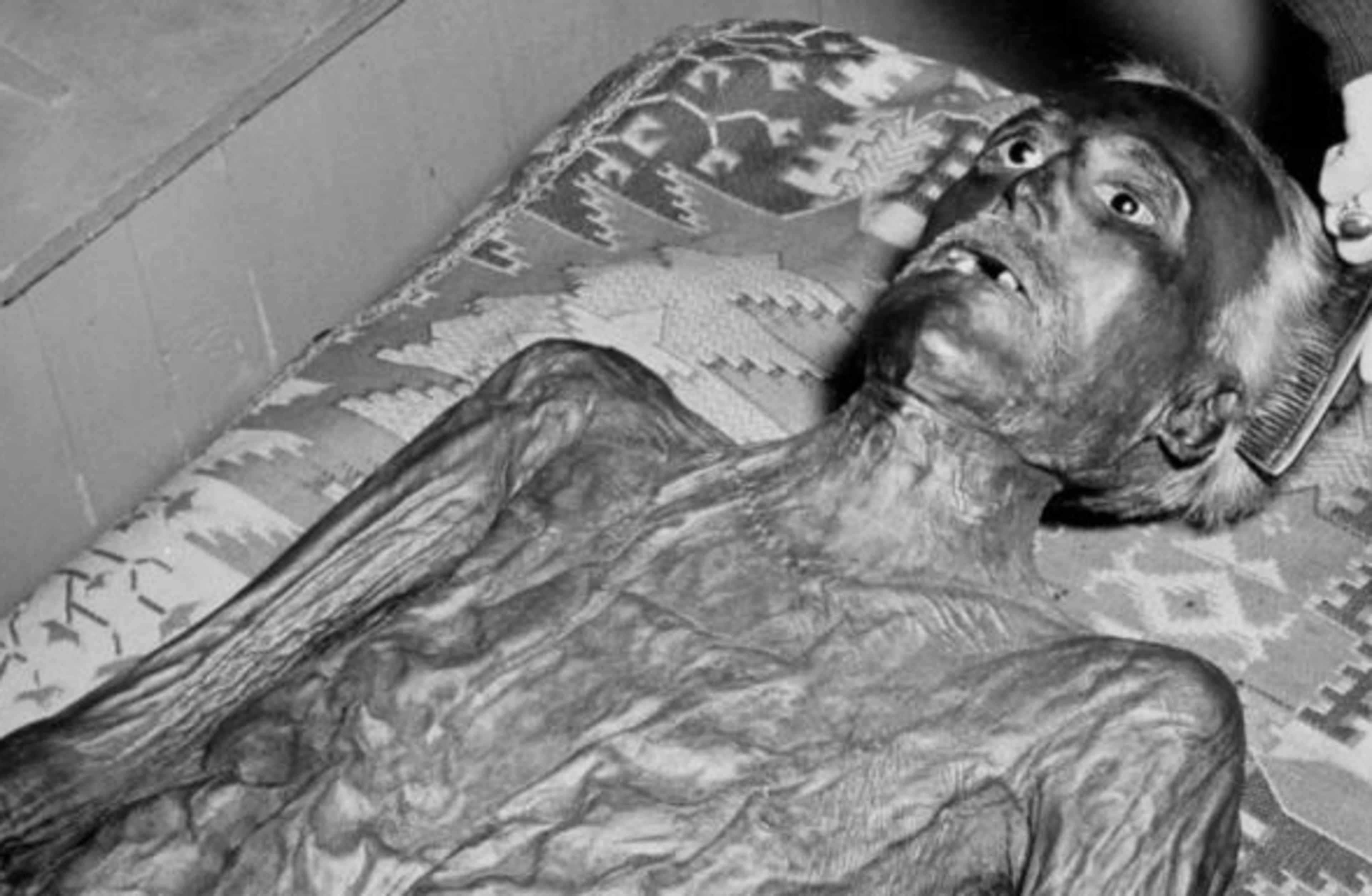
When Finis L. Bates saw newspaper illustrations of the dead man, he was convinced that David E. George was his old friend John St. Helen, and therefore, John Wilkes Booth. Bates rushed to Enid, where the local undertaker, W.B. Penniman, had heavily embalmed the unclaimed body with arsenic. Because of the heavy chemical preservation, the body did not decompose; instead, it transformed into a leathered, well-preserved mummy.
Timeline of the Post-Mortem Tour (1903–1970s)
What followed was one of the most bizarre chapters in American showmanship, spanning nearly three-quarters of a century:
- 1903–1907: The mummified body sits in a chair in Penniman’s Oklahoma parlor, dressed in a suit, staring blankly at a newspaper as a macabre local tourist attraction.
- 1907: Finis L. Bates gains custody of the corpse and publishes his 309-page book, The Escape and Suicide of John Wilkes Booth, using the mummy to promote his theories.
- 1910s–1920s: Bates rents the mummy to various traveling carnivals and state fairs, presenting it as the “authentic” body of Lincoln’s assassin.
- 1923: Following Bates’ death, his widow sells the mummy to William Evans, the “Carnival King of the Southwest,” who exhibits it on his Idaho farm and tours the western states.
- 1930: Carnival promoter John Harkin buys the mummy for $5,000, driving it across the country in a battered truck, offering a $1,000 reward to anyone who could prove it was not Booth.
- 1931: A panel of Chicago medical specialists and criminalists examines and X-rays the corpse, claiming that various bone fractures and scars match Booth’s recorded injuries.
- 1937–1950s: The mummy becomes a premier attraction for Jay Gould’s Million Dollar Circus, alongside acrobats and animal acts.
- Late 1970s: The mummy vanishes from the public eye, rumored to have been acquired by a private collector.
The Macabre Sideshow: Why the Mummy Toured America
History is replete with bizarre occurrences, and the strange saga of Booth’s alleged survival and subsequent post-mortem career is often counted among the most mind-bending anomalies, rivaling other famous coincidences in American history. The touring mummy acted as a dark mirror to the national mourning that followed Lincoln’s death. While Lincoln’s embalmed body had traveled on a solemn funeral train watched by millions of grieving citizens, the purported body of his killer became a cheap freak-show commodity. Audiences paid a nickel or a quarter to peer at the leathery remains of the country’s most notorious villain, blending educational curiosity with sensationalized entertainment.
Lesser-Known Facts about the Booth Mummy
- The Mummy’s Curse: Legend has it that the corpse brought financial ruin to almost everyone who owned or exhibited it. In 1920, a circus train transporting the mummy crashed, killing eight people, and the body was subsequently kidnapped for ransom.
- The Leg Bone Mix-Up: While the 1931 Chicago medical examination concluded that the mummy had a fractured leg bone matching Booth’s, critics pointed out a critical detail: the mummy’s fracture was on its right leg, whereas history records that Dr. Samuel Mudd set Booth’s injured left leg.
- A Hidden Artifact: During the 1931 autopsy, doctors allegedly discovered a corroded signet ring inside the mummy’s stomach, bearing the initial “B.” How it got there remains an unsolved mystery.
Why It Still Matters Today
The story of the John Wilkes Booth mummy is more than just a historical oddity; it is a profound case study in the American psyche. It illustrates the deep-seated public skepticism toward official government narratives that emerged after the trauma of the Civil War. In an era before DNA testing, the physical presence of a mummy allowed people to project their doubts, fears, and morbid curiosities onto a tangible object. This saga highlights the early roots of the modern conspiracy theory culture that continues to shape contemporary media and political discourse today.
People Also Ask
Was the mummy actually John Wilkes Booth?
No. Modern historians, forensic experts, and the federal government agree that John Wilkes Booth died on April 26, 1865, at Garrett’s farm. The body was conclusively identified by companions, family members, and medical personnel before being laid to rest in Baltimore.
Where is the John Wilkes Booth mummy today?
The mummy was last seen publicly in the late 1970s. Its current location is unknown; it is widely believed to be held in a private collection or to have been quietly buried or destroyed after federal laws cracked down on the commercial display of human remains.
Who was Finis L. Bates?
Finis L. Bates was a prominent lawyer and author who championing the theory that Booth escaped. He is also famous for being the paternal grandfather of the renowned actress Kathy Bates.
Conclusion
The bizarre post-mortem journey of the John Wilkes Booth mummy remains one of the most fascinating spectacles of early 20th-century American pop culture. Serving as a relic of a divided nation’s lingering grief and endless fascination with conspiracy, this leathery artifact reminds us that history is often as much about what people want to believe as what actually happened.


