For centuries, the ultimate test of personal honor, political survival, and social standing was not settled in a court of law, but at the tip of a sword or the barrel of a pistol. The history of famous historical duels reveals a world where reputation was valued far above life itself, and where a single insult could seal a person’s fate. From the wind-swept dueling grounds of Weehawken to the remote shores of Ganryu Island, these affairs of honor were governed by strict, unyielding codes of conduct. Understanding these lethal confrontations provides a fascinating window into the sociopolitical anxieties of bygone eras, showing how personal grievances often intersected with grand historical shifts. In American history, these clashes did not merely settle private feuds; they reshaped the political landscape, eliminated founding fathers, and redefined the boundaries of early American democracy. By examining these legendary standoffs, we can uncover the raw, volatile human passions that drove some of history’s most prominent figures to stake everything on a single, deadly moment.
The Culture of Honor: Understanding the Code Duello
To modern sensibilities, the idea of walking onto a field to shoot at a former friend or political rival seems absurd. However, during the 17th, 18th, and early 19th centuries, dueling was an institutionalized social ritual. This practice was governed by the Code Duello—a formalized set of rules originating in Europe, most famously codified in Ireland in 1777. The code sought to regulate violence, offering a structured path to reconcile ‘affairs of honor’ while ideally minimizing actual fatalities. In many cases, the goal of a duel was not to kill the opponent, but to demonstrate physical courage and a willingness to die for one’s reputation. This culture was particularly potent among the political and military elites, who believed that a stained reputation disqualified them from leadership. These codes functioned with an exclusivity that mirrored the secret oaths of elite organizations and secret societies, establishing a class-bound system of honor that stood above the common law.
The Clash of American Titans: Hamilton vs. Burr
Perhaps no event in the early American republic illustrates the destructive power of political rivalry like the duel between Alexander Hamilton and Aaron Burr on July 11, 1804. Hamilton, the former Secretary of the Treasury, had spent years working to undermine Burr, whom he viewed as an unprincipled demagogue. When Hamilton actively campaigned against Burr during the New York gubernatorial race of 1804, Burr demanded an explanation for a series of insults. Hamilton’s evasive response led Burr to issue a challenge.
The two met at the notorious dueling grounds in Weehawken, New Jersey. This location was already steeped in tragedy for the Hamilton family; it was the exact same spot where Hamilton’s eldest son, Philip, had been killed in a duel three years prior—one of those tragic, famous coincidences that seemed to haunt the family’s legacy. Hamilton, who had privately written that he intended to throw away his first shot, was mortally wounded by Burr’s bullet. Hamilton had a storied history of service, having risen to prominence under the man who commanded the Continental Army, George Washington. His untimely death shocked the young nation, effectively ending Burr’s political career and galvanizing the public against the brutal tradition of dueling.
Andrew Jackson and the Defense of Rachel’s Honor
Long before he occupied the White House, Andrew Jackson was known for his volatile temper and fierce loyalty. On May 30, 1806, Jackson faced off against Charles Dickinson, a lawyer and famously accurate marksman, in Logan, Kentucky. The conflict began when Dickinson insulted Jackson’s wife, Rachel, calling her a bigamist due to a legal error in her 1791 divorce from her first husband. Jackson, a former Tennessee militia leader, could not let such an affront stand. Standing 24 feet apart, Dickinson fired first, hitting Jackson squarely in the chest, breaking his ribs and grazing his breastbone. Showing astonishing resolve, Jackson remained standing, staunched the wound, aimed carefully, and fired a fatal shot. Jackson carried Dickinson’s bullet near his heart for the rest of his life, a constant physical reminder of the heavy price of honor in the American South.
A Chronology of Honor: Timeline of Legendary Duels
To understand how these legendary confrontations unfolded across centuries and continents, here is a chronological breakdown of these pivotal standoffs:
- 1598 (September 22): Playwright Ben Jonson kills actor Gabriel Spenser in a duel over theatrical supremacy in Elizabethan London. Jonson escapes the gallows via a bizarre legal loophole.
- 16th Century (Naples): Isabella de Carazzi and Diambra de Pettinella engage in a spectacular public swordfight over the affection of bachelor Fabio de Zeresola, later immortalized in Spanish art.
- 1612 (Ganryu Island): Legendary samurai Miyamoto Musashi defeats his archrival Sasaki Kojiro using a wooden sword carved from a boat oar, establishing his status as Japan’s preeminent swordsman.
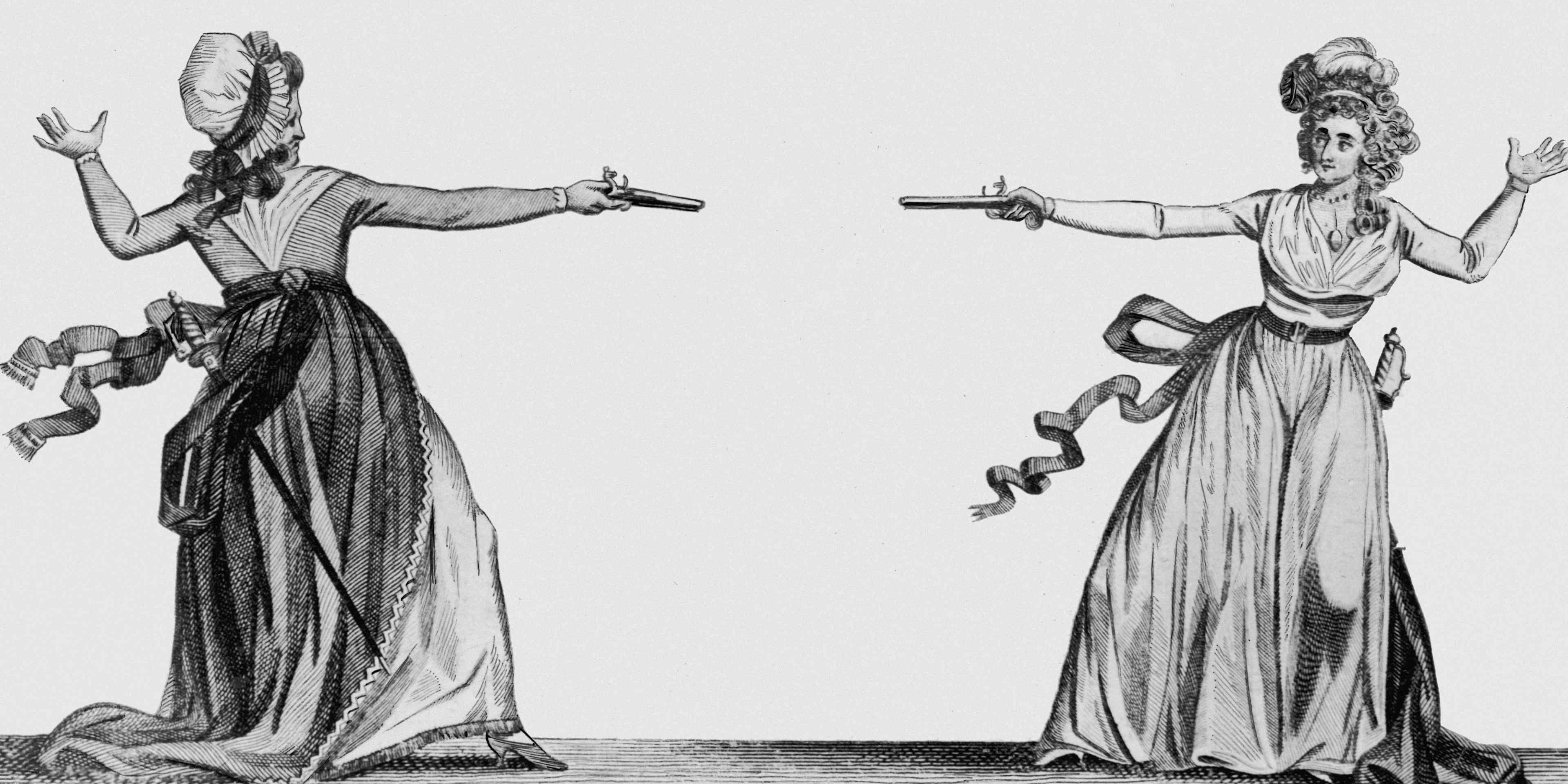
- 1792 (London): The infamous ‘Petticoat Duel’ takes place in Hyde Park between Lady Almeria Braddock and Mrs. Elphinstone over a disparaging comment about age.
- 1804 (July 11): Vice President Aaron Burr mortally wounds Alexander Hamilton at Weehawken, New Jersey, forever altering American political history.
- 1806 (May 30): Future U.S. President Andrew Jackson kills Charles Dickinson in Kentucky to defend his wife’s honor.
- 1837 (January 27): Russian literary icon Alexander Pushkin is mortally wounded by his brother-in-law George d’Anthès in St. Petersburg due to intense romantic jealousy.
- 1870 (February 23): French impressionist painter Édouard Manet duels his friend and art critic Edmond Duranty with swords in the Saint-Germain forest after a negative review.
Global Duels of Art, Passion, and Letters
Beyond the American frontier, dueling was equally prevalent among artists, writers, and aristocrats across Europe and Asia, shaping cultural movements and leaving behind enduring legends.
The Samurai’s Psychological Masterstroke: Musashi vs. Kojiro
In 1612, Japan’s greatest swordsmen, Miyamoto Musashi and Sasaki Kojiro, met on the shores of Ganryu Island. Musashi, known for his tactical genius, arrived hours late to psychologically disarm Kojiro. Using a heavy wooden sword (bokken) carved from a spare oar, Musashi countered Kojiro’s famous ‘swallow cut’ and delivered a single fatal blow. This duel cemented Musashi’s legacy not just as a fighter, but as a master strategist who later authored the classic philosophical text, The Book of Five Rings.
The Pen vs. the Sword: Édouard Manet and Alexander Pushkin
In Europe, intellectual rivalries often ended in violence. In 1870, painter Édouard Manet slapped art critic Edmond Duranty over a lukewarm review, leading to a sword duel in Paris. Fortunately, the encounter ended with a minor wound to Duranty, and the two reconciled shortly after over coffee. Tragically, the great Russian poet Alexander Pushkin was not so lucky. Driven by jealousy over the aggressive courtship of his wife by George d’Anthès, Pushkin challenged his brother-in-law to a pistol duel in 1837. Pushkin was shot in the stomach and died two days later, robbing Russia of its greatest literary light.
The Petticoat Duel: A London Scandal
In 1792, Lady Almeria Braddock challenged Mrs. Elphinstone to a duel in London’s Hyde Park. The cause? Mrs. Elphinstone had insinuated that Lady Braddock was much older than she claimed. Armed first with pistols and then with swords, the women fought until Lady Braddock wounded Mrs. Elphinstone in the arm, securing a written apology and settling the dispute in what became known as the legendary Petticoat Duel.
Lesser-Known Facts About Historical Duels
- The ‘Benefit of Clergy’ Loophole: When playwright Ben Jonson was sentenced to hang for killing Gabriel Spenser in 1598, he escaped death by claiming ‘benefit of clergy.’ By reading a specific Bible verse (often called the ‘neck verse’), he proved he could read, which transferred his case to a lenient ecclesiastical court. He was branded on the thumb and released.
- A Duel Captured on Canvas: The 16th-century Neapolitan swordfight between Isabella de Carazzi and Diambra de Pettinella was so sensational that it became the subject of legendary Spanish artist Jusepe de Ribera’s 1636 masterpiece, Duelo de Mujeres.
- The Dummy Duelists: In many 18th-century duels, ‘seconds’ (the assistants who organized the duel) successfully negotiated peaceful resolutions on the field. More than 90% of duels did not result in fatalities, as participants often deliberately fired wide (a practice known as ‘deloping’) to satisfy honor without committing murder.
Why the Code Duello Still Matters Today
While the practice of dueling has been outlawed for over a century, its legacy still echoes in modern legal and political frameworks. The outrage surrounding the deaths of figures like Alexander Hamilton and Alexander Pushkin served as crucial turning points, shifting public opinion and helping to establish modern legal standards for conflict resolution. Instead of personal violence, modern societies developed robust systems of libel, slander, and civil courts to address grievances. However, the psychological dynamics of dueling—where public image and perceived insults drive extreme behavior—remain highly visible in today’s social media age, where online ‘shaming’ and digital feuds act as the modern equivalent of the field of honor.
People Also Ask
Who was the most famous person killed in a duel?
Alexander Hamilton is widely considered the most famous historical figure killed in a duel. His 1804 confrontation with Vice President Aaron Burr at Weehawken, New Jersey, shocked the United States and marked the beginning of the end for the social acceptance of dueling in the North.
Did women participate in duels?
Yes, women did occasionally participate in duels, which were colloquially termed ‘petticoat duels.’ Famous examples include the 1792 sword and pistol duel between Lady Almeria Braddock and Mrs. Elphinstone in London, and the 16th-century Neapolitan duel between Isabella de Carazzi and Diambra de Pettinella over a mutual love interest.
How did Andrew Jackson survive so many duels?
Andrew Jackson survived multiple duels through sheer physical resilience and tactical patience. In his famous 1806 duel with Charles Dickinson, Jackson deliberately allowed Dickinson to fire first, taking a bullet to the chest, so that he could take his time and deliver a single, carefully aimed fatal shot.
Conclusion
In conclusion, the history of famous historical duels serves as a vivid reminder of how deeply personal honor was intertwined with public life. Whether fought with swords on a remote Japanese island, or with pistols on the cliffs of New Jersey, these lethal encounters shaped politics, literature, and art. Ultimately, the decline of dueling marked a civilizational shift toward institutional justice, replacing the violent defense of personal reputation with the rule of law. Yet, the timeless human struggle for respect, status, and honor continues to shape our world today.


