The foundation of modern America’s educational system was laid long before the arrival of yellow school buses, computerized classrooms, and standardized testing. During the 17th and 18th centuries, education in the 13 colonies was a starkly fragmented, deeply religious, and often remarkably harsh endeavor. Rather than a centralized, state-funded institution, schooling was a patchwork of local initiatives heavily dictated by religious zeal, geographic reality, gender, and social class. In the New England settlements, reading was treated as a vital spiritual weapon to ward off the devil, while the agrarian South left education to private tutors or ignored it altogether for the working class. This article explores the dramatic regional divides, the rudimentary tools of the colonial classroom, the severe methods of physical discipline, and the rare early efforts at cross-cultural education—revealing how these early systems shaped the future of American literacy and social structure.
The Historical Background: The Fragmented Roots of Colonial American Learning
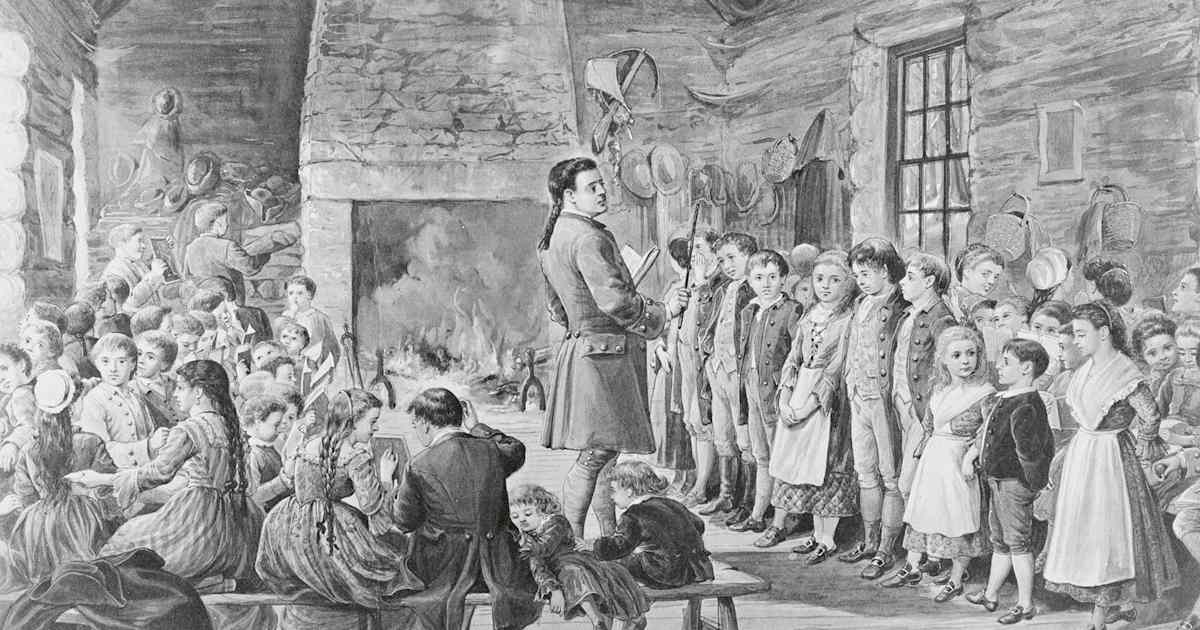
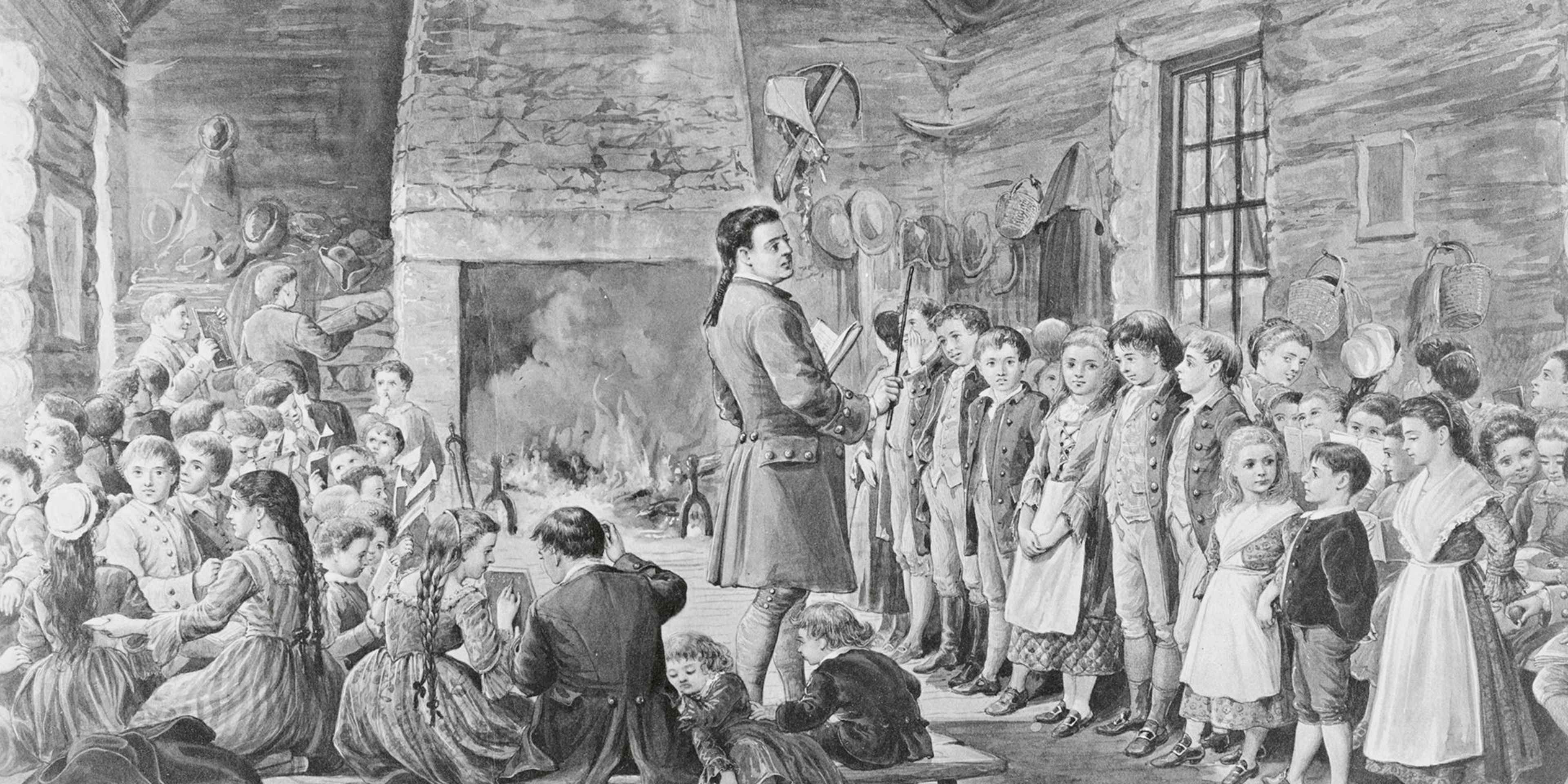
To understand colonial American schooling, one must first look at the map. In the 17th and 18th centuries, the English colonies in North America were divided into three distinct cultural and economic regions: New England, the Middle Colonies, and the Southern Colonies. Because there was no centralized federal government, there was no standardized curriculum, age grouping, or official school year. Education was deeply tied to the prevailing religious and socio-economic systems of each region.
The primary catalyst for education in early America was the Protestant Reformation, which taught that individuals had a personal responsibility to read and interpret the Holy Scriptures to ensure their own salvation. In the Massachusetts Bay Colony, settled in the 1630s by devout Puritans, literacy was elevated to a spiritual mandate. If a child could not read the Bible, they were seen as vulnerable to the temptations of the devil. Conversely, in the Southern colonies, where Anglicanism dominated and population density was low due to vast tobacco plantations, education was viewed as a private family matter rather than a community responsibility. This led to massive educational disparities between the wealthy elite and the working class, indentured servants, and enslaved people.
Timeline of Colonial Educational Milestones (1630–1774)
To comprehend how education evolved throughout the colonial era, we can trace a chronological progression of key legislative, institutional, and social milestones:
- 1630s: Puritan settlers land in New England and establish the Massachusetts Bay Colony, immediately prioritizing family-based religious literacy.
- 1636: Harvard College is founded in Cambridge, Massachusetts. Its original purpose is to train highly educated Congregationalist ministers to lead the colonial communities.
- 1642: The Massachusetts Compulsory Attendance Law is passed. While it does not require children to attend a physical school building, it legally binds household heads to ensure all children and apprentices under their roof learn to read, understand religious tenets, and comprehend the capital laws of the colony.
- 1647: Massachusetts passes the historic Old Deluder Satan Act. This law establishes the first public mandate for community-funded schooling, requiring towns of 50 or more households to hire a reading teacher and towns of 100 or more households to build a Latin grammar school.
- 1690: The first edition of The New England Primer is printed in Boston. This tiny textbook, blending the alphabet with grim Puritan religious couplets, becomes the standard reading curriculum across the northern colonies for over a century.
- 1760: The Williamsburg Bray School is established in Virginia, at the recommendation of Benjamin Franklin and with the support of the Anglican charity, the Associates of Dr. Bray. It provides an early, though highly constrained, educational opportunity for free and enslaved Black children.
- 1774: The Williamsburg Bray School closes on the eve of the American Revolutionary War, marking the end of a unique experimental era in early American cross-cultural education.
Pivotal Figures Who Shaped Early American Education
The development of colonial education was influenced by highly contrasting figures who held vastly different philosophies regarding who should be educated and why:
Sir William Berkeley (1605–1677): The longest-serving Governor of Virginia, Berkeley famously articulated the aristocratic Southern stance on public learning. In 1671, he wrote: “I thank God, there are no free schools nor printing… for learning has brought disobedience, and heresy, and sects into the world, and printing has divulged them.” Berkeley believed that keeping the masses uneducated was the best way to maintain social order and preserve royal authority, a philosophy that deeply delayed the development of public school systems in the South.
Benjamin Franklin (1706–1790): Hailing from the Middle Colonies, Franklin represented the pragmatism of the American Enlightenment. He criticized the classical Latin grammar schools as outdated and elitist. In 1751, he helped establish the Academy of Philadelphia, which offered a revolutionary curriculum focused on practical skills—such as writing, geography, math, history, and modern languages—designed to prepare students for business and civic life. Franklin also played an instrumental role in advocating for the establishment of the Bray Schools to educate Black children.
Ann Wager (d. 1774): As the sole teacher of the Williamsburg Bray School for fourteen years, Ann Wager instructed between 300 and 400 free and enslaved Black children in reading, sewing, and the tenets of the Anglican Church. While the school’s curriculum was designed by white trustees to encourage enslaved children to accept their social subjugation, Wager’s instruction inadvertently provided her students with the tools of literacy, which many used to foster agency, document their lives, and seek pathways to personal freedom.
Classroom Tools and Methods: From Hornbooks to Primers
Colonial classrooms were devoid of the colorful visual aids and extensive libraries found in modern schools. Instead, learning relied on a few highly standardized, rudimentary tools and an emphasis on rote memorization.
The Hornbook: A Toddler’s First Primer
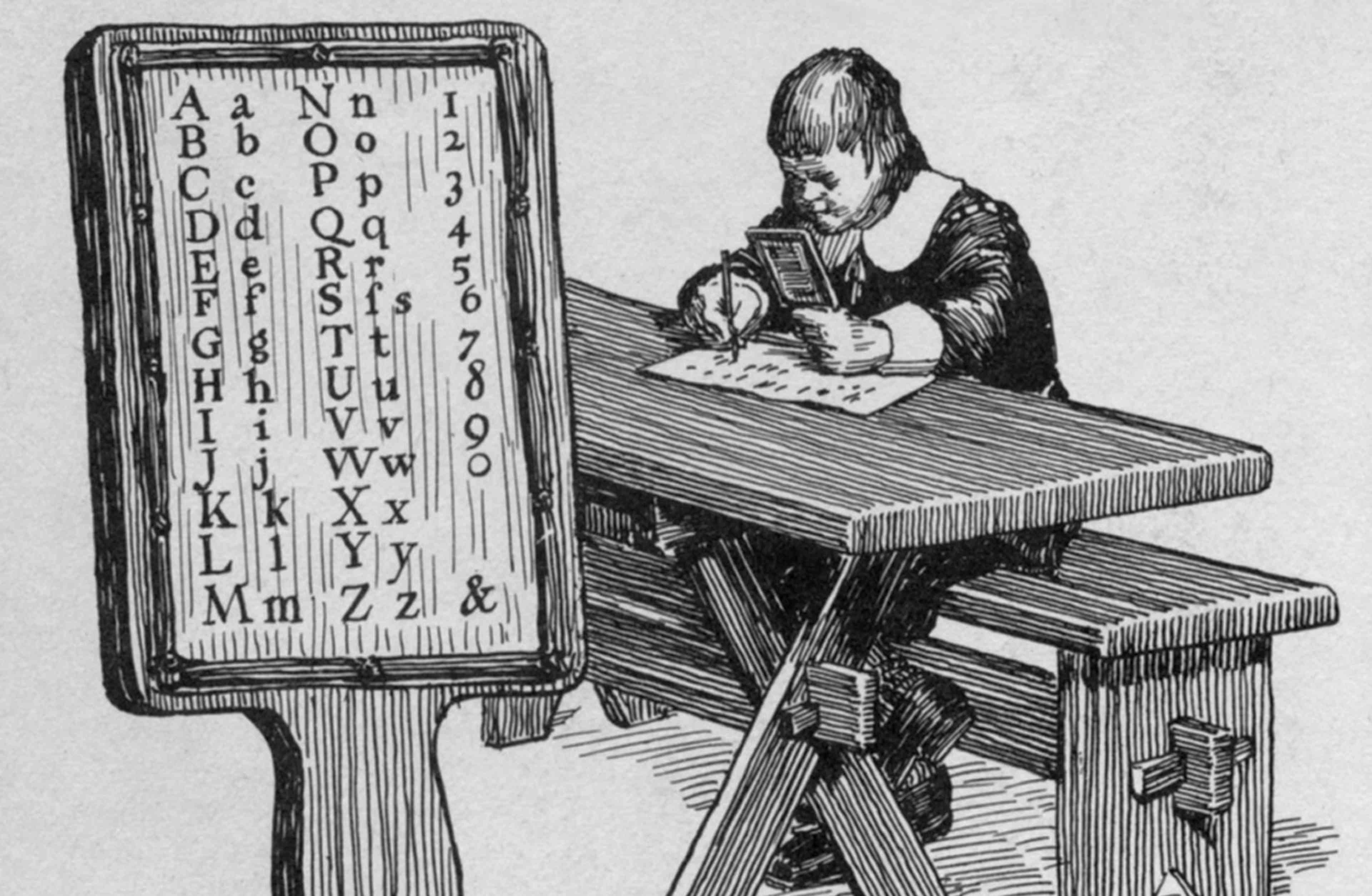
Before children ever touched a book, they learned their letters from a hornbook. This was not a book at all, but rather a small, flat wooden paddle with a handle. A single sheet of paper containing the alphabet, the Lord’s Prayer, and Roman numerals was pasted onto the wood. To protect the paper from being soiled by children’s dirty hands, it was covered with a thin, translucent layer of pressed and polished animal horn. Children used these sturdy paddles to trace letters and memorize their basic prayers.
The New England Primer: Morality in the Alphabet
Once children mastered the hornbook, they graduated to The New England Primer. This pocket-sized textbook blended reading instruction with strict Puritan theology. Every letter of the alphabet was accompanied by a grim, woodcut illustration and a moralistic rhyming couplet. For instance, the letter ‘A’ featured the rhyme, “In Adam’s Fall, We Sinned All,” while the letter ‘F’ warned, “The Idle Fool, Is whipt at School.” Students were expected to memorize and recite these passages continuously, practicing a highly repetitive form of rote learning.
The Dame School: Living Room Literacy
For the youngest children, formal schooling often began in a neighbor’s kitchen. Known as dame schools, these informal classes were run by local widows or older women who looked after children in exchange for a tiny fee. While cooking or sewing, the ‘dame’ would teach children the basics of phonics, spelling, and religious catechism. For many young girls, the dame school was the only formal education they would ever receive, as higher levels of schooling were strictly reserved for boys.
Discipline and Punishment: The “Rod of Correction”
In colonial schools, the modern philosophy of positive reinforcement was entirely nonexistent. Influenced by the Puritan belief in original sin, schoolmasters believed that children were born inherently sinful and that physical punishment was divinely sanctioned to “beat the devil” out of them. A typical Massachusetts school rule from 1645 stated that the schoolmaster had absolute authority to punish children, and parents were legally forbidden from intervening.
The most common tool for physical correction was the ferule, a heavy wooden ruler with a flat end used to strike a student’s open palm. For more severe infractions, schoolmasters used rattan canes or a whip called a cat-o-nine-tails. However, discipline was not limited to physical beatings; public shaming was also a popular and highly creative art form:
- Caging: Disobedient students might be locked inside a wooden cage suspended from the ceiling or the front of the schoolhouse, making their humiliation visible to the entire town.
- Cooping: A particularly cruel punishment where a misbehaving child was forced to lie on their back underneath a dirty chicken coop for the duration of the school day.
- The Dunce Cap and Whispering Stick: Students who failed to grasp their lessons were forced to wear a cone-shaped “dunce” cap while sitting on a tall stool. Those caught talking out of turn were forced to wear a “whispering stick”—a wooden peg strapped into their mouth like a horse’s bit.
- Thimble-Tapping: Even the kindly old widows of the dame schools had their limits. They frequently used a heavy metal thimble to tap sharply on a lazy child’s cranium to regain their attention.
Turning Points and Long-Term Impacts on the United States
The disparities and structures established during the colonial era deeply influenced the trajectory of American history. The passage of the Old Deluder Satan Act in 1647 marked the first time in the Western world that a government asserted its right to mandate and fund education, creating the intellectual template for the modern public school system. In the 19th century, educational reformer Horace Mann used New England’s early town-funded school model to launch the “Common School Movement,” which established free, secular, tax-supported public education across the nation.
However, the stark regional differences in educational access also left deep, long-lasting scars. Because the Southern colonies resisted public schooling and left education to the private sphere, deep class divides persisted. After the Civil War, the South struggled for decades to build cohesive public school infrastructures. Furthermore, the systematic denial of formal education to enslaved and indigenous populations created deep racial inequalities in literacy and socioeconomic mobility that activists would spend centuries fighting to dismantle during the Civil Rights Movement.
Lesser-Known Historical Anecdotes
1. Schoolmasters as Indentured Servants and Criminals
While New England sought highly educated, pious men to run their schools, qualified teachers were incredibly scarce in the South. To fill the gap, Southern plantation owners frequently purchased indentured servants or even transported convicts to act as private tutors. These “bondsmen teachers” were often of questionable character. Colonial newspapers regularly featured runaway advertisements detailing fleeing schoolmasters, with one notable ad describing a runaway teacher who was “much given to drinking and gambling.” In fact, young George Washington’s very first schoolmaster was a bondsman purchased by his father, a man named Hobby who also worked as the local grave-digger.
2. No Wood, No Heat
In the bitter winters of New England, keeping a one-room schoolhouse warm was a life-or-death matter. Because schools operated on razor-thin budgets, they did not buy firewood. Instead, every student’s family was legally required to supply a massive cord of wood to the schoolhouse. If a family was late or failed to deliver their wood, their child was physically forced to sit in the furthest, coldest corner of the schoolhouse, far away from the fireplace, as a direct punishment for the parents’ neglect.
3. Mobile “Field Schools” on Wheels
Because Southern plantations were spaced miles apart, building a permanent, central schoolhouse was highly impractical. To solve this problem, some communities pooled their resources to build a small, wooden “field school” on a fallow tobacco patch. When it came time to rotate the crops or replant the field, the community would place the entire school building on massive wooden logs and literally roll it across the landscape to a new plantation, making it one of America’s earliest mobile school systems.
Why Colonial Education Still Matters Today
The legacy of colonial education is not merely a collection of dusty artifacts; it actively shapes modern American life. Today’s system of funding public schools through local property taxes is a direct descendant of the Massachusetts town meetings of the 17th century. This localized funding model continues to spark heated debates over wealth inequality and educational equity between rich and poor school districts.
Furthermore, the persistent cultural battles over school prayer, religious curriculum, and state-mandated testing are a direct continuation of the centuries-old struggle between the Puritan belief in moral, faith-based instruction and the Enlightenment focus on secular, practical knowledge. By studying the origins of early American education, we gain a clearer understanding of the values, prejudices, and ideals that continue to define our classrooms today.
People Also Ask
What was the Old Deluder Satan Act?
The Old Deluder Satan Act was a law passed in Massachusetts in 1647. It required towns of 50 or more families to hire a schoolmaster to teach reading and writing, and towns of 100 or more families to establish a Latin grammar school. Its name came from the belief that Satan sought to keep humans ignorant of the Scriptures.
Did girls go to school in the 13 colonies?
Yes, but their education was highly limited. Girls frequently attended dame schools to learn reading and domestic arts like sewing and weaving, but they were generally barred from Latin grammar schools and higher education, which were reserved exclusively for boys preparing for careers in law, medicine, or the ministry.
What was a hornbook in colonial times?
A hornbook was a primitive learning tool consisting of a wooden paddle with a sheet of paper containing the alphabet and the Lord’s Prayer pasted onto it. It was covered with a thin sheet of transparent animal horn to protect the paper from damage.
How was a colonial schoolmaster paid?
Colonial schoolmasters were rarely paid entirely in cash. Instead, they received a small salary supplemented by tuition fees paid in agricultural goods, such as corn, barley, and peas, as well as mandatory contributions of firewood from the families of their students.
Conclusion
In summary, education in the 13 colonies was far from the idealized, unified system we enjoy today. It was a world of stark regional contrasts, heavy religious indoctrination, and uncompromising physical discipline. Yet, within this harsh environment, early Americans laid the foundational building blocks of public education, literacy, and civic responsibility that would eventually define the democratic ideals of the United States. By understanding this complex heritage, we can better appreciate the ongoing evolution of the American classroom.


1 comment