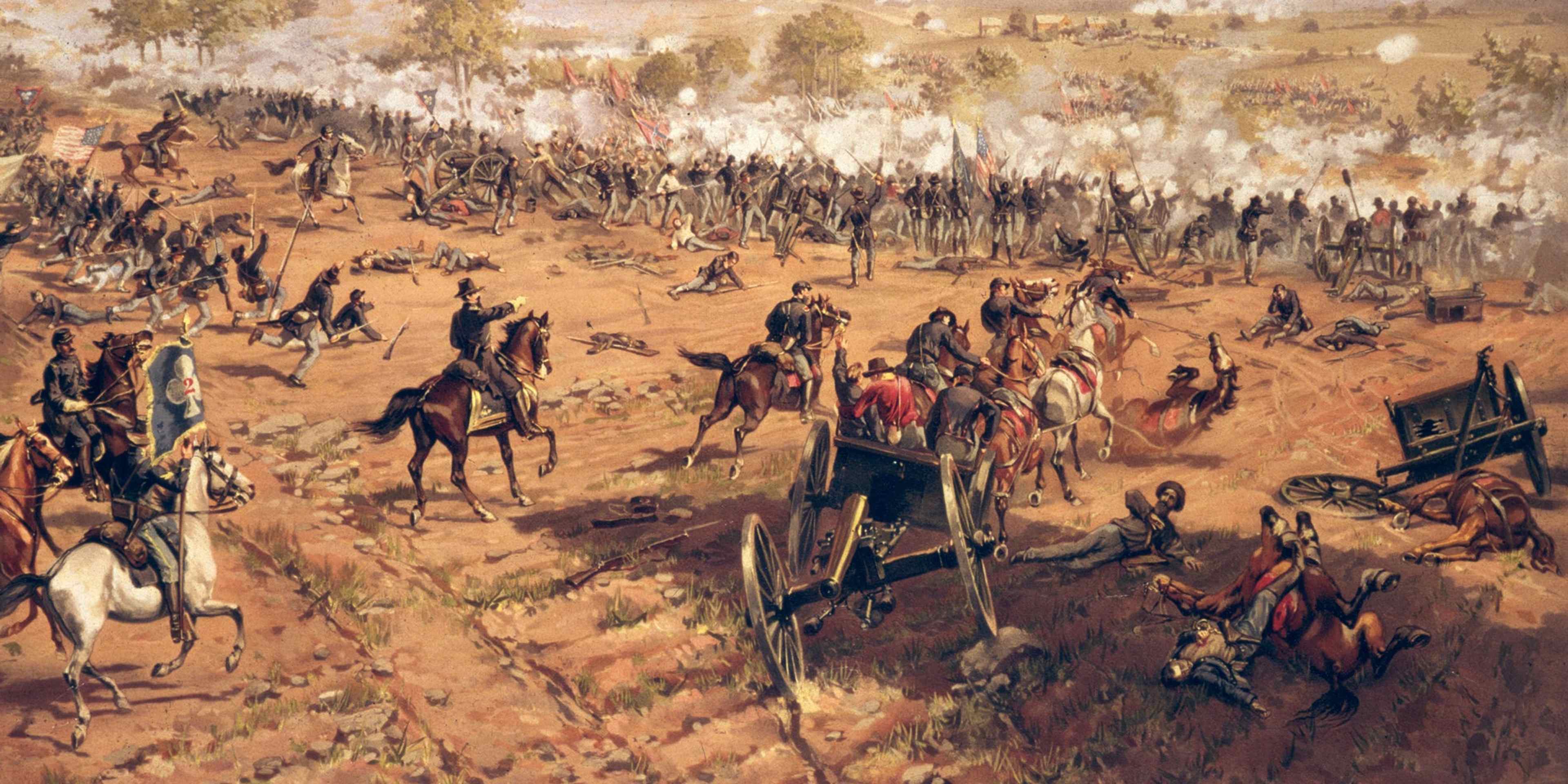
Fought over three sweltering days in July 1863, the Battle of Gettysburg stands as the most critical and mythic clash of the American Civil War. This catastrophic confrontation did not just claim tens of thousands of lives; it fundamentally re-charted the trajectory of a fractured nation struggling to define the bounds of human liberty. Prior to this engagement, the Confederate Army of Northern Virginia, led by General Robert E. Lee, appeared nearly invincible. Riding high after a stunning victory at Chancellorsville, Lee launched a bold second invasion of the North, hoping to break the political will of the Union and secure European recognition. Instead, he collided with the newly appointed Major General George G. Meade and the Union Army of the Potomac at a small crossroads town in Pennsylvania. What followed was a brutal, three-day struggle that halted the Confederate advance and forever shattered their offensive capabilities. This pivotal contest remains the high-water mark of the Confederacy and a defining moment that preserved the American experiment.
Historical Background and Context
In the early summer of 1863, the American Civil War was at a critical crossroads. General Robert E. Lee’s Confederate Army of Northern Virginia had recently achieved a spectacular, though costly, victory against the Union’s Army of the Potomac at the Battle of Chancellorsville in May. Despite this triumph, the Confederacy faced severe systemic challenges. In the Western Theater, Union Major General Ulysses S. Grant had laid a choking siege on the Mississippi River stronghold of Vicksburg. Lee understood that a defensive campaign in Virginia would slowly deplete his resources. By launching a bold offensive into Union territory, Lee hoped to draw federal forces away from Vicksburg, relieve the war-torn Virginia countryside, and gather vital agricultural supplies from the fertile Pennsylvania valleys.
Beyond these immediate logistical goals, Lee’s invasion had a grander geopolitical purpose. A decisive Confederate victory on Northern soil would bolster the political standing of peace-advocating Northern Democrats (known as “Copperheads”) and put pressure on President Abraham Lincoln to negotiate an end to the war. Furthermore, Lee believed that a spectacular battlefield triumph could finally convince Great Britain and France to officially recognize the Confederacy and intervene on its behalf. To understand the gravity of this campaign, historians often analyze how the Battle of Gettysburg turned the tide of the Civil War, representing the strategic shift from Confederate ascendancy to a defensive struggle for survival.
Key Timeline of the Three-Day Clash
The battle was not pre-planned; rather, it developed organically as elements of both armies collided in the small crossroads town of Gettysburg, Pennsylvania. Below is the chronological breakdown of how the three days of intense fighting unfolded:
- June 28, 1863: Frustrated by Major General Joseph Hooker’s reluctance to aggressively pursue Lee, President Lincoln replaces him with Major General George G. Meade as commander of the Army of the Potomac. Meade immediately orders his forces north to shadow the Confederate army.
- July 1, 1863 (Day 1): Elements of Confederate General A.P. Hill’s corps approach Gettysburg in search of supplies. They clash with a Union cavalry division commanded by Brigadier General John Buford, who sets up defensive positions west of the town. As reinforcements pour in from both sides, the Confederates succeed in pushing the outnumbered Union defenders back through the town of Gettysburg. The retreating Federals take up strong defensive positions on the high ground south of town, specifically Cemetery Hill, Culp’s Hill, and Cemetery Ridge. Lee orders General Richard Ewell to capture the Union positions “if practicable,” but Ewell declines to attack, a decision that would prove highly controversial.
- July 2, 1863 (Day 2): The Union army establishes a defensive line resembling a fishhook, anchoring their flanks on Culp’s Hill and the Round Tops. Lee orders Lieutenant General James Longstreet to launch an attack on the Union’s left flank, while Ewell’s corps strikes the right near Culp’s Hill. A major tactical blunder occurs when Major General Daniel Sickles, whose eccentric leadership and severed leg became legendary, moves his Union Third Corps nearly a mile forward of the main line without orders. This creates a vulnerable salient and triggers intense, bloody combat in areas that became iconic: the Peach Orchard, the Wheatfield, and Devil’s Den. Despite devastating losses, including a desperate, bayonet-charging defense of Little Round Top by Colonel Joshua Lawrence Chamberlain’s 20th Maine, the Union forces manage to hold their line.
- July 3, 1863 (Day 3): Believing the Union center on Cemetery Ridge is weakened, Lee decides to risk a massive frontal assault. Following a colossal, two-hour artillery bombardment by some 150 Confederate guns, approximately 12,500 Confederate soldiers under the divisions of George Pickett, J. Johnston Pettigrew, and Isaac R. Trimble march across three-quarters of a mile of open field. This assault, famously known as “Pickett’s Charge,” is decimated by Union artillery and infantry crossfire. Barely half of the advancing Confederates survive, and the charge fails completely, marking the end of the battle.
- July 4, 1863: Lee’s battered army waits in vain for a Union counterattack. Under a driving rain, Lee begins a long, agonizing retreat back to Virginia. Simultaneously, in the Western Theater, Vicksburg surrenders to General Grant, dealing a double blow to the Confederacy.
Prominent Historical Figures and Their Roles
The Battle of Gettysburg featured a complex tapestry of military leaders whose decisions on the field altered the course of American history. Understanding these figures provides essential context for the battle’s outcome:
General Robert E. Lee (Confederacy)
As the commander of the Army of Northern Virginia, Lee’s tactical brilliant reputation was at its peak in 1863. However, his overconfidence in his soldiers’ abilities and his aggressive instinct led him to ignore the defensive recommendations of his subordinates, culminating in the disastrous decision to order Pickett’s Charge.
Major General George G. Meade (Union)
Appointed just three days before the battle, Meade demonstrated remarkable calm and competence. He utilized his defensive ground effectively, anticipated Lee’s strikes, and successfully coordinated his corps commanders. Though criticized by Lincoln for not aggressively pursuing and destroying Lee’s retreating army, Meade’s victory saved the Union.
Lieutenant General James Longstreet (Confederacy)
Lee’s second-in-command and chief advisor, Longstreet advocated for a defensive-offensive strategy, suggesting that the Confederates should bypass Gettysburg to find high ground between Meade and Washington, D.C., forcing the Union to attack them. When Lee insisted on attacking, Longstreet reluctantly executed his orders, bearing a deep skepticism of the assault on July 3.
Colonel Joshua Lawrence Chamberlain (Union)
A former college professor from Maine, Chamberlain commanded the 20th Maine Regiment on the extreme left of the Union line at Little Round Top. Low on ammunition and facing repeated Confederate assaults on July 2, Chamberlain ordered a legendary swinging bayonet charge that secured the vital hill and prevented the Union line from being enveloped.
Major Turning Points and Strategic Blunders
Several crucial decisions and failures dictated the outcome of Gettysburg. On the first day, General Ewell’s hesitation to capture Cemetery Hill allowed the arriving Union Army to secure the superior defensive high ground. On the second day, General Sickles’ unauthorized advance created a chaotic crisis but ultimately absorbed the brunt of Longstreet’s attack, buying time for Union reinforcements. Finally, Lee’s stubborn insistence on Pickett’s Charge on the third day—ignoring Longstreet’s warnings—resulted in the annihilation of his finest infantry divisions, leaving him with no choice but to retreat.
Long-Term Impact on America and the Union
The consequences of the Battle of Gettysburg were profound and enduring. With over 51,000 combined casualties (23,000 Union and 28,000 Confederate), it remains the costliest battle in American history. Psychologically, it shattered the myth of Southern invincibility and severely demoralized the Confederate population. Geopolitically, the twin victories at Gettysburg and Vicksburg permanently ended any hope of European intervention or recognition of the Confederacy. From this point forward, the South was forced onto a defensive footing, waging a war of attrition that it did not have the industrial power or manpower to win.
Furthermore, the battle inspired President Abraham Lincoln’s iconic address during the dedication of the National Cemetery on November 19, 1863. In a brief yet powerful speech, Lincoln transformed the meaning of the war from a mere struggle to preserve the Union into a grand crusade for human liberty and equality. Today, historians analyze why the Gettysburg Address is one of the most famous speeches in history, noting how its 272 words redefined the American democratic promise of a “government of the people, by the people, for the people.”
Lesser-Known Facts about the Battle
While Gettysburg is heavily documented, several fascinating and surprising details are often overlooked by popular history:
- The Myth of the Shoe Factory: A common historical myth suggests that the Confederate army marched into Gettysburg purely in search of a shoe factory. While A.P. Hill’s men were indeed looking for supplies, Gettysburg did not have a shoe factory; it did, however, have numerous tanneries and was a major crossroads town where ten roads converged, making it an inevitable military meeting point.
- The Only Civilian Casualty: Despite the scale of the battle, only one civilian was directly killed by combat. Mary Virginia “Jennie” Wade, a 20-year-old woman, was struck and killed by a stray bullet on July 3 while baking bread for Union soldiers in her sister’s home.
- The Devastating Aftermath: The small town of Gettysburg, with a resident population of only about 2,400 people, was left to care for over 20,000 wounded soldiers. Homes, churches, and barns were hastily converted into makeshift hospitals, initiating rapid advancements in American surgical practices and the embalming industry.
Why Gettysburg Matters Today
The Battle of Gettysburg is not merely a collection of troop movements and casualty figures; it is the ultimate symbol of a nation tested. It represents the immense cost of maintaining democratic institutions and the perpetual struggle to ensure that the promise of equality is extended to all citizens. The battlefields of Gettysburg remain a sacred pilgrimage site for millions of visitors annually, reminding modern generations of the fragility of national unity and the profound sacrifices required to preserve a free society.
People Also Ask
Who won the Battle of Gettysburg?
The Union Army of the Potomac, commanded by Major General George G. Meade, won the Battle of Gettysburg. They successfully repelled the invading Confederate Army of Northern Virginia led by General Robert E. Lee.
Why was the Battle of Gettysburg a turning point in the Civil War?
Gettysburg was a turning point because it permanently ended General Robert E. Lee’s ability to launch major offensive operations into Northern territory, destroyed Southern hopes of securing foreign recognition from Britain and France, and severely damaged Confederate military strength and public morale.
How many casualties occurred at the Battle of Gettysburg?
The battle resulted in approximately 51,000 total casualties over three days. The Union sustained about 23,000 casualties (killed, wounded, captured, or missing), while the Confederacy suffered an estimated 28,000 casualties, representing more than a third of Lee’s entire army.
Conclusion
The Battle of Gettysburg stands as a monument to human courage, tragic loss, and strategic consequence. Through the strategic mistakes of General Lee and the stubborn, heroic defense of General Meade’s forces, the Union preserved its integrity and turned the tide of the American Civil War. When we look back at the fields of Gettysburg and the words of Abraham Lincoln, we are reminded that the ideals of freedom and unity are constantly forged in the fires of sacrifice and must never be taken for granted.


