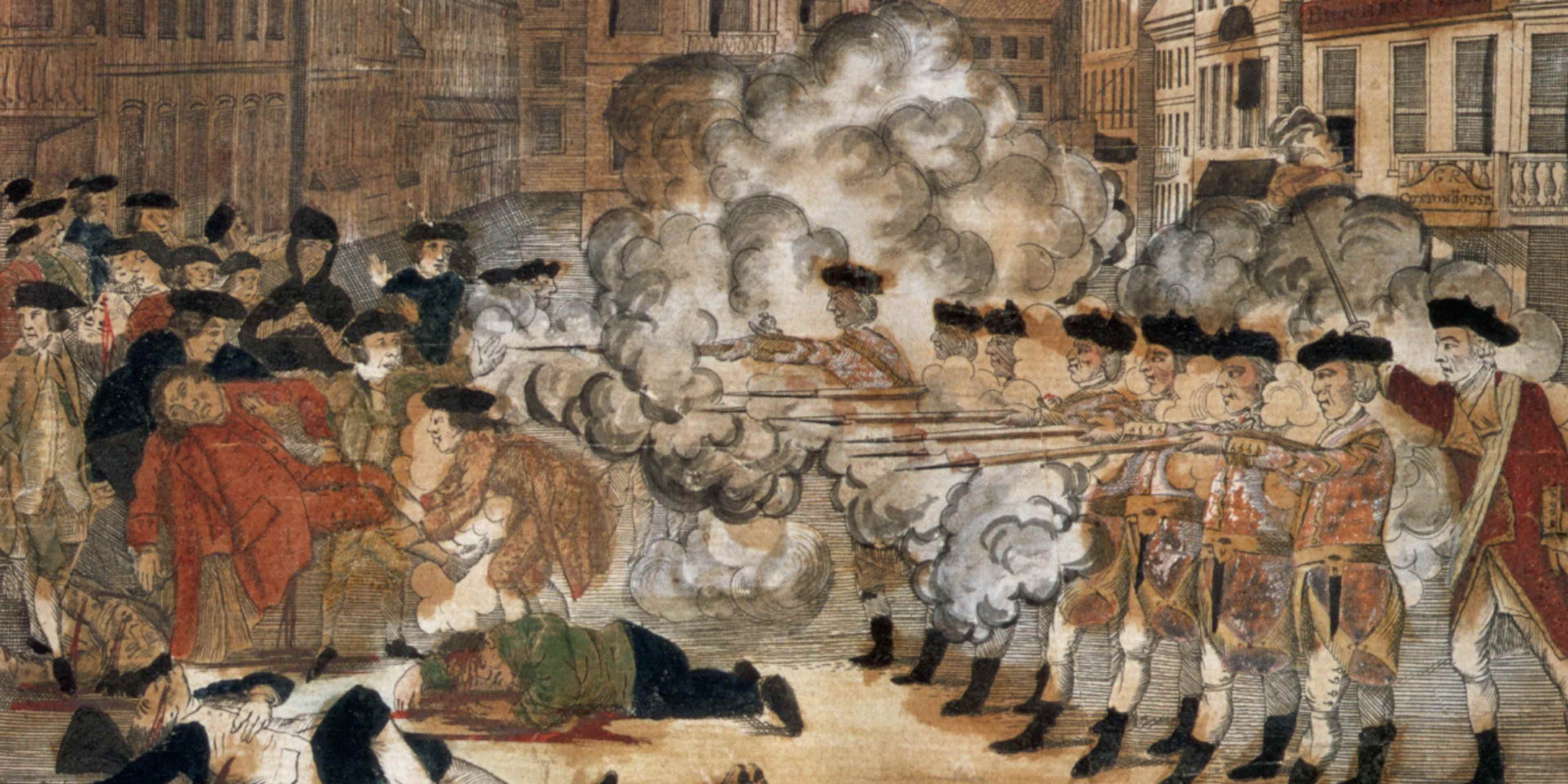
The night of March 5, 1770, would forever alter the course of American history. On the cold, snow-slicked cobblestones of King Street in Boston, a tense standoff between an angry civilian mob and British occupational soldiers erupted into deadly gunfire. This tragic clash, which left five colonists dead, was immediately seized upon by radical Patriots determined to break the shackles of imperial control. Chief among them was Paul Revere, a skilled Boston silversmith whose legendary “midnight ride” of 1775 often overshadows his equally critical work as a master propagandist. Just three weeks after the shooting, Revere published “The Bloody Massacre,” a hand-colored copperplate engraving that inflamed public passions across the thirteen colonies. This striking image did not merely report the news—it manufactured a powerful narrative of ruthless imperial tyranny and innocent, helpless martyrdom, becoming arguably the most successful piece of political propaganda in American history.
Historical Background: Tensions in Occupied Boston
To understand why a single engraving could possess such revolutionary power, one must look at the pressure-cooker environment of Boston in 1770. Following the French and Indian War, the British Parliament sought to recoup its massive financial losses by taxing the American colonists. The passage of the Townshend Acts of 1767 levied heavy duties on essential imports such as glass, lead, paint, paper, and tea. When Bostonians resisted, British authorities retaliated by dispatching military forces to occupy the city. In October 1768, regiments of Redcoats marched into Boston, establishing an unwelcome and highly visible military presence in a town of only 15,000 residents.
For nearly eighteen months, daily friction wore down the patience of both soldiers and citizens. Redcoats, who were poorly paid, competed with local working-class Bostonians for part-time jobs along the docks, sparking frequent brawls. In February 1770, tensions reached a boiling point when an eleven-year-old boy named Christopher Seider was shot and killed by a customs informer during a protest. Seider’s funeral became a massive public demonstration, setting a grim, defiant mood throughout the town. During this era, news traveled slowly. While town criers were the original social media carrying spoken news to local ears, visual prints and pamphlets were indispensable for spreading ideological flames across long distances, and the upcoming tragedy on King Street would prove the absolute power of the printed word and image.
The King Street Skirmish: A Chronological Timeline
The events of March 5, 1770, occurred in a flash of chaos, but their chronological sequence reveals how a minor street altercation rapidly spiraled into a historic catalyst:
- Early Evening (approx. 8:00 PM): Edward Garrick, a young wigmaker’s apprentice, publicly accuses British Captain-Lieutenant John Goldfinch of failing to pay his bill. Private Hugh White, a British sentry on duty outside the Custom House on King Street, defends his officer. When Garrick becomes insulting, White strikes him on the side of the head with the butt of his musket.
- The Gathering Mob (8:30 PM – 9:00 PM): News of the altercation spreads quickly. An angry crowd of several dozen young men, dockworkers, and laborers converges on King Street. They surround Private White, shouting insults and pelting him with ice, packed snowballs, and chunks of coal.
- Reinforcements Arrive (approx. 9:10 PM): Fearing for his life, Private White calls for assistance. Captain Thomas Preston leads a guard of seven soldiers from the 29th Regiment of Foot to relieve and protect White. They form a semi-circle with fixed bayonets around the sentry post.
- The Fateful Shots: The mob swells to several hundred. Many carry heavy wooden clubs. Amidst the jeering and flying debris, a piece of ice strikes Private Hugh Montgomery, knocking him to the ground. Upon regaining his feet, Montgomery fires his musket. Within seconds, in the utter confusion and without a direct command, several other soldiers fire their weapons into the crowd.
- Immediate Casualties: When the gunsmoke clears, three men lie dead: Crispus Attucks, James Caldwell, and Samuel Gray. Two others, Samuel Maverick and Patrick Carr, are mortally wounded and die in the days that follow.
- March 1770 (The Propaganda Battle): Immediately following the event, both Patriots and Loyalists race to frame the narrative. While the British soldiers are arrested and jailed, Paul Revere prepares a visual counter-offensive to sway public opinion.
- October to December 1770 (The Trials): Captain Preston and his men face trial for murder in a Boston court, defended by Patriot attorney John Adams, who seeks to prove that colonial courts are capable of delivering unbiased justice.
Key Figures of the Incident and Their Legacies
The narrative of the Boston Massacre is populated by several crucial historical actors, each playing a distinct role in the unfolding drama:
- Paul Revere: Best remembered today for warning of the British march on Lexington in 1775, Revere was a versatile and enterprising middle-class silversmith, engraver, and active member of the Sons of Liberty. His distribution of the “Bloody Massacre” print established him as one of the preeminent visual communicators of the pre-revolutionary era.
- Henry Pelham: A talented young artist and the half-brother of legendary portrait painter John Singleton Copley. Pelham drew the original design of the confrontation, titled “The Fruits of Arbitrary Power,” which Paul Revere copied and published as his own.
- Crispus Attucks: A man of African and Native American descent who had escaped from slavery to work as a merchant seaman and dockworker. Attucks was at the front of the mob and became the first colonial casualty of the encounter, recognized historically as the first martyr of the American Revolution.
- Captain Thomas Preston: The British officer in command on the night of March 5. Preston was accused of ordering his men to fire upon the crowd. His subsequent trial resulted in an acquittal, as evidence demonstrated he never gave such an order.
- John Adams: A respected Boston lawyer and future President of the United States. Adams took the unpopular case of defending the British soldiers to uphold the rule of law. His brilliant defense secured the acquittal of Captain Preston and six of the soldiers, while two were convicted of the lesser charge of manslaughter.
Anatomy of a Masterpiece: Analyzing Revere’s Propaganda
To maximize its emotional impact, Paul Revere designed “The Bloody Massacre on King Street” to be a deeply biased, politically motivated caricature of the actual event rather than an objective historical document. When analyzed closely, several deliberate inaccuracies emerge that served the Patriot cause:
First, Revere depicted the British soldiers standing in a perfect, organized firing line, executing a coordinated volley. In reality, the shooting was a disorganized, chaotic scrum characterized by mutual panic and confusion. Second, Revere placed Captain Preston behind his men, shown with a raised sword actively commanding them to fire. In truth, Preston stood in front of his troops, desperately trying to prevent violence, and never ordered a discharge of muskets.
Third, the crowd of Bostonians is represented as well-dressed, orderly, and entirely defenseless citizens cowering in terror. The engraving completely conceals the fact that the colonists were an unruly, aggressive mob armed with thick wooden clubs, actively throwing heavy ice and stones at the guard. Fourth, Revere added the fictional name “Butcher’s Hall” to the sign above the Custom House, directly associating the building—and by extension, the British crown—with a slaughterhouse. Finally, despite Crispus Attucks’ well-known heritage, Revere portrayed him as a light-skinned white man to ensure the image would evoke maximum sympathy among the predominantly white populations of other colonies.
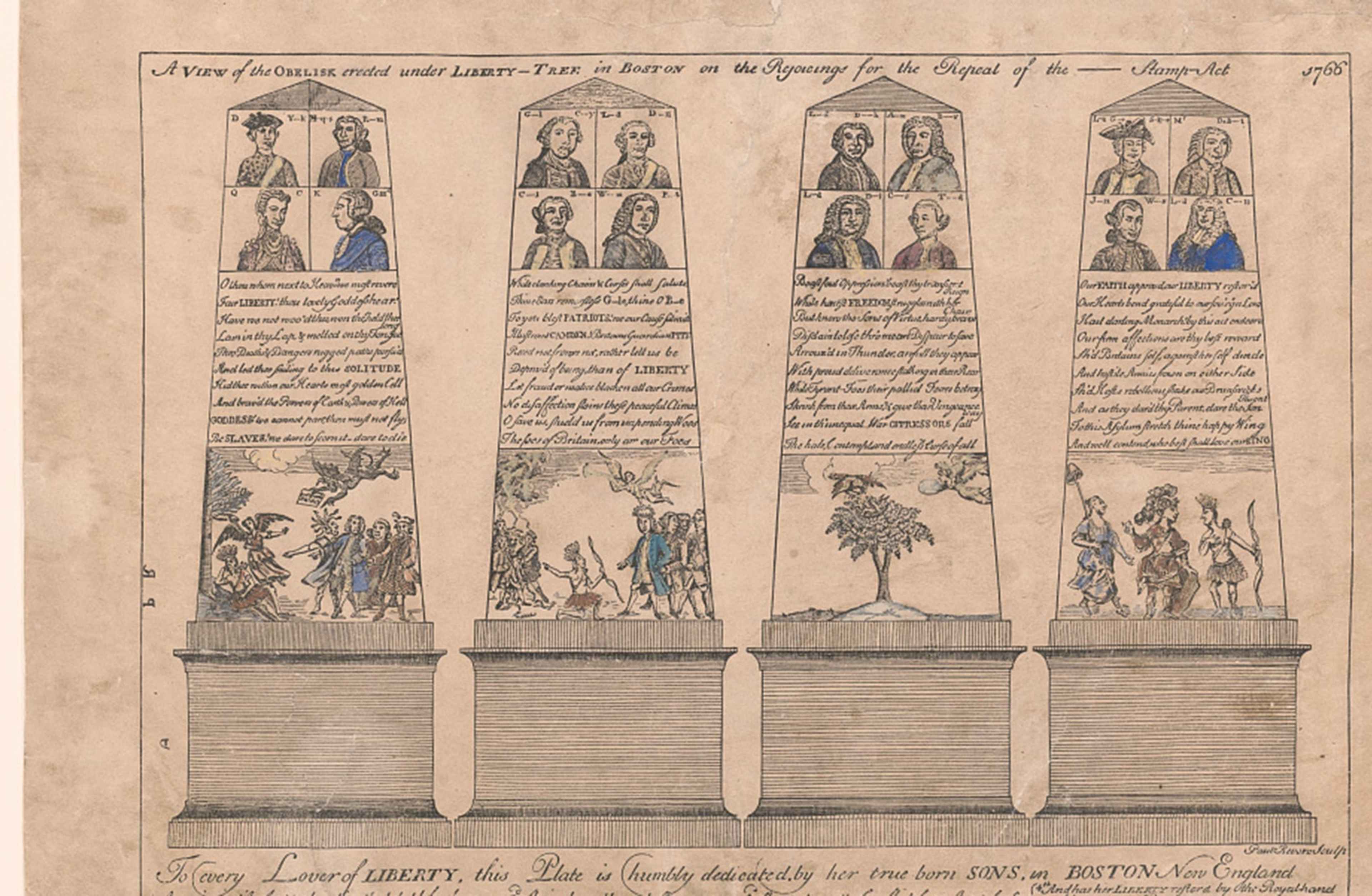
During this period, colonial print culture was undergoing a massive transformation. While early printing presses and America’s first newspapers laid the groundwork for public debate, single standalone engravings like Revere’s broadside had a uniquely immediate, visceral emotional impact. A highly visual, hand-colored print could communicate anger and outrage instantly, bypassing the need for long-form literacy and cementing a unifying narrative of British brutality across class lines.
The Controversy: Henry Pelham’s Stolen Artwork
One of the most fascinating behind-the-scenes dramas of the Boston Massacre engraving is the accusation of blatant plagiarism. Paul Revere did not actually sketch the design for “The Bloody Massacre.” The composition was copied almost line-by-line from a drawing created by the young Boston artist Henry Pelham. Pelham had entrusted his drawing, titled “The Fruits of Arbitrary Power, or The Bloody Massacre,” to Revere so that Revere could engrave it onto a copper plate.
Recognizing the immense political and financial potential of the piece, Revere quickly produced his own copperplate engraving and rushed it to the printers. Revere advertised his print for sale on March 26, 1770, a full week before Pelham could publish and sell his own version. Furious at this betrayal, Pelham wrote a scathing letter to Revere on March 29, 1770, stating: “When I heard that you was cutting a plate of the late Murder, I thought it impossible, as I knew you was not capable of doing it unless you copied it from mine…” Pelham accused Revere of violating the “dictates of Honour and Justice” and taking “undue advantage” of his trust.
Historians note that in the eighteenth century, copy protection and copyright laws were virtually non-existent, and borrowing artistic concepts was relatively common. However, Revere’s motive was likely driven by political urgency. As the revolutionary crisis deepened, the Sons of Liberty understood that the struggle against Great Britain was increasingly a war of information. Getting their version of the story out to the other colonies as quickly as possible was paramount, and Revere’s rapid actions ensured the Patriot narrative dominated the continent.
The Trial and the Verdict: A Triumph of Law
While Revere’s propaganda painted the Redcoats as cold-blooded murderers, the ensuing legal trial presented a far more nuanced picture. In a brilliant move to demonstrate the integrity of the colonial justice system, Patriot leader John Adams agreed to defend the accused soldiers. Adams risked his personal safety and political reputation to ensure they received a fair trial, believing that the cause of liberty must be anchored in the rule of law.
The trials took place in late 1770. During his famous summation to the jury, Adams uttered his legendary words: “Facts are stubborn things; and whatever may be our wishes, our inclinations, or the dictates of our passions, they cannot alter the state of facts and evidence.” Adams successfully argued that the soldiers had been provoked by a dangerous mob and fired out of self-defense. Captain Preston and six of his soldiers were acquitted of all charges. Two soldiers, Hugh Montgomery and Matthew Kilroy, were found guilty of the lesser charge of manslaughter. To escape the death penalty, they successfully pleaded the “benefit of clergy,” a legal loophole that allowed them to be branded on the thumb with the letter “M” (for murderer) and released.
Long-Term Impact on the Road to Independence
Despite the fair trial and the subsequent acquittals, the damage to the British authority was already done. Revere’s engraving had successfully framed the Boston Massacre as a defining symbol of British oppression. It helped maintain a slow, steady burn of anti-British sentiment during the relatively peaceful years of 1771 and 1772, leading up to the Boston Tea Party in 1773.
To ensure the tragedy was never forgotten, the Sons of Liberty established an annual “Massacre Day” on March 5. On the first anniversary in 1771, Revere staged a dramatic exhibition at his home, setting illuminated versions of the “Bloody Massacre” print inside his windows. Lit from behind, these glowing images resembled early motion pictures, drawing silent, somber crowds of thousands of Bostonians. The event kept the spirit of resistance alive, paving the direct path toward the outbreak of the Revolutionary War at Lexington and Concord in 1775.
Lesser-Known Facts About the Boston Massacre and Revere’s Print
- The Awkward P.S.: Even though Henry Pelham was utterly furious with Paul Revere for stealing his artwork, his famous March 29 letter of accusation concluded with a request for Revere to deliver some iron hinges that Pelham’s mother had ordered. This humorous detail highlights the incredibly tight-knit, everyday relationships within the small community of colonial Boston.
- The Whitewashed Martyr: While Crispus Attucks became a legendary symbol of the American struggle, Revere’s decision to depict him as a white man in the engraving reflects the racial politics of the period. Radical leaders feared that featuring a prominent Black and Native American man at the forefront of the resistance might alienate wealthy white slaveholders in the Southern colonies, whose support was vital for a unified continental cause.
- Loyalist Pelham: Irony defined the lives of the two artists. While the “plagiarist” Paul Revere went on to become one of America’s most celebrated Patriot heroes, the “true” artist of the massacre scene, Henry Pelham, became a staunch Loyalist. Outraged by the growing violence of the Patriots, Pelham eventually fled Boston for England when the war broke out, spending the rest of his life in Europe.
Why It Still Matters Today
In our modern era of digital media, viral videos, and instant information, Paul Revere’s engraving remains a profoundly relevant study in media literacy. It stands as one of the earliest and most successful examples of how a single, carefully framed image can bypass complex facts, appeal directly to public emotion, and permanently alter political history. The engraving reminds us that visual narratives often outlive the nuanced truths of the events they depict, a phenomenon that continues to shape our contemporary political, social, and cultural landscapes.
People Also Ask
Was Paul Revere’s engraving historically accurate?
No, the engraving was highly inaccurate and functioned primarily as Patriot propaganda. It depicted the British soldiers firing a coordinated volley under direct orders from Captain Preston, while portraying the Bostonians as peaceful, upper-class victims. In reality, the event was a chaotic street brawl initiated by an aggressive mob throwing ice and clubs, and Captain Preston never gave the order to fire.
Did Paul Revere steal the design for the Boston Massacre print?
Yes, Paul Revere copied his famous “The Bloody Massacre” engraving almost stroke-for-stroke from a drawing titled “The Fruits of Arbitrary Power” by a young Boston artist named Henry Pelham. Revere engraved and sold his version first, sparking a bitter accusation of plagiarism from Pelham in late March 1770.
What happened to the British soldiers after the Boston Massacre?
The soldiers were arrested and tried in a colonial court. Defended by John Adams, Captain Preston and six of his soldiers were acquitted of murder. Two soldiers were convicted of manslaughter, escaped the death penalty by pleading “benefit of clergy,” and were branded on their thumbs before being sent back to England.
Conclusion
Paul Revere’s engraving of the Boston Massacre remains a testament to the power of visual media in shaping the destiny of a nation. By transforming a chaotic street fight into a legendary symbol of imperial cruelty, Revere unified the diverse and often divided colonies under a shared banner of outrage. While the image itself was rooted in artistic theft and deliberate historical inaccuracies, its ultimate legacy was undeniable: it lit a patriotic fire that could not be extinguished, securing Paul Revere’s place not just as a legendary midnight rider, but as the master illustrator of the American Revolution.


