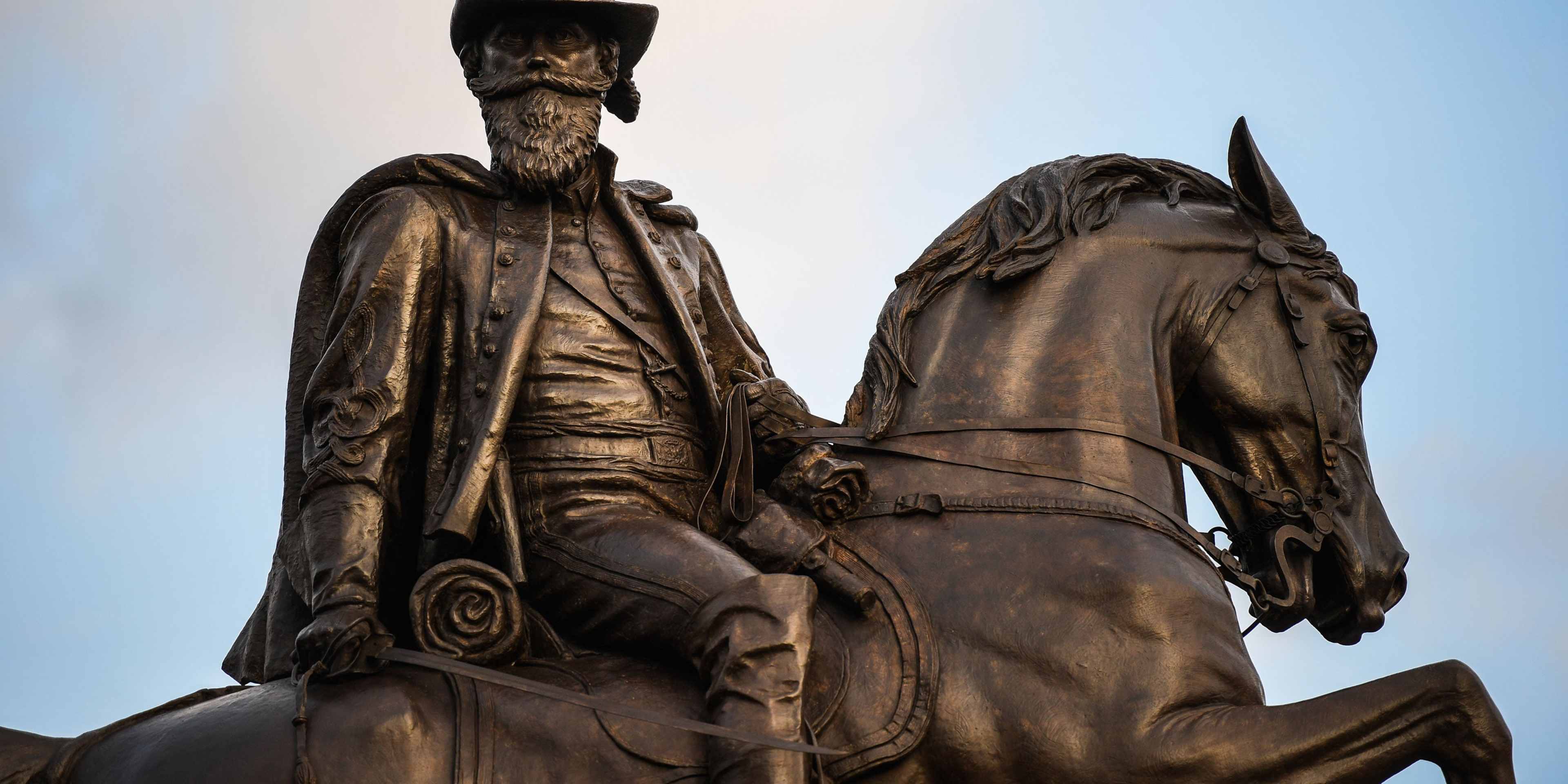
James Ewell Brown “Jeb” Stuart remains one of the most enigmatic and colorful figures in the study of American Civil War history. Celebrated for his dashing peacock attire—a plumed hat accented by an ostrich feather, a red-lined cape, and a gold sash—Stuart was the ultimate embodiment of the Southern cavalier myth. Yet, beneath the flamboyant exterior lay a highly skilled military strategist, whose unmatched reconnaissance abilities made him the indispensable “eyes and ears” of General Robert E. Lee’s Army of Northern Virginia. His career represents a thrilling yet tragic microcosm of the wider conflict, marked by brilliant triumphs that raised Confederate morale and critical missteps that ultimately altered the course of the nation’s history. To understand the legacy of J.E.B. Stuart is to understand the complex realities of 19th-century military tactics, the devastating transition to modern warfare, and the heavy price of fame on the battlefield.
Historical Background and Early Life
Born in Patrick County, Virginia, on February 6, 1833, James Ewell Brown Stuart grew up in a prominent Southern family. He left home at the age of 12 to attend school in Wytheville, Virginia, and later spent time at Emory and Henry College. In 1850, Stuart secured an appointment to the United States Military Academy at West Point. During his time there, he became acquainted with several men who would later define the Civil War era, most notably Robert E. Lee, who assumed the role of West Point’s superintendent in 1852.
Graduating in 1854, Stuart was commissioned as a cavalry officer, demonstrating exceptional equestrian skills. His early assignments took him to the Texas frontier and later to the 1st Cavalry Regiment at Fort Leavenworth in the Kansas Territory. It was here that Stuart experienced the tumultuous events of Bleeding Kansas, a violent precursor to the Civil War driven by intense clashes between pro-slavery and abolitionist factions. During this era of frontier expansion, U.S. forces frequently clashed with Native American tribes defending their ancestral homelands. In 1857, Stuart participated in military engagements against the Cheyenne, where he was wounded in a mounted attack. Historians view this period as a tragic chapter of American expansion, reflecting the profound resistance of Indigenous populations against federal encroachment.
In 1859, Stuart played a vital role in another historic flashpoint. While in Washington, D.C., attempting to patent a specialized cavalry saber attachment he had invented, he was dispatched to assist Robert E. Lee in suppressing the famed abolitionist John Brown’s raid on the federal arsenal at Harpers Ferry, Virginia. Stuart was the officer who personally delivered the surrender demand to Brown at the engine house before Marines breached the building.
A Chronological Timeline of J.E.B. Stuart’s Civil War Campaigns
- April 1861: Following the secession of Virginia, Stuart resigned his U.S. Army commission to join the Confederate States of America, aligning himself with Thomas “Stonewall” Jackson’s Army of the Shenandoah.
- July 1861: Stuart proved his tactical prowess in the aftermath of the First Battle of Bull Run, where his cavalry vigorously pursued retreating Union forces and captured critical supplies.
- June 1862: In a legendary feat of bravado, Stuart led his 1,200 troopers in a complete circumnavigation of General George B. McClellan’s Army of the Potomac, mapping out the Union right flank and boosting Southern morale.
- September 1862: Promoted to major general, Stuart established himself as Robert E. Lee’s chief intelligence officer during the Maryland Campaign, repeating his circumnavigation feat.
- May 1863: Following the mortal wounding of Stonewall Jackson at the Battle of Chancellorsville, Stuart successfully took temporary command of Jackson’s infantry corps, proving his versatility as a commander.
- June 9, 1863: Stuart’s forces were surprised by Union cavalry at the Battle of Brandy Station, the largest cavalry engagement of the war, shattering the illusion of Confederate cavalry invincibility.
- July 1-3, 1863: Delayed by a raiding expedition around the Union army, Stuart arrived late to the Battle of Gettysburg, leaving Lee without vital intelligence.
- May 11-12, 1864: Stuart was mortally wounded during the Battle of Yellow Tavern and died the following day in Richmond at the age of 31.
Key Figures in Stuart’s Circle
The life of J.E.B. Stuart was intertwined with some of the most influential figures of the Civil War:
- Robert E. Lee: The commander of the Army of Northern Virginia, Lee viewed Stuart almost as a son, famously referring to him as “the eyes of the army.” Lee relied heavily on Stuart’s reconnaissance to plan his campaigns.
- Thomas “Stonewall” Jackson: Stuart’s close friend and operational partner. Stuart’s quick action at Chancellorsville after Jackson was shot helped secure a pyrrhic victory for the Confederacy.
- Flora Cooke Stuart: Stuart’s devoted wife, whom he married after a whirlwind courtship at Fort Leavenworth. She was the daughter of Philip St. George Cooke, a career U.S. Army officer. When the Civil War broke out, her father remained loyal to the Union, prompting a bitter family rift.
- Philip Sheridan: The aggressive Union cavalry commander who orchestrated the Overland Campaign cavalry offensive that ultimately led to Stuart’s death at Yellow Tavern.
Causes, Context, and Sociopolitical Alignment
Stuart’s decision to resign his commission in the U.S. Army and join the Confederacy was driven by a deep-seated loyalty to his home state of Virginia. Like many Southern officers of his day, Stuart prioritized state sovereignty over federal allegiance, stating that he would defend Virginia regardless of the political cost. As a slaveholder, Stuart was deeply embedded in the social and economic fabric of the antebellum South. His military actions were fundamentally tied to the defense of a socio-economic system built on the exploitation of enslaved African Americans, a reality that modern historians emphasize alongside his tactical achievements.
Major Turning Points: From Brandy Station to Gettysburg
The summer of 1863 marked a dramatic shift in Stuart’s military fortune. Always prone to theatrical displays, Stuart held a massive “grand review” of his cavalry forces near Brandy Station, Virginia, in early June. This ostentatious display caught the attention of Union commanders, who launched a surprise attack on June 9, 1863. Although Stuart managed to hold the field, the Battle of Brandy Station proved that the Union cavalry was rapidly closing the gap in skill and determination.
Just weeks later, during the Confederate invasion of the North, Stuart chose to embark on a wide-ranging raid around the Union Army rather than maintaining close contact with Lee’s advancing forces. His prolonged absence left Lee blind to the movements of the Union Army of the Potomac. Stuart did not arrive at Gettysburg until the second day of the clash, a critical delay that contributed to the disastrous Confederate defeat. Analysts frequently point out how the Battle of Gettysburg turned the tide of the Civil War, cementing Stuart’s failure there as one of the most debated controversies of military history.
The Tragic End at Yellow Tavern
During Union General Ulysses S. Grant’s relentless Overland Campaign in 1864, Union cavalry general Philip Sheridan sought to draw Stuart into a decisive battle. On May 11, 1864, Sheridan’s massive cavalry corps engaged Stuart’s outnumbered forces at Yellow Tavern, just north of Richmond. While bravely rallying his men and firing his revolver at the advancing Union troops, Stuart was shot through the left side by John A. Huff, a dismounted Union private. Stuart was rushed to Richmond, where he succumbed to his wounds on May 12, 1864. Upon hearing of his death, General Robert E. Lee reportedly wept, stating, “I can scarcely think of him without weeping.”
Lesser-Known Facts About J.E.B. Stuart
The Family Feud with a Union General
Stuart’s father-in-law, Philip St. George Cooke, was a native Virginian but chose to remain loyal to the Union during the war, rising to the rank of brigadier general. Enraged by this decision, Stuart disowned him and wrote to his wife that her father “will regret it but once, and that will be continually.” Stuart even changed the name of his eldest son, Philip St. George Cooke Stuart, to James Ewell Brown Stuart Jr. to sever all ties with his Union father-in-law.
A Musician at His Side
Stuart loved music and theatricality. He kept a personal banjo player, Sam Sweeny, on his staff. Sweeny, a talented musician, traveled with Stuart’s headquarters, playing lively tunes and camp songs to keep morale high. Even during long, exhausting night marches, Sweeny’s banjo music echoed through the cavalry columns.
The Gloating Telegraph
Following a daring Christmas raid in 1862 behind Union lines in northern Virginia, Stuart captured a large bounty of horses, mules, and supplies. In a display of supreme confidence, Stuart personally sent a telegraph message to U.S. Quartermaster General Montgomery C. Meigs, complaining about the poor quality of the Union mules he had just stolen, asking him to provide better quality draft animals next time.
Why J.E.B. Stuart’s Legacy Matters Today
Today, J.E.B. Stuart’s legacy sits at the intersection of historical military tactics and the modern struggle over historical memory. He remains a key figure in study programs at modern military academies, celebrated for his pioneering use of cavalry as a mobile shock force and intelligence-gathering network. Concurrently, Stuart’s prominent placement in the “Lost Cause” narrative of the Confederacy has made him a subject of intense modern debate. The removal of his monument on Richmond’s Monument Avenue in 2020 reflects a broader societal effort to recontextualize the Civil War, separating the tactical romanticism of Stuart from the brutal realities of the slavery-defending cause for which he fought.
People Also Ask (FAQ)
Why was J.E.B. Stuart called the ‘eyes and ears’ of the Confederate Army?
Stuart earned this moniker from General Robert E. Lee because of his extraordinary capability to conduct reconnaissance, screen the movements of the Confederate infantry, and gather precise intelligence on Union army positions and troop numbers.
What was J.E.B. Stuart’s fatal mistake at Gettysburg?
Stuart’s mistake was embarking on an unauthorized, wide-ranging raid around the Union army in late June 1863, which severed communications with Lee. This left the Confederate leadership completely blind to the Union positions as they entered the critical battle of Gettysburg.
Who killed J.E.B. Stuart?
Stuart was mortally wounded by John A. Huff, a private in the 5th Michigan Cavalry, during the Battle of Yellow Tavern on May 11, 1864. Huff was a former sharpshooter who died in action just a few weeks later.
Conclusion
J.E.B. Stuart was a military force of nature—a man whose flamboyant style, bold operations, and tactical genius defined the cavalry warfare of the American Civil War. From his early days on the rugged frontier to his tragic death at Yellow Tavern, Stuart lived and fought with a theatrical intensity that captivated both his allies and his enemies. While his legacy is forever complicated by his late arrival at Gettysburg and his defense of the Confederacy, there is no denying his status as one of the most brilliant and dramatic figures in the annals of American history.


