In September 1620, a three-masted merchant ship called the Mayflower set sail from Plymouth, England, carrying 102 passengers into the vast, unpredictable waters of the Atlantic Ocean. This small group of religious dissenters and secular adventurers, collectively known today as the Pilgrims, was bound for the New World in search of a fresh start. Their journey would culminate in the founding of Plymouth Colony, an event that became a cornerstone of the American origin story. Yet, the history of the Pilgrims is not merely a tale of survival and peaceful harvest feasts; it is a complex narrative of deep religious conviction, political innovation, fragile alliances, and devastating conflict with the Indigenous peoples who had inhabited the land for millennia. Understanding their true legacy requires exploring beyond the idealized myths to examine the harsh realities, geopolitical pressures, and historical turning points that shaped early New England.
The Historical Background: Religious Dissent and the Flight from England
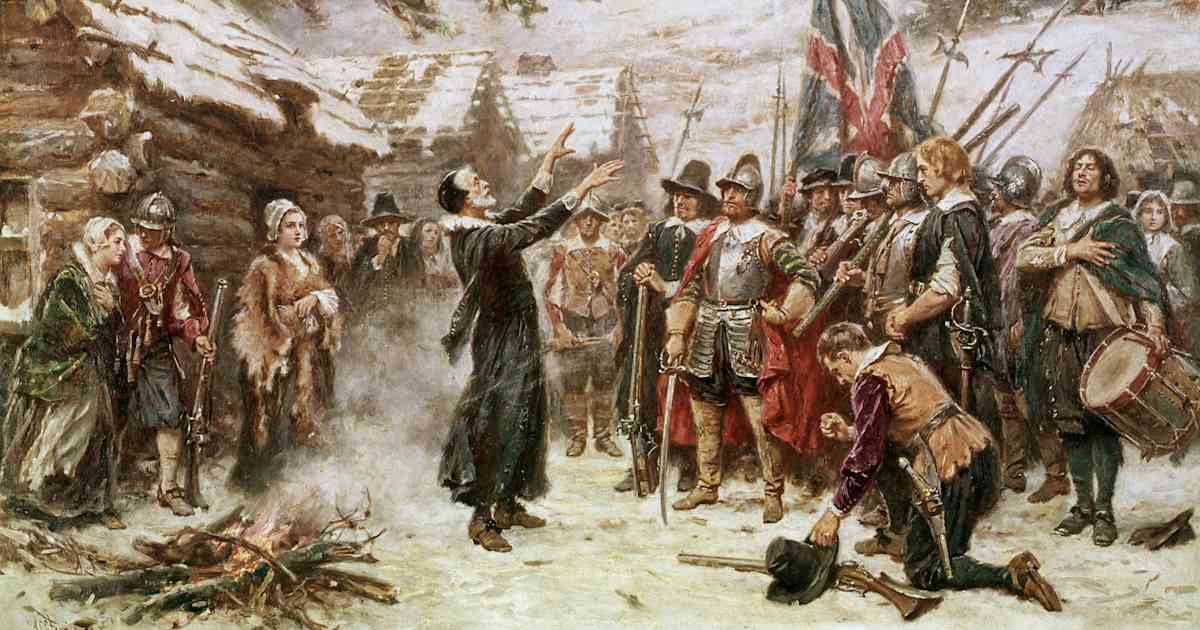
To understand why the Pilgrims took the monumental risk of crossing the Atlantic, one must look back to the religious turmoil of late 16th and early 17th-century England. Under King James I, the Church of England was the official state religion, and nonconformity was treated as a treasonous offense. While mainstream Puritans sought to reform or “purify” the church from within, a radical faction known as the English Separatists believed the state church was beyond saving. They chose to illegally break away entirely, forming their own independent congregations.
In 1607, facing intense persecution, a group of Separatists from the English Midlands fled to the Netherlands. They settled first in Amsterdam and later in the city of Leiden, enjoying the relative religious tolerance of Dutch society. However, life in exile presented its own challenges. The Separatists struggled with economic hardship, as they were excluded from Dutch trade guilds and relegated to low-paying textile work. Furthermore, parents watched with growing anxiety as their children began adopting Dutch customs and losing their English heritage and language. Realizing their community was at risk of dissolving, the leaders conceived a daring plan: they would establish a permanent colony in the New World where they could preserve their English identity and practice their faith without compromise.
The Journey and the Mayflower Compact
Securing financial backing from a group of London merchants known as the Merchant Adventurers, the Separatists prepared for their voyage. They planned to settle near the Hudson River, which was then considered part of the northern reaches of the Virginia Colony. After a smaller companion ship, the Speedwell, proved unseaworthy and forced them to return to port twice, the passengers crowded onto the Mayflower. Only 35 of the passengers were Separatists (whom they called “Saints”); the remaining majority consisted of secular passengers recruited by the financial backers to ensure the colony’s economic viability (whom the Separatists referred to as “Strangers”).
The 65-day voyage was plagued by fierce Atlantic storms, which blew the ship hundreds of miles north of its intended destination. On November 11, 1620, the Mayflower anchored at Cape Cod, in present-day Massachusetts. Because they had landed outside the jurisdiction of the Virginia Company, some of the “Strangers” argued that their contracts were void and that they were no longer bound by any law. Recognizing the danger of mutiny and lawlessness in a hostile wilderness, the colony’s leaders drafted a revolutionary agreement.
The Mayflower Compact, signed by 41 adult male passengers while still aboard the ship, bound the signers into a “civil body politic” for their mutual preservation and governance. This document marked the first framework for self-government written in North America, establishing the democratic principle that laws should be made for the general good of the colony by the consent of the governed.
Chronological Timeline of Plymouth Colony
- September 1620: The Mayflower departs from Plymouth, England, carrying 102 passengers.
- November 11, 1620: The ship anchors at Cape Cod; the Mayflower Compact is signed.
- December 1620: After scouting the coastline, the Pilgrims land at Plymouth Harbor and begin construction.
- Winter 1620–1621: The “Starving Time” claims the lives of more than half of the settlers due to disease, exposure, and scurvy.
- March 1621: Samoset and Squanto make contact with the settlers, facilitating a peace treaty with Chief Massasoit of the Wampanoag.
- Autumn 1621: The Pilgrims and the Wampanoag celebrate the successful first harvest, later romanticized as the “First Thanksgiving.”
- 1630: The Great Puritan Migration begins with the arrival of John Winthrop and the founding of the Massachusetts Bay Colony.
- 1657: Governor William Bradford dies, having served 30 terms as the colony’s leader.
- 1675–1676: King Philip’s War ravages New England, ending the long peace and decimating Indigenous populations.
- 1692: Struggling economically, Plymouth Colony is officially absorbed into the Massachusetts Bay Province.
Prominent Figures of Plymouth
Several key individuals played indispensable roles in the survival, governance, and ultimate historical legacy of Plymouth Colony:
- William Bradford: A deeply religious Separatist leader who served as the governor of Plymouth Colony for 30 terms. His detailed manuscript, Of Plymouth Plantation, remains the single most important primary source documenting the colony’s early years, providing a vivid account of the Mayflower voyage and the settlers’ daily struggles.
- Myles Standish: A professional military officer hired by the Pilgrims to organize their defense. Standish was known for his aggressive defense tactics and played a crucial role in establishing fortified positions and conducting negotiations with neighboring tribes.
- Tisquantum (Squanto): A member of the Pawtuxet tribe who had been kidnapped by English explorers years earlier, sold into slavery, and managed to return to his homeland, only to find his entire village wiped out by an epidemic. Fluent in English, Squanto served as an interpreter and guide, teaching the Pilgrims how to cultivate native crops like maize and where to fish.
- Massasoit: The grand sachem (chief) of the Pokanoket Wampanoag. Massasoit formed a strategic alliance with the Pilgrims, seeking a powerful military partner to protect his people against rival tribes, particularly the Narragansett, who had been spared the worst of the recent devastating plagues.
Turning Points: The Starving Time and the Wampanoag Alliance
The first winter in Plymouth was nothing short of catastrophic. Inadequate shelter, poor nutrition, and rampant outbreaks of scurvy and respiratory infections decimated the population. At one point, only a handful of healthy individuals remained to care for the sick and bury the dead. By the spring of 1621, 50 of the original 102 passengers had perished.
The survival of the remaining settlers was secured by a critical turning point: the arrival of Samoset and Tisquantum (Squanto) in March 1621. Squanto brokered an alliance between the Pilgrims and Massasoit. This mutual defense treaty promised that neither group would harm the other, and that they would aid one another in the event of an attack by outside forces. This alliance allowed the Pilgrims to establish a agricultural foothold, culminating in the famous three-day harvest feast in the fall of 1621. While today’s Thanksgiving celebrations are often commercialized, this event was a genuine diplomatic and agricultural milestone, celebrating a hard-won harvest that ensured the colony’s survival.
The Dark Turn: Deterioration and King Philip’s War
The peace established by Massasoit and Governor Bradford was fragile and did not survive the next generation. As more English colonists poured into New England during the Great Puritan Migration of the 1630s, the demand for land grew exponentially. The English increasingly encroached on Native territories, ignoring traditional boundaries and imposing colonial laws on Indigenous populations.
Following the death of Massasoit, his son Metacomet (known to the English as King Philip) became chief of the Wampanoag. Watching his people’s land diminish and their sovereignty eroded, Metacomet forged a massive coalition of regional tribes to drive the colonists back. The resulting conflict, King Philip’s War (1675–1676), was one of the bloodiest and most destructive conflicts in American history relative to population. Entire towns were burned, and over 5,000 New Englanders were killed—three-quarters of whom were Native Americans. The war shattered the power of the southern New England tribes, resulting in the enslavement of many survivors and the systematic dispossession of their ancestral lands.
Lesser-Known Historical Facts
- The Speedwell’s Failure: The Pilgrims originally intended to sail with two ships. However, the Speedwell leaked constantly, forcing both ships to return to England. Many historians believe the crew of the Speedwell intentionally sabotaged the ship by overmasting it, as they wanted to escape their year-long passenger contracts.
- They Were Not Called “Pilgrims”: The early settlers referred to themselves as “Old Comers” or “Saints.” The term “Pilgrims” was not popularized until 1820, when the renowned orator Daniel Webster used the phrase “Pilgrim Fathers” during a bicentennial address in Plymouth, inspired by a passage in William Bradford’s memoirs.
- Famous Descendants: Because of the small starting population and high survival rates of subsequent generations, tens of millions of modern Americans can trace their lineage back to the Mayflower. Famous descendants include presidents John Adams and James A. Garfield, as well as cultural icons like Humphrey Bogart and Julia Child.
Why the History of Plymouth Colony Still Matters Today
The history of the Pilgrims remains a powerful and contested narrative in modern America. On one hand, the Mayflower Compact represents an early milestone in the development of American constitutional democracy and the ideal of self-governance. On the other hand, the rapid expansion of Plymouth Colony and the subsequent tragedy of King Philip’s War serve as a stark reminder of the devastating impact of colonization on Indigenous populations. Today, many Native Americans observe Thanksgiving as a “National Day of Mourning,” reflecting on the loss of life, land, and culture. Engaging with this history honestly allows modern society to move past romanticized myths and appreciate the complex, shared legacy of early America.
People Also Ask
Why did the Pilgrims leave England?
The Pilgrims left England because of religious persecution under King James I. As Separatists, they believed the Church of England was corrupt and wanted the freedom to worship in their own independent congregations without facing arrest or fines.
What is the difference between Pilgrims and Puritans?
While both were Calvinists who opposed the Church of England, the Pilgrims were Separatists who believed the church was beyond reform and wanted to separate from it entirely. Puritans, on the other hand, wanted to reform or “purify” the Church of England from within and established the much larger Massachusetts Bay Colony in 1630.
Did the first Thanksgiving actually happen?
Yes, but it was not called “Thanksgiving” by the participants, nor was it a recurring annual holiday initially. It was a three-day harvest celebration in the autumn of 1621 where approximately 50 English settlers and 90 Wampanoag men gathered to eat, play games, and strengthen their diplomatic alliance.
Conclusion
The story of the Pilgrims is a multi-faceted history of extraordinary courage, extreme hardship, and tragic consequences. From their illegal escape out of England to the drafting of the revolutionary Mayflower Compact, these early settlers laid down deep-seated institutional foundations for American self-rule. However, their ultimate survival was entirely dependent on the knowledge and diplomacy of the Wampanoag people—an alliance that eventually crumbled under the weight of colonial expansion. By examining both the accomplishments and the tragedies of Plymouth Colony, we gain a deeper, more honest understanding of the complex roots from which America grew.


