George Edward Pickett remains one of the most polarizing and romanticized military figures in American Civil War history. Known primarily for the disastrous, high-stakes infantry assault on the third day of the Battle of Gettysburg, Pickett’s life and military career encompassed far more than a single tragic afternoon in July 1863. He was a West Point graduate who finished last in his class, a decorated Mexican-American War hero, and a central figure in key territorial disputes on the Pacific frontier. By exploring his life, we uncover a complex narrative of personal ambition, tragic loss, and the devastating realities of 19th-century warfare that continue to capture the historical imagination.
Historical Background: From Richmond to West Point
George Pickett was born into a wealthy and highly respected aristocratic family in Richmond, Virginia, on January 25, 1825. Growing up in the heart of the antebellum South, Pickett was expected to pursue a career of social distinction. He initially chose to study law in Illinois, where he established connections with prominent local figures, including a young Abraham Lincoln. However, Pickett soon pivoted toward a military path, securing an appointment to the United States Military Academy at West Point in 1842.
During his time at West Point, Pickett was widely regarded as a charismatic, jovial, and immensely likable cadet. However, his academic performance left much to be desired. He spent more time accumulating demerits and socializing than studying. When his class graduated in 1846, Pickett finished 59th out of 59 cadets—earning the notorious title of “Class Goat.” Despite this academic ignominy, Pickett was immediately thrust into active service, as the United States had just declared war on Mexico.
The Antebellum Military Career of George Pickett
Pickett entered the U.S. Army as a second lieutenant and quickly disproved any notions that his poor academic standing reflected a lack of courage. During the Mexican-American War (1846–1848), he served with distinction. His finest hour came during the Battle of Chapultepec in September 1847. When his close friend and fellow officer, James Longstreet, was wounded while carrying the American colors, Pickett seized the flag, rushed up the castle walls, and raised the Stars and Stripes over the fortress under heavy enemy fire. This heroic feat earned him a promotion to captain.
Following the war, Pickett was stationed on the harsh Texas frontier. Personal tragedy struck during this period; in 1851, his first wife, Sally Harrison Minge, died in childbirth along with their newborn infant. Despondent, Pickett threw himself into his military duties. In 1856, he was transferred to the Washington Territory, where he supervised the construction of Fort Bellingham. While stationed in the Pacific Northwest, Pickett married his second wife, a Haida Indigenous woman named Morning Mist. Sadly, she also died shortly after giving birth to their son, James, in 1857.
In 1859, Pickett found himself at the center of an international diplomatic crisis known as the “Pig War.” Located on San Juan Island, the border dispute arose after an American farmer shot a pig belonging to the British Hudson’s Bay Company. Pickett, commanding a small contingent of U.S. soldiers, defied British warships and occupied the island, famously declaring, “We’ll make a second Bunker Hill of it!” His stubborn resolve prevented a British landing and earned him widespread admiration in the United States, ultimately leading to a peaceful joint military occupation of the island.
The Road to Civil War: Choosing Virginia
When the clouds of secession gathered in early 1861, Pickett faced a profound crisis of loyalty. Though he had spent his entire adult life serving the United States flag, his allegiance ultimately lay with his home state. Following Virginia’s secession from the Union in April 1861, Pickett resigned his commission in the U.S. Army and traveled east to Richmond to offer his services to the nascent Confederate States of America.
Initially commissioned as a colonel in charge of defensive works along the Lower Rappahannock River, Pickett’s natural leadership qualities quickly caught the attention of his superiors. By early 1862, he was promoted to brigade commander under Major General James Longstreet. He fought with bravery during the Peninsula Campaign, earning accolades at the Battles of Williamsburg and Seven Pines. However, during the bloody Battle of Gaines’ Mill in June 1862, Pickett was shot through the shoulder. The severe wound sidelined him for several months, preventing him from participating in the battles of Second Bull Run and Antietam.
Timeline of Key Events in George Pickett’s Life
- January 25, 1825: Born in Richmond, Virginia.
- 1846: Graduates dead last from West Point and joins the U.S. Army for the Mexican-American War.
- September 1847: Displays extraordinary heroism at the Battle of Chapultepec.
- 1859: Commands American troops on San Juan Island during the tense “Pig War.”
- April 1861: Resigns from the U.S. Army after Virginia secedes and joins the Confederacy.
- June 1862: Severely wounded in the shoulder at the Battle of Gaines’ Mill.
- July 3, 1863: Leads his fresh division in the disastrous infantry assault known as “Pickett’s Charge” during the Battle of Gettysburg.
- February 1864: Fails to recapture New Bern, North Carolina, and orders the execution of 22 Union loyalists.
- April 1, 1865: Suffers a crushing defeat at the Battle of Five Forks while away from his command.
- April 9, 1865: Lee surrenders at Appomattox, ending Pickett’s wartime service.
- July 30, 1875: Dies in Norfolk, Virginia, at the age of 50.
The Great Turning Point: Pickett’s Charge at Gettysburg
By late 1862, Pickett had been promoted to major general and placed in command of a Virginia division in Longstreet’s First Corps. In the summer of 1863, Confederate General Robert E. Lee launched his second invasion of the North, culminating in the monumental Battle of Gettysburg. To understand the strategic desperation of this moment, historians often analyze how the Battle of Gettysburg turned the tide of the Civil War.
Pickett’s division did not arrive on the battlefield until the evening of July 2, completely missing the first two days of intense fighting. Consequently, his men were fresh, while other Confederate units were heavily battered. On July 3, Lee determined to break the Union center on Cemetery Ridge with a massive frontal assault. Despite James Longstreet’s vocal protests that no 15,000 men could successfully cross that open mile of fire, Lee ordered the assault. Pickett’s division was selected to spearhead the attack alongside divisions led by Generals J. Johnston Pettigrew and Isaac Trimble.
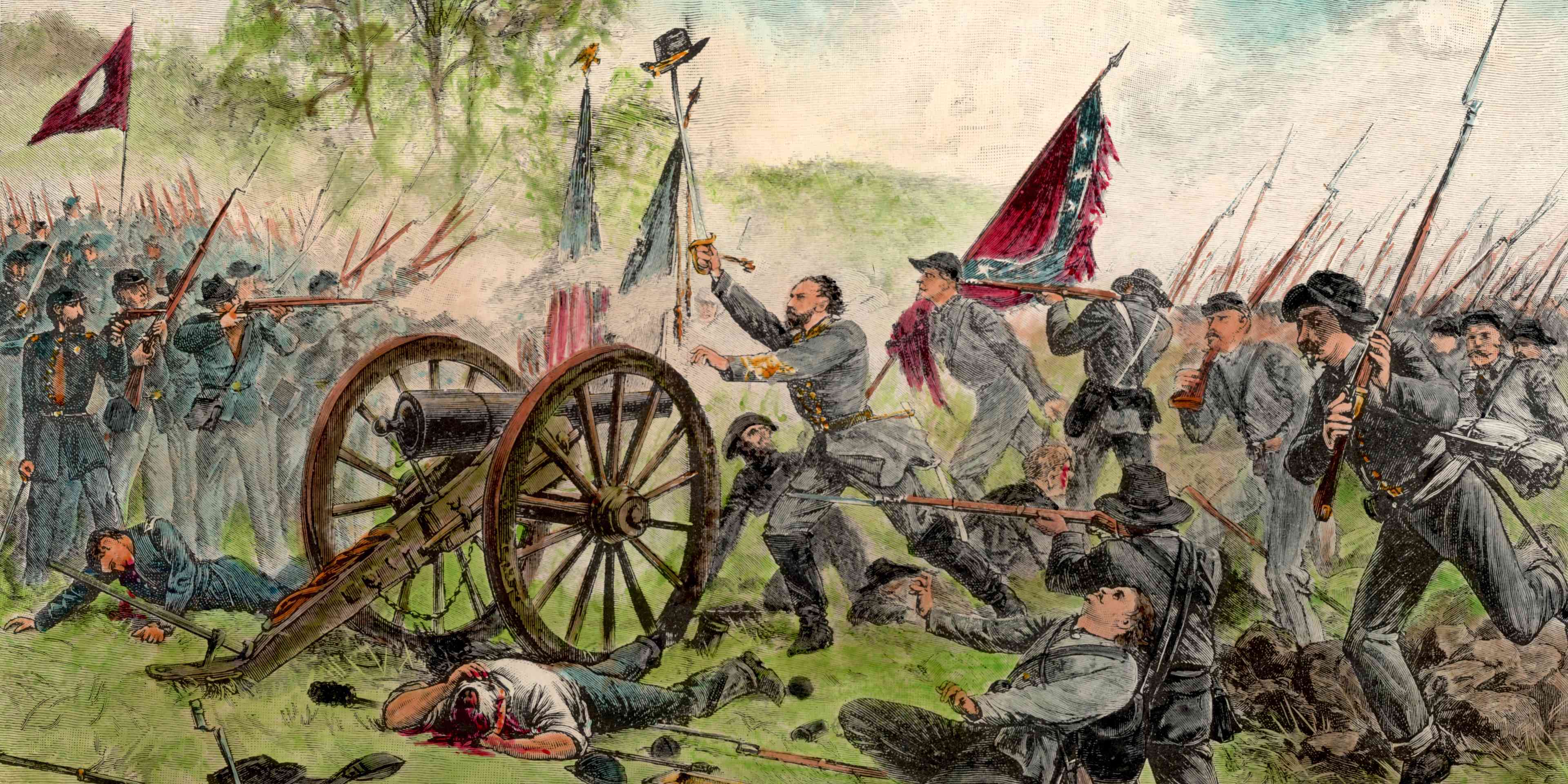
Following a massive but largely ineffective Confederate artillery bombardment, nearly 12,500 Southern soldiers stepped out of the tree line on Seminary Ridge. Marching in pristine parade-ground alignment, they advanced across a mile of completely open, undulating fields. The Union artillery, positioned on the high ground, tore devastating gaps in the Confederate lines with canister and explosive shells.
As Pickett’s men neared the stone wall at the Union center—a location later dubbed the “High-Water Mark of the Confederacy”—Union infantry unleashed a relentless hail of musket fire. Though a small handful of Confederates briefly breached the Union line, they were quickly overwhelmed and repulsed. The retreat was a scene of unmitigated slaughter. Pickett’s division suffered staggering casualties, with nearly 50 percent of his men killed, wounded, or captured. All three of his brigade commanders—James L. Kemper, Richard B. Garnett, and Lewis A. Armistead—were casualties. When a visibly shaken Robert E. Lee ordered Pickett to reform his division to guard against a counterattack, a heartbroken Pickett famously replied, “General Lee, I have no division.”
The Downward Spiral: North Carolina and Five Forks
Pickett never forgave Lee for the destruction of his division, and his military career went into a steady decline. Seeking to distance him from the main army, Lee assigned Pickett to a departmental command in North Carolina. In early 1864, Pickett tried to capture the Union-held town of New Bern. The operation failed completely. In the angry aftermath, Pickett discovered that 22 Union prisoners he had captured were actually former Confederate soldiers who had switched sides. He ordered them summarily hanged. This controversial decision sparked outrage in the North and led to postwar accusations of war crimes.
Pickett returned to Virginia to aid in the grueling Siege of Petersburg. His final military disgrace occurred on April 1, 1865, at the Battle of Five Forks. Tasked with holding a vital crossroads that protected the last remaining Confederate supply railway, Pickett committed a legendary blunder. Believing no Union attack was imminent, he left his lines to attend a social “shad bake” (a fish lunch) with cavalry generals Fitzhugh Lee and Thomas Rosser. While Pickett was miles away enjoying his lunch, Union forces under Philip Sheridan struck. Deprived of their commander, the Confederate lines crumbled. The disaster at Five Forks forced Lee to abandon Petersburg and Richmond, leading directly to his surrender at Appomattox Court House on April 9, 1865.
Postwar Escape, Reconciliation, and Legacy
Fearing execution for his role in the New Bern hangings, Pickett fled with his third wife, LaSalle “Sallie” Corbell, to Canada immediately after the war. However, they returned to Virginia in 1866 after Pickett was assured of safety. He owed his freedom largely to Ulysses S. Grant’s military leadership and political intervention. Grant, who had been a classmate of Pickett’s at West Point, personally stepped in to block any war crimes prosecution, allowing Pickett to live out his remaining years in peace.
Pickett declined several lucrative job offers, including a generalship in the Egyptian army, choosing instead to live quietly as a farmer and an insurance agent in Norfolk, Virginia. He died on July 30, 1875, at the age of 50. After his death, his widow, LaSalle Corbell Pickett, dedicated her life to writing books and lecturing. She heavily romanticized and fabricated stories of his life, transforming him in the public eye from a deeply flawed commander into a tragic, dashing cavalier of the “Lost Cause” mythology.
Lesser-Known Facts About George Pickett
- The Goat and the Hero: Despite graduating dead last in his West Point class, Pickett is one of the very few “Class Goats” to achieve the rank of Major General in American history, a distinction he shares with Union General George Custer.
- Almost Sparked a War Over a Pig: Pickett’s defiant stand during the 1859 “Pig War” on San Juan Island almost plunged the United States and Great Britain into a major military conflict right on the eve of the Civil War.
- The Infamous Shad Bake: Pickett’s division was destroyed at Five Forks while he was eating fish. He was so embarrassed by the incident that he tried to conceal his absence from official reports.
Why George Pickett’s Story Matters Today
The legacy of George Pickett is a powerful case study in how historical memory is constructed. For decades after the Civil War, the romanticized narrative created by his wife shielded Pickett from harsh military criticism, casting him as the ultimate tragic hero of a lost crusade. Modern historians, however, view him through a more critical lens, balancing his undeniable personal bravery with his devastating tactical failures and the war crimes at New Bern. His life illustrates the danger of romanticizing war and highlights the complex, often fragile nature of reconciliation in a divided nation.
People Also Ask (FAQs)
Did George Pickett survive Pickett’s Charge?
Yes, George Pickett survived the infamous charge unscathed physically, as he positioned his headquarters near the rear of the advancing lines to coordinate the division’s movements, which was standard practice for major generals at the time.
Why did George Pickett hate Robert E. Lee?
Pickett held a deep, lifelong resentment toward Robert E. Lee for ordering the assault at Gettysburg. He blamed Lee entirely for the slaughter of his division, reportedly stating later in life, “That old man had my division massacred.”
What was the outcome of the war crimes investigation against Pickett?
Though Pickett was investigated for ordering the hanging of 22 Union loyalists in North Carolina, his former West Point classmate, Union General Ulysses S. Grant, personally intervened to ensure Pickett received a full pardon, preventing any prosecution.
Conclusion
George Pickett’s life was defined by extreme highs and devastating lows. From the heroic heights of Chapultepec and San Juan Island to the bloody fields of Gettysburg and the final disgrace at Five Forks, Pickett’s journey encapsulates the tragedy of the American Civil War. His story remains a stark reminder of the human cost of military ambition and the enduring power of historical mythmaking in shaping how we remember the past.


