The story of the 54th Massachusetts Infantry is a monumental chapter in the annals of the American Civil War, representing not only a fierce combat unit but also a revolutionary leap forward for civil rights and racial equality. Formed in the wake of President Abraham Lincoln’s Emancipation Proclamation, this regiment of brave Black soldiers shattered deep-seated prejudices and proved their valor on the bloodiest battlefields of the South. Their legacy remains a cornerstone of the broader narrative of American Civil War history, demonstrating how disenfranchised men fought with unmatched courage for a nation that had yet to recognize their full humanity. Understanding their struggle, sacrifice, and ultimate triumph is essential to grasping the long, ongoing journey toward true equality in the United States.
Historical Background: A Nation Divided and the Call to Arms
To fully understand the rise of the 54th Massachusetts Volunteer Infantry, one must examine the socio-political climate of the early 1860s. When the Civil War erupted in 1861, President Abraham Lincoln initially framed the conflict solely as a fight to preserve the Union, rather than an outright crusade to abolish slavery. This strategic framing was meant to keep crucial border states from seceding. However, abolitionists—both Black and white—argued from the very beginning that the war’s core moral issue was slavery, and that the Union could never truly be restored without eradicating this brutal institution.
Furthermore, African Americans eagerly sought to enlist in the Union Army, viewing the conflict as a direct battle for their own freedom and the liberation of millions of enslaved people in the South. Despite their eagerness, they were barred from military service due to deeply ingrained racial prejudices and legal restrictions. It was not until the signing of the Emancipation Proclamation on January 1, 1863, that the federal government officially opened the door for Black men to serve, declaring that they would be “received into the armed service of the United States.” This landmark decree marked a pivotal moment in the history of Blacks in the military, paving the way for the creation of organized Black regiments.
Chronological Timeline of the 54th Massachusetts Infantry
The journey of the 54th Massachusetts from recruitment to the battlefields of the South was rapid, intense, and historic. Below is a breakdown of the key dates and events that defined the regiment:
- January 1, 1863: President Abraham Lincoln issues the Emancipation Proclamation, officially authorizing the enlistment of African American soldiers.
- February 1863: Abolitionist Governor John A. Andrew of Massachusetts issues the first call for Black volunteers to form a state regiment. Recruiting stations open across the North.
- May 28, 1863: The fully trained 54th Massachusetts, consisting of 1,007 Black soldiers and 37 white officers, marches proudly through the streets of Boston before boarding transport ships bound for South Carolina.
- June 11, 1863: Under protest from Colonel Shaw, the regiment is forced to participate in the destructive and controversial raid on the undefended town of Darien, Georgia.
- July 16, 1863: The 54th engages in its first real combat at Grimball’s Landing on James Island, successfully repelling a Confederate attack and saving a white regiment from encirclement.
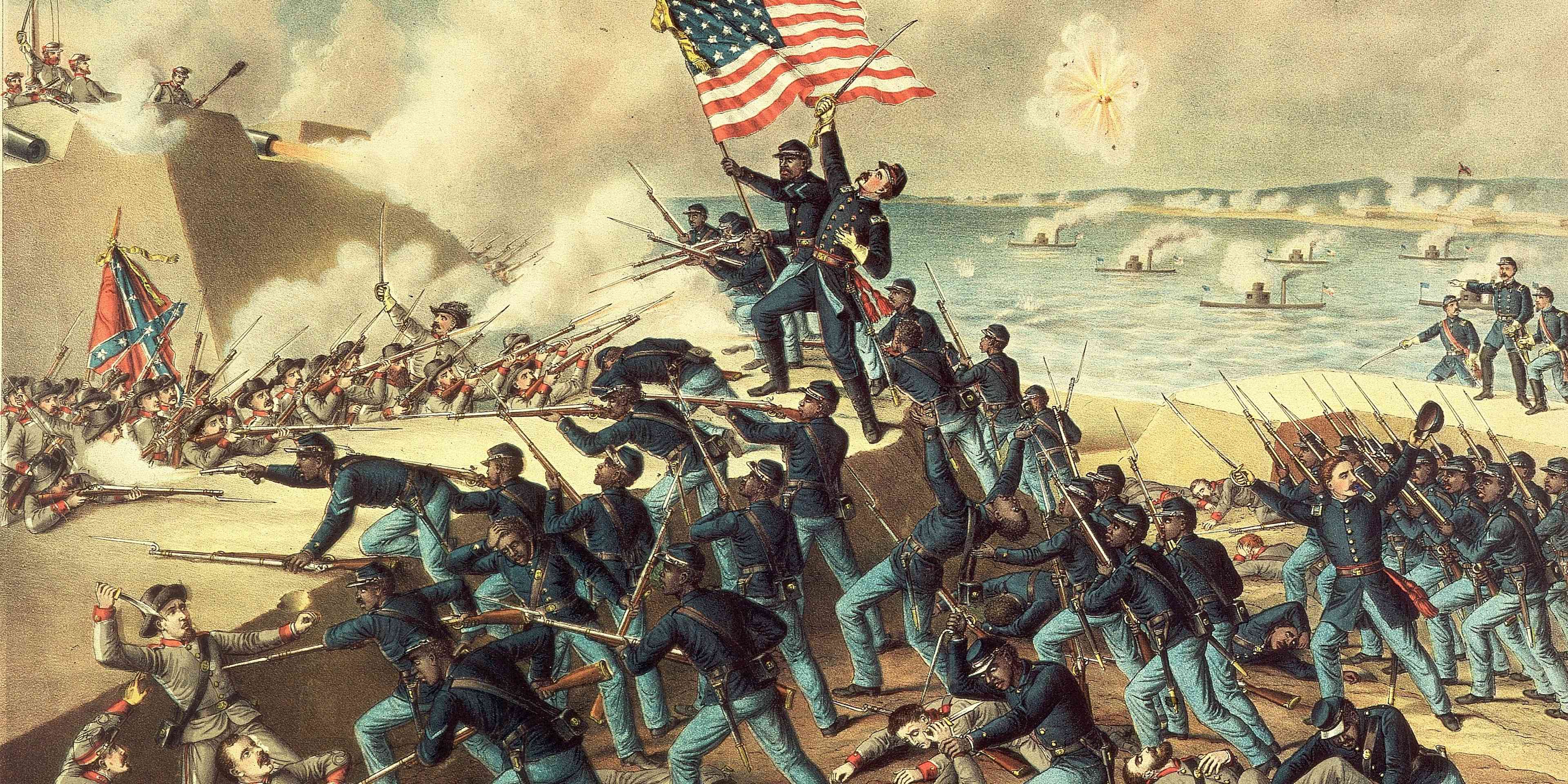
- July 18, 1863: The historic and bloody assault on Fort Wagner near Charleston, South Carolina. Colonel Shaw and nearly half of the assaulting force are killed, wounded, or captured.
- 1864–1865: The reorganized 54th Massachusetts participates in various siege operations and battles, including the Battle of Olustee in Florida and the Battle of Honey Hill in South Carolina.
- September 1, 1865: After the end of the Civil War, the surviving members of the regiment return to Boston and are formally mustered out of service.
Key Figures and Their Lasting Impact
The success and moral authority of the 54th Massachusetts were driven by exceptional individuals who risked everything for their cause:
Colonel Robert Gould Shaw
Governor John A. Andrew chose Robert Gould Shaw, a 25-year-old white officer from a wealthy and prominent Boston abolitionist family, to lead the regiment. Shaw was a seasoned soldier who had dropped out of Harvard to join the Union Army and had survived being wounded at the brutal Battle of Antietam. Initially hesitant to take the command, Shaw ultimately embraced his role with fierce dedication. He trained his men rigorously, treated them with immense respect, and fought alongside them. His death at the parapet of Fort Wagner cemented his status as a martyr for freedom.
Frederick Douglass and His Sons
The legendary abolitionist Frederick Douglass served as a key recruiter for the 54th Massachusetts. Recognizing that the military service of Black men would make their post-war claim to citizenship undeniable, Douglass urged Black men to enlist. To demonstrate his personal commitment, two of his own sons, Charles and Lewis Douglass, were among the very first to volunteer. Lewis Douglass went on to become a sergeant major in the regiment and survived the assault on Fort Wagner.

Sergeant William Harvey Carney
Born into slavery, William Harvey Carney escaped to freedom via the Underground Railroad and enlisted in the 54th Massachusetts. During the chaotic retreat at Fort Wagner, Carney saw the regiment’s flag bearer fall. He grabbed the American flag, pressed forward despite sustaining multiple severe bullet wounds, and planted it on the fort’s wall. When the regiment was forced to retreat, Carney carried the flag back to safety, famously declaring, “Boys, the old flag never touched the ground!” For his extraordinary heroism, Carney became the first African American to perform an action that earned the prestigious Congressional Medal of Honor.
The Double Fight: Confronting Enemy Fire and Systemic Discrimination
The soldiers of the 54th Massachusetts did not just fight the Confederate Army; they also fought a constant domestic battle against systemic discrimination within the Union itself. First, they faced severe threats from the Confederacy. The Confederate Congress declared that any captured Black Union soldiers would be immediately enslaved or executed, and any white officer commanding them would face a similar fate. Despite this terrifying prospect, the men of the 54th marched South without hesitation.
Second, they faced a degrading wage gap. The U.S. government paid white soldiers $13 a week, while Black soldiers were offered only $10 a week, with an additional $3 deducted for clothing costs, leaving them with a meager $7. Insulted by this unequal treatment, the entire regiment—both Black soldiers and their white officers—refused to accept any pay at all in protest. For nearly 18 months, these men fought bravely on empty pockets, sending their families into financial hardship, until Congress finally authorized equal, retroactive pay for Black soldiers in June 1864.
The Turning Point: The Assault on Fort Wagner
The definitive moment for the 54th Massachusetts arrived on the evening of July 18, 1863. Fort Wagner was a massive, heavily fortified sand and earth fortress that guarded the harbor of Charleston, South Carolina. Colonel Shaw, eager to prove the capability and courage of his men to a skeptical military establishment, requested that the 54th lead the direct frontal assault against the fort.
As dusk fell, Shaw led 600 of his men across a narrow, exposed strip of beach directly toward the fort’s towering walls. The Union command had severely underestimated the strength of the Confederate garrison inside. As the 54th charged, they were met with a devastating hail of artillery and rifle fire. Despite the overwhelming onslaught, the men breached the outer works of the fort. Shaw was shot through the chest and killed instantly while urging his men forward. Outgunned and outnumbered, the regiment was forced to withdraw, suffering 281 casualties. Although the battle was a tactical defeat, the extraordinary courage displayed by the 54th permanently silenced critics who doubted the courage of Black soldiers.
Lesser-Known Fascinating Facts
- The Ultimate “Insult” Backfires: Following the battle, the victorious Confederates dumped Colonel Shaw’s body into a mass grave alongside his fallen Black soldiers, believing this “unceremonious” burial would deeply insult his wealthy northern family. When Union officials later offered to recover Shaw’s body, his father, Francis Shaw, proudly declined, stating: “We would not have his body removed from where it lies so nobly in a grave with his brave and devoted soldiers. We can imagine no holier place.”
- The Diverse Origins of the Regiment: Because Massachusetts had a relatively small Black population, recruiters traveled across the country. Volunteers arrived from New York, Ohio, Indiana, and even Canada. About 25% of the soldiers had escaped from slave-holding states or traveled from the Caribbean, representing a diverse coalition of Black men united in the fight against slavery.
- Hollywood Immortality: The heroic story of the 54th Massachusetts was immortalized in the critically acclaimed 1989 film Glory, starring Matthew Broderick, Denzel Washington, and Morgan Freeman. The film won three Academy Awards and introduced the history of the regiment to a whole new generation of Americans.
Why the 54th Massachusetts Still Matters Today
The legacy of the 54th Massachusetts Volunteer Infantry transcends the battlefields of the Civil War. By proving their valor at Fort Wagner, these men paved the way for the enlistment of over 180,000 African American soldiers in the Union Army, a force that President Lincoln later admitted was instrumental in securing victory. Their struggle for equal pay laid the groundwork for future civil rights movements, highlighting the fundamental concept of equal pay for equal work.
Today, the Shaw Memorial, a magnificent bronze relief sculpted by Augustus Saint-Gaudens on the Boston Common, stands as a testament to their enduring legacy. It reminds us that freedom and equality were not simply handed down by presidential decrees, but were earned through the blood, sweat, and unyielding dignity of those who refused to accept anything less than full citizenship. Their story remains highly relevant today as modern society continues to grapple with issues of racial justice, systemic inequality, and the true meaning of patriotism.
People Also Ask (FAQ)
Who was the leader of the 54th Massachusetts Infantry?
The 54th Massachusetts was led by Colonel Robert Gould Shaw, a young, idealistic white officer from a prominent Boston abolitionist family. He was tragically killed alongside his men during the assault on Fort Wagner on July 18, 1863.
Was the 54th Massachusetts the first Black regiment?
No, the 54th Massachusetts was the second all-Black Union regiment organized during the Civil War. The first was the 1st Kansas Colored Volunteer Infantry Regiment, which was organized slightly earlier and fought in Missouri and Oklahoma.
What happened to the 54th Massachusetts at Fort Wagner?
During the assault on Fort Wagner on July 18, 1863, the 54th Massachusetts led a brave but disastrous frontal charge. They faced overwhelming Confederate defensive fire, resulting in the death of Colonel Shaw and 281 casualties among the 600 soldiers who participated in the charge.
Why did the 54th Massachusetts refuse their pay?
The regiment refused their wages because the U.S. government paid Black soldiers significantly less than white soldiers ($10 per week minus a clothing fee for Black troops, compared to $13 per week plus clothing for white troops). To protest this injustice, the entire regiment refused to accept any pay until Congress enacted equal pay in 1864.
Conclusion
The 54th Massachusetts Infantry was far more than a military regiment; they were trailblazers of human dignity and civil rights. In the face of mortal danger from the enemy and systemic prejudice from their own government, they marched forward with unwavering honor. Their sacrifice at Fort Wagner did not win the fort, but it won the hearts and minds of a skeptical nation, proving once and for all that courage knows no color. Their story remains a brilliant beacon of hope and a powerful reminder of the cost of freedom.


