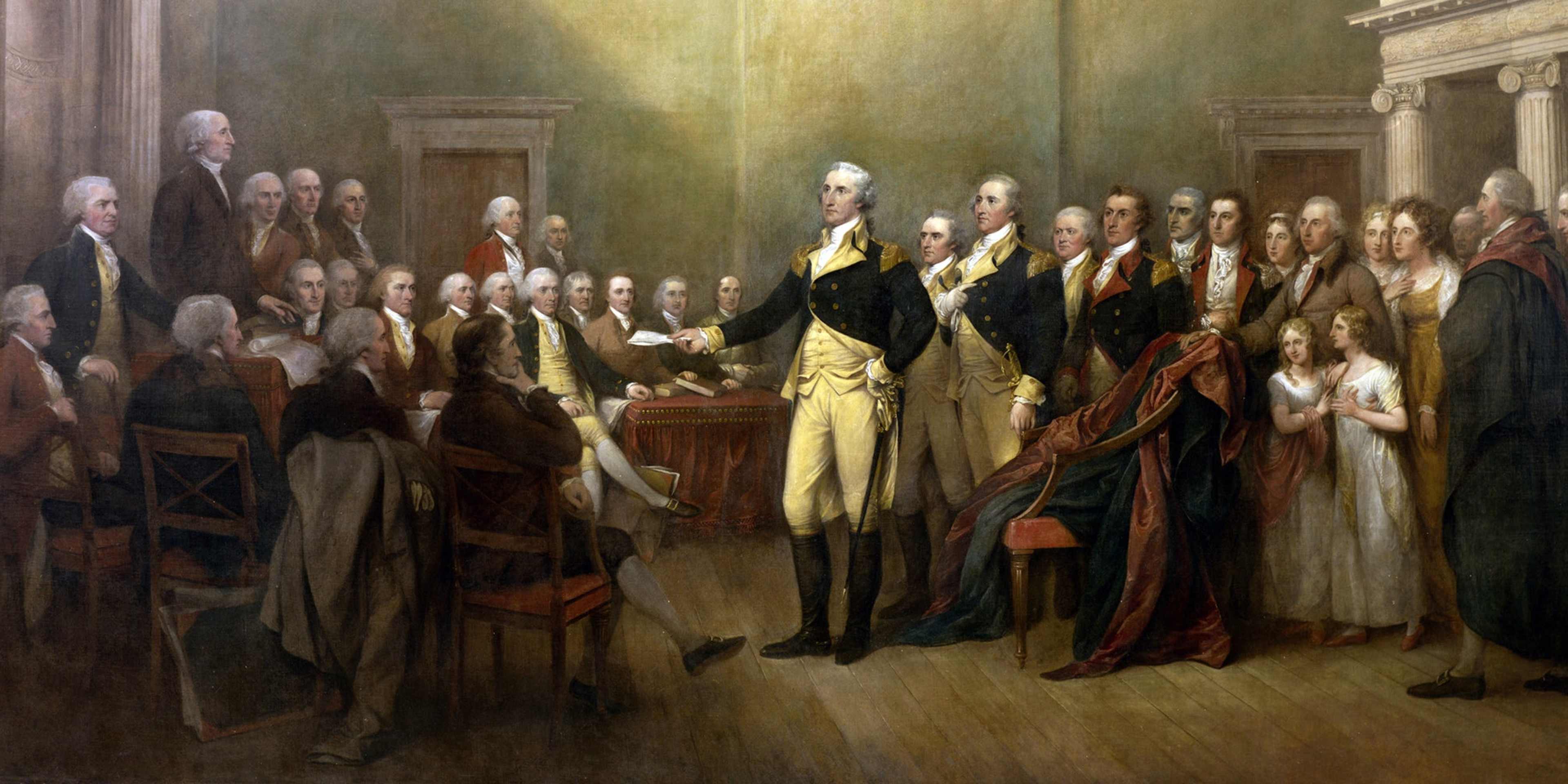
In the humid summer of 1783, as the smoke of the American Revolutionary War finally cleared, General George Washington stood on the precipice of a monumental personal and national milestone. At fifty-one years old, the war-weary Commander-in-Chief of the Continental Army desired nothing more than to lay down his sword, return to his beloved estate at Mount Vernon, and spend his remaining years in peaceful agricultural pursuits. Yet, before he could officially resign his commission and step back into the quiet life of a private citizen, Washington felt a profound, almost desperate obligation to offer one final piece of counsel to the fragile coalition of states he had spent eight years defending. This parting wisdom, known historically as the Circular Letter to the States, served as Washington’s first attempt at retirement and laid the ideological groundwork for what would eventually become the United States Constitution. Far from a simple farewell, this letter was a brilliant, urgent, and prescient blueprint designed to save the young American experiment from collapsing under the weight of its own post-war chaos.
Historical Background: America at a Perilous Crossroads in 1783
The year 1783 was a period of profound uncertainty for the fledgling American republic. Although the British forces had suffered a decisive defeat at Yorktown in 1781, a formal peace treaty had not yet been finalized, leaving the continent in a state of geopolitical limbo. The Articles of Confederation, which served as the nation’s first governing constitution, established a central government that was notoriously weak, lacking the authority to levy taxes, regulate commerce, or enforce national laws. Individual states operated almost as independent nations, fiercely protective of their sovereignty and deeply suspicious of any centralized authority.
Adding to this volatile mix was a massive national debt accumulated during the war. The Continental Congress was virtually bankrupt, unable to pay the back wages owed to the brave soldiers who had fought for independence. This financial desperation had nearly culminated in the infamous Newburgh Conspiracy earlier that year, where mutinous officers threatened to march on Congress. While Washington successfully defused that crisis, the threat of military coup or civil anarchy loomed large.
Furthermore, the transition of the Continental Army back to civilian life was fraught with tension. Washington had spent years managing not only British threats but also internal political squabbles and military command transitions. It is worth noting that the leadership of the revolutionary forces had evolved significantly; historians often look back to see who commanded the Continental Army before Washington took the reins to appreciate the monumental task of professionalizing a civilian militia. When Washington finally prepared to step down, he knew that the military victory would be entirely hollow if the newly liberated states could not establish a stable, unified government.
The Core Elements of the 1783 Circular Letter
Written from his headquarters in Newburgh, New York, and dated June 8, 1783, Washington’s letter was addressed directly to the governors of the original thirteen colonies, yet its target audience was the American citizenry. Washington was acutely aware that the fate of republican self-governance hung in the balance. In the letter, he outlined what he termed the four pillars essential to the survival and prosperity of the United States.
First and foremost, Washington argued for an indissoluble Union of the States under one Federal Head. He warned that if the states insisted on complete autonomy, they would descend into petty, localized conflicts, making them easy prey for foreign empires. Second, he called for a sacred regard to public justice. This was a direct appeal to the states to honor their financial obligations, specifically paying off the national debt and compensating the veterans of the Revolutionary War. Without fiscal integrity, Washington believed, the new nation would lose its moral standing and international credit.
Third, he advocated for the adoption of a proper peace establishment. Washington recognized that while a standing army was feared by republicans as a potential tool of tyranny, a well-regulated militia and a structured national defense system were absolutely necessary to deter foreign aggression. Fourth, Washington emphasized the necessity of a pacific and cooperative disposition among the populace. He urged Americans to look past their local prejudices, sacrifice minor individual advantages for the greater national good, and embrace a spirit of mutual respect and civility. This moral dimension of leadership was deeply personal to Washington, who as a young man had meticulously hand-copied rules of social etiquette to guide his own character.
Key Turning Points: From Military Commander to Citizen and President
The circular letter was a critical turning point in the history of American governance. Initially, some political factions viewed the letter with skepticism, interpreting it as an inappropriate overreach by a military officer trying to dictate civilian policy. However, Washington’s genuine desire to relinquish power—modeled after the ancient Roman leader Cincinnatus—ultimately disarmed his critics.
In December 1783, Washington traveled to Annapolis, Maryland, where the Continental Congress was meeting, and formally resigned his military commission. This act of peaceful transition of power shocked the monarchies of Europe, prompting King George III to reportedly declare that if Washington truly gave up power, he would be ‘the greatest man in the world.’
Washington’s retirement, however, was short-lived. By mid-1787, the weakness of the Articles of Confederation had pushed the nation to the brink of financial ruin and social unrest, exemplified by events like Shays’ Rebellion. Recognizing the crisis, Washington’s 1783 Circular Letter was widely reprinted in newspapers to remind the public of his prophetic warnings. This public resurgence of his advice set the stage for the Constitutional Convention of 1787.
When the delegates drafted the new U.S. Constitution, they incorporated many of the core principles Washington had outlined four years prior, particularly a strong federal executive and the power of the federal government to levy taxes and maintain national defense. These global connections were vital, as the young nation had to navigate complex international relations, including the crucial role of the Caribbean in the Revolutionary War and subsequent trade agreements with European colonial powers.
By 1789, Washington was unanimously elected as the first President of the United States, proving that his attempt to retire had failed, but his vision for the country had triumphed.
Lesser-Known Facts About Washington’s First Retirement Attempt
- A Ghostwriter in the Shadows: While the ideas in the Circular Letter were entirely Washington’s, the elegant, polished prose was heavily assisted by his trusted military aides-de-camp, including Alexander Hamilton and Jonathan Trumbull Jr., who helped refine the general’s thoughts into a soaring literary appeal.
- The Fear of a Military Dictator: In 1783, many Americans were terrified that Washington would use the Continental Army to crown himself king. The Circular Letter was a strategic political masterstroke because it loudly declared his intention to retire while simultaneously proving he cared deeply about civilian governance.
- A Prophetic Warning on Slavery: Though Washington was himself a slaveholder, his emphasis on ‘public justice’ and the moral duties of a free people laid an early intellectual foundation that abolitionists would later use to challenge the institution of slavery, pointing out the hypocrisy of a nation founded on ‘liberty’ that denied it to millions.
Why Washington’s 1783 Advice Still Matters Today
More than two centuries later, Washington’s Circular Letter remains incredibly relevant to modern political discourse. The tension between state sovereignty and federal authority continues to define American politics, from debates over environmental regulations to healthcare and voting rights. Furthermore, Washington’s plea for public civility and the sacrifice of personal or local prejudices for the common good serves as a stark, necessary reminder in an era of deep political polarization. The letter stands as a timeless warning that the survival of a democratic republic is never guaranteed; it requires active, moral participation, fiscal responsibility, and an unyielding commitment to national unity.
People Also Ask (FAQ)
What was the main purpose of George Washington’s 1783 Circular Letter?
The main purpose was to outline a political blueprint for the survival of the United States. Written as Washington prepared to retire from the Continental Army, the letter offered four key recommendations: national unity, fiscal responsibility (public justice), a centralized defense system, and a spirit of cooperation among citizens.
How did the Circular Letter foreshadow the US Constitution?
The letter directly argued against the weaknesses of the Articles of Confederation. Washington’s call for a ‘federal head’ and a ‘proper peace establishment’ anticipated the stronger executive branch, the federal power of taxation, and the national military system that were eventually codified in the 1787 United States Constitution.
Why is Washington compared to the Roman leader Cincinnatus?
Like Lucius Quinctius Cincinnatus, a Roman statesman who accepted temporary dictatorial powers to win a war and then immediately returned to his farm, Washington surrendered his absolute military command of the Continental Army in 1783 to return to private life at Mount Vernon, cementing the American precedent of civilian control over the military.
Conclusion
George Washington’s first attempt to retire in 1783 produced one of the most significant, yet frequently overlooked, documents in early American history. The Circular Letter to the States was not merely a polite goodbye; it was a profound act of leadership that challenged a fragile, divided country to rise to the occasion of its own independence. By articulating the four pillars of federal unity, public justice, national defense, and civil cooperation, Washington provided the intellectual framework that saved the United States from self-destruction. Though his retirement at Mount Vernon was ultimately interrupted by his unanimous election to the presidency, his timeless advice continues to guide the nation’s ongoing democratic experiment.


