On April 14, 1865, a single gunshot fired inside Ford’s Theatre altered the course of American history forever. The Lincoln assassination was not merely the act of a lone madman; it was the culmination of a vast, desperate conspiracy aimed at decapitating the Union government just as the Civil War was drawing to a close. While every schoolchild knows that John Wilkes Booth pulled the trigger, the true depth of the plot, the bizarre near-misses, and the tragic fates of those in the presidential box remain shrouded in mystery. Exploring these hidden layers reveals a fragile nation teetering on the edge of chaos, where fate was decided by the smallest of choices—such as a last-minute change of theater plans or a calling card left in a hotel mailbox. This article dives deep into the lesser-known facts, critical timelines, and the profound, enduring legacy of one of America’s greatest tragedies.
The Historical Background of a Fractured Nation
To fully comprehend the gravity of the Lincoln assassination, one must understand the sociopolitical atmosphere of the spring of 1865. The American Civil War was reaching its bloody climax. Confederate General Robert E. Lee had surrendered at Appomattox Court House on April 9, 1865, effectively signaling the collapse of the Confederacy. Yet, while the North celebrated, deep-seated resentment and desperation burned brightly among Southern sympathizers. John Wilkes Booth, a famous and charismatic actor from a prominent theatrical family, viewed President Abraham Lincoln not as a savior of the Union, but as a tyrannical dictator who sought to destroy the Southern way of life and upend racial hierarchies.
The Catalysts and Failed Kidnapping Plot
Initially, Booth did not plan to murder the president. In the summer of 1864, after clandestine meetings with Confederate secret service agents in Montreal, Booth spearheaded an elaborate plot to kidnap Lincoln. The objective was to abduct the president, smuggle him across the Potomac River into the Confederate capital of Richmond, Virginia, and use him as a high-stakes bargaining chip to secure the release of thousands of rebel prisoners of war. On March 17, 1865, Booth and his co-conspirators hid along a quiet country road in Washington, D.C., waiting to ambush the presidential carriage. Lincoln was scheduled to attend a play at Campbell Hospital to benefit wounded soldiers. However, the president changed his plans at the last minute, leaving Booth and his crew empty-handed. When Richmond fell and Lee surrendered weeks later, the kidnapping plot became obsolete, and Booth’s desperation transformed into a murderous resolve.
Timeline of the Lincoln Assassination: April 14 to July 7, 1865
The conspiracy moved rapidly from a desperate idea to a coordinated, multi-target strike. Below is the chronological breakdown of the fatal day and its immediate aftermath:
- April 14, 1865, 11:00 AM: While visiting Ford’s Theatre to pick up his mail, John Wilkes Booth learns that President Lincoln and General Ulysses S. Grant plan to attend the evening performance of the comedy Our American Cousin. He immediately begins coordinating his co-conspirators.
- April 14, 1865, 8:00 PM: Booth holds a final meeting at the Herndon House with Lewis Powell, David Herold, and George Atzerodt. They plan a synchronized triple assassination of President Lincoln, Vice President Andrew Johnson, and Secretary of State William Seward.
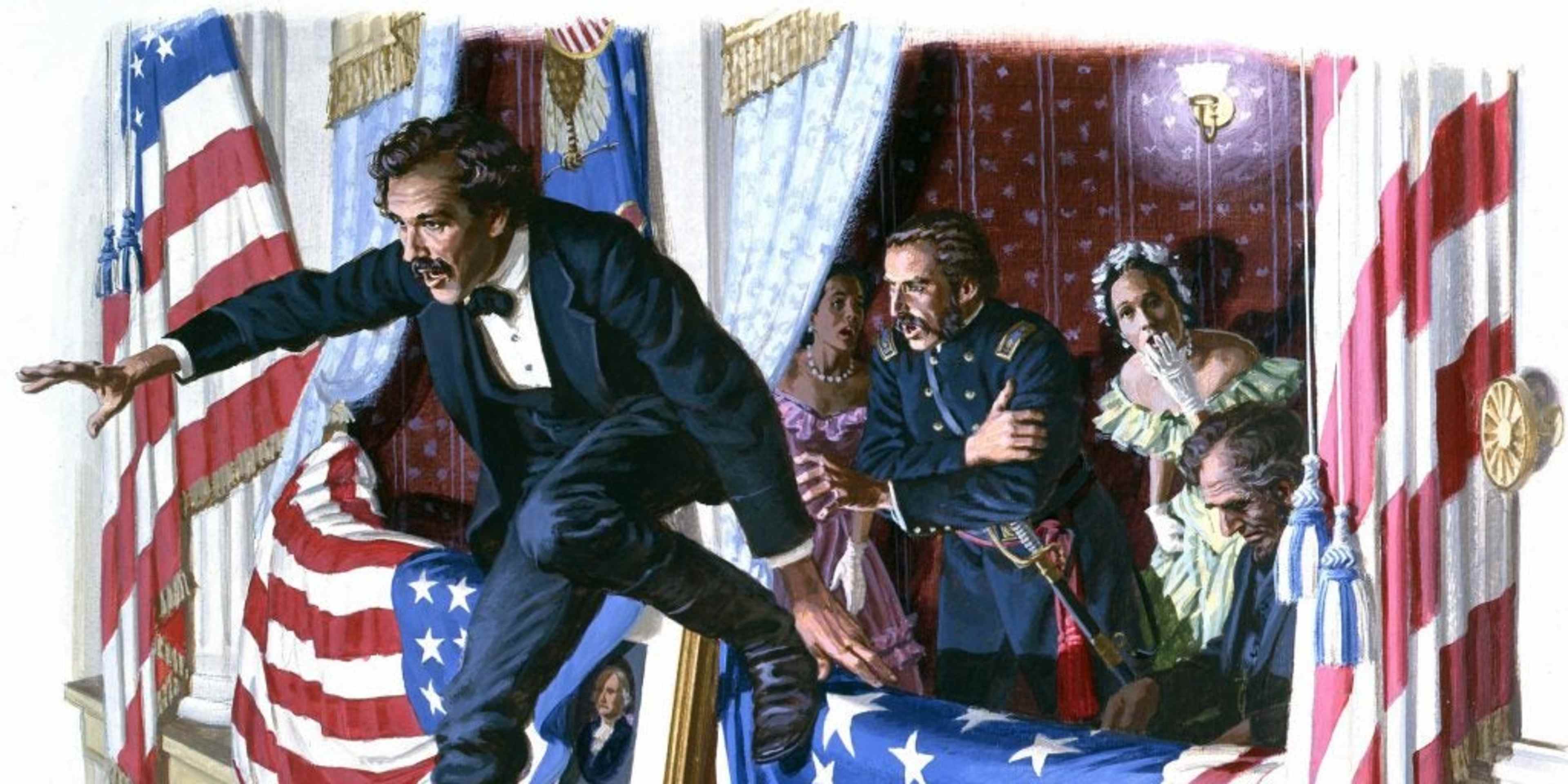
- April 14, 1865, 10:15 PM: Booth slips into the presidential box at Ford’s Theatre and shoots Lincoln in the back of the head with a .44-caliber Deringer. He slashes Major Henry Rathbone with a Bowie knife and leaps to the stage, crying “Sic semper tyrannis!” (Thus always to tyrants) before escaping.
- April 14, 1865, 10:15 PM: Simultaneously, Lewis Powell brutally stabs Secretary of State William Seward at his home. Seward miraculously survives. Meanwhile, George Atzerodt loses his nerve and fails to attack Vice President Johnson.
- April 15, 1865, 7:22 AM: President Abraham Lincoln is pronounced dead at the Petersen boardinghouse across the street from the theater.
- April 26, 1865: After a massive 12-day manhunt involving 10,000 federal troops, Booth is cornered in a tobacco barn in Virginia and shot by Union soldier Boston Corbett.
- July 7, 1865: Four of the co-conspirators—Mary Surratt, Lewis Powell, David Herold, and George Atzerodt—are executed by hanging after a military tribunal trial.
The Crucial Figures and Their Fates
The dramatic events of that fateful night involved a wide cast of characters whose lives were forever altered by the tragedy.
John Wilkes Booth: The Fanatical Actor
John Wilkes Booth was not a fringe lunatic but one of the most famous, handsome, and celebrated stage actors of his day. His deep pro-Confederate convictions led him to view the President as a threat to liberty. Booth believed his actions would throw the federal government into chaos and breathe new life into the dying Confederate cause. Instead, his act of violence united the North in grief and brought down a harsh Reconstruction era on the South.
General Ulysses S. Grant: The Empty Chair
General Grant was originally invited to sit in the presidential box next to the Lincolns. He accepted, but his wife, Julia Dent Grant, had recently clashed with Mary Todd Lincoln and flatly refused to spend an evening with the mercurial First Lady. Citing a desire to travel to New Jersey to see their children, the Grants backed out. This decision saved Grant’s life, as Booth’s conspiracy specifically targeted him as well. Finding a replacement proved difficult; several high-profile figures turned down the invitation before Clara Harris and her fiancé, Major Henry Rathbone, stepped in.
Major Henry Rathbone and Clara Harris: A Haunting Legacy
Major Henry Rathbone attempted to tackle Booth immediately after the shot was fired, suffering a deep stab wound to his arm. While he recovered physically, the psychological trauma of failing to save the president destroyed him. He married Clara Harris (his stepsister) in 1867, but his mental health deteriorated rapidly. On December 23, 1883, while living in Germany, Rathbone shot and stabbed his wife to death before turning the knife on himself. He survived the self-inflicted wounds and spent the remaining three decades of his life in an asylum for the criminally insane.
Causes, Context, and Turning Points
The Lincoln assassination was fueled by the deep wounds of a nation divided by slavery, state sovereignty, and constitutional crises. On April 11, 1865, just three days before his death, Lincoln gave a public speech endorsing limited voting rights for newly freed African Americans. Booth, who was in the audience, turned to a companion and vowed that it would be the last speech Lincoln would ever give. This speech was the ultimate turning point that transformed Booth’s objective from abduction to cold-blooded murder.
The attack itself was designed to create a power vacuum. By targeting the President, Vice President, and Secretary of State, Booth hoped to disrupt the line of succession, throw the Union into administrative paralysis, and allow remaining Confederate forces to regroup. However, the plot failed to achieve its political goals; the government remained stable, and Vice President Andrew Johnson was quietly sworn in as the 17th president of the United States hours after Lincoln’s passing.
The Long-Term Impact on Reconstruction and Civil Rights
The assassination of Lincoln was a catastrophic blow to the post-war healing of the United States. Lincoln had favored a lenient, conciliatory approach to bringing the Southern states back into the fold, famously proclaiming “malice toward none, with charity for all.” His death paved the way for the Radical Republicans in Congress to take control of Reconstruction, imposing strict military rule over the South.
Furthermore, the accession of Andrew Johnson—a Southern Democrat who opposed equal rights for Black Americans—led to a bitter, years-long struggle over civil rights and the constitutional limits of executive power. This era of political warfare deeply fractured the country and delayed true equality, showing how the bullets fired at Ford’s Theatre echoed through generations of civil rights struggles. In analyzing these historic shifts, historians often view Lincoln’s death as one of the most tragic disruptions to the pivotal strides for freedom in American history.
Lesser-Known Facts of the Lincoln Assassination
1. Robert Todd Lincoln and a String of Uncanny Coincidences
Abraham Lincoln’s eldest son, Robert Todd Lincoln, was plagued by a series of tragic associations with presidential deaths. Though he declined his father’s invitation to Ford’s Theatre due to exhaustion, he rushed to his father’s deathbed the following morning. Years later, while serving as Secretary of War, Robert was standing just feet away when President James A. Garfield was shot in 1881. In 1901, he arrived at the Pan-American Exposition in Buffalo, New York, just as President William McKinley was assassinated. Robert eventually refused future presidential invitations, noting there was a “fatality” about his presence. In an even more unbelievable twist of fate, months before the assassination, Robert was saved from falling under a moving train by none other than Edwin Booth—John Wilkes Booth’s brother. These events are often cataloged among the most astonishing historical coincidences in American annals.
2. The Radical Republicans Welcomed the News
While the majority of the nation was plunged into deep mourning, some political factions secretly rejoiced. Certain Radical Republicans believed Lincoln was far too lenient toward the defeated Confederacy and thought his death was a “godsend” that would allow a more vengeful figure, like Andrew Johnson, to punish the South. Michigan Senator Zachariah Chandler wrote that God had permitted Lincoln to live only as long as he was useful, paving the way for a “better man” to finish the job.
3. Booth’s Mysterious Calling Card to Andrew Johnson
Just hours before he pulled the trigger, John Wilkes Booth walked into the Kirkwood House hotel and left a handwritten note for Vice President Andrew Johnson. It read: “Don’t wish to disturb you. Are you at home? J. Wilkes Booth.” This card fueled intense conspiracy theories that Johnson himself was complicit in the assassination. Mary Todd Lincoln openly believed Johnson had a hand in her husband’s death, writing to friends that the card was proof of a pre-existing relationship between the two men.
4. The Grim Fate of the Petersen House and Ford’s Theatre
Following the tragedy, souvenir hunters virtually ransacked the room where Lincoln died, taking bloody bedsheets, pieces of furniture, and hair clippings. The boardinghouse owner, William Petersen, tried to monetize the tragedy by charging visitors admission to view the deathbed, but he fell into extreme financial ruin and eventually died of an opium overdose. Meanwhile, the federal government banned Ford’s Theatre from ever being used as a place of amusement again, converting it into war department archives. In a bizarre final tragedy, on June 9, 1893—the exact day of Edwin Booth’s funeral in New York—three floors of Ford’s Theatre collapsed, killing 22 federal workers.
Why the Lincoln Assassination Still Matters Today
The Lincoln assassination is not merely a dry historical event; it is the structural fault line upon which modern American political division was built. The premature death of the Great Emancipator fundamentally altered the trajectory of civil rights, voting access, and racial equality in the United States, leaving questions about racial justice and federal authority unanswered for over a century. It serves as a stark warning of how political polarization, combined with radicalization and violence, can instantly reshape the destiny of a nation. Today, as we navigate our own era of intense political discourse, the lessons of April 14, 1865, remain a haunting reminder of the fragility of democracy.
People Also Ask (FAQs)
Who were the four conspirators executed for Lincoln’s assassination?
The four conspirators executed by hanging on July 7, 1865, were Lewis Powell (who attacked William Seward), George Atzerodt (who was assigned to kill Andrew Johnson), David Herold (who aided Booth’s escape), and Mary Surratt, who owned the boardinghouse where the conspirators met. Mary Surratt was the first woman executed by the United States federal government.
What happened to Ford’s Theatre after the assassination?
The theater was seized by the federal government, gutted, and turned into an office building for the War Department. It was not reopened as a working theater until 1968, over a century after Lincoln’s death. Today, it operates as both a historic site and an active theater.
Did John Wilkes Booth die in the tobacco barn?
Yes. Booth was cornered by Union cavalry at Richard Garrett’s farm in Port Royal, Virginia, on April 26, 1865. When he refused to surrender, the barn was set on fire. Booth was shot in the neck by Sergeant Boston Corbett and died a few hours later on the porch of the farmhouse.
Conclusion
The tragedy of the Lincoln assassination remains a definitive and harrowing chapter in American history. From the aborted kidnapping plots to the haunting coincidences surrounding Robert Todd Lincoln, the events of April 1865 reveal a deeply complex and fragile period in the nation’s journey. While John Wilkes Booth succeeded in taking the life of America’s 16th president, he failed to destroy the Union. Lincoln’s legacy as the Great Emancipator survived the bullet, enduring as a beacon of freedom, unity, and resilience that continues to guide the nation to this day.


