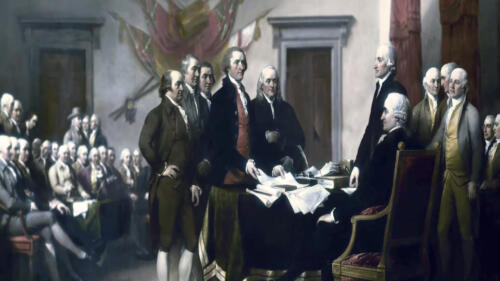
When we picture the Founding Fathers of the United States, we often conjure up formal, static images of men in powdered wigs, clutching quill pens and debating lofty constitutional philosophy in stuffy colonial chambers. But the reality is far more dynamic, colorful, and surprising. These revolutionary leaders were not just political theoreticians; they were hands-on inventors, experimental farmers, cutting-edge scientists, and bold financial architects who had to build a brand-new nation from the ground up. From the bloody cobblestones of the Boston Massacre to the creation of a unified national currency, the birth of America was a grand, high-stakes experiment in human ingenuity. To fully appreciate their impact, we must look beyond the familiar prose of the Declaration of Independence and explore the multi-faceted, practical legacy of innovation, sacrifice, and visionary planning that continues to define the American spirit to this very day.

The Historical Background: Tensions in the Thirteen Colonies
In the mid-18th century, the relationship between Great Britain and its North American colonies began to unravel. Following the costly French and Indian War, the British Parliament sought to recoup its expenses by levying a series of direct taxes on the colonists, who had no representation in London. This sparked widespread outrage and birthed the famous rallying cry, “No taxation without representation.” When studying the early development of this young, rebellious republic, understanding the physical and political landscape is essential; exploring the 13 colonies map and original states helps put the physical and political borders in perspective, illustrating how geographically fractured yet ideologically aligned these distinct regions truly were.
As acts of civil disobedience like the Boston Tea Party escalated, the British government responded with military occupation and punitive measures. What began as local skirmishes and economic boycotts soon escalated into a full-scale ideological struggle, necessitating a structured military response and a unified political front.
Key Events Timeline: The Birth of a Nation
- March 5, 1770 – The Boston Massacre: British soldiers fire into a crowd of angry colonists, killing five people. Among them is Crispus Attucks, a man of African and Indigenous descent, who is widely remembered as the first casualty of the American Revolution.
- April 19, 1775 – The Battles of Lexington and Concord: The “shot heard ’round the world” marks the official military outbreak of the American Revolutionary War.
- July 4, 1776 – The Declaration of Independence: Drafted by Thomas Jefferson and approved by the Second Continental Congress, this revolutionary document formalizes the colonies’ break from Great Britain.
- September 17, 1787 – The U.S. Constitution is Signed: Delegates at the Constitutional Convention in Philadelphia draft a robust framework for a strong federal government, replacing the weak Articles of Confederation.
- September 11, 1789 – Hamilton Appointed Treasury Secretary: Alexander Hamilton takes office as the first Secretary of the Treasury, initiating his grand vision for the American financial system.
- February 25, 1791 – Chartering of the First Bank of the United States: Congress approves Hamilton’s proposal for a national bank to stabilize the economy and manage government debt.
- April 2, 1792 – The Coinage Act: The federal government establishes the United States Mint, introducing a unified national currency based on the U.S. dollar.
The Men and Women Who Shaped the Era
George Washington: The Reluctant Commander and Innovative Farmer
While George Washington is universally revered as the “Father of His Country” and the first President of the United States under the Constitution, his leadership began on the battlefield. The early days of organizing the armed resistance against the British Empire were incredibly chaotic. Long before Washington took total command, questions arose regarding who commanded the Continental Army before Washington, highlighting how the military structure of the young nation was cobbled together under immense duress. Beyond his military and executive roles, Washington was a highly progressive agricultural innovator, constantly testing crop rotation methods and inventing practical tools, such as his famous 16-sided threshing barn, to modernize American farming.
Alexander Hamilton: The Financial Architect
Arriving in the colonies as a penniless immigrant from the Caribbean, Alexander Hamilton rose through sheer intellect and determination to become Washington’s military aide-de-camp and, eventually, the chief architect of the U.S. financial system. Hamilton realized that a sovereign nation could not survive without economic credibility. He fought tirelessly to consolidate state debts, establish a national bank, and introduce a uniform currency. His policies transformed a bankrupt, agricultural confederation into a nascent financial powerhouse capable of competing with European empires.
Crispus Attucks: The First Martyr of Liberty
Crispus Attucks, a man of mixed African and Wampanoag Native American heritage, was an escaped slave who worked as a merchant seaman. On that fateful night of March 5, 1770, he stood at the front of a crowd confronting British soldiers in Boston. His death became a powerful symbol for the abolitionist and revolutionary movements, proving that the struggle for American liberty was diverse and complex from its very inception.
Benjamin Franklin: The Renaissance Founder
Perhaps no other Founder embodied the spirit of practical innovation more than Benjamin Franklin. As a world-renowned scientist, writer, and diplomat, Franklin’s contributions went far beyond statecraft. His experiments with electricity led to the invention of the lightning rod, protecting countless wooden structures across colonial cities. He also developed bifocal spectacles, the efficient Franklin stove, and organized America’s first volunteer fire department and public lending library.

Causes and Global Context
The American Revolution was not fought in a vacuum. It was deeply rooted in the intellectual current of the European Enlightenment, which questioned the divine right of kings and championed individual liberties, the social contract, and natural rights. Economically, the colonies were chafing under British mercantilist policies that restricted colonial manufacturing and forced trade to flow exclusively through British merchants. When global empires clashed during the Seven Years’ War, the resulting financial strain forced Great Britain to tighten its grip on its colonies, inadvertently triggering a unified resistance that would forever alter the course of modern history.
Major Turning Points of the Revolution
While the war dragged on for eight grueling years, several pivotal moments decided its outcome. The Battle of Saratoga in 1777 proved to be a major turning point, convincing France that the American colonists actually had a chance of winning. This alliance brought crucial naval and financial support. Years later, the Siege of Yorktown in 1781 effectively brought British military operations to a halt. However, the most critical transition was not military, but political. The realization that the initial government under the Articles of Confederation was too weak to preserve the union led to the Constitutional Convention of 1787, shifting America from a loose alliance of sovereign states to a cohesive federal republic.
Alexander Hamilton’s Financial Revolution
When Alexander Hamilton took the reins of the newly formed Department of the Treasury in 1789, he faced a financial nightmare. The national debt was astronomical, inflation was rampant, and the continental currency was virtually worthless. Hamilton argued that a national debt, if managed properly, could actually serve as a “national blessing” by binding the financial interests of wealthy citizens and foreign investors directly to the survival of the federal government.
To achieve this, he proposed three revolutionary pillars: the assumption of state war debts by the federal government, the creation of the First Bank of the United States, and the establishment of a national mint. Under the Coinage Act of 1792, the U.S. Mint began producing standardized gold, silver, and copper coins. This eliminated the confusing, unstable mixture of foreign currencies—such as Spanish dollars and British shillings—that had previously paralyzed colonial trade, laying down the solid bedrock of the modern global economy.
Lesser-Known Facts and Surprising Anecdotes
- The Origin of the 13 Stripes: The 13 alternating red and white stripes on the American flag represent the original 13 colonies that declared independence from British rule. However, the initial design of “Old Glory” was not entirely standardized; various seamstresses and military regiments arranged the stars in different configurations, ranging from circular wreaths to stars scattered randomly across the blue field.
- Colonial Campaign Parties: The political process of the early republic was far from dry and formal. In fact, elections in colonial America were huge, booze-fueled parties where candidates, including George Washington, would purchase enormous quantities of rum punch, cider, and beer for voters to win their favor on election day—a practice known as “treating.”
- The 16-Sided Barn: George Washington’s obsession with agricultural efficiency led him to design a revolutionary, 16-sided wooden threshing barn at Mount Vernon. The unique shape allowed horses to trot in a circular motion on the upper level, treading wheat so that the grain fell through specifically spaced floorboards to the clean collection area below, preventing sanitation issues.
Long-Term Impact on America and the World
The legacy of the Founding Fathers reshaped the globe. By proving that a diverse group of colonies could successfully overthrow a major colonial power and establish a stable, representative democracy, they inspired a wave of democratic revolutions across Europe and the Americas, from the French Revolution to the independence movements in Latin America. Domestically, the federal system they built established a delicate, enduring balance of power between federal authority and state sovereignty, while the Bill of Rights became a cornerstone of civil liberties that continues to protect individual freedom.
Why It Still Matters Today
The debates that raged in the halls of Philadelphia in the late 18th century are the exact same debates we read about in the news today. Every time we argue about the scope of executive power, the relationship between federal laws and state rights, the role of central banking, or the national debt, we are participating in a conversation started by Alexander Hamilton, Thomas Jefferson, and James Madison. Their legacy is not a dusty monument of the past, but an active, ongoing dialogue that shapes our current legal, economic, and social landscape.
People Also Ask
Who are considered the main Founding Fathers?
While dozens of individuals played vital roles, the “Big Seven” are widely considered to be George Washington, John Adams, Thomas Jefferson, James Madison, Alexander Hamilton, Benjamin Franklin, and John Jay.
Why does the American flag have 13 stripes?
The 13 stripes represent the original thirteen colonies that declared independence from British rule in 1776, establishing the foundational states of the United States of America.
What was Alexander Hamilton’s most important contribution?
Hamilton’s most important contribution was designing the U.S. financial system. This included the funding of national and state war debts, the creation of the First Bank of the United States, and the establishment of the U.S. Mint, which created a stable, unified currency.
Who was Crispus Attucks?
Crispus Attucks was an escaped slave of African and Native American descent who was the first person killed during the Boston Massacre in 1770, making him the first martyr of the American Revolution.
Conclusion
The story of America’s Founding Fathers is far deeper than a single declaration signed in 1776. It is a story of immense intellectual diversity, intense political rivalry, and practical innovation. These leaders were scientists, agriculturalists, and financial masters who understood that building a free nation required solid infrastructure, financial stability, and continuous technological progress. By exploring their complete legacy—both their brilliant achievements and their deep contradictions—we gain a richer, more honest appreciation of the complex foundations upon which the United States was built.


