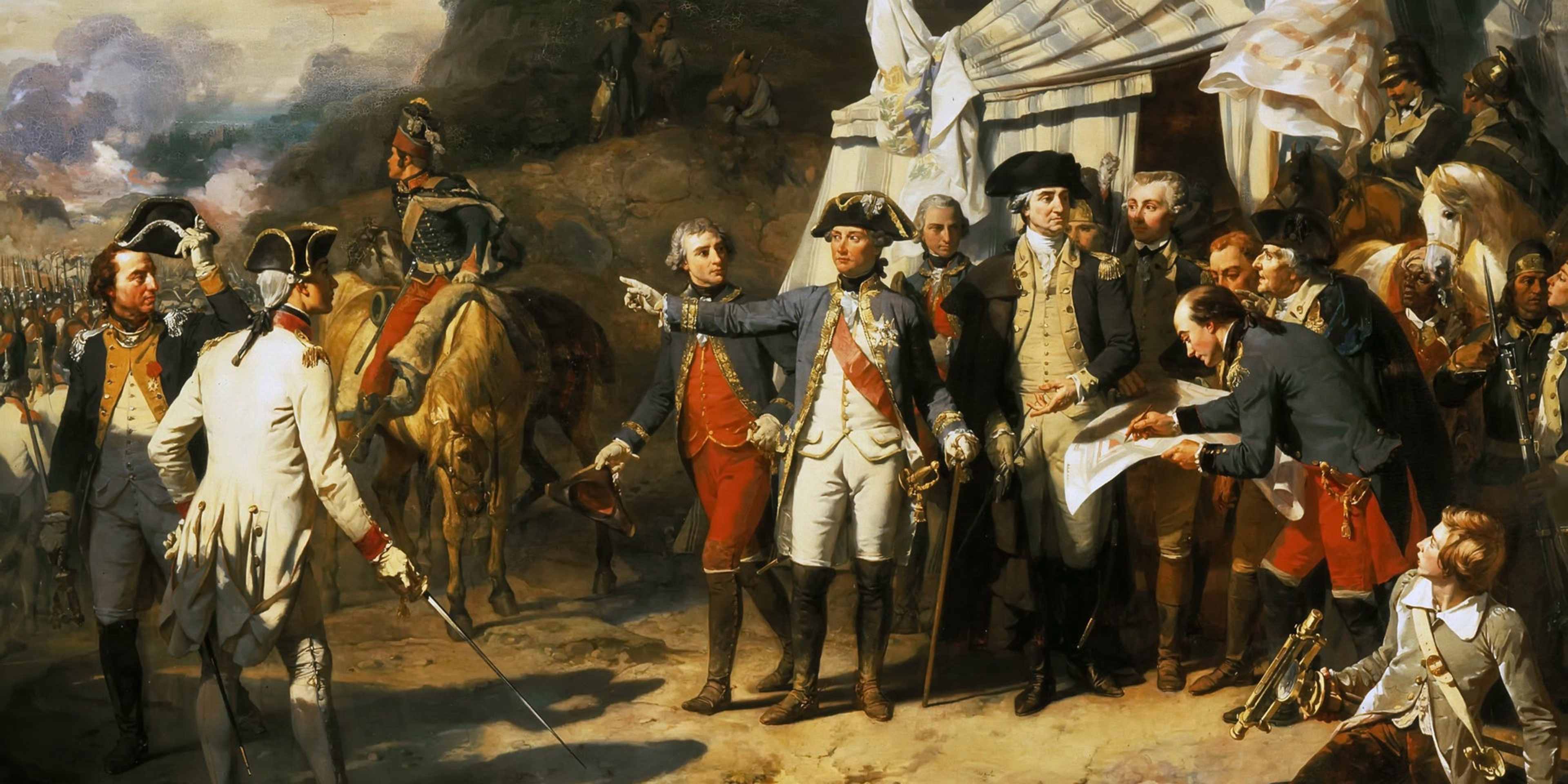
The Battle of Yorktown in October 1781 stands as the definitive climax of the American Revolutionary War, a monumental clash that transformed a desperate colonial rebellion into the birth of a sovereign global superpower. For over six grueling years, the Continental Army had struggled against the world’s most formidable military empire, facing brutal winters, financial ruin, and tactical setbacks. However, in the autumn of 1781, a perfect convergence of American resilience, brilliant military deception, and indispensable French naval and land support trapped British General Lord Charles Cornwallis on the peninsula of Yorktown, Virginia. This decisive confrontation not only shattered the British military strategy in North America but also sealed the fate of British rule, forcing Great Britain to acknowledge the independence of the newly formed United States. To truly understand the remarkable trajectory of American history, one must examine how this high-stakes siege unfolded, the key figures who risked everything, and the enduring legacy of a victory that seemed almost impossible.
Historical Background and the Road to Yorktown
By 1781, the Revolutionary War had reached a critical stalemate. After years of fighting in the northern colonies, the British military command shifted its focus to the Southern Campaign, hoping to leverage loyalist support and secure the wealthy southern territories. British General Lord Charles Cornwallis marched through the Carolinas, winning hard-fought victories but severely depleting his forces. Needing a secure deep-water port to receive crucial supplies and reinforce his troops, Cornwallis established a base at Yorktown, Virginia, along the York River. Meanwhile, the Continental Army under General George Washington was stationed near New York City, war-weary and financially exhausted. The dream of independence for the thirteen colonies hung in a delicate balance. It was clear that without a massive, decisive victory, the American cause might collapse under the weight of economic ruin and troop desertions.
The Grand Strategy: Deception and Convergence
The opportunity for a turning point arrived in the summer of 1780 with the arrival of 5,500 French troops commanded by the Comte de Rochambeau in Newport, Rhode Island. Washington originally favored a combined assault on the heavily fortified British stronghold of New York City, held by General Henry Clinton. However, when news arrived in August 1781 that Admiral François Joseph Paul de Grasse was sailing a powerful French fleet to the Chesapeake Bay rather than New York, Washington pivotally shifted his strategy.
To execute this new plan, Washington had to march his combined Franco-American army hundreds of miles south without alerting Clinton. This led to one of the greatest military deceptions in history. Washington ordered the construction of massive brick bread ovens and large camps in New Jersey, directly in sight of British scouts, simulating preparations for a prolonged siege of New York. He even drafted false battle plans and allowed them to fall into British hands. The ruse worked flawlessly; by the time Clinton realized Washington had slipped away, the allied forces were already marching through Maryland on their way to Virginia.
Chronological Timeline of the Yorktown Campaign (1781)
To understand the tactical precision of this campaign, we must examine the key dates that defined the siege:
- August 14, 1781: Washington receives word that Admiral de Grasse’s French fleet is heading to the Chesapeake Bay, triggering the decision to march south.
- September 5, 1781: The Battle of the Capes. Admiral de Grasse defeats the British fleet under Admiral Thomas Graves, cutting off Cornwallis’s sea escape and naval reinforcement.
- September 14–26, 1781: Allied French and American forces arrive in Williamsburg, Virginia, uniting their armies just 13 miles from Yorktown.
- September 28, 1781: The formal siege of Yorktown begins as allied forces encircle the town.
- October 6, 1781: Allied troops begin digging the first siege parallel trench, 800 yards from the British lines.
- October 9, 1781: The allied bombardment begins; Washington personally fires the first American cannon.
- October 11, 1781: Work begins on the second parallel trench, 400 yards closer, but progress is blocked by British Redoubts No. 9 and No. 10.
- October 14, 1781: Allied forces launch a night assault, successfully capturing Redoubts No. 9 and No. 10.
- October 16, 1781: Cornwallis attempts a desperate evacuation across the York River, which is foiled by a violent storm.
- October 17, 1781: A British drummer boy beats the signal for parley, and negotiations for surrender begin.
- October 19, 1781: The British army officially surrenders, effectively ending the major land combat phase of the American Revolution.
Crucial Historical Figures and Their Legacies
The triumph at Yorktown was not the work of a single mastermind, but rather a brilliant collaboration of diverse leaders:
- General George Washington: As Commander-in-Chief of the Continental Army, Washington demonstrated superb flexibility and executive leadership. His willingness to scrap his long-held plan of attacking New York in favor of a Southern campaign proved his tactical genius. This victory cemented his status as a legendary leader, directly paving the way for his eventual role as the first President of the United States.
- Comte de Rochambeau: The commander of the French expeditionary forces, Rochambeau brought invaluable European siege expertise and professional discipline to the allied effort. His cooperative relationship with Washington was essential in bridging the gap between two traditionally rival nations.
- Marquis de Lafayette: The young, idealistic French aristocrat had already spent years fighting alongside Washington. His forces in Virginia successfully shadowed Cornwallis, keeping him pinned at Yorktown until the main army arrived.
- Alexander Hamilton: Desperate to earn military glory and advance his post-war political career, Colonel Hamilton successfully lobbied Washington for a combat command. His daring, bayonets-only assault on Redoubt No. 10 showcased his fierce bravery and strategic intellect, setting the stage for his prominent role as the first Secretary of the Treasury.
- General Lord Charles Cornwallis: A highly capable British commander who found himself trapped by poor communication from his superiors and the unexpected loss of naval superiority. His surrender at Yorktown dealt a fatal blow to his reputation in England, though he later salvaged his career in India.
To contextualize the political environment of the colony where this drama unfolded, it is worth noting how Virginia’s early institutions, such as Virginia’s House of Burgesses, had spent decades fostering the very ideas of self-governance and liberty that ultimately drove men to rebel against the Crown.
Major Turning Points: The Storming of Redoubts 9 and 10
By mid-October, the allied forces had successfully bombarded British defenses, but they needed to complete their second parallel trench to bring their artillery within devastating range. This progress was blocked by two outlying British fortifications: Redoubt No. 9 and Redoubt No. 10.
To seize these strongpoints with maximum speed and the element of surprise, Washington ordered a coordinated night attack on October 14. French troops under William of Deux-Ponts assaulted Redoubt No. 9, while Alexander Hamilton led an American vanguard of 400 light infantrymen against Redoubt No. 10.
To ensure total silence and speed, Hamilton ordered his men to completely unload their muskets and rely solely on their fixed bayonets. Dodging a hail of British musketry and clearing wooden obstacles, the Americans charged into the fort. In less than ten minutes of intense, hand-to-hand combat, Hamilton’s forces captured Redoubt No. 10 with minimal casualties. The French similarly took Redoubt No. 9. This daring feat allowed the allies to finish their trench line, leaving Cornwallis with no defense against a devastating, close-range bombardment.
The Long-Term Impact: From Yorktown to the Treaty of Paris
The surrender on October 19, 1781, was a psychological and political earthquake. While British forces still held major ports like New York, Charleston, and Savannah, the loss of over 7,000 soldiers at Yorktown destroyed the British government’s political will to continue the costly conflict. Upon hearing the news, British Prime Minister Lord North famously cried, “Oh God, it is all over!”
In March 1782, the British Parliament passed a resolution to end offensive operations in America. Negotiations commenced, culminating in the signing of the Treaty of Paris on September 3, 1783. This treaty officially recognized the sovereignty of the United States, bringing the thirteen colonies’ history as British subjects to a formal close and initiating a new era of global democratic experiments.
Lesser-Known Historical Anecdotes
The historical record of Yorktown is filled with fascinating, lesser-known stories that highlight the human and unpredictable nature of the conflict:
1. Cornwallis’s Surrender Day “Illness”
On October 19, 1781, during the formal surrender ceremony, General Cornwallis claimed he was too ill to attend. Instead, he sent his second-in-command, Brigadier General Charles O’Hara, to deliver his sword. O’Hara attempted to hand the sword to Rochambeau to insult the Americans, but the French general gestured toward Washington. Recognizing the snub, Washington refused to accept it directly and directed O’Hara to surrender the sword to his own deputy, Major General Benjamin Lincoln.
2. The Storm That Foiled a Great Escape
Just days before surrendering, Cornwallis attempted a desperate midnight evacuation of his army across the York River to Gloucester Point, hoping to break through the allied lines and march north to safety. However, after the first wave crossed, a sudden, violent squall scattered the boats, forcing Cornwallis to abandon the plan and face the inevitable.
3. The Unsung Heroism of James Armistead Lafayette
An enslaved African American man named James Armistead served as a double agent for the Marquis de Lafayette. Armistead infiltrated Cornwallis’s camp posing as a runaway slave, gathering critical intelligence about British troop movements and defense layouts that proved vital to the allied victory.
Why the Battle of Yorktown Still Matters Today
The legacy of Yorktown extends far beyond the battlefield. It represents the triumph of cooperative international alliances, highlighting how global partnerships—such as the crucial military aid provided by France—can alter the course of human history. Furthermore, the victory established the military prestige of George Washington, providing the essential foundation of trust required to draft the U.S. Constitution and establish a stable executive presidency. Today, Yorktown stands as a powerful symbol of perseverance, strategic ingenuity, and the enduring quest for self-determination.
People Also Ask (FAQ)
Who won the Battle of Yorktown?
The Battle of Yorktown was won by the allied forces of the American Continental Army, led by General George Washington, and the French Army and Navy, led by the Comte de Rochambeau and Admiral de Grasse.
Why was the Battle of Yorktown the turning point of the Revolutionary War?
While battles had occurred throughout the colonies for years, Yorktown was the last major land battle. The surrender of Cornwallis’s army depleted British forces by one-third and shattered the political will of the British Parliament, leading directly to the peace negotiations that resulted in the Treaty of Paris.
How did the French fleet help at Yorktown?
The French fleet, commanded by Admiral de Grasse, won the critical Battle of the Capes against the British Royal Navy. This victory established naval superiority in the Chesapeake Bay, preventing Cornwallis from escaping by sea and blocking British reinforcement fleets from New York.
Conclusion
The Battle of Yorktown was a masterclass in military synergy, patience, and daring execution. By successfully coordinating land and sea forces across hundreds of miles, General George Washington and his French allies turned a vulnerable peninsula into the birthplace of American independence. This hard-won triumph proved to a skeptical world that a collection of idealistic colonies could stand against the mightiest empire on earth, forever rewriting the trajectory of global democracy.


