The Homestead Act of 1862 remains one of the most revolutionary and consequential pieces of legislation in the history of the United States. Signed into law by President Abraham Lincoln during the height of the American Civil War, this landmark act fundamentally reshaped the nation’s demographic, economic, and geographic landscape. By offering 160 acres of public land to any citizen—including formerly enslaved people and women—for a nominal filing fee and five years of continuous residence, the federal government initiated an unprecedented migration westward. While this law fulfilled the American dream of land ownership for millions, it also came at an immense cost, accelerating the forced displacement and cultural erasure of Indigenous nations. Today, the legacy of the Homestead Act remains a powerful symbol of American democratic opportunity, intertwined with the complex realities of expansionism and tribal dispossession.

Historical Background: The Struggle for the American Frontier
Before the rapid westward expansion of the 19th century, early American settlement was confined to the eastern seaboard, characterized by the agrarian structures of the 13 colonies. As the nation grew, the desire for land became a defining feature of the American identity. However, the path to passing a homestead law was blocked for decades by intense sectional conflict. During the 1840s and 1850s, the “Free Soil” movement gained momentum, advocating for “free land for free men” in the Western territories.
Southern slaveholding states fiercely opposed these proposals. Southern politicians feared that distributing small tracts of land to independent, non-slaveowning farmers would lead to the creation of new free states, thereby upsetting the delicate balance of power in Congress. It was only when the Southern states seceded at the onset of the Civil War that the Republican-controlled Congress was finally able to pass the legislation. On May 20, 1862, Abraham Lincoln signed the Homestead Act into law, signaling a new era of federal land policy.
Causes and Context: Why the Act Was Passed
The ideological roots of American land ownership trace back to the aftermath of the American Revolution, which established a national domain and sparked debates about how public lands should be managed. By 1862, several pressing factors converged to make the Homestead Act a reality:
- The Civil War Strategy: The Union government sought to secure the loyalty of the West and encourage agricultural production to sustain the war effort.
- Economic Opportunity: Rapid industrialization in the East had created crowded, low-wage urban centers. Offering land in the West provided a “safety valve” for displaced workers and immigrants seeking economic independence.
- Free Labor Ideology: Northern Republicans championed the concept of “free labor,” believing that individual citizens should have the right to own the fruits of their own work without competing against the institution of slavery.
Key Events Timeline
- 1850: The Homestead Bill is introduced in Congress but is repeatedly defeated due to Southern opposition.
- May 20, 1862: President Abraham Lincoln signs the Homestead Act of 1862 into law.
- January 1, 1863: The Act goes into effect. Daniel Freeman, a Union soldier, files the very first claim in Beatrice, Nebraska.
- 1866: The Southern Homestead Act is passed to allow formerly enslaved people and poor white Southerners to claim land in five southern states.
- 1869: The completion of the Transcontinental Railroad vastly accelerates settlement by making western travel safer and faster.
- 1890: The U.S. Census Bureau declares that the American frontier is officially closed, as settlement had spread across the entire continent.
- 1976: Congress passes the Federal Land Policy and Management Act, officially repealing the Homestead Act in the lower 48 states.
- 1986: The Homestead Act is repealed in Alaska, marking the absolute end of the homesteading era.
Important Figures and Their Roles
President Abraham Lincoln
As the 16th President of the United States, Lincoln viewed the Homestead Act as a way to empower ordinary citizens. He believed that the national government should assist people in securing economic self-sufficiency, calling the act a measure “to elevate the condition of men.”
Galusha A. Grow
A representative from Pennsylvania and Speaker of the House during the Civil War, Galusha Grow is often called the “Father of the Homestead Act.” He dedicated over a decade of his congressional career to fighting for the passage of free-land legislation, presenting it as a fundamental human right to cultivate unoccupied earth.
Daniel Freeman
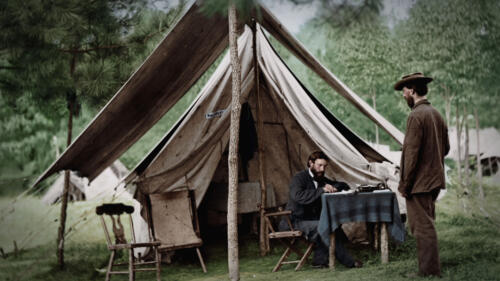
A soldier and land surveyor, Freeman is historically recognized as the first official homesteader. According to legend, he persuaded a land office registrar to open at midnight on January 1, 1863, so he could file his claim before departing for military duty.
Major Turning Points in Western Expansion
The trajectory of the Homestead Act was radically altered by two primary turning points: the American Civil War and the expansion of the railroads. The war itself acted as the political catalyst, clearing the legislative path of Southern obstructionists. Following the war, the rapid construction of railroad networks transformed the logistics of settlement. To connect these remote frontier settlements with the rest of the nation, the expansion of communication infrastructure was vital, particularly as the US Post Office delivered the mail across vast, newly settled territories, linking isolated sod houses to global markets and national news.
Long-Term Impact on America: Opportunity and Tragedy
The legacy of the Homestead Act is a study in profound dualities. On one hand, it democratized land ownership on an unprecedented scale. Over 120 years, the federal government granted 270 million acres of land—about 10% of the entire United States—to roughly 1.6 million homesteaders. This created a massive, self-reliant agrarian middle class and established the American Midwest as the “breadbasket of the world.” It also offered unique paths to independence for single women and freed slaves, who claimed land in significant numbers.
On the other hand, this massive reallocation of land had devastating consequences for Indigenous nations. The “public lands” distributed by the federal government were the ancestral territories of native tribes, including the Sioux, Cheyenne, Arapaho, and Lakota. To make way for homesteaders, the U.S. government systematically violated treaties, forced tribes onto reservations, and engaged in military campaigns to suppress native resistance. The loss of land, buffalo, and cultural autonomy initiated a legacy of intergenerational trauma that indigenous communities still navigate today.
Lesser-Known Facts About the Homestead Act
- The “12×14” Loophole: To secure a patent, homesteaders had to build a dwelling that was at least “12 by 14.” While the law meant feet, many clever speculators built tiny houses that were 12 by 14 inches, or rented portable cabins on wheels to move them from claim to claim to fool land inspectors.
- Unprecedented Independence for Women: Unlike many laws of the era, the Homestead Act allowed single, widowed, or divorced women to file claims in their own names. Thousands of independent women successfully “proved up” their land, fostering early feminist movements in western states like Wyoming and Colorado.
- The Final Homestead: The very last homestead claim was successfully made by Ken Deardorff on 80 acres of land in southwestern Alaska. He filed his claim in 1974 and received his official land patent in 1988.
Why It Still Matters Today
The Homestead Act continues to shape contemporary America. It is estimated that approximately 93 million Americans are direct descendants of those who received homestead patents. This massive transfer of wealth through land ownership laid the economic foundation for generations of American families. At the same time, the Act’s environmental legacy—including the intensive farming of the Great Plains—contributed directly to ecological disasters like the Dust Bowl of the 1930s. Today, as discussions around indigenous land rights, historical reparations, and federal land management continue, the Homestead Act remains a critical reference point for understanding how the modern United States was built.

People Also Ask (PAA)
Who qualified for the Homestead Act of 1862?
Any head of a household, or individual who was at least 21 years old, could qualify. This included U.S. citizens, freed slaves, single women, and immigrants who declared their intention to become citizens, provided they had never taken up arms against the U.S. government.
What were the requirements to “prove up” the land?
Homesteaders had to pay a small registration fee, live on the land continuously for five years, build a home, and cultivate the soil. If they met these requirements, they received full ownership (a patent) of the 160 acres.
Did the Homestead Act affect Native Americans?
Yes, profoundly. The act distributed millions of acres of tribal lands to settlers. The federal government used forced relocation, treaty breaking, and military force to clear Indigenous peoples from their ancestral homelands to accommodate homesteaders.
Conclusion
The Homestead Act of 1862 was a monumental piece of social engineering that transformed the geography and demography of the United States. While it stood as a beacon of democratic opportunity that allowed millions of everyday people to secure economic independence, it was simultaneously a catalyst for the tragic displacement of Native Americans. Understanding the Homestead Act requires confronting this complex legacy—celebrating the resilience of the homesteaders while acknowledging the historical injustices that paved the way for their success.


