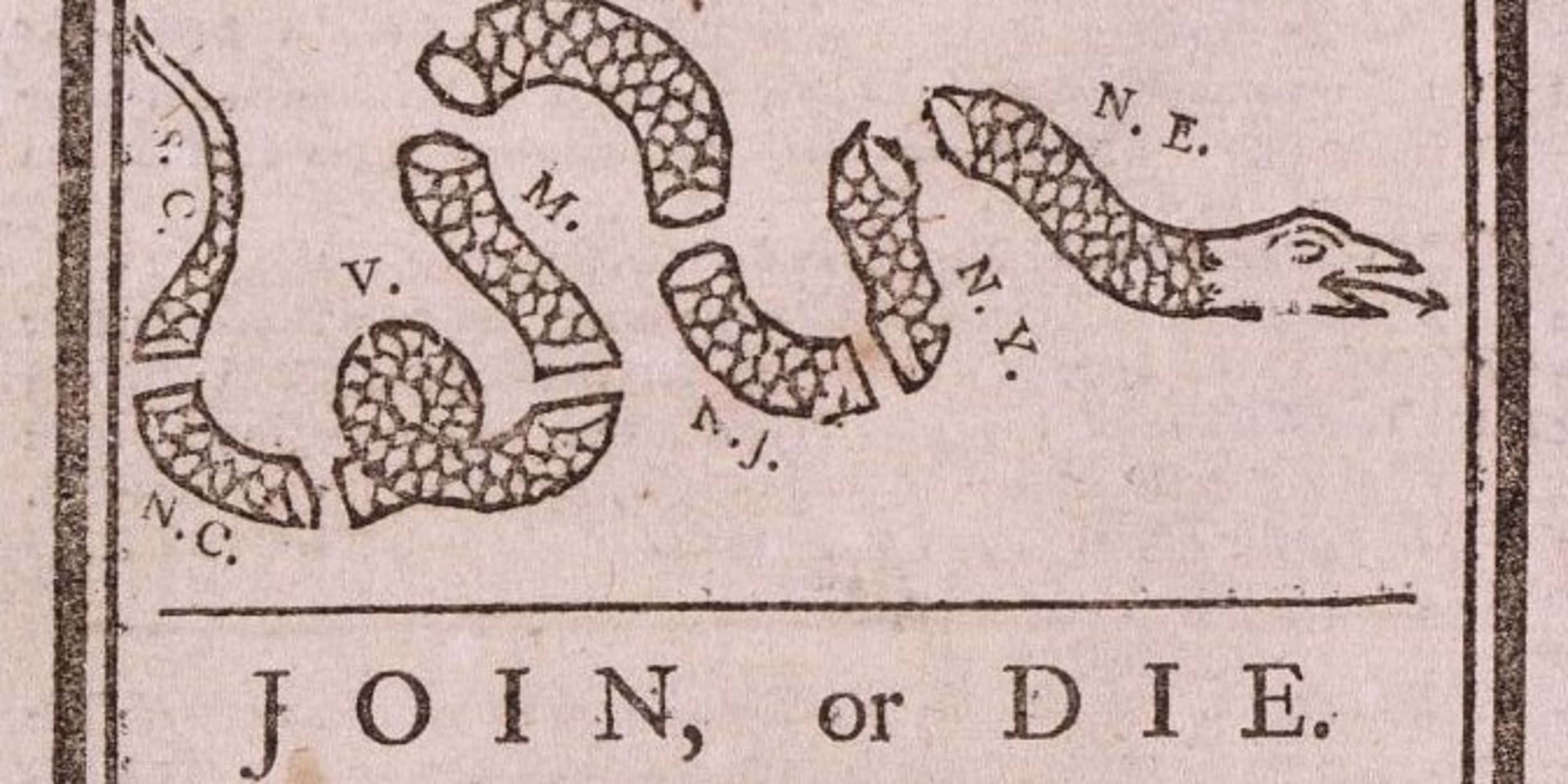
Long before the internet and social media memes became powerful instruments of political warfare, a visionary polymath in colonial Pennsylvania recognized the unparalleled power of visual storytelling. In May 1754, Benjamin Franklin published what is widely considered the first viral image in American history: the famous Join or Die political cartoon. Depicting a timber rattlesnake severed into eight distinct segments, this stark graphic was a desperate, urgent plea for solidarity among the fractured and often combative British colonies. At the time, North America was on the precipice of a global conflict, and Franklin understood that without immediate collaboration, the colonies would be systematically destroyed. While his initial proposal for a unified government failed to gain traction, the “Join or Die” motif evolved from a local rallying cry into a timeless symbol of American revolutionary spirit. Understanding the origin, evolution, and rhetorical power of Benjamin Franklin’s Join or Die cartoon is critical to appreciating how a disparate group of settlements transformed into a singular, united nation.
The Historical Background: A Fractured Colonial Landscape
In the early 1750s, the British colonies in North America were anything but united. They operated as distinct political entities, each with its own charter, colonial assembly, currency, and defense priorities. To understand why this unity was so difficult to achieve, one must examine the diverse 13 colonies map and history, which highlights how vastly different these provinces were in terms of economy, religion, and governance. Tensions between the British and French empires were escalating rapidly, particularly in the fertile lands of the Ohio River Valley. Both empires claimed this territory, and French military forces, alongside their indigenous allies, began constructing forts to solidify their dominance.
As French forces advanced, the western frontiers of Pennsylvania, Virginia, and New York faced imminent threat. Benjamin Franklin, then a prominent civic leader and the publisher of the Pennsylvania Gazette, recognized that a fragmented colonial defense would lead to ruin. He argued that the colonies’ reluctance to pool resources and coordinate military strategies made them highly vulnerable. On May 9, 1754, Franklin published an editorial warning his readers of French incursions. To drive the point home for an audience that possessed varying levels of literacy, he accompanied his writing with a simple yet striking visual: a woodcut illustration of a segmented snake.
A Chronological Timeline of the Cartoon’s Journey
The “Join or Die” cartoon did not merely exist in a single historical moment; it experienced a fascinating evolution across two major wars. Below is a chronological breakdown of its history:
- May 9, 1754: Benjamin Franklin publishes the woodcut in the Pennsylvania Gazette in Philadelphia, Pennsylvania.
- May-June 1754: The cartoon is reprinted in more than half a dozen other early American newspapers, spreading the message of colonial unity rapidly across the eastern seaboard.
- June 1754: The Albany Congress meets in Albany, New York. Franklin presents his Albany Plan of Union, which is approved by the delegates but ultimately rejected by colonial assemblies and the British Crown.
- 1754–1763: The French and Indian War rages. The colonies remain militarily separate, relying heavily on British regulars.
- 1765: The Stamp Act crisis begins. Colonists, protesting British taxation without representation, resurrect the severed snake to symbolize opposition to Parliament.
- 1774: As the American Revolution approaches, Paul Revere integrates a version of the snake battling a British dragon into the masthead of The Massachusetts Spy.
Key Figures Behind the Movement
Several notable historical figures played pivotal roles in creating, disseminating, and repurposing the iconic cartoon:
1. Benjamin Franklin (1706–1790)
The mastermind behind the “Join or Die” concept, Franklin was a printer, author, scientist, and statesman. His role was both intellectual and practical: he recognized the geopolitical threat, designed the communication strategy, and drafted the political blueprint for colonial union. His legacy as the “First American” is deeply tied to this early push for federalism.
2. Paul Revere (1735–1818)
Best known for his midnight ride, Revere was also an accomplished silversmith and engraver. Two decades after Franklin’s original publication, Revere recognized the enduring rhetorical power of the snake. He adapted the image for revolutionary propaganda, transforming it from a symbol of imperial defense into a symbol of anti-imperial defiance.
3. Richard Partridge
A Quaker merchant who served as Pennsylvania’s colonial agent in London. Franklin mailed the cartoon and editorial to Partridge in 1754, hoping to influence British policymakers. This move showed Franklin’s early grasp of global public relations, even though British officials viewed the prospect of a united colonial government with extreme suspicion.
Causes, Context, and the Albany Plan of Union
The sociopolitical context of 1754 was defined by imperial rivalry and colonial indifference. The British government, wary of the expense of defending its American territories, urged colonial governors to form a joint defensive alliance. This led to the Albany Congress in June 1754. Franklin used this gathering to propose the Albany Plan of Union, a revolutionary document that outlined a unified colonial government. Under his plan, a “Grand Council” of representatives from each colony would handle defense, raise armies, and levy taxes, all overseen by a President General appointed by the British monarch.
Despite the logic of Franklin’s proposal, it faced insurmountable obstacles. The individual colonies were fiercely protective of their autonomy and tax-levying powers. Simultaneously, the British Parliament feared that a united colonial assembly would become too powerful and difficult to control. Consequently, the plan was rejected by both sides. Instead of a coordinated colonial force, Great Britain dispatched its own army, setting the stage for the global conflict known as the Seven Years’ War. To learn more about how these colonies operated during this era, check out these fascinating facts about the 13 colonies.
Major Turning Points: Rebirth in the American Revolution
The true genius of the “Join or Die” cartoon lies in its adaptability. The first major turning point occurred during the Stamp Act Crisis of 1765. When Great Britain imposed direct taxes on the colonies to pay off war debts, the colonists found themselves united by a shared grievance. Patriots pulled the severed snake out of the historical archives. It was no longer about uniting under the British Crown to fight the French; it was about uniting against the British Crown to protect colonial liberties.
The second major turning point occurred in 1774, when the Coercive Acts (Intolerable Acts) were passed. Newspapers in Boston, New York, and Pennsylvania replaced their traditional mastheads with variations of Franklin’s snake. The snake was no longer just an “emblem” of colonial defense; it had become an active, menacing warning to the British Empire. This shift in meaning laid the psychological foundation for the Declaration of Independence in 1776.
The Long-Term Impact on America
The long-term impact of Benjamin Franklin’s cartoon cannot be overstated. Structurally, the debates surrounding the Albany Plan of Union served as a rough draft for the future United States. The concept of proportional representation and a federal government overseeing state-level assemblies directly influenced the Articles of Confederation and, eventually, the United States Constitution.
Culturally, the cartoon established a rich tradition of American political satire and editorial cartooning. It proved that complex geopolitical arguments could be distilled into simple, universally understood symbols. Furthermore, the timber rattlesnake became a permanent fixture of American iconography, directly inspiring the famous Gadsden Flag (“Don’t Tread on Me”) which remains a prominent political symbol to this day.
Lesser-Known Facts and Surprising Anecdotes
- The Missing Colonies: The snake is divided into only eight pieces, not thirteen. Franklin combined the four New England colonies (New Hampshire, Massachusetts, Connecticut, and Rhode Island) into “N.E.” to emphasize their regional solidarity. He omitted Delaware, which shared a governor with Pennsylvania, and Georgia, which was deemed too young and distant to contribute effectively to defense.
- The French Connection: The artistic concept may have been borrowed from a 1685 French book of emblems, which featured a split snake alongside the phrase se rejoindre ou mourir (“will join or die”). Franklin, a known Francophile, likely adapted this image for his own campaign.
- The Sunset Folklore: The cartoon capitalized on a popular 18th-century superstition. Many colonists believed that if a snake were cut into pieces, it would miraculously come back to life if its segments were reassembled before the sun set. This folklore gave the image a powerful spiritual connotation of resurrection and renewal.
Why the “Join or Die” Cartoon Still Matters Today
Today, Franklin’s woodcut is celebrated as America’s first political meme. In the digital age, we take for granted the speed with which images can go viral to shape public opinion. Franklin understood this dynamic 270 years ago. In an era when literacy was limited, a simple drawing of a divided snake could communicate a complex, urgent message instantly. It serves as a historical reminder of the power of media, the importance of civic unity during times of crisis, and the delicate balance between individual state autonomy and federal union—a debate that continues to define American politics today.
People Also Ask (FAQ)
What did the “Join or Die” snake represent?
The snake represented the British colonies in North America. Each segment of the severed snake was labeled with the initials of a colony or region, symbolizing that the colonies were physically fragmented and politically weak unless they united under a single government.
Why was the “Join or Die” cartoon created?
Benjamin Franklin created the cartoon in 1754 to encourage the colonies to unite and support the Albany Plan of Union. The goal was to establish a coordinated colonial government and military alliance to defend against French forces and their Native American allies during the French and Indian War.
Is “Join or Die” the first American political cartoon?
Yes, historians widely consider “Join or Die” to be the first political cartoon published in America. It was created and printed by Benjamin Franklin in the May 9, 1754, edition of the Pennsylvania Gazette.
Conclusion
Benjamin Franklin’s “Join or Die” cartoon is more than just a historical artifact; it is a testament to the power of visionary communication. By transforming a complex geopolitical crisis into a simple, visceral image, Franklin did not just rally his contemporaries—he designed a lasting symbol of American identity. Though the Albany Plan of Union failed, the spirit of the severed snake endured, ultimately binding thirteen highly independent colonies into a single, revolutionary union that changed the course of global history.


