Abner Doubleday is a name that resonates deeply within the annals of American heritage, yet it remains shrouded in one of the most persistent myths in sporting history. While millions of Americans recognize him as the supposed inventor of baseball, the historical reality of this Union general is far more fascinating, complex, and tied to the battlefields of the American Civil War. From aiming the very first Union shots fired in defense of Fort Sumter to leading desperate defensive lines on the bloody fields of Gettysburg, Doubleday was a dedicated military strategist, a staunch abolitionist, and a key figure during America’s most turbulent era. Understanding his life offers a captivating window into how early American society constructed its national identity through both military sacrifice and manufactured folklore.
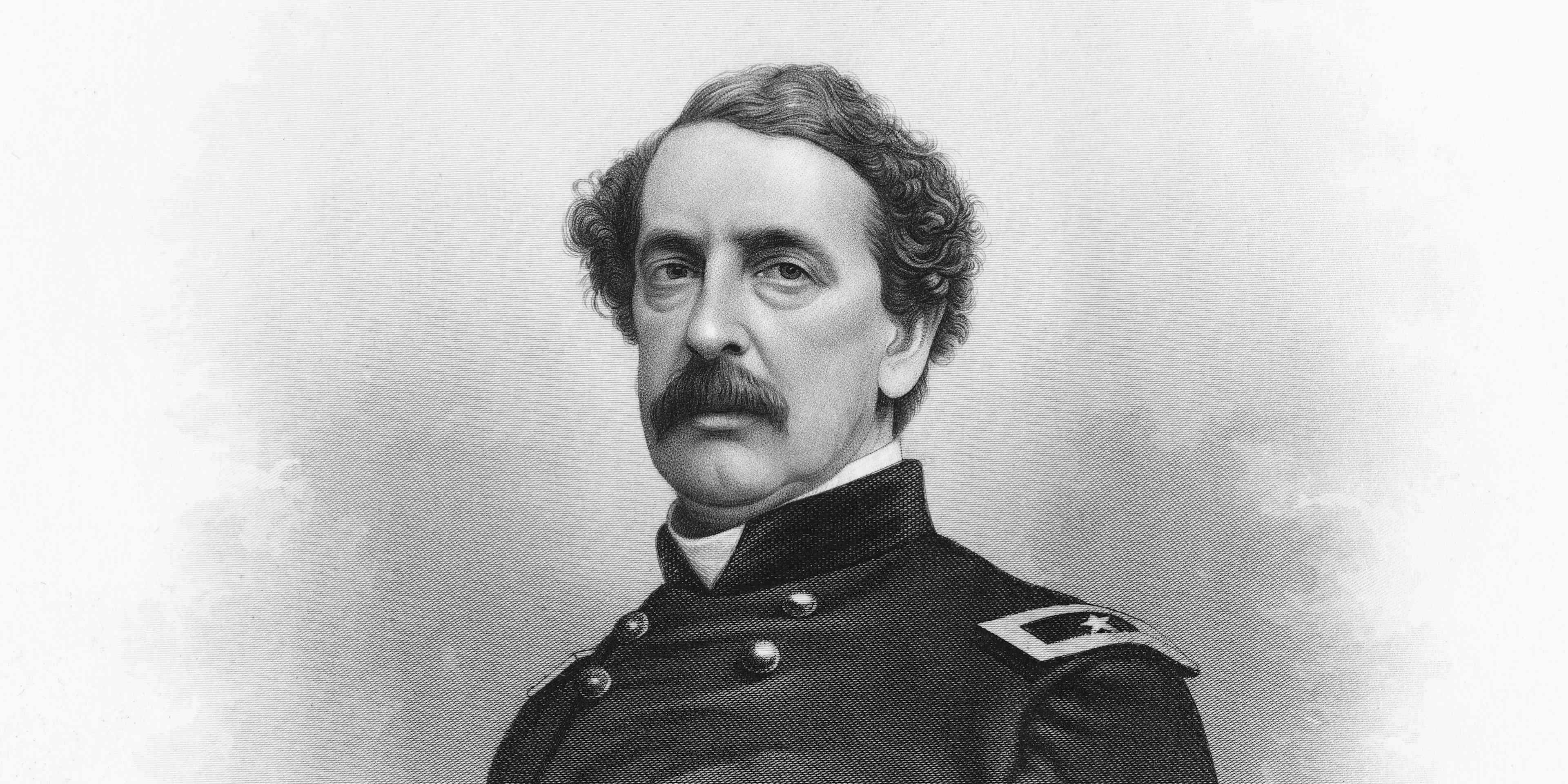
The Making of an Officer: Early Life and Military Genesis
Born on June 26, 1819, in Ballston Spa, New York, Abner Doubleday was destined for a life of public service. His father, Ulysses F. Doubleday, was a veteran of the War of 1812 and later represented New York as a U.S. Congressman. Raised in an intellectually stimulating household, young Abner initially pursued civil engineering, working as a surveyor for local railroads. However, his path shifted dramatically in 1838 when he received an appointment to the United States Military Academy at West Point. Graduating in 1842 alongside future Civil War icons, Doubleday began his active duty career as a brevet second lieutenant in the 3rd U.S. Artillery.
His early career was defined by garrison duties and active combat during the Mexican-American War (1846–1848), where he served as an artillery officer and managed critical supply lines in Camargo, Mexico. Following the war, Doubleday married Mary Hewitt in 1852 and was soon deployed to the difficult terrain of Florida during the Third Seminole War (1855–1858). These formative conflicts honed his administrative skills, tactical patience, and resilience—traits that would prove indispensable in the catastrophic civil conflict looming on the horizon.
The Spark of Rebellion: Fort Sumter and the Outbreak of War
By 1859, Doubleday was stationed at Fort Moultrie in Charleston Harbor, South Carolina. As an uncompromising abolitionist and a vocal supporter of Abraham Lincoln, Doubleday was deeply unpopular among the local secessionist population. As political tensions reached a boiling point following the election of 1860, Doubleday and the fort’s commander, Major Robert Anderson, recognized that Fort Moultrie was highly vulnerable to land-based militia attacks. In a stealthy midnight operation in December 1860, they abandoned Moultrie and relocated their garrison to the more defensible, water-bound Fort Sumter.
The standoff came to a violent climax on April 12, 1861, when South Carolina forces opened fire on the fort. As second-in-command, Doubleday was given the honor of aiming and ordering the first Union retaliatory shot of the Civil War, aiming a heavy 32-pounder gun at a Confederate battery on Morris Island. After an intense 36-hour bombardment, the heavily outgunned Union garrison was forced to surrender, but Doubleday and his men returned to the North as heroes, their defiance sparking the mobilization of the Union war effort.
Challenging Campaigns: From Bull Run to Antietam
Promoted to brigadier general of volunteers in early 1862, Doubleday was thrust into the brutal campaigns of the Eastern Theater. His first major test as a brigade commander came in August 1862 during the bloody Second Battle of Bull Run. Near Brawner’s Farm, Doubleday’s quick tactical thinking saw him dispatch reinforcements to aid General John Gibbon’s hard-pressed men, successfully holding off fierce assaults from Confederate General Thomas ‘Stonewall’ Jackson. Despite a subsequent Union retreat, Doubleday earned high marks for managing a disciplined rearguard action.
Shortly thereafter, during the Maryland Campaign in September 1862, Doubleday was elevated to divisional command within the I Corps. At the Battle of South Mountain, he successfully routed Confederate positions, and days later at the Battle of Antietam, his division bore the brunt of some of the bloodiest fighting of the entire war in the infamous ‘Cornfield.’ His steadfast leadership under fire earned him a promotion to major general of volunteers in November 1862. Despite subsequent setbacks at Fredericksburg and being held in reserve at Chancellorsville, Doubleday was poised to play a defining role in the war’s most critical turning point.
The Crucible of Gettysburg
On July 1, 1863, the opening day of the historic Battle of Gettysburg, Doubleday’s military career reached both its zenith and its most controversial moment. When I Corps commander General John F. Reynolds was killed by a sniper early in the engagement, Doubleday was suddenly thrust into overall command of the field. Facing an overwhelmingly superior force of advancing Confederates, Doubleday executed Reynolds’ stubborn defensive plan with remarkable tenacity.
For over five hours, his heavily outnumbered men held the vital high ground along the Chambersburg Pike, inflicting severe casualties on the Confederate forces. Though his lines eventually collapsed late in the afternoon, forcing a retreat through the streets of Gettysburg, Doubleday’s desperate stand bought invaluable time for the rest of the Union Army to arrive and fortify the dominant heights of Cemetery Hill and Culp’s Hill. Despite his heroism, Army of the Potomac commander General George Meade, influenced by false reports of Doubleday’s performance, unfairly relieved him of corps command. Embittered, Doubleday served bravely as a divisional commander for the remaining two days of the battle, sustaining a painful neck wound during Pickett’s Charge.
Post-War Reconstruction, Activism, and the Buffalo Soldiers
Following Gettysburg, Doubleday served in administrative capacities in Washington, D.C., where he investigated military corruption, blockade-running, and treason. After the war concluded in 1865, he chose to remain in the regular army. During the Reconstruction era, Doubleday served as a sub-assistant commissioner for the Freedmen’s Bureau in Texas, actively working to secure civil rights, education, and fair labor contracts for newly emancipated African Americans.
Later, he was appointed colonel of the 24th U.S. Infantry—an all-Black regiment commonly known as the Buffalo Soldiers. Stationed in Texas, Doubleday defended his soldiers against systemic racism and fought to ensure they received the same rations, equipment, and respect as white units. His dedication to racial justice cemented his legacy as a progressive military leader ahead of his time.
Deconstructing the Baseball Invention Myth
For generations, school children were taught that Abner Doubleday invented the game of baseball in a cow pasture in Cooperstown, New York, in the summer of 1839. This legendary tale, however, is entirely fictional. The myth was manufactured in 1905 by the Mills Commission, an investigative body assembled by sporting goods mogul Albert Spalding to prove that baseball was a purely American creation with no British roots (such as the game of Rounders).
The commission relied almost entirely on the highly suspect, unverified testimony of an elderly man named Abner Graves, who claimed to have seen Doubleday draw up the rules of the game in 1839. In reality, Doubleday was enrolled at West Point during the summer of 1839 and was not even in Cooperstown. Furthermore, Doubleday’s personal journals, letters, and extensive writings contain absolutely no mention of baseball, nor did he ever claim to have played or designed the game. Despite this debunking, the myth took a firm hold on American culture, leading to the establishment of the National Baseball Hall of Fame in Cooperstown.
Lesser-Known Historical Facts About Abner Doubleday
- The Cable Car Pioneer: While stationed as a recruitment officer in San Francisco during the early 1870s, Doubleday became fascinated by mechanical transport. He successfully filed and secured the very first patent for the city’s iconic cable car system, helping to shape the future of urban transportation.
- Spiritualism and Eastern Philosophy: In his later years, Doubleday moved to New Jersey and became a prominent member of the Theosophical Society. He eventually served as its president, translating classic Sanskrit texts and exploring spiritualism, Eastern mysticism, and reincarnation.
- A Literal Family of Generals: Military excellence ran deep in the family. His grandfather fought in the American Revolution, and his brother, Ulysses Doubleday, also achieved the rank of Union brevet brigadier general during the Civil War.
Why Abner Doubleday’s Legacy Matters Today
Abner Doubleday’s true historical footprint is far more valuable than the sport myth attached to his name. He represents the unsung, steady hand of the Union army—an officer who put duty, nation, and human rights above personal glory. By examining his life, modern observers gain a deeper appreciation for the operational realities of the Civil War, the complex politics of military command, and the early struggles for civil rights during Reconstruction. He reminds us that history is often shaped as much by the myths we create as by the genuine sacrifices made on the battlefield.
People Also Ask (FAQ)
Did Abner Doubleday actually invent baseball?
No, Abner Doubleday did not invent baseball. The claim was fabricated by the Mills Commission in the early 20th century to create an appealing, patriotic origin story for the sport. Historical evidence proves that baseball evolved gradually from earlier English games like Rounders and Cricket.
What was Abner Doubleday’s most significant Civil War achievement?
While Doubleday is famous for firing the first defensive Union shots at Fort Sumter, his most tactically significant achievement was on the first day of the Battle of Gettysburg. Taking command after General Reynolds was killed, Doubleday held off a superior Confederate force for hours, allowing the Union army to secure the highly defensible high ground that ultimately won the battle.
Where is Abner Doubleday buried?
Abner Doubleday died on January 26, 1893, at the age of 73. He is buried in Arlington National Cemetery in Virginia, where his grave is marked by an impressive granite monument honoring his decades of dedicated military service to the United States.
Conclusion
Though he may never have swung a bat or drafted the rules of a diamond, Abner Doubleday remains a towering figure in American history. As a dedicated West Point graduate, a brave combat commander, an advocate for freedmen, and a patent-holding innovator, his life was defined by intellectual curiosity and unwavering patriotism. Stripping away the baseball myth does not diminish Doubleday’s legacy; rather, it restores his rightful place in history as a true defender of the Union who helped steer the nation through its darkest hour.


