The Battle of Spotsylvania Court House stands as one of the most terrifying, relentless, and critical clashes of the American Civil War. Fought over nearly two grueling weeks in May 1864, this colossal confrontation marked a decisive transition in the conflict. Gone were the days of quick maneuvers and decisive single-day battles; instead, the war transformed into a brutal campaign of attrition that tested the psychological and physical limits of both armies. Following the bloody and indecisive fighting in the dense, flaming woods of the Wilderness, the Union’s newly appointed General-in-Chief, Ulysses S. Grant, made a choice that stunned both his own men and the Confederate high command: rather than retreating to lick his wounds, he ordered his troops to march deeper into enemy territory. This relentless advance set the stage for a dramatic race to the tiny crossroads of Spotsylvania, Virginia, where the blue and the gray would lock themselves in a death grip that would alter the course of American history forever.
Historical Background: The Crucible of the Overland Campaign
By the spring of 1864, the American Civil War had dragged on for three devastating years. In March of that year, President Abraham Lincoln made a pivotal decision, elevating Lieutenant General Ulysses S. Grant to command all Union forces. Grant’s grand strategy was simple yet revolutionary: rather than focusing solely on capturing geographic territory, he intended to apply simultaneous, unrelenting pressure on all Confederate armies across multiple theaters. While Major General William Tecumseh Sherman pushed deep into Georgia, Grant chose to travel alongside the Army of the Potomac, commanded by Major General George G. Meade, to directly confront General Robert E. Lee and his legendary Army of Northern Virginia. This relentless partnership between Abraham Lincoln and Ulysses S. Grant was determined to crush the rebellion, regardless of the cost.
The campaign commenced on May 4, 1864, when Union troops crossed the Rapidan River, marching straight into a tangled wasteland of second-growth forest known as the Wilderness. Lee, recognizing his numerical disadvantage, struck Grant in the dense undergrowth, neutralizing the Union’s superior artillery and troop numbers. After two days of horrific, close-quarters combat that saw the forest floor catch fire, burning wounded soldiers alive, the battle ended in a tactical draw. Traditionally, previous Union commanders would have retreated across the river to reorganize. However, Grant did not look back. On the night of May 7, he ordered his columns to march south, bypassed Lee’s right flank, and headed toward Richmond via a vital crossroads town: Spotsylvania Court House.
A Chronological Timeline of the Twelve Days of Spotsylvania
To understand the sheer magnitude of the Battle of Spotsylvania Court House, one must examine the chronological progression of this agonizing two-week struggle:
- May 7–8: The Race to the Crossroads. Grant’s nighttime march is delayed by congested roads and stubborn Confederate cavalry skirmishers. Recognizing Grant’s move, Lee sends his First Corps under Major General Richard H. Anderson to march through the night. The Confederates narrowly beat the Union vanguard to Spotsylvania Court House, immediately digging in and building formidable defensive breastworks.
- May 9: The Loss of a Union Icon. Both armies construct extensive earthworks. While placing his artillery, the beloved commander of the Union VI Corps, Major General John Sedgwick, is killed by a Confederate sharpshooter’s bullet from nearly a thousand yards away, just moments after reassuring his men that the enemy “couldn’t hit an elephant at this distance.”
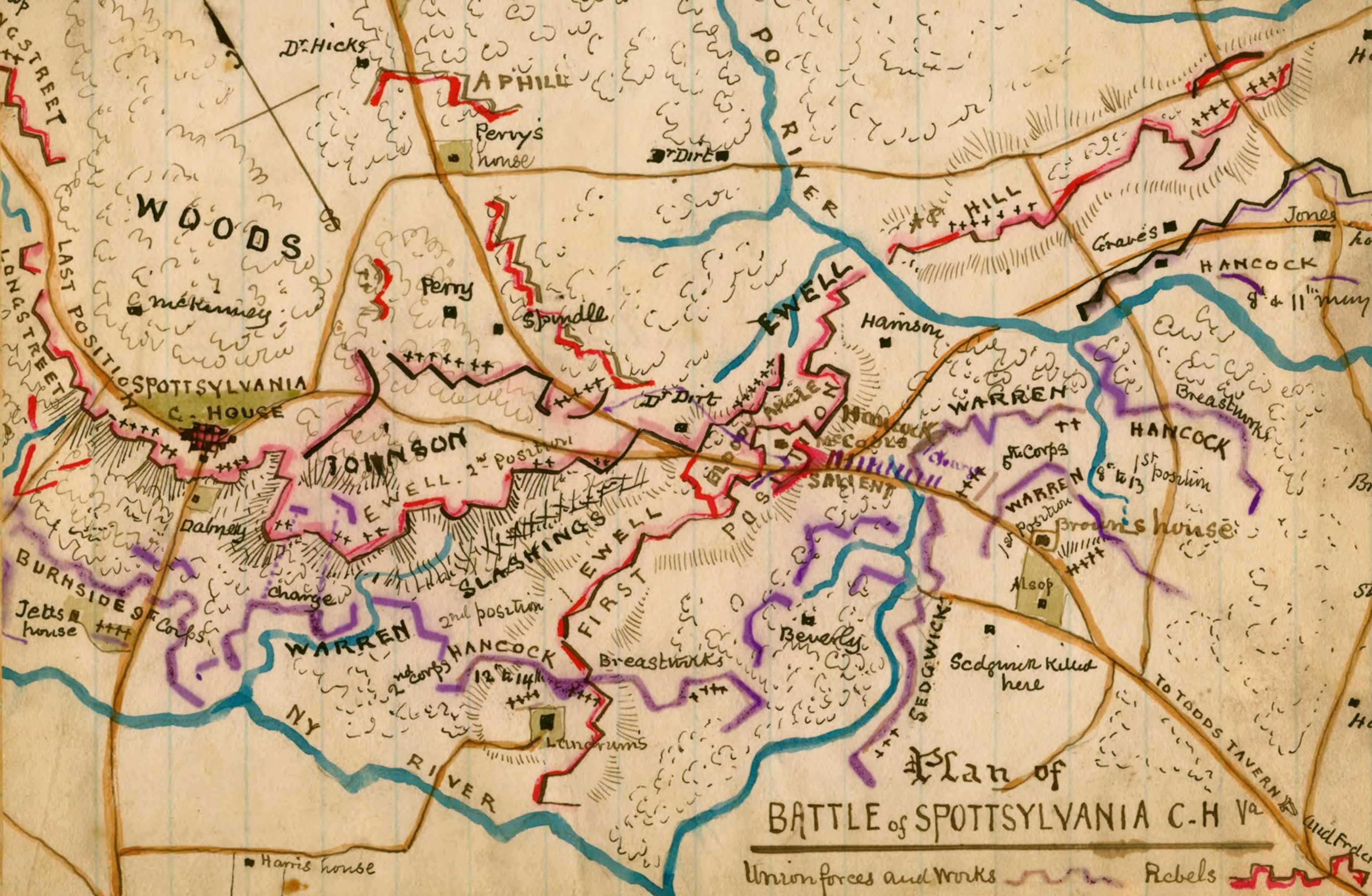
- May 10: Upton’s Daring Charge. Colonel Emory Upton leads a highly organized, fast-moving column of twelve Union regiments to storm a vulnerable section of the Confederate line known as the “Mule Shoe” salient. Upton successfully breaches the line but is forced to withdraw due to a lack of timely reinforcements.
- May 11: The Ride of Yellow Tavern. Six miles north of Richmond, Union cavalry under Major General Philip Sheridan clashes with Confederate horsemen. In this fierce battle, the legendary Confederate cavalry commander, Major General J.E.B. Stuart, is mortally wounded, depriving Lee of his eyes and ears.
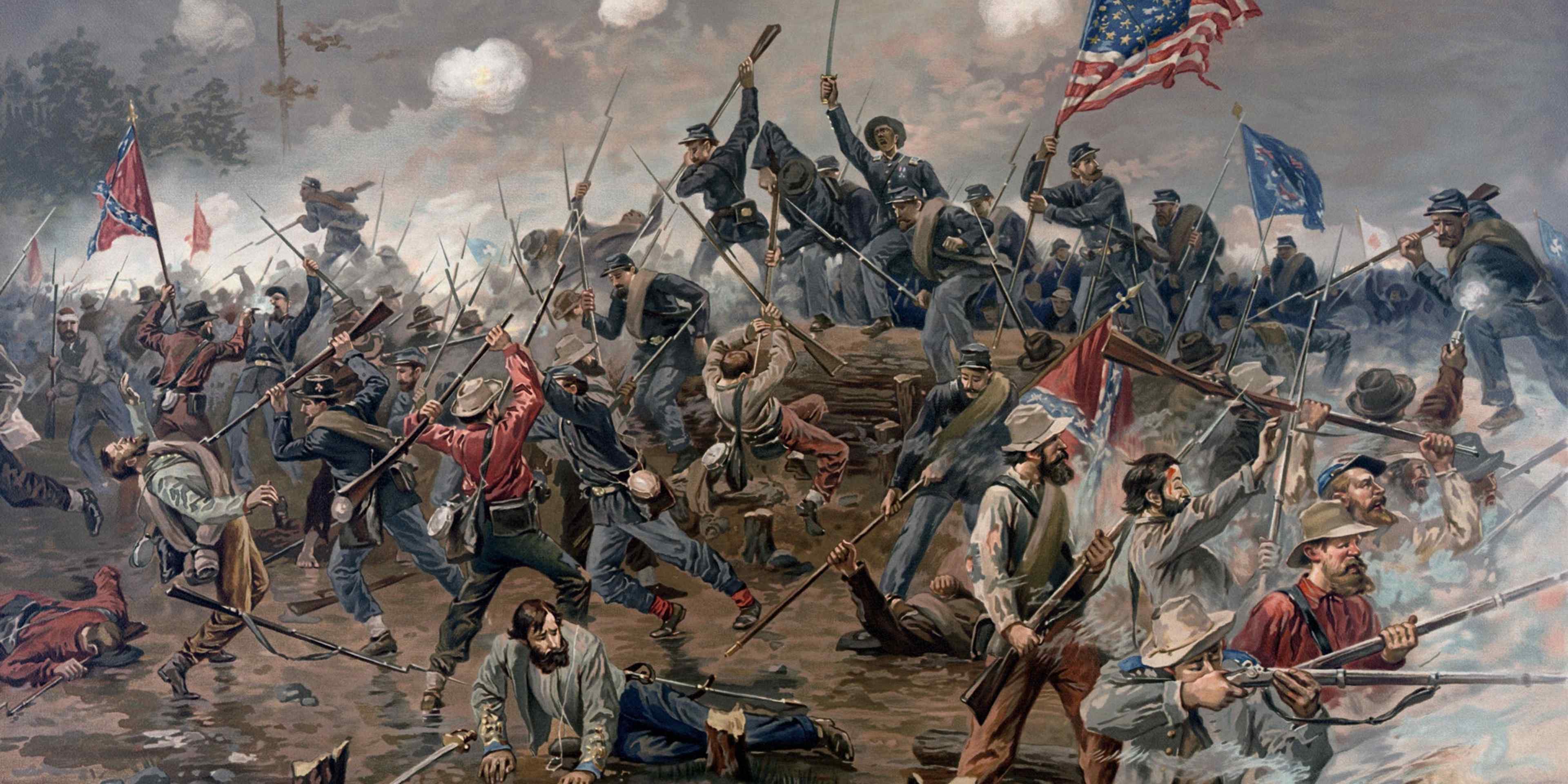
- May 12–13: The Horror of the Bloody Angle. Grant launches a massive dawn assault using Major General Winfield Scott Hancock’s II Corps against the apex of the Mule Shoe. What follows is 20 continuous hours of savage, rain-slicked, hand-to-hand combat, cementing the location’s dark legacy as the “Bloody Angle.”
- May 18: The Final Assault. After days of heavy rains that turned the battlefield into a quagmire of mud and decomposing bodies, Grant makes one final, desperate attempt to break Lee’s newly constructed defense lines. The attack is easily repulsed by devastating Confederate artillery fire.
- May 19: The Clash at Harris Farm. Lee attempts a flanking maneuver to locate the Union right flank, resulting in a bloody engagement at Harris Farm. Both sides suffer heavy casualties before the Confederates are driven back.
- May 21: Grant Moves South. Concluding that Lee’s entrenched positions cannot be breached, Grant disengages his army and continues his flanking march toward Richmond, heading next toward the North Anna River and eventually Cold Harbor.
Key Figures and Their Strategic Impact
The human drama of Spotsylvania was driven by a cast of formidable leaders whose decisions shaped the fate of the nation:
General Ulysses S. Grant
Representing a new breed of modern general, Grant demonstrated his relentless grit during this campaign. When facing immense pressure and staggering casualties, he famously sent a dispatch to Washington declaring, “I propose to fight it out on this line if it takes all summer.” Ulysses S. Grant’s brilliant military leadership was defined by his understanding of global logistics, resource management, and the grim reality that keeping the pressure on Lee was the only way to end the Confederacy.
General Robert E. Lee
Faced with shrinking resources and manpower, Lee showcased his mastery of defensive warfare. Relying on advanced field fortifications, Lee managed to anticipate Grant’s movements and repeatedly block him. However, the battle also exposed Lee’s desperation; at several points, including during the chaos of the May 12 breakthrough, Lee attempted to lead counterattacks personally, only to have his devoted soldiers physically seize his horse and shout, “Lee to the rear!”
Colonel Emory Upton
At just 24 years old, Upton realized that traditional, wide-front infantry charges against fortified positions were suicidal. He devised a tactical innovation: massing his men into a tight, deep column, charging across open ground without stopping to fire, and relying on the bayonet to breach the line. His successful, though temporary, breakthrough at the Mule Shoe earned him a promotion to brigadier general and foreshadowed the trench assault tactics of World War I.
Turning Points: The Crucible of the “Bloody Angle”
The undisputed climax of the battle occurred at the “Bloody Angle,” a small bend in the massive “Mule Shoe” salient. When Hancock’s Union II Corps swept over the Confederate works in the foggy dawn of May 12, they captured over 3,000 Confederate prisoners and threatened to split Lee’s army in half. Desperate to plug the gap, Lee threw in reinforcements under Brigadier General John B. Gordon.
For the next twenty hours, the fighting devolved into a primal struggle. Men fought hand-to-hand, stabbing with bayonets, clubbing with rifle butts, and firing blindly through crevices in the log breastworks. Rain poured down, filling the trenches with a sickening mixture of water, blood, and mud, where wounded men drowned under the weight of the dead. The sheer volume of minié balls flying through the air was so intense that a 22-inch thick white oak tree was completely sheared through by gunfire alone. By midnight, Confederate engineers had completed a secondary line of defenses at the base of the salient, and Lee’s battered survivors finally slipped back, leaving behind a trench filled to the brim with bodies.
Long-Term Impact on the Nation
The battle resulted in approximately 18,000 Union casualties and 12,000 Confederate casualties, making it one of the costliest engagements of the war. Its historical impact can be measured across multiple fronts:
Politically, the staggering losses of both the Wilderness and Spotsylvania shocked the Northern public, fueling a wave of war weariness and severely testing Lincoln’s reelection efforts. However, strategically, the battle was a disaster for the Confederacy. While Lee had successfully defended his position and prevented a breakthrough, he could not replace his losses. Grant, supported by a vast Northern population and industrial base, could easily replenish his ranks. Additionally, the sheer scale of deaths during this campaign significantly advanced America’s funeral industry, accelerating the development of modern embalming techniques, transit protocols for the dead, and the establishment of national cemeteries to honor the fallen.
Lesser-Known Facts about Spotsylvania Court House
- The Sheared White Oak Tree: The stump of the famous 22-inch white oak tree, entirely cut down by bullet strikes during the firefight at the Bloody Angle, was salvaged after the war. It is now preserved and displayed in the Smithsonian National Museum of American History as a silent witness to the unmatched intensity of Civil War fire.
- The Sharpshooter’s Irony: Major General John Sedgwick’s death on May 9 remains one of the most famous ironies in military history. His last words, assuring his nervous soldiers that Confederate snipers could not hit an elephant at that distance, were cut short by a Whitworth rifle bullet that struck him just below his left eye.
- Water-logged Trenches: The torrential rains during the battle of May 12-14 were so severe that some trenches became mini-canals. Dozens of wounded soldiers from both sides, unable to crawl out of the deep mud and water due to their injuries, tragically drowned in the very earthworks they were fighting to defend.
Why the Battle of Spotsylvania Still Matters Today
The Battle of Spotsylvania Court House is more than just a grim catalog of casualties; it represents the birth of modern, industrial warfare. The extensive use of field fortifications, subterranean dugouts, and rapid-fire trench defense served as a direct precursor to the agonizing stalemate of the Western Front in World War I. Today, the preserved battlefield, managed by the National Park Service as part of the Fredericksburg and Spotsylvania National Military Park, stands as a solemn monument to human endurance, the high cost of freedom, and the ultimate preservation of the Union.
People Also Ask (FAQs)
Who won the Battle of Spotsylvania Court House?
The battle was tactically inconclusive, as neither side succeeded in breaking the other’s lines. However, it was a major strategic victory for the Union. Instead of retreating after heavy losses, Grant continued to push south, forcing Lee’s depleted army onto the defensive and drawing them closer to Richmond.
What made the “Bloody Angle” so famous?
The “Bloody Angle” is famous for hosting perhaps the most intense, prolonged, close-quarters hand-to-hand combat of the entire Civil War. For nearly 20 continuous hours, soldiers fought separated only by a wall of pine logs, under a torrential downpour, in conditions of unimaginable brutality.
What was the “Mule Shoe” salient?
The “Mule Shoe” was a massive, U-shaped outward bulge in the Confederate defensive line. It was designed to cover a key ridge, but its curved shape made it highly vulnerable to being surrounded and attacked from multiple sides, which is exactly what Grant attempted to exploit on May 10 and May 12.
Conclusion
The Battle of Spotsylvania Court House remains a testament to the unyielding resolve of two deeply committed armies. It illustrated the terrifying evolution of 19th-century combat into an era of total war, characterized by trenches, high-density small arms fire, and strategic attrition. While the physical scars on the Virginia landscape have long healed, the memory of those who fought and died in the mud of the Mule Shoe and the Bloody Angle continues to serve as an enduring reminder of the immense sacrifice required to forge modern America.


