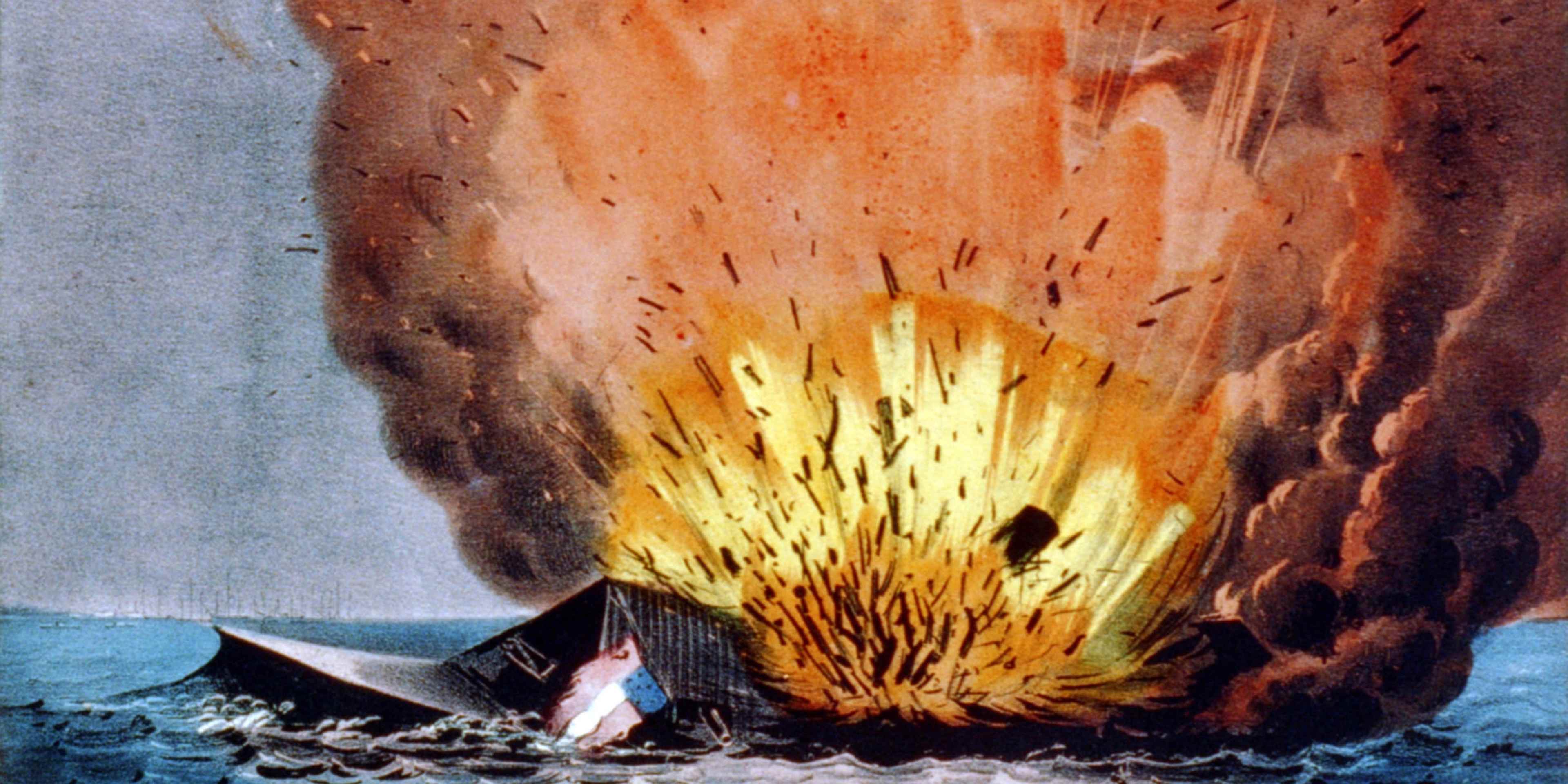
On the cold morning of March 9, 1862, off the coast of Virginia, the course of global naval warfare changed in an instant. The Battle of Hampton Roads, famously known as the historic duel between the USS Monitor and the CSS Virginia (formerly the USS Merrimack), represents one of the most transformative chapters in the American Civil War history. It was not just a clash of iron; it was the death knell of the wooden warship era and the dawn of modern naval engineering. Fought at the mouth of the Elizabeth, Nansemond, and James rivers, this legendary engagement shook the foundations of military doctrine worldwide. For the Union, it was a desperate race to preserve a critical naval blockade. For the Confederacy, it was a bold, technologically ambitious bid to break that very chokehold and command the waterways of Virginia. Although the tactical outcome of this monumental battle remained technically inconclusive, the shockwaves it sent through global empires—from Washington to London and Paris—reverberated across the globe, signaling to all that the age of sail and oak was officially over.
Historical Background: The Crisis at Sea
At the outset of the American Civil War in 1861, Union President Abraham Lincoln recognized that the key to defeating the Confederacy lay in choking its economy. The Union Navy instituted a vast naval blockade—part of General Winfield Scott’s famed Anaconda Plan—to seal off Southern ports and prevent the export of cotton and the import of European war materials. Confederate leaders, particularly Secretary of the Navy Stephen Mallory, knew that the South lacked the industrial capacity to build a conventional navy that could challenge the North’s wooden fleet. Thus, they turned to an asymmetrical and highly experimental solution: ironclad warships.
In April 1861, as Union forces hastily evacuated the Gosport Navy Yard in Portsmouth, Virginia, they scuttled and burned several vessels, including the powerful 40-gun steam frigate USS Merrimack. Rather than letting her rot, the Confederates raised the hull of the Merrimack from the mud of the Elizabeth River. Under the direction of designers like John L. Porter and William P. Williamson, they chopped away her burned upper works, covered her in massive, sloped iron armor plating, and fitted her with a devastating cast-iron ram on her bow. Rechristened the CSS Virginia, this metal-sheathed leviathan was designed to steam into Hampton Roads and shatter the Union blockade once and for all.
Causes and Context: The Ironclad Race
When intelligence of the Confederacy’s armored project reached Washington, panic ensued. The Union’s wooden blockading fleet at Hampton Roads, consisting of proud traditional warships like the USS Cumberland, the USS Congress, and the USS Minnesota, suddenly appeared defenseless. In response, Gideon Welles, the Union’s Secretary of the Navy, formed an Ironclad Board to review armored designs. They selected a radical, futuristic proposal by a brilliant Swedish inventor named John Ericsson. While the South worked to convert the Merrimack, Ericsson labored in New York to build a brand-new type of vessel from scratch: the USS Monitor.
The race was neck-and-neck. If the Virginia could break out before the Monitor arrived, she could systematically destroy the Union fleet, open Richmond and Norfolk to international trade, and potentially invite European powers like Britain or France to intervene in the war.
Key Events Timeline
- April 20, 1861: Retreating Union forces burn and scuttle the USS Merrimack at the Gosport Navy Yard in Virginia.
- June 1861: Confederate salvage operations successfully raise the Merrimack, launching an ambitious project to rebuild her as an ironclad.
- February 17, 1862: The rebuilt ship is officially commissioned into the Confederate Navy as the CSS Virginia.
- February 25, 1862: In Brooklyn, New York, the highly innovative USS Monitor is officially commissioned into the United States Navy.
- March 8, 1862 (Day One – The Onslaught): The CSS Virginia, commanded by Flag Officer Franklin Buchanan, steams into Hampton Roads. She rams and sinks the USS Cumberland and forces the USS Congress to surrender before setting her ablaze. The wooden Union fleet is utterly helpless.
- March 8, 1862 (Night): The USS Monitor, commanded by Lieutenant John L. Worden, arrives in Hampton Roads after a treacherous sea voyage from New York, taking up a defensive position near the grounded USS Minnesota.
- March 9, 1862 (Day Two – The Duel): The USS Monitor and CSS Virginia engage in a relentless, four-hour, close-range battle. Neither ship can penetrate the other’s iron armor, resulting in a tactical stalemate.
Important Figures and Their Impact
John Ericsson
The genius Swedish engineer John Ericsson was the mastermind behind the USS Monitor. His design featured over 40 patented inventions. Instead of traditional broadsides, Ericsson placed two massive 11-inch Dahlgren smoothbore guns inside a centrally located, steam-powered rotating turret. The vessel rode incredibly low in the water—with only 18 inches of ironclad deck exposed—rendering her an exceptionally difficult target to hit.
Flag Officer Franklin Buchanan
The aggressive and highly experienced Franklin Buchanan was the commander of the CSS Virginia. On the first day of the battle, he demonstrated the absolute lethality of iron over wood. However, during the surrender of the USS Congress, Buchanan went topside and was shot in the thigh by Union musket fire from the shore. This wound forced him to turn over command to his executive officer, Lieutenant Catesby ap Roger Jones, who would pilot the vessel during the fateful duel on March 9.
Lieutenant John L. Worden
Lieutenant Worden commanded the USS Monitor during its baptism by fire. He bravely stood in the pilot house, directing the ship’s movements. During the climax of the battle, a Confederate shell exploded directly against the viewing slit of the pilot house, temporarily blinding Worden and covering his face with gunpowder. Although he was forced to hand command over to Lieutenant Samuel Dana Greene, his resolute leadership saved the Union fleet from annihilation.
Major Turning Points in the Battle
The Battle of Hampton Roads had several pivotal moments that altered the course of naval history:
- The Ramming of the Cumberland: This event proved that ironclads could easily destroy the strongest wooden warships of the era. However, when the Virginia rammed the Cumberland, the heavy cast-iron ram broke off and remained lodged in the sinking Union ship. This loss significantly weakened the Virginia’s offensive capability for the following day’s duel.
- The Intervention of the Monitor: As the CSS Virginia prepared to destroy the grounded USS Minnesota on March 9, the strange, low-lying USS Monitor—described by onlookers as “a cheese box on a raft”—stepped in. This dramatic entry transformed a one-sided massacre into a balanced, historic confrontation.
- The Shelling of the Monitor’s Pilot House: When the CSS Virginia’s gunners targeted the Monitor’s small steering station, they successfully injured Captain Worden. The resulting confusion caused the Monitor to drift momentarily, giving the Virginia the opportunity to retreat toward Norfolk, effectively ending the battle.
Long-Term Impact on America and Global Navies
The immediate strategic result of the Battle of Hampton Roads was a draw; neither ship suffered terminal damage, and both sides claimed victory. However, the long-term impact was revolutionary. This single engagement rendered every wooden navy on Earth obsolete overnight. European powers, who had spent centuries building massive wooden fleets, immediately stopped construction on wooden ships and shifted entirely to ironclad technology.
Furthermore, the battle successfully preserved the Union blockade, ensuring that the Confederacy remained economically strangled. This naval preservation allowed the Union to execute major land campaigns and secure pivotal turning points, much like other 7 major Civil War battles that defined the conflict. It also highlighted the massive industrial superiority of the North, which rapidly produced dozens of Monitor-class warships, while the blockaded South struggled to build even a handful. Over time, the structural changes of the Union military forced a reliance on diverse manpower and demographic contributions, such as the overlooked role of Asian soldiers in the Civil War who fought on both sides of the conflict, reflecting a slowly evolving American military fabric.
Lesser-Known Facts and Historical Trivia
- The Name Confusion: Many people refer to this event as the battle between the “Monitor and the Merrimack.” However, the Merrimack was the Union name of the ship before she was burned. During the battle, she was officially the Confederate vessel CSS Virginia.
- “Roads” Does Not Mean Streets: The “Roads” in Hampton Roads does not refer to paved streets. In nautical terminology, a “road” or “roadstead” is a sheltered body of water near a harbor where ships can safely ride at anchor.
- Sinking and Scuttling: Neither ship survived the year 1862. When Union forces captured Norfolk in May 1862, the retreating Confederates blew up the CSS Virginia to prevent her from falling into enemy hands. Meanwhile, the USS Monitor sank in a fierce gale off Cape Hatteras, North Carolina, on December 31, 1862, taking 16 brave crewmen down with her.
Why It Still Matters Today
The Battle of Hampton Roads remains the foundational blueprint of the modern navy. John Ericsson’s concept of a heavily armored hull, steam propulsion, a low profile, and a rotating gun turret is the direct ancestor of every modern battleship, destroyer, and aircraft carrier sailing today. Moreover, the preservation efforts of the USS Monitor’s wreckage—which was discovered in 1973 and is now conserved at the Mariners’ Museum in Newport News, Virginia—continue to yield extraordinary insights into nineteenth-century metallurgy, maritime archaeology, and naval engineering.
People Also Ask
Who won the Battle of Hampton Roads?
The battle itself was a tactical draw. Neither the USS Monitor nor the CSS Virginia was able to penetrate the other’s armor or cause catastrophic damage. However, it was a strategic victory for the Union, as the Monitor successfully defended the remaining wooden fleet and preserved the vital Union blockade.
What were the two main ships in the Battle of Hampton Roads?
The two primary ships were the USS Monitor, representing the United States (Union), and the CSS Virginia (built from the salvaged remains of the USS Merrimack), representing the Confederate States.
Why was the Battle of Hampton Roads so important?
It was the first-ever naval battle between steam-powered, ironclad warships. It instantly proved that wooden warships were obsolete and revolutionized naval warfare design across the globe.
Conclusion
The Battle of Hampton Roads was more than a mere Civil War skirmish; it was a watershed moment that permanently altered the trajectory of human technology. When the smoke cleared over the Chesapeake Bay on March 9, 1862, the world’s great military powers looked on in awe. In a single weekend, centuries of naval traditions, wooden hulls, and billowing sails were swept into the annals of history, replaced by the relentless march of industrial iron, steam, and revolving steel turrets.


