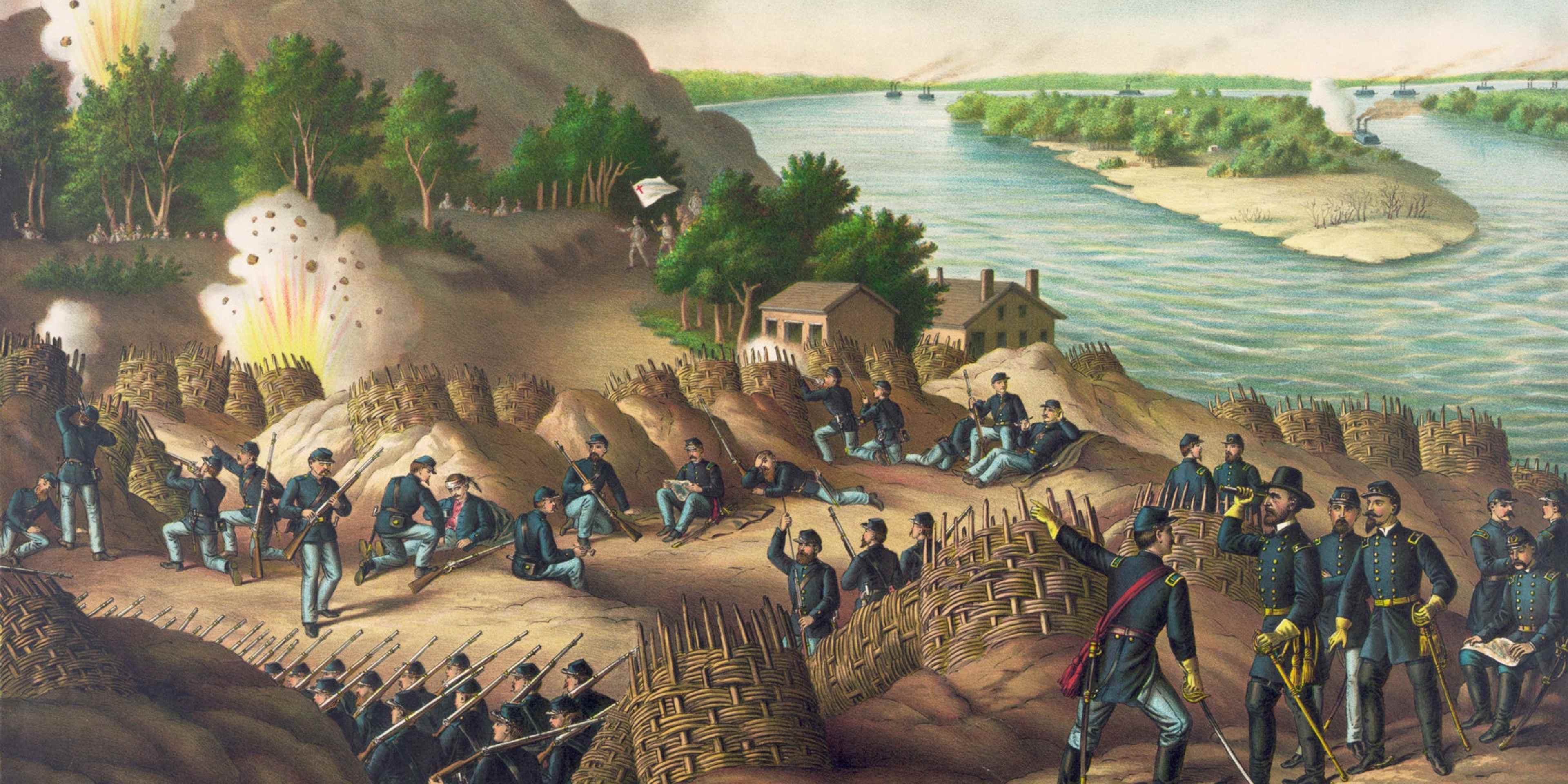
The Battle of Vicksburg stands as one of the most intellectually complex and strategically decisive campaigns of the American Civil War. Situated high on the bluffs of the Mississippi River, the fortified city of Vicksburg, Mississippi, acted as a formidable gateway, blocking Union access to the vital waterway and keeping the western Confederate states bound to the east. For months, Union General Ulysses S. Grant sought a way to pierce this southern citadel, culminating in a grueling 47-day siege that permanently fractured the Confederacy. The success of this campaign proved crucial to upholding the democratic union and the political ideals originally envisioned in the founding documents of the United States. By securing the Mississippi, the Union not only executed a major phase of the Anaconda Plan but also fundamentally altered the trajectory of the war.
Historical Background: Why Vicksburg Was “The Key”
In the spring of 1863, the American Civil War was at a precarious crossroads. While Confederate General Robert E. Lee was preparing to march his Army of Northern Virginia toward Pennsylvania, Union leaders in the West focused on a single, vital objective: Vicksburg. Located halfway between Memphis, Tennessee, and New Orleans, Louisiana, Vicksburg was the final obstacle preventing the Union from gaining total control of the Mississippi River. This grand river was the ultimate economic highway of 19th-century America. For Midwestern states loyal to the Union, losing the ability to transport goods down the Mississippi to the Gulf of Mexico was economically devastating. Conversely, the Confederacy used Vicksburg as a vital gateway to import cattle, grain, and munitions from the resource-rich Trans-Mississippi states of Texas, Arkansas, and Louisiana.
President Abraham Lincoln summed up the strategic reality perfectly: “Vicksburg is the key. The war can never be brought to a close until that key is in our pocket.” Confederate President Jefferson Davis was equally aware of its value, referring to the city as “the nailhead that holds the South’s two halves together.” Under the command of Confederate Lieutenant General John C. Pemberton, Vicksburg was fortified with heavy artillery batteries and protected by deep, muddy bayous and steep, clay hillsides, making any direct military approach a monumental challenge.
The Masterclass Campaign: Grant’s Bold Spring Maneuver
Major General Ulysses S. Grant’s first attempts to capture Vicksburg in the winter of 1862–1863 were catastrophic failures. Flooded swamps, heavy winter rains, and Confederate cavalry raids on his supply depots continually thwarted his plans. Undeterred, Grant devised a brilliant and highly risky strategy in the spring of 1863. Instead of retreating back to Memphis, Grant decided to march his Army of the Tennessee south down the west bank of the Mississippi River, through the Louisiana marshes.
Meanwhile, Union Admiral David Dixon Porter executed a daring nighttime operation on April 16, 1863, running his fleet of ironclads and transport ships past the roaring Confederate batteries of Vicksburg. With the fleet successfully downriver, Grant was able to cross his troops back over to the east bank of the Mississippi River at Bruinsburg. Grant then cut his army loose from its traditional supply lines—a tactical move that shocked his subordinates, including General William Tecumseh Sherman. Living off the land, Grant’s forces launched a rapid lightning campaign, marching 180 miles, winning five decisive battles, and driving a wedge between Pemberton’s army and the Confederate forces under General Joseph E. Johnston in Jackson, Mississippi.
Chronological Breakdown: The Vicksburg Campaign Timeline
To fully grasp the scope and speed of this military masterpiece, one must examine the chronological progression of events:
- December 26–29, 1862: The Battle of Chickasaw Bayou ends in a crushing Union defeat, signaling that Vicksburg could not be taken easily from the north.
- April 16, 1863: Admiral Porter runs his gunboats past Vicksburg’s defenses under heavy fire, establishing a naval presence south of the city.
- April 30, 1863: Grant’s army crosses the Mississippi River at Bruinsburg, initiating the land phase of the campaign.
- May 12, 1863: Union forces defeat Confederates at the Battle of Raymond, prompting Grant to pivot his army toward Jackson.
- May 14, 1863: Grant captures Jackson, the state capital of Mississippi, cutting off Vicksburg’s supply rail lines and isolating the city.
- May 16, 1863: The Battle of Champion Hill takes place. In the bloodiest battle of the campaign, Grant decisively defeats Pemberton’s forces, forcing them to retreat into the Vicksburg defenses.
- May 18, 1863: The Siege of Vicksburg officially begins as Union forces surround the city.
- July 4, 1863: After 47 days of starvation and unrelenting bombardment, General Pemberton surrenders Vicksburg to General Grant.
The 47-Day Siege: Living in “Prairie Dog Village”
After being driven into the city’s defensive lines, the Confederate garrison dug in. Grant initially ordered two massive, direct frontal assaults on the Vicksburg fortifications on May 19 and May 22. Both attacks were repulsed with staggering Union casualties. Realizing that the Confederate positions were too strong to take by force, Grant opted to lay siege to the city, cutting off all avenues of escape and supply.
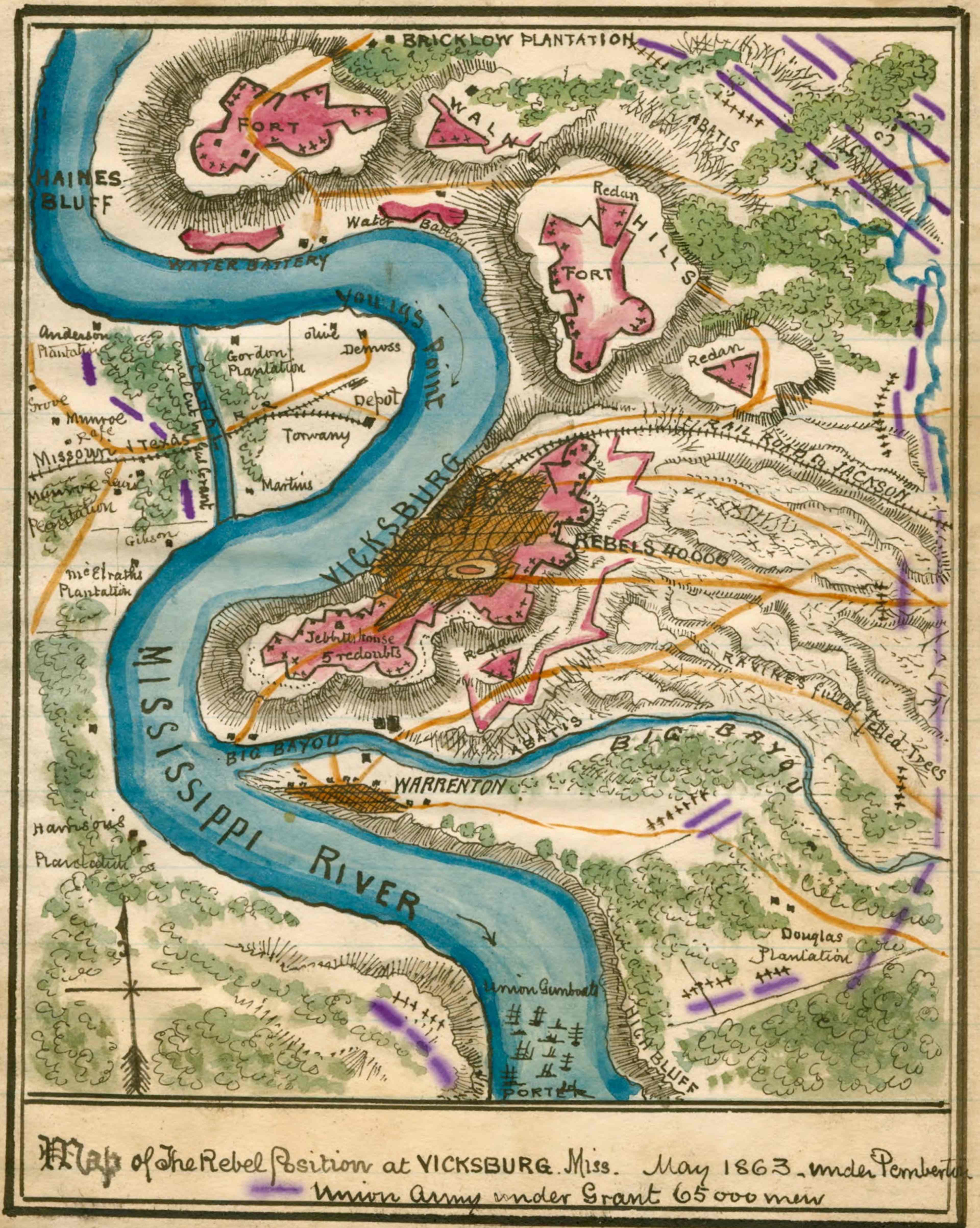
Grant’s army constructed 15 miles of trenches, completely wrapping around Pemberton’s 29,000 defenders. For the next 47 days, Vicksburg was subjected to a relentless double bombardment from Grant’s land artillery and Admiral Porter’s gunboats on the river. To escape the non-stop shelling, civilians and soldiers excavated more than 500 caves directly into the yellow clay hills of the city. These damp, dark tunnels became temporary homes, featuring carpets, furniture, and libraries. Union soldiers, observing the citizens popping up and down from the ground, began referring to Vicksburg as “Prairie Dog Village.” As the weeks dragged on, food supplies vanished. Horses, mules, dogs, and eventually rats became primary sources of protein for the starving citizens and desperate soldiers.
Pivotal Figures of the Vicksburg Campaign
The campaign featured some of the most prominent military minds and figures of the era:
- Major General Ulysses S. Grant: His relentless determination, operational mobility, and willingness to abandon traditional logistics during the Vicksburg campaign cemented his legacy as a brilliant strategist, eventually leading to his promotion as General-in-Chief of all Union armies.
- Lieutenant General John C. Pemberton: The Pennsylvania-born Confederate general was caught in an impossible strategic vise. He faced contradictory orders from his immediate superior, General Joseph E. Johnston, who ordered him to abandon the city to save his army, and President Jefferson Davis, who insisted he hold Vicksburg at all costs. Pemberton chose to hold, resulting in the trapping and loss of his entire army.
- Admiral David Dixon Porter: His masterful coordination of naval forces and daring block-running was absolutely critical to Grant’s ultimate victory.
The Ultimate Turning Points Within the Campaign
The true turning point of the Vicksburg campaign was the Battle of Champion Hill on May 16, 1863. Had Pemberton succeeded in blocking Grant’s advance there, the Union army would have been vulnerable, cut off from its primary supply lines. Instead, Grant’s victory at Champion Hill forced the Confederates into a chaotic retreat, separating them from General Joseph E. Johnston’s relief forces. Another crucial turning point was the detonation of Union mines beneath the Third Louisiana Redan on June 25, 1863. Union miners had dug tunnels directly underneath the Confederate fort and packed them with gunpowder, creating a massive crater and triggering intense hand-to-hand combat that signaled the inevitable collapse of the defense.
The Long-Term Impact on America
The fall of Vicksburg on July 4, 1863—combined with the defeat of Robert E. Lee’s army at the Battle of Gettysburg just one day prior—marked the true military turning point of the American Civil War. The Confederacy was permanently severed. The Trans-Mississippi region was completely isolated, depriving the South of critical soldiers, horses, and food supplies. President Lincoln could proudly declare that the Mississippi River “again goes unvexed to the sea.”
Crucially, the victory also opened up massive territories in the South for Union mobilization, directly facilitating the recruitment and deployment of United States Colored Troops (USCT). The bravery and sacrifices of these newly freed Black soldiers at battles like Milliken’s Bend near Vicksburg contributed immensely to the rich legacy of Black heroes throughout U.S. military history, proving their valor on the path to national emancipation.
Fascinating and Lesser-Known Facts About Vicksburg
- An 81-Year Boycott of Independence Day: Because General Pemberton officially surrendered Vicksburg on July 4, the holiday became a symbol of bitter defeat and occupation for local residents. The city of Vicksburg did not officially celebrate the Fourth of July for 81 years, finally relenting during the patriotic fervor of World War II in 1944. This complex historical event contrasts deeply with the nationwide history of why Americans celebrate the Fourth of July with fireworks and national pride.
- The Wallpaper Newspaper: As the siege dragged on, the local newspaper, The Vicksburg Daily Citizen, ran completely out of newsprint. Determined to keep publishing, the editor printed the paper on the blank back of rolls of decorative floral wallpaper. The final issue, printed on July 2, was found by Union soldiers, who added a note and printed it to commemorate their victory.
- The Death of a Camel: Douglas the Camel, a dromedary camel used by the 43rd Mississippi Infantry, served as a mascot and pack animal during the siege. Sadly, Douglas was killed by a Union sniper during the daily skirmishing.
Why the Battle of Vicksburg Still Matters Today
Today, the battle is immortalized at the Vicksburg National Military Park, which preserves the extensive siege lines, historic monuments, and the reconstructed remains of the USS Cairo, a Union ironclad gunboat. For modern military scholars, Vicksburg remains the quintessential textbook study of joint army-navy operations, logistics, and siege warfare. The campaign teaches us about resilience, the devastating impact of total war on civilian populations, and the immense cost of preserving a divided nation.
People Also Ask (FAQ)
Who won the Battle of Vicksburg?
The Battle of Vicksburg was a decisive victory for the Union Army, led by Major General Ulysses S. Grant.
Why was Vicksburg so important during the Civil War?
Vicksburg was known as the “key” to the war because it was the last major Confederate stronghold on the Mississippi River. Capturing it gave the Union complete control of the river and split the Confederacy in two.
How long did the Siege of Vicksburg last?
The siege lasted for 47 days, beginning on May 18, 1863, and ending with the Confederate surrender on July 4, 1863.
What were the total casualties at Vicksburg?
The Vicksburg campaign was costly. The Union suffered roughly 10,142 casualties (killed, wounded, and missing), while the Confederates suffered approximately 9,091 battle casualties, in addition to the surrender of 29,495 soldiers.
Conclusion: The Legacy of Vicksburg
The Siege of Vicksburg was a triumph of strategic patience, operational brilliance, and sheer endurance. By capturing the fortress city on the Mississippi, General Ulysses S. Grant secured his place in military history and dealt a mortal blow to the Confederate cause. The legacy of Vicksburg serves as a solemn reminder of the tremendous sacrifices required to forge a more perfect Union and heal a fractured nation.


