The Battle of Shiloh, fought in the spring of 1862, remains one of the most defining and cataclysmic confrontations of the American Civil War. Occurring in the dense woods of southwestern Tennessee, this brutal two-day engagement pitted Union General Ulysses S. Grant’s Army of the Tennessee against a surprise onslaught by Confederate General Albert Sidney Johnston’s Army of the Mississippi. What began as a desperate struggle for survival for the Union forces quickly transformed into a bloody testament to the sheer scale and horror of modern industrialized warfare. With over 23,000 casualties, the staggering loss of life shocked both the Union and the Confederacy, permanently shattering any romanticized illusions of a quick, painless war. Shiloh proved to be a critical strategic turning point, opening the way for Union dominance in the Western Theater and ultimately redefining the military trajectory of the United States. To fully comprehend how this monumental clash reshaped the American landscape, we must delve deep into the strategic maneuvers, the key leaders, and the visceral human experiences that defined those fateful April days.
The Strategic Prelude: Causes and Historical Context
By early 1862, the Western Theater of the American Civil War was reaching a boiling point. Federal forces had achieved a series of stunning victories under the command of an unassuming but relentless Union general, Ulysses S. Grant. Having successfully captured Fort Henry on the Tennessee River and Fort Donelson on the Cumberland River, Grant had broken the Confederate defensive line in the West, forcing Rebel forces to abandon key strongholds, including the Tennessee state capital of Nashville.
Desperate to halt the Union advance, Confederate General Albert Sidney Johnston withdrew his scattered troops and concentrated them at Corinth, Mississippi. Corinth was a highly prized objective; it served as a vital railroad junction where the Mobile and Ohio Railroad intersected with the Memphis and Charleston Railroad. If the Union army captured Corinth, they would effectively sever the Confederacy’s primary east-west transportation link, dealing a near-fatal blow to the Southern war effort.
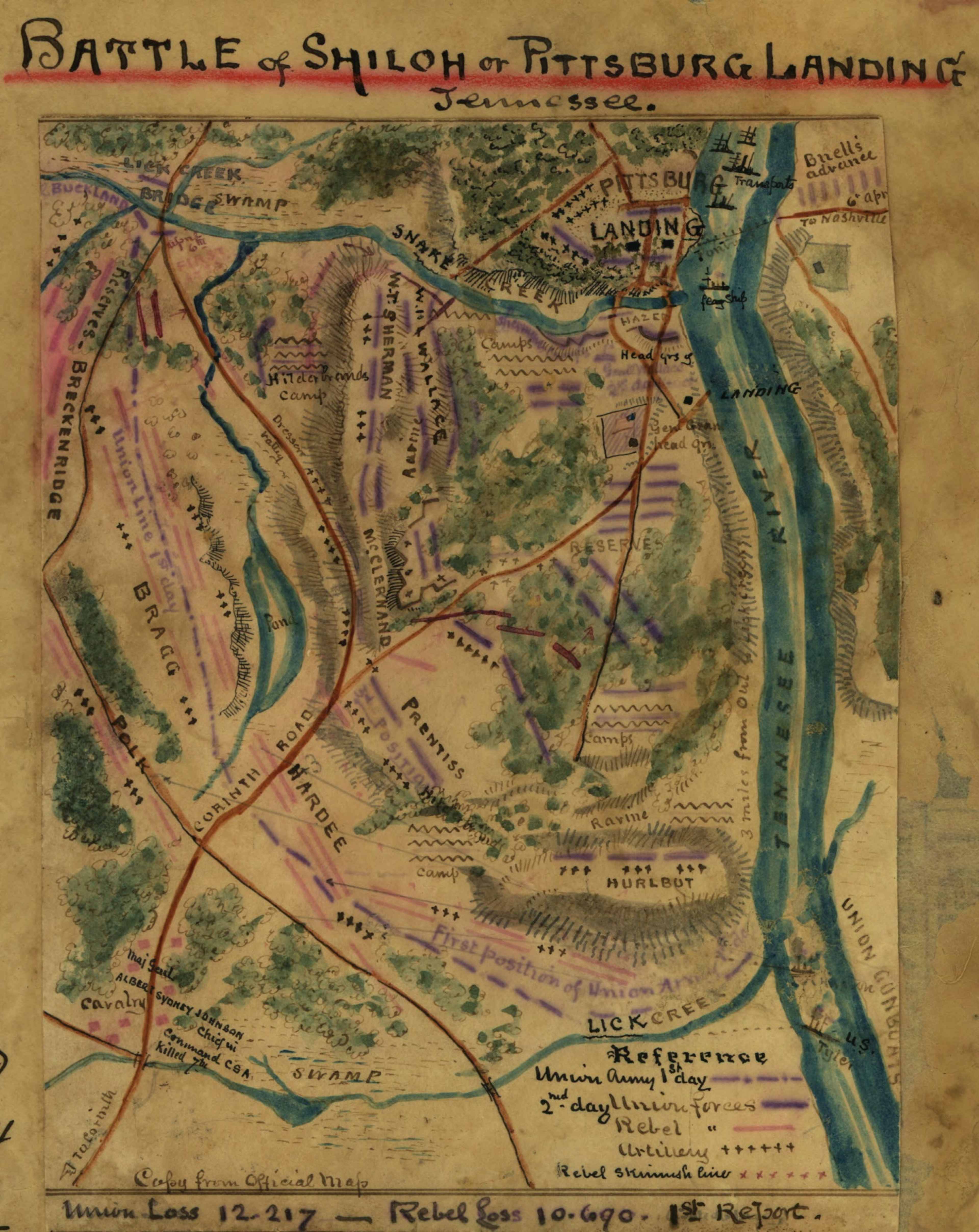
Recognizing this strategic reality, Grant moved his 42,000-man Army of the Tennessee to Pittsburg Landing, a small outpost on the west bank of the Tennessee River just twenty miles north of Corinth. There, Grant was instructed to wait for the arrival of Major General Don Carlos Buell and his 20,000-man Army of the Ohio. Once combined, this massive Federal force would march on Corinth. In the study of this conflict, it is common to encounter different names for the same engagement, reflecting why some Civil War battles have two names depending on whether writers refer to nearby landmarks like the Shiloh log church or the Union landing site at Pittsburg Landing.
Key Events Timeline: Two Days of Relentless Bloodshed
The timeline of the Battle of Shiloh is a narrative of rapid escalation, chaotic fighting, and shifting fortunes over forty-eight intense hours:
- April 3, 1862: Determined to strike Grant before Buell can reinforce him, General Albert Sidney Johnston begins marching his 45,000-man army out of Corinth. Heavy spring rains and muddy roads delay the Confederate advance, turning a short march into a grueling ordeal.
- April 5, 1862: The Confederate Army of the Mississippi arrives near the Union encampments. Despite the proximity, Grant and his division commanders—including William Tecumseh Sherman—remain convinced that the Confederates are not planning a major offensive.
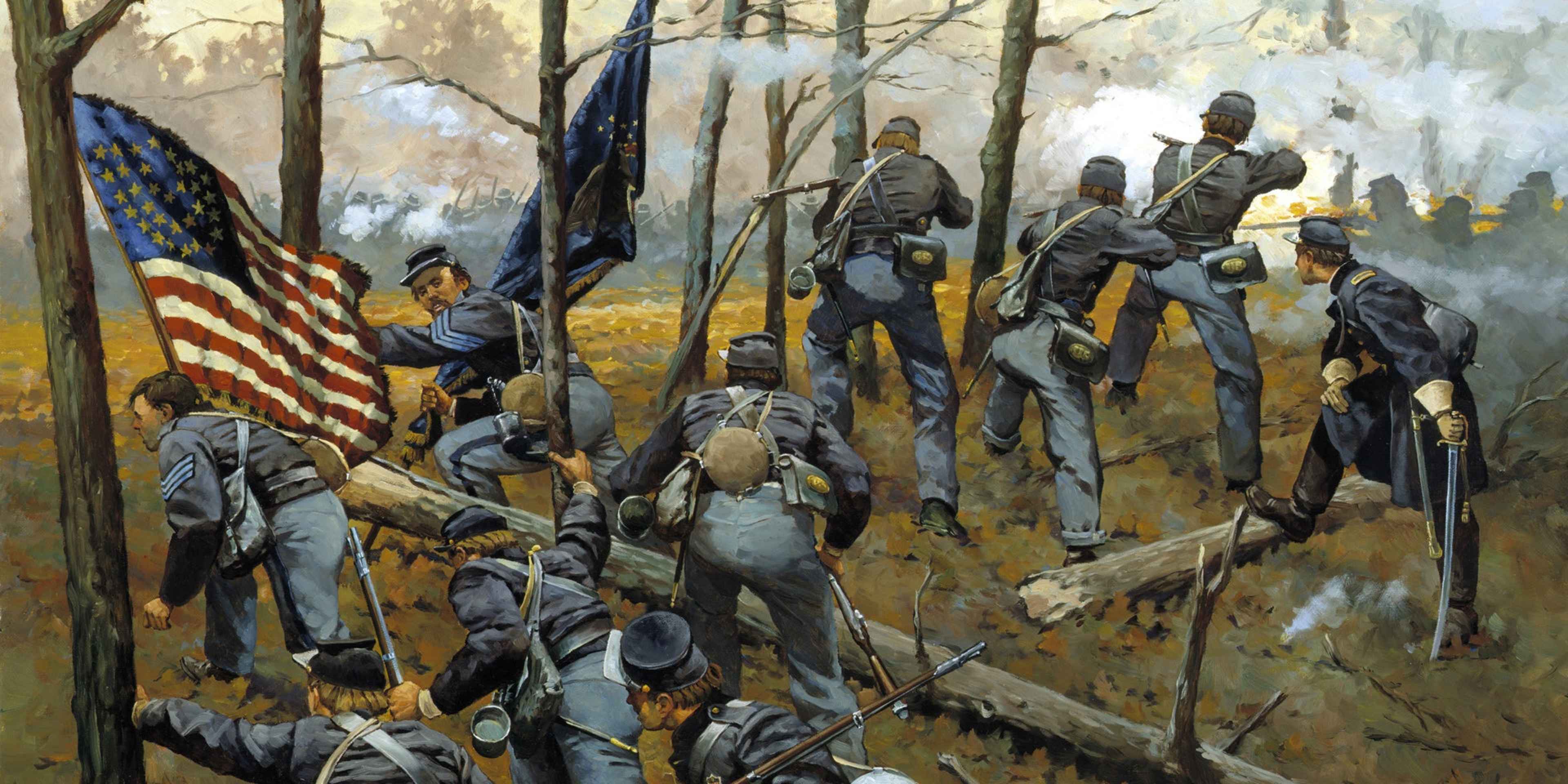
- April 6, 1862 (Dawn): A Union patrol discovers the Confederate advance guard just a mile from the main Federal camps. Johnston launches a massive, uncoordinated surprise attack, driving back the unprepared Union soldiers near Shiloh Church.
- April 6, 1862 (Midday): Desperate fighting rages across the battlefield. A pocket of Union soldiers under Brigadier General Benjamin Prentiss makes a heroic stand at a sunken road, a position that becomes known as the Hornet’s Nest due to the relentless whirring of bullets.
- April 6, 1862 (Afternoon): While leading a charge, Confederate commander Albert Sidney Johnston is struck in the leg by a stray bullet. The bullet severs an artery, and he quickly bleeds to death, making him the highest-ranking general on either side to die in combat during the war. General P.G.T. Beauregard assumes command of the Confederates.
- April 6, 1862 (Nightfall): Beauregard halts the Confederate assault, believing victory is secure. However, the Union line at Pittsburg Landing holds firm. Over the course of the rainy night, the vanguard of General Buell’s Army of the Ohio arrives via river transports to reinforce Grant.
- April 7, 1862: Armed with fresh reinforcements and an overwhelming numerical advantage, Grant launches a massive counteroffensive at dawn. The exhausted Confederates are slowly driven back, losing all the ground they had gained the previous day.
- April 7, 1862 (Late Afternoon): Realizing his army is spent and depleted, Beauregard orders a general retreat back toward Corinth. The Union forces, too exhausted to mount an effective pursuit, secure a bloody but decisive victory.
Important Figures and Their Lasting Impact
The outcome of the Battle of Shiloh was heavily dictated by the personalities, decisions, and fates of several prominent military commanders:
General Ulysses S. Grant
Before Shiloh, Grant was praised for his victories at Forts Henry and Donelson, but his lack of preparation for the Confederate surprise attack drew severe criticism from the press and politicians. Despite being caught off guard, Grant’s coolness under pressure on April 6 allowed him to patch together a defensive perimeter. When asked by General Sherman on the rainy night of April 6 if they should retreat, Grant famously replied, “No. Lick ’em tomorrow, though.” This battle proved to be a trial by fire that demonstrated why Ulysses S. Grant was one of America’s most brilliant military leaders, highlighting his relentless determination and refusal to accept defeat.
General Albert Sidney Johnston
Considered by Confederate President Jefferson Davis to be the finest general in the South, Johnston’s death was a catastrophic psychological and leadership blow to the Confederacy. His aggressive battle plan succeeded in catching the Union off guard, but his decision to lead from the front lines ultimately cost him his life and robbed the South of its top Western commander.
General Pierre Gustave Toutant (P.G.T.) Beauregard
As second-in-command, Beauregard took over after Johnston fell. His decision to halt the attacks on the evening of April 6 remains one of the most debated choices of the war. While some argue he missed a golden opportunity to crush Grant’s army, others point out that his troops were disorganized, exhausted, and low on ammunition.
General Lew Wallace
The commander of Grant’s Third Division, Wallace spent much of April 6 marching and countermarching due to confusing orders, arriving at the battlefield only after the day’s fighting had ended. Though his fresh troops played a crucial role in the April 7 counterattack, the delay stained his military reputation for years, prompting him to later find fame as the author of the legendary 1880 historical novel Ben-Hur: A Tale of the Christ.
Major Turning Points on the Battlefield
Several pivotal moments during the two-day battle decided the fate of the Union and Confederate armies:
The Stand at the Hornet’s Nest
For nearly six hours on April 6, a collection of Union divisions held a sunken road against repeated, suicidal Confederate charges. This defense bought Grant invaluable time to establish a heavy artillery line near Pittsburg Landing. Although General Prentiss was eventually surrounded and forced to surrender with over 2,000 men, the delay shattered the momentum of the Confederate assault.
The Death of Johnston
At approximately 2:30 PM on the first day, Johnston was wounded while directing an attack near the Peach Orchard. Because he had sent his personal physician to tend to wounded Union prisoners, no one on his staff recognized the severity of his wound until it was too late. The loss of command structure stalled the Confederate drive at a critical juncture.
The Arrival of Buell and the Counterattack
The arrival of over 20,000 fresh Union troops overnight completely shifted the balance of power. On the morning of April 7, the Confederates faced a revitalized, superior force that they simply did not have the manpower or energy to withstand.
The Long-Term Impact on the American Nation
The Battle of Shiloh was a watershed moment that forever changed how Americans viewed the Civil War. Prior to April 1862, many in both the North and the South believed the conflict would be resolved quickly with minimal bloodshed. Shiloh shattered this illusion. The combined casualties of over 23,000 men exceeded the total casualties of the Revolutionary War, the War of 1812, and the Mexican-American War combined.
The gruesome aftermath of the battle forced the nation to confront the reality of mass death on a scale never before imagined. This grim necessity eventually changed how the country processed grief, illustrating how the massive scale of Civil War deaths advanced the funeral industry through the development of modern embalming techniques and formal military cemeteries.
Strategically, the Union victory at Shiloh secured western Tennessee, opened the way for the capture of Corinth, and ultimately facilitated the Union’s control of the Mississippi River valley, paving the way for the eventual Siege of Vicksburg.
Lesser-Known Facts of the Battle of Shiloh
- The Angel’s Glow: After the battle, many wounded soldiers lay stranded in the cold rain for days. In the darkness, some noticed that their open wounds emitted a faint, blueish glow. Remarkably, those whose wounds glowed had a much higher survival rate and cleaner wounds. Decades later, scientists discovered this was caused by Photorhabdus luminescens, a bioluminescent bacterium that produces natural antibiotics, killing off harmful pathogens.
- The Bloody Pond: Located near the Peach Orchard, this small farm pond became a gathering spot for wounded soldiers from both sides looking to quench their thirst and wash their wounds. The water became so heavily stained with blood that it was forever christened “Bloody Pond.”
- The Echo of Shiloh Church: The battle was named after a small, humble log Methodist church built in 1851. Irony was not lost on the soldiers; “Shiloh” is a Hebrew word meaning “place of peace.”
Why It Still Matters Today
Today, the Shiloh National Military Park stands as one of the best-preserved Civil War battlefields in the United States. Shiloh serves as a solemn reminder of the devastating cost of division and the profound sacrifices made to preserve the Union. The battle also represents a critical phase in the evolution of American military strategy and leadership, marking the emergence of Ulysses S. Grant as the commander who would ultimately lead the Union to victory. By studying Shiloh, we gain a deeper appreciation for the complex, painful process through which the modern United States was forged.
People Also Ask
Where was the Battle of Shiloh fought?
The Battle of Shiloh was fought in southwestern Tennessee, near a vital river transport point called Pittsburg Landing and close to a local meetinghouse named Shiloh Church. The battlefield is located about twenty miles north of the Mississippi-Tennessee border.
Who won the Battle of Shiloh?
The Union Army, led by General Ulysses S. Grant and reinforced by General Don Carlos Buell, won the Battle of Shiloh. Although the Confederates launched a highly successful surprise attack on the first day, the Union held its defensive line and launched a decisive counteroffensive on the second day, forcing a Confederate retreat.
What were the dates of the Battle of Shiloh?
The Battle of Shiloh took place over two days, from April 6 to April 7, 1862.
Why is the Battle of Shiloh also called the Battle of Pittsburg Landing?
In the 19th century, the Union Army typically named battles after nearby bodies of water or physical landmarks (such as Pittsburg Landing on the Tennessee River), while the Confederate Army named battles after nearby towns, churches, or settlements (such as Shiloh Church). Both names refer to the exact same historic clash.
Conclusion
The Battle of Shiloh was a brutal, eye-opening conflict that defined the early years of the American Civil War. Through sheer determination, strategic reinforcement, and critical turning points like the stand at the Hornet’s Nest, the Union secured a vital victory that altered the course of the war in the Western Theater. Though the price of victory was tragically high, the legacy of Shiloh remains etched in the American consciousness as the moment the nation realized the true, devastating cost of its preservation.


