The term Bleeding Kansas evokes a dark, chaotic chapter in American history, representing the violent prelude to the catastrophic American Civil War [1]. Between 1854 and 1861, the rolling prairies of the Kansas Territory became a bloody battleground where the nation’s deepest moral and economic contradiction—slavery—collided in open warfare [1, 2]. This conflict was not merely a localized skirmish; it was a structural fracture that shattered the delicate political compromises holding the United States together. Driven by the controversial concept of “popular sovereignty,” settlers from both Northern free states and Southern slaveholding states rushed into the territory, desperate to claim the land for their respective ideologies [1]. The resulting proxy war pitted abolitionists, Free-Staters, and pro-slavery “Border Ruffians” against one another in a tragic cycle of fraudulent elections, guerrilla raids, and political assassinations [1]. By exploring this pivotal era, we uncover how a single legislative act turned neighbors into mortal enemies and made the Civil War practically inevitable [1].
The Historical Background: Reopening Unhealed Wounds
To understand the outbreak of violence in Kansas, one must look back to the foundational compromises of the United States. Since the framing of the Constitution, the federal government had sought to maintain a delicate political equilibrium between Northern free states and Southern slaveholding states. This tension was temporarily pacified by the Missouri Compromise of 1820, which drew a literal line across the Louisiana Purchase at the 36º30’ parallel, banning slavery anywhere north of that boundary (with the exception of Missouri itself) [1]. However, this geographic truce was only a temporary band-aid over a deep moral abscess. The issue of human bondage remained a volatile, unresolved dilemma, reminiscent of the early debates regarding why Thomas Jefferson’s anti-slavery passage was removed from the Declaration of Independence, proving that the young republic had merely delayed its day of reckoning.
By the mid-19th century, the relentless march of Westward expansion—fueled by the ideology of Manifest Destiny—brought these tensions to a boiling point [1]. The discovery of gold in California in 1848 amplified the national urge to construct a transcontinental railroad to link the Atlantic and Pacific oceans [1]. Senator Stephen A. Douglas of Illinois, an ambitious Democrat, desperately wanted Chicago to serve as the eastern terminal for this grand railroad network [1]. However, to construct a northern rail route, the vast, unorganized territory of Nebraska had to be formally incorporated [1]. To win the essential support of Southern congressmen who favored a southern transcontinental route, Douglas introduced a fateful piece of legislation that would dismantle decades of fragile peace: the Kansas-Nebraska Act of 1854 [1].
Signed into law on May 30, 1854, the Kansas-Nebraska Act repealed the Missouri Compromise of 1820 and split the region into two territories: Kansas and Nebraska [1]. In place of the geographic restriction on slavery, Douglas championed the doctrine of popular sovereignty, which dictated that the settlers of each territory would vote to decide whether to admit their future state as “free” or “slave” [1]. This democratic experiment backfired spectacularly. Rather than fostering local self-determination, it transformed the Kansas Territory into a magnet for ideological extremists from both sides, sparking a migration race to influence the impending vote [1].
A Chronological Timeline of the Kansas Conflict
The transition from political debate to physical violence occurred rapidly [1]. Below is the chronological breakdown of the pivotal events that characterized the era of Bleeding Kansas:
- May 30, 1854: The Kansas-Nebraska Act is officially signed into law, initiating a race to populate the newly opened Kansas Territory [1].
- November 29, 1854: The territory holds its first election to select a congressional delegate. Armed pro-slavery Missourians, known as “Border Ruffians,” cross the border en masse to cast illegal ballots, securing a pro-slavery victory [1].
- March 30, 1855: The election for the territorial legislature is held. Massive voter fraud occurs again as thousands of Missourians flood Kansas polling stations, establishing a fraudulent, pro-slavery legislature in Lecompton [1].
- September–October 1855: Outraged by the fraudulent elections, anti-slavery settlers (Free-Staters) gather in Topeka to form their own extra-legal rival government and draft the Topeka Constitution, which bans slavery [1].
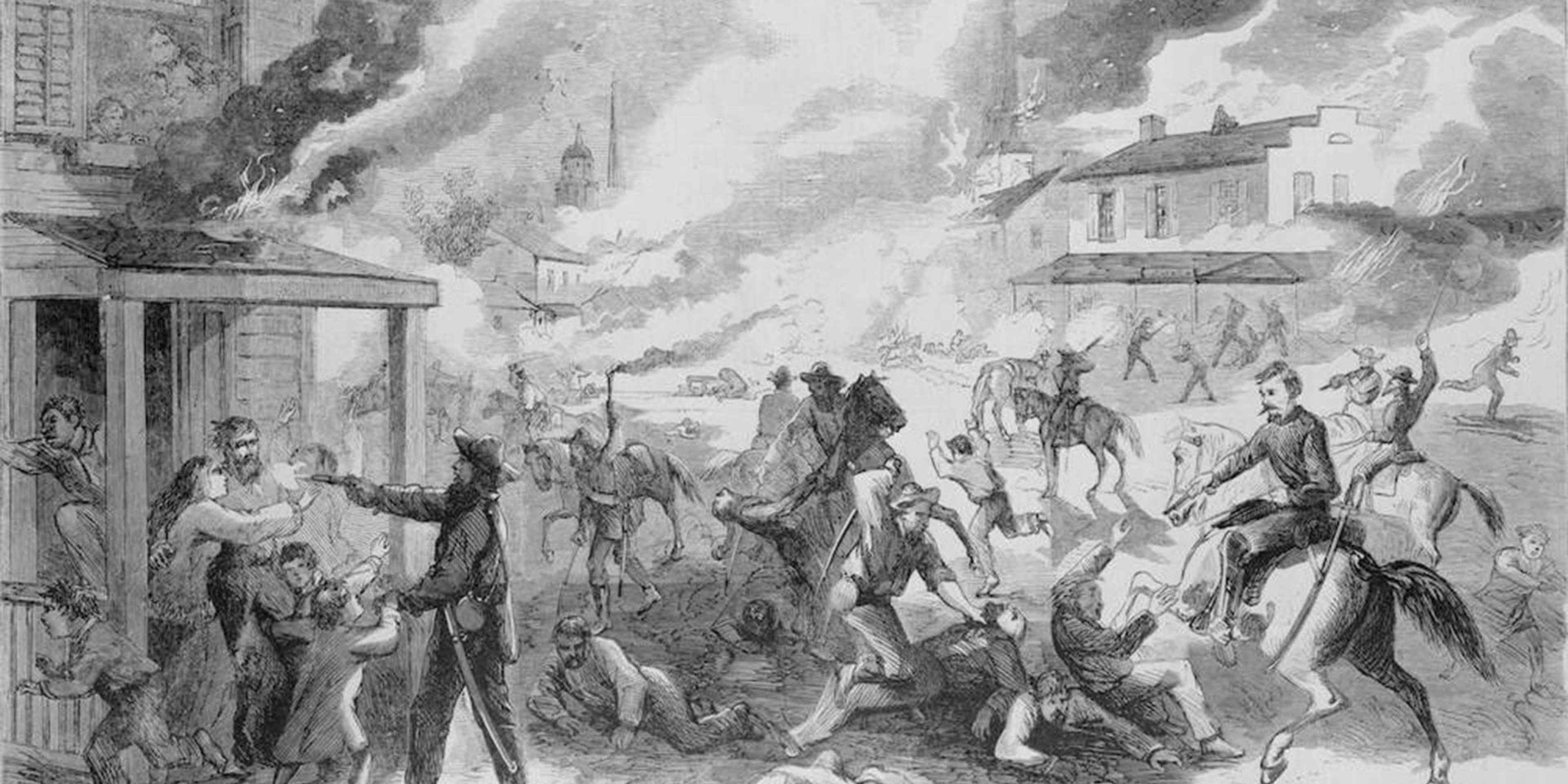
- May 21, 1856: A pro-slavery posse, acting under the guise of legal authority, marches on the free-state stronghold of Lawrence, destroying printing presses, looting homes, and burning the Free State Hotel in the infamous “Sack of Lawrence” [1].
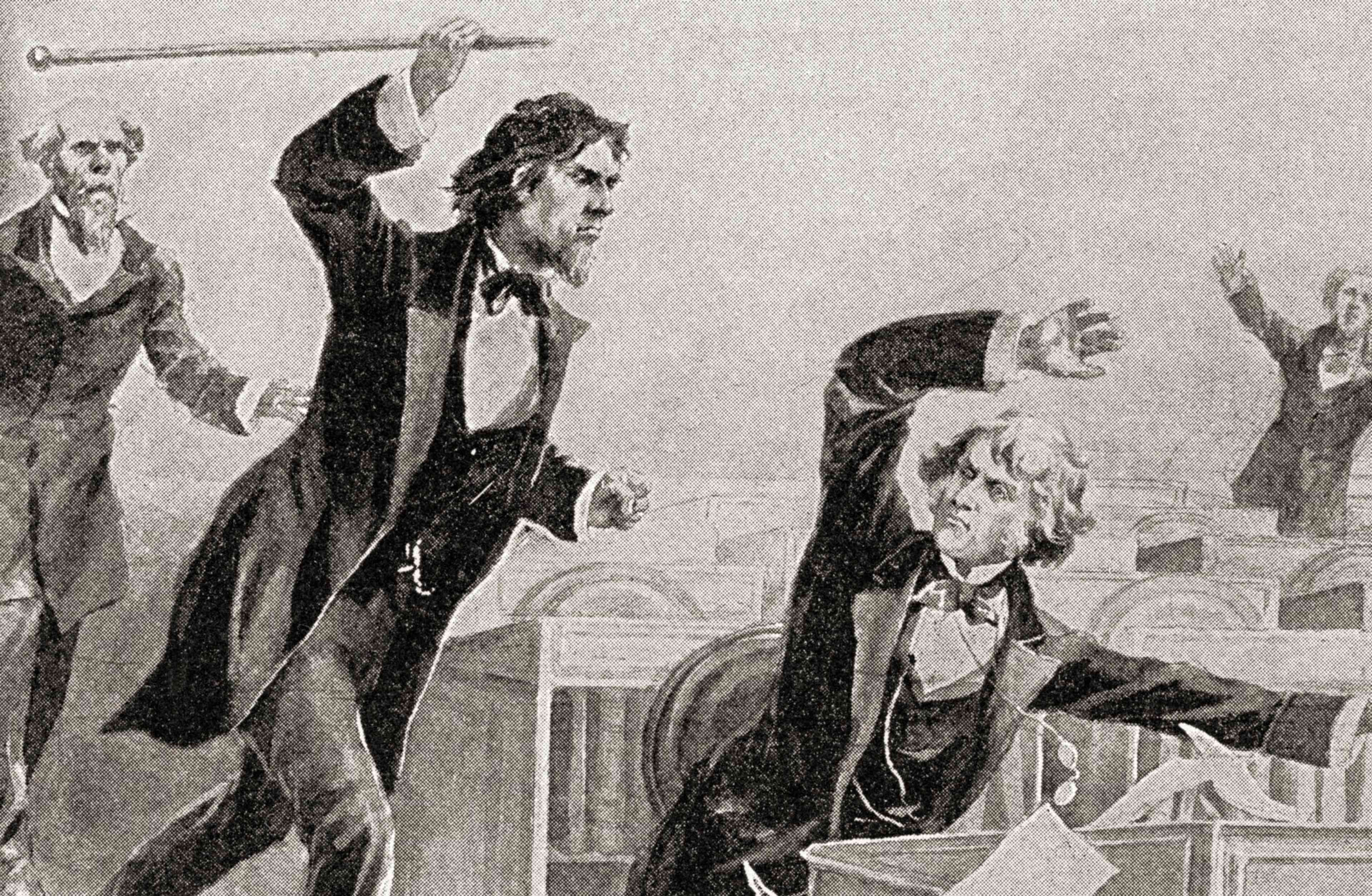
- May 22, 1856: On the floor of the United States Senate, Representative Preston Brooks of South Carolina savagely canes abolitionist Senator Charles Sumner of Massachusetts, demonstrating that the violence of Kansas had infiltrated the highest levels of federal power [1].
- May 24–25, 1856: In retaliation for the Sack of Lawrence, radical abolitionist John Brown and a small band of followers drag five pro-slavery settlers from their cabins along Pottawatomie Creek and execute them with broadswords [1].
- September 1856: Newly appointed Territorial Governor John W. Geary arrives in Kansas, utilizing federal troops to disarm rival militias and temporarily restore a semblance of order [1].
- May 19, 1858: The Marais des Cygnes massacre occurs. Pro-slavery border raiders capture eleven unarmed anti-slavery men, executing five of them in one of the final major atrocities of the era [1].
- January 29, 1861: Following the secession of Southern states from the Union, Kansas is officially admitted to the United States as a free state [1].
Important Figures and Their Historical Impact
The tragedy of Bleeding Kansas was driven by larger-than-life historical actors whose radical choices and unyielding convictions permanently altered the American landscape [1]:
Stephen A. Douglas
Known as the “Little Giant,” Senator Stephen Douglas was the chief architect of the Kansas-Nebraska Act [1]. Believing that popular sovereignty was a moderate compromise that would defuse national tensions, Douglas underestimated the moral fervor surrounding slavery. His legislation alienated Northern Democrats, split his party, and paved the way for the rise of the anti-slavery Republican Party.
John Brown
A deeply religious, radical abolitionist, John Brown viewed himself as an instrument of divine justice tasked with destroying the institution of slavery [1]. Unlike moderate Free-Staters who sought political and legal recourse, Brown believed that only bloodshed could purge America of its national sin [1]. His brutal actions at Pottawatomie Creek struck terror into the hearts of Southerners and marked him as a legendary, polarizing figure who would later attempt to spark a massive slave rebellion at Harpers Ferry, Virginia, in 1859 [1].
Charles Sumner and Preston Brooks
The shocking interaction between Senator Charles Sumner and Representative Preston Brooks highlighted the collapse of civil discourse in America [1]. After Sumner delivered a blistering, two-day speech titled “The Crime Against Kansas”—which personally insulted pro-slavery Senator Andrew Butler—Butler’s nephew, Preston Brooks, entered the Senate chamber and beat Sumner unconscious with a heavy metal-topped cane [1]. While the North viewed Sumner as a martyr for free speech, the South celebrated Brooks as a hero [1].
John W. Geary
As the third territorial governor of Kansas, John W. Geary brought a tough, no-nonsense approach to the region [1]. Having previously served as the mayor of San Francisco during its lawless Gold Rush days, Geary was uniquely equipped to handle vigilante violence [1]. By remaining strictly impartial and utilizing the authority of the U.S. Army, he successfully dispersed armed factions, showing that federal resolve could restore order when local authorities failed [1].
Causes and Context: The Struggle for Land and Ideology
While the national debate focused heavily on the moral status of slavery, the underlying dynamics on the ground in Kansas were also heavily influenced by economic self-interest and land ownership [1]. Most of the settlers who migrated to Kansas were not radical abolitionists, but rather Free-Staters or “free soilers” [1]. These individuals, mostly migrating from the Midwest, were largely motivated by the desire to secure fertile land without competing against wealthy plantation owners who utilized unpaid, enslaved labor [1].
The socio-political landscape of the 1850s was characterized by a fundamental clash between Hamilton’s and Jefferson’s competing visions of America. The North had rapidly industrialized, embracing free labor, commerce, and urbanization. The South, conversely, remained deeply rooted in an agrarian, plantation-based economy reliant on slavery. For the South, the expansion of slavery into new Western territories was a matter of political survival; without new slave states, they would permanently lose representation and power in the U.S. Senate. This structural anxiety turned Kansas into a proxy war, as both regions recognized that the fate of the territory would dictate the future balance of power in Washington, D.C.
Major Turning Points: The Failure of Democracy
The primary turning point of Bleeding Kansas was the complete breakdown of the democratic voting process [1]. The flagrant interference of the “Border Ruffians” in the early elections delegitimized the territorial government in the eyes of Northern observers [1]. This culminated in a bizarre, dangerous scenario where Kansas possessed two functioning governments: the official, federally recognized pro-slavery government at Lecompton, and the shadow, anti-slavery government at Topeka [1].
When President Franklin Pierce and his successor, James Buchanan, chose to officially recognize the fraudulent Lecompton legislature, they effectively radicalized moderate Northerners [1]. The subsequent attempt to force the pro-slavery Lecompton Constitution upon Kansas—despite clear evidence that the vast majority of Kansas residents opposed slavery—shattered the remaining trust between Northern and Southern Democrats [1]. Even Stephen Douglas broke with President Buchanan over this issue, arguing that the Lecompton Constitution was a mockery of popular sovereignty [1]. This internal democratic schism ensured that peaceful compromise was no longer a viable option.
Long-Term Impact on America
The legacy of Bleeding Kansas is directly tied to the outbreak of the American Civil War [1]. The violence in the territory served as a physical and psychological dress rehearsal for the national conflict that would claim over 600,000 lives. It proved to citizens in both regions that peaceful, legislative coexistence was becoming impossible. The political fallout from the Kansas-Nebraska Act permanently dismantled the second party system. The Whig Party collapsed, and the Republican Party arose from its ashes, united under the banner of preventing the expansion of slavery.
Furthermore, the physical violence in Kansas catalyzed the radicalization of the American public [1]. The brutal imagery of the Sumner caning and the terror of John Brown’s raids convinced Southerners that Northern abolitionists were intent on inciting violent slave uprisings, while Northerners became convinced that a powerful “Slave Power” conspiracy was actively subverting democratic institutions and free speech [1]. The original, unresolved compromises built into the nation’s framework, which historical scholars often examine alongside the ideals and compromises of the Founding Fathers, were finally breaking under the weight of moral and geographic expansion.
Lesser-Known Facts and Anecdotes
1. Beecher’s Bibles
During the conflict, the famous Northern abolitionist preacher Henry Ward Beecher (brother of Harriet Beecher Stowe, author of Uncle Tom’s Cabin) raised funds to purchase state-of-the-art Sharps rifles for anti-slavery settlers. Because shipment of weapons to the volatile territory was heavily restricted, the rifles were shipped in wooden crates marked “Bibles” or “books.” Consequently, these high-powered rifles became widely known throughout Kansas as “Beecher’s Bibles.”
2. The Rapid Turnover of Governors
Being the territorial governor of Kansas was one of the most hazardous and politically ruinous jobs in 19th-century America. Between 1854 and 1861, Kansas went through a total of six different governors [1]. Most were forced to resign, fled the territory in fear for their lives, or were dismissed by the president for failing to appease the competing factions [1].
3. The Bloodless Wakarusa War
In December 1855, a force of nearly 1,500 pro-slavery Missourians laid siege to the anti-slavery town of Lawrence. The confrontation, known as the Wakarusa War, was characterized by high tension but very little physical combat. Thanks to the diplomatic intervention of Free-State leaders and a timely winter storm, a treaty was signed before a full-scale battle could take place. Only one casualty was recorded: an anti-slavery settler named Thomas Barber, who was shot while riding on a nearby road.
Why It Still Matters Today
The history of Bleeding Kansas remains remarkably relevant to contemporary society. It serves as a stark, cautionary tale about the fragility of democratic institutions when political polarization overrides the rule of law. When citizens begin to view elections as fundamentally fraudulent, and when the legal systems designed to resolve disputes are seen as partisan tools, the ground is laid for political violence. The tragedy of Kansas reminds us that democracy requires a shared commitment to truth, fair processes, and mutual respect. Without these shared values, the institutions that protect civil liberties can quickly crumble, turning political rivals into mortal combatants.
People Also Ask
What was the main cause of Bleeding Kansas?
The main cause of Bleeding Kansas was the passage of the Kansas-Nebraska Act of 1854 [1]. By introducing “popular sovereignty,” the act allowed settlers in the Kansas Territory to vote on whether to permit slavery, which triggered a violent migration race between pro-slavery and anti-slavery factions desperate to control the election outcomes [1].
Who were the Border Ruffians?
The Border Ruffians were pro-slavery guerrilla fighters and settlers, primarily from the neighboring slave state of Missouri, who crossed into Kansas to illegally vote in territorial elections, intimidate anti-slavery settlers, and engage in violent skirmishes to ensure Kansas would be admitted as a slave state [1].
How did Bleeding Kansas lead directly to the Civil War?
Bleeding Kansas radicalized both the North and the South, destroying trust in democratic compromises and elections [1]. It led to the collapse of national political parties, spurred the rise of the Republican Party, and demonstrated that the issue of slavery could no longer be resolved through peaceful legislative means, making armed conflict inevitable [1].
Did John Brown participate in Bleeding Kansas?
Yes [1]. John Brown was a radical abolitionist leader who rose to national prominence during the Bleeding Kansas conflict [1]. In response to pro-slavery violence, he led the Pottawatomie Creek Massacre in May 1856, where his forces executed five pro-slavery settlers, marking a major escalation in the territory’s violence [1].
Conclusion
In the final analysis, Bleeding Kansas was the crucible in which the fate of the United States was forged. The violent clashes on the frontier exposed the fatal flaws of popular sovereignty and demonstrated that the moral question of human bondage could not be solved by local majoritarian votes. The lives lost on the Kansas prairies from 1854 to 1861 were the first casualties of a much larger struggle that would soon consume the entire nation [1]. By studying this turbulent era, we gain a deeper appreciation for the complex, often painful journey toward a more perfect union, and a vital reminder of the enduring cost of liberty.


