In the rigid, highly patriarchal environment of 17th-century New England, one woman dared to challenge the absolute authority of the Puritan clergy, forever altering the course of American religious history. Anne Hutchinson was a charismatic spiritual leader, midwife, and mother whose theological insights and weekly meetings captivated the Massachusetts Bay Colony. However, her unorthodox beliefs and immense popularity quickly earned her the ire of the colonial magistrates. Seeking to preserve their absolute religious and civil control, the Puritan leadership subjected her to civil and ecclesiastical trials, ultimately culminating in her exile. Understanding Anne Hutchinson’s beliefs, significance, and banishment is not merely an exercise in studying early colonial dissent; it is a journey into the very roots of American civil liberty, individual conscience, and the struggle for freedom of speech. Her courageous stand exposed the deep-seated anxieties of a fragile theocracy and laid the intellectual foundations for a more tolerant and pluralistic society.
Historical Background: The Crucible of Puritan New England
To understand the rise of Anne Hutchinson, one must first understand the intense, highly regulated world of the Massachusetts Bay Colony in the 1630s. Founded by English Puritans who fled the persecution of King Charles I and the Anglican Church, the colony was intended to be a “City upon a Hill”—a model Christian society. In this society, there was no separation between church and state. The political leaders, including Governor John Winthrop, were also the guardians of religious orthodoxy. Law, morality, and theology were inextricably bound together, and any form of religious dissent was viewed as an existential threat to the colony’s survival and its covenant with God.
Anne Hutchinson (ne9e Marbury) was born in Lincolnshire, England, in 1591. Her father, Francis Marbury, was a rebellious Puritan minister who was repeatedly prosecuted and imprisoned for criticizing the lack of educated clergy in the Church of England. From her father, Anne inherited not only a fierce intellectual independence but also a deep literacy and a profound knowledge of the Christian Scriptures. In 1612, she married William Hutchinson, a prosperous merchant, and settled in Alford, working as a highly skilled midwife and herbalist. During this period, she became deeply influenced by the teachings of John Cotton, a charismatic minister who preached a theology of “free grace,” emphasizing God’s inward salvation over outward ritual.
When John Cotton was forced to flee England for Boston in 1633 due to his reforming views, the Hutchinsons made the momentous decision to follow him. Arriving in 1634 with her husband and their ten surviving children, Anne quickly became a respected figure in Boston. Her medical skills as a midwife brought her into close contact with colonial women, who often confided their spiritual anxieties to her. This network of women would soon become the foundation of her influential ministry.
The Antinomian Controversy: Anne Hutchinson’s Core Beliefs
As Anne Hutchinson’s informal teaching sessions grew in popularity, they expanded from small gatherings of women to large, twice-weekly meetings attended by up to eighty people, including some of the colony’s most prominent men, such as the newly elected Governor Henry Vane. At the center of these meetings was a fierce theological debate that came to be known as the Antinomian Controversy.
The controversy centered on two diametrically opposed views of salvation:
- The Covenant of Works: Most Puritan ministers in Massachusetts argued that while salvation was a gift from God, an individual’s moral behavior, active church participation, and adherence to societal laws (sanctification) were outward proof of their salvation.
- The Covenant of Grace: John Cotton, and most vehemently Anne Hutchinson, argued that salvation was a purely internal, divine gift granted by God’s free grace alone (justification). Hutchinson asserted that a person’s behavior, sin, or compliance with moral laws did not affect their salvation, nor could good deeds serve as evidence of an inner state of grace.
The term “Antinomian” literally translates to “against the law”. To the Puritan leadership, Hutchinson’s assertions were incredibly dangerous. They feared that if outward behavior did not reflect salvation, then citizens would feel free to ignore civil laws, refuse to work, and disregard the authority of both the church and the state. Furthermore, by asserting that individuals could communicate directly with God without the intervention of an ordained minister, Hutchinson threatened to render the entire Puritan clerical establishment obsolete.
Key Events Timeline of the Controversy
The theological crisis unfolded rapidly over several years, forever changing the social fabric of early New England:
- 1591: Anne Marbury is born in Lincolnshire, England.
- 1612: Anne marries William Hutchinson; they begin their family and follow minister John Cotton.
- 1633: John Cotton flees England due to religious persecution, sailing to Boston.
- 1634: The Hutchinson family arrives in the Massachusetts Bay Colony, where Anne begins serving as a midwife and hosting informal religious discussions.
- 1636: Hutchinson’s home meetings attract widespread attention, drawing influential leaders like Governor Henry Vane. Tensions escalate as orthodox ministers feel their authority threatened.
- 1637 (November): Anne Hutchinson is brought to trial before the General Court at Newtown, presided over by Governor John Winthrop.
- 1638 (March): Hutchinson is formally excommunicated and banished. She, her family, and thirty other families depart for Aquidneck Island in Rhode Island.
- 1642: William Hutchinson dies, leaving Anne unprotected. Boston ministers continue to harass her, prompting her move to New Amsterdam.
- 1643 (Summer): Anne Hutchinson and most of her children are killed during a conflict with Siwanoy warriors.
The Crucial Figures and Their Roles
The drama of the Antinomian Controversy was driven by a cast of powerful, highly motivated individuals whose actions shaped the early American landscape:
John Winthrop
As the long-serving Governor of the Massachusetts Bay Colony, Winthrop was a staunch advocate for theological conformity and social order. He viewed Hutchinson as a “hell-spawned agent of destructive anarchy” and an existential threat to his “City upon a Hill”. Winthrop presided over her trial and was relentless in his efforts to destroy her influence, even after her banishment.
John Cotton
The brilliant Puritan minister whose sermons originally inspired Hutchinson. While Cotton initially supported Hutchinson and shared many of her “free grace” views, he eventually distanced himself from her when the political pressure intensified. Fearing for his own career and safety, Cotton ultimately testified against her during her trial, choosing survival over solidarity.
Roger Williams
A fellow religious dissident who had been banished from Massachusetts in 1635 for advocating the separation of church and state. When Hutchinson was banished, Roger Williams extended a hand of friendship, suggesting that she and her followers settle in the Narragansett Bay area, where they would establish Portsmouth.
Wampage (Anne-Hoeck)
A Siwanoy chief who participated in the 1643 raid in which Hutchinson died. In a fascinating display of indigenous diplomatic custom and profound respect for his fallen adversary, Wampage later adopted Hutchinson’s sole surviving daughter, Susan, and took the name “Anne-Hoeck” in her honor.
Turning Point: The Trial and Banishment of 1637
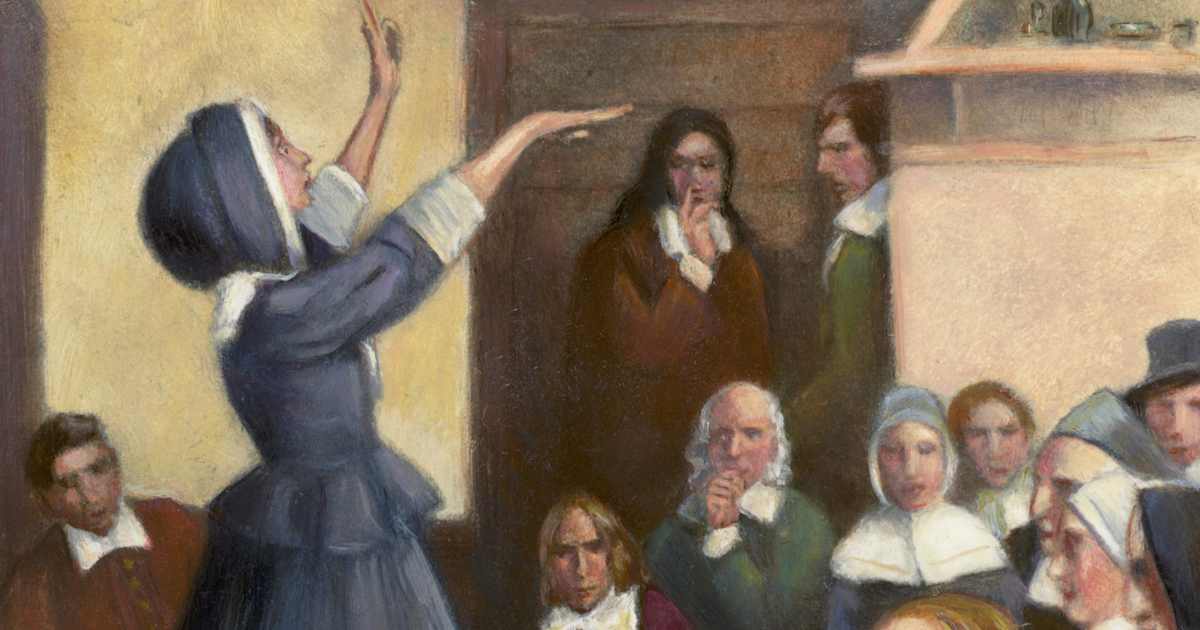
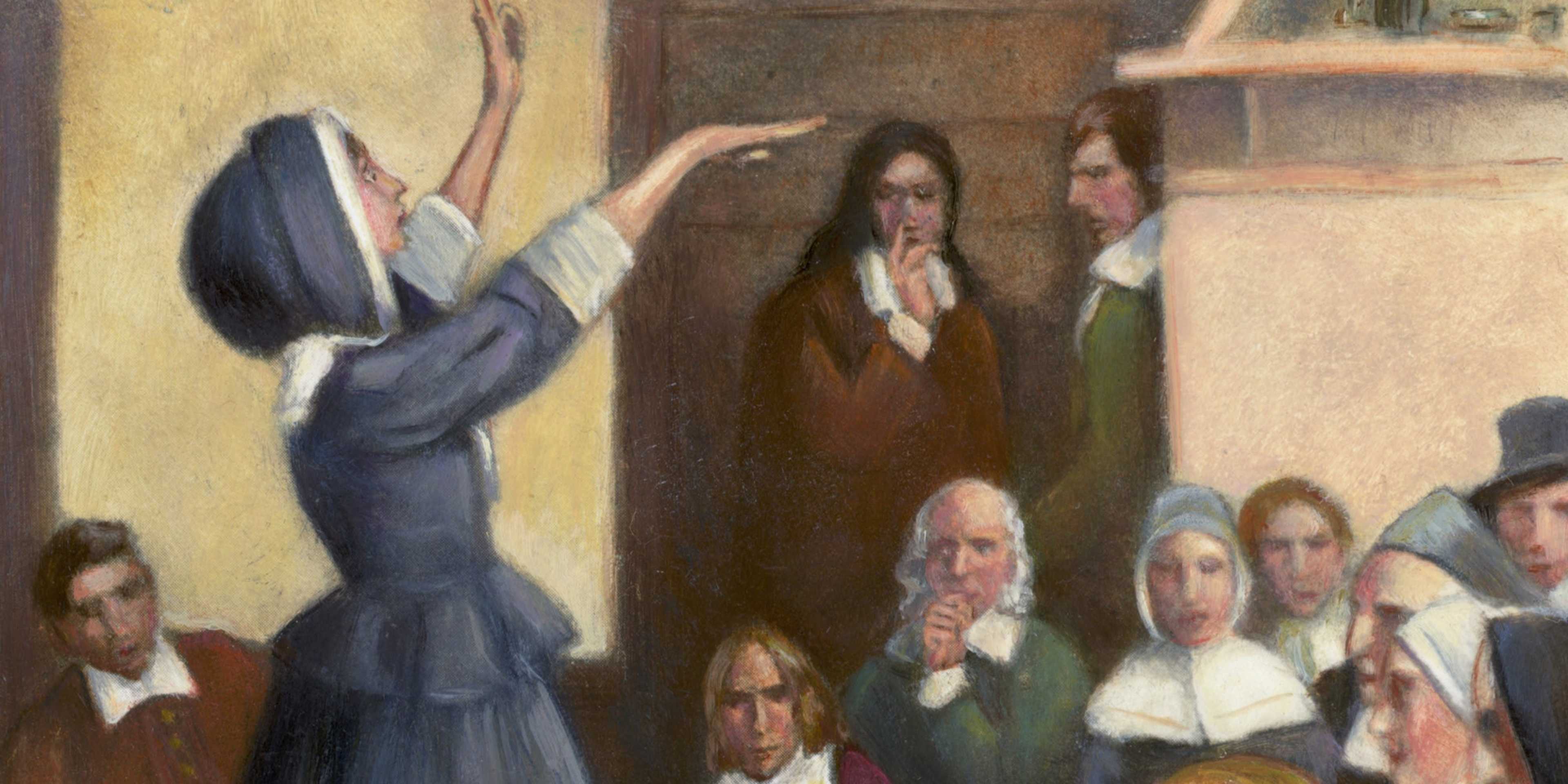
By late 1637, the Puritan leadership had resolved to silence Anne Hutchinson. She was called to appear before the General Court at Newtown, facing charges of sedition and heresy. At the time, Hutchinson was several months pregnant and suffering from physical exhaustion, yet she was forced to stand for hours in a cold room, facing interrogation by a hostile panel of male magistrates and ministers.
For the first two days of the trial, Hutchinson put on a masterful defense. Drawing on her extensive knowledge of scripture, she brilliantly parried every theological trap set by Governor Winthrop. She argued that hosting discussions in her home was entirely in keeping with the biblical teachings of Titus, which commanded older women to teach the younger. She refused to admit to any wrongdoing, repeatedly forcing the court to realize they had no concrete, legal grounds upon which to condemn her.
However, the turning point of the trial came when Hutchinson made a bold, fateful declaration. In a moment of intense religious conviction, she claimed that she had received her understanding directly from God through “an immediate revelation”. This declaration played directly into the hands of her accusers. Puritans believed that God spoke only through the Bible and authorized ministers; claiming personal, direct revelations from God was considered the ultimate heresy.
Winthrop seized upon this confession, declaring that the court now had all the evidence it needed. Hutchinson was condemned as a heretic and a woman “unfit for our society”. The court sentenced her to banishment from the colony, forcing her and her devoted followers to leave the only home they had known in the New World.
The Defamation Campaign and Tragic End
Even after her banishment, the hostility of the Massachusetts Bay authorities did not wane. During her house arrest in the winter of 1637–1638, she suffered a traumatic stillbirth of a severely deformed baby. Winthrop and other ministers seized upon this personal tragedy to mount a vicious smear campaign, publicly declaring that the “monstrous birth” was God’s direct punishment for her heretical teachings. Years before the Salem witch trials, this climate of suspicion, religious hysteria, and accusations of demonic influence was already firmly entrenched in the minds of the Puritan elite, who painted Hutchinson as a literal instrument of the devil.
Following the death of her husband William in 1642, and fearing that Massachusetts would soon annex the Rhode Island territory, Hutchinson moved her remaining family to the Dutch colony of New Amsterdam (modern-day New York). They established a homestead on Long Island Sound. Tragically, in the summer of 1643, during a violent conflict between local Native American tribes and Dutch settlers (known as Kieft’s War), Siwanoy warriors attacked the Hutchinson household. Anne, along with fourteen of her children and household members, was killed.

Upon hearing of her brutal death, Governor John Winthrop did not offer sympathy. Instead, he celebrated, writing that God’s hand had finally caught up with the “American Jezebel”.
Lesser-Known Facts About Anne Hutchinson
- The Survival of Susan Hutchinson: During the Siwanoy raid, Anne’s nine-year-old daughter, Susan, was out picking wild berries. She hid in the crevice of a massive boulder known today as Split Rock. The Siwanoy warriors spared her life, and Chief Wampage took her in, raising her as his own daughter. She lived with the tribe for nine years before eventually returning to colonial society.
- The Origin of the Parkway: The Hutchinson River Parkway and the Hutchinson River in New York are named directly in honor of Anne Hutchinson, marking the general area where her family homesteaded and met their tragic end.
- A Silent Connection to Royalty: Through her descendants, Anne Hutchinson’s bloodline continues to run through several famous historical figures, including U.S. Presidents Franklin D. Roosevelt, George H.W. Bush, and George W. Bush.
Why Her Legacy Still Matters Today
Anne Hutchinson’s story is much more than a tragic colonial tale. Her trial was a defining moment in early American history that helped shape the nation’s core principles. By asserting that her conscience was subject to God alone, and not to the dictates of magistrates or ministers, Hutchinson laid the intellectual groundwork for religious freedom and the separation of church and state, gradually paving the way for the surprising religious diversity of America’s 13 colonies.
Furthermore, Hutchinson is widely remembered as a pioneering figure for women’s rights. At a time when women were expected to be completely silent in public and submissive to male authority, she stood tall against the most powerful men in her society, matching them scripture for scripture and intellectual blow for blow. Today, a bronze statue of Anne Hutchinson stands proudly outside the Massachusetts State House in Boston, dedicated to her as a “courageous exponent of civil liberty and religious toleration”.
People Also Ask
What were Anne Hutchinson’s main beliefs?
Anne Hutchinson believed in the “Covenant of Grace,” which asserted that salvation was an internal gift from God and did not depend on outward moral behavior or works. She also preached that individuals could establish a direct, personal connection with God without the need for church leaders or ministers.
Why was Anne Hutchinson banished?
She was banished because her religious teachings challenged the absolute political and spiritual authority of the Puritan ministers. Additionally, her claim during her trial that she received direct revelations from God was considered a dangerous heresy that threatened to subvert the established social order.
Where did Anne Hutchinson go after her banishment?
After her banishment in 1638, she and her family moved to Aquidneck Island in Rhode Island, where they helped found the town of Portsmouth. Later, she moved to the Dutch colony of New Amsterdam (now New York), where she spent her final years.
Conclusion
The dramatic life, trials, and tragic death of Anne Hutchinson remain a powerful testament to the enduring power of individual conscience. By refusing to bow to the oppressive theological conformity of the Massachusetts Bay Colony, Hutchinson challenged the core structures of early colonial power. Though she was silenced by exile and a brutal end, her voice echoed through the centuries, inspiring future generations of reformers to champion the causes of religious liberty, free speech, and gender equality. Her lasting significance lies in her brave refusal to let her mind be ruled by others—a fundamental American ideal that continues to define the nation to this day.


