In the chilly spring of 1621, two vastly different worlds collided on the shores of modern-day Massachusetts. On one side stood the remnants of the English Puritans and Separatists, weakened by a brutal winter that had claimed half their population; on the other, the Wampanoag Confederacy, an Indigenous nation devastated by a catastrophic epidemic and threatened by aggressive rival tribes. The resulting alliance, codified in the 1621 Peace Treaty, is frequently romanticized as the peaceful foundation of Thanksgiving. However, the reality behind this historic agreement was not born of simple altruism, but of sophisticated geopolitics, mutual desperation, and strategic survival. By exploring the deep historical context of why the Wampanoag signed this treaty, we uncover a complex web of diplomacy, tragedy, and political maneuvering that fundamentally shaped the trajectory of colonial America.
Historical Background: Two Worlds on the Brink of Collapse
The period leading up to the spring of 1621 was marked by profound disruption and trauma for both the English colonists and the Wampanoag people. For the English, the decision to cross the Atlantic was driven by a complex mix of religious zeal, social displacement, and a search for economic stability. Understanding why did the Pilgrims come to America is crucial to understanding their vulnerability; they were religious Separatists seeking to establish a godly society free from the corrupting influences of Europe. After enduring a miserable journey aboard the Mayflower, they arrived in November 1620, completely unprepared for the unforgiving New England winter, resulting in the death of nearly half of their 102 passengers due to scurvy, exposure, and disease.
Meanwhile, the Wampanoag (meaning “People of the First Light”) had successfully managed and thrived on their ancestral lands for over 10,000 years, establishing a sophisticated confederacy of dozens of villages. However, between 1616 and 1619, their world was shattered by a devastating epidemic known historically as the “Great Dying.” Modern historians and epidemiologists suggest the culprit was likely leptospirosis, smallpox, or viral hepatitis introduced by European fishermen and fur traders [1]. This mysterious plague decimated up to 90 percent of the coastal Indigenous population, leaving once-bustling villages like Patuxet—where the Pilgrims would build their colony—completely abandoned and littered with the unburied bones of the deceased [1].
The Strategic Alliance: Why Ousamequin Sought Peace
By 1620, the Wampanoag nation was in a state of extreme geopolitical vulnerability. While the coastal tribes had been ravaged by disease, their inland rivals, the Narragansett, had largely escaped the epidemic due to their geographic isolation [1]. Under the leadership of their sachem, the Narragansett began taking advantage of the Wampanoags’ weakened state, demanding tribute and threatening to subjugate them entirely [1].
The Grand Sachem of the Wampanoag, Ousamequin (frequently referred to by the colonists by his title, Massasoit, meaning “Great Leader”) [1], faced an existential crisis. He needed a powerful ally to deter Narragansett aggression and protect his remaining people [1]. When the Mayflower settlers arrived, Ousamequin observed them closely from a distance [1]. While he was highly suspicious of Europeans—largely due to past atrocities, such as the 1614 kidnapping of Wampanoag men by Captain Thomas Hunt to be sold into Spanish slavery [1]—Ousamequin recognized a unique opportunity. The English possessed “pieces” (matchlock muskets) and small cannons that, despite being clumsy, struck terror into neighboring tribes [1]. A mutual defense treaty with these heavily armed newcomers could restore the balance of power in the region.
Key Events Timeline (1614–1678)
- 1614: Captain Thomas Hunt kidnaps Tisquantum (Squanto) and dozens of other Wampanoags from Patuxet, selling them into slavery and instigating intense Indigenous distrust toward Europeans [1].
- 1616–1619: The “Great Dying” epidemic ravages the Wampanoag Confederacy, reducing their population by an estimated two-thirds to ninety percent [1].
- November 1620: The Mayflower anchors at Cape Cod, and the colonists eventually decide to settle at the abandoned Wampanoag site of Patuxet, renaming it Plymouth [1].
- March 16, 1621: Samoset, an Abenaki sagamore, enters Plymouth Colony and startles the colonists by greeting them in English, initiating formal diplomatic relations [1].
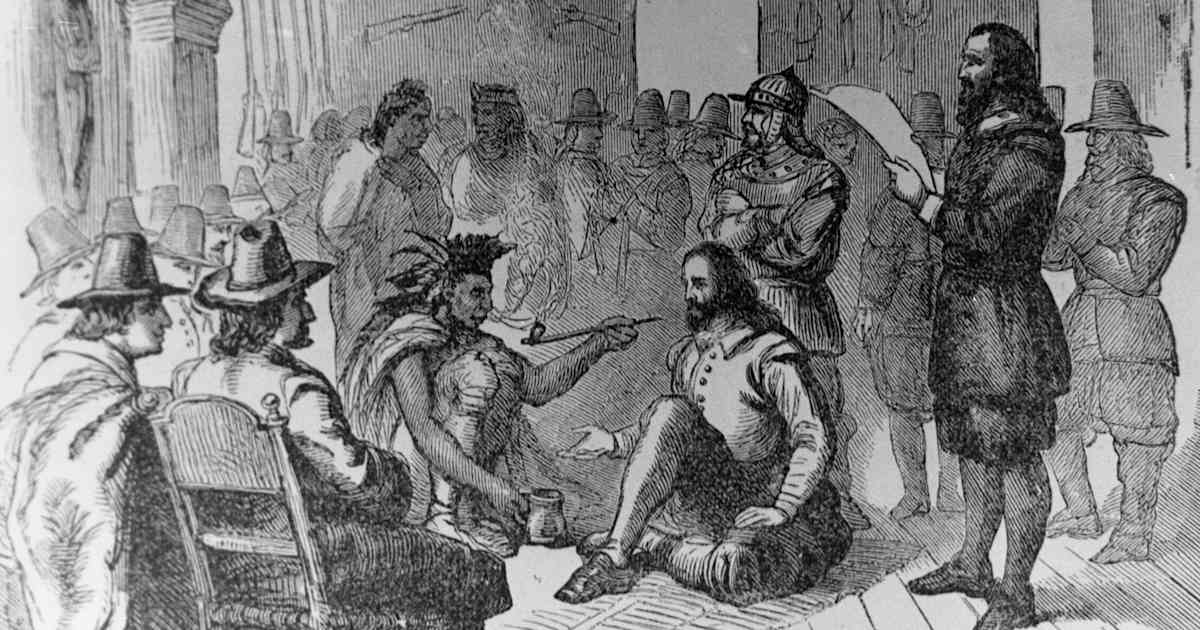
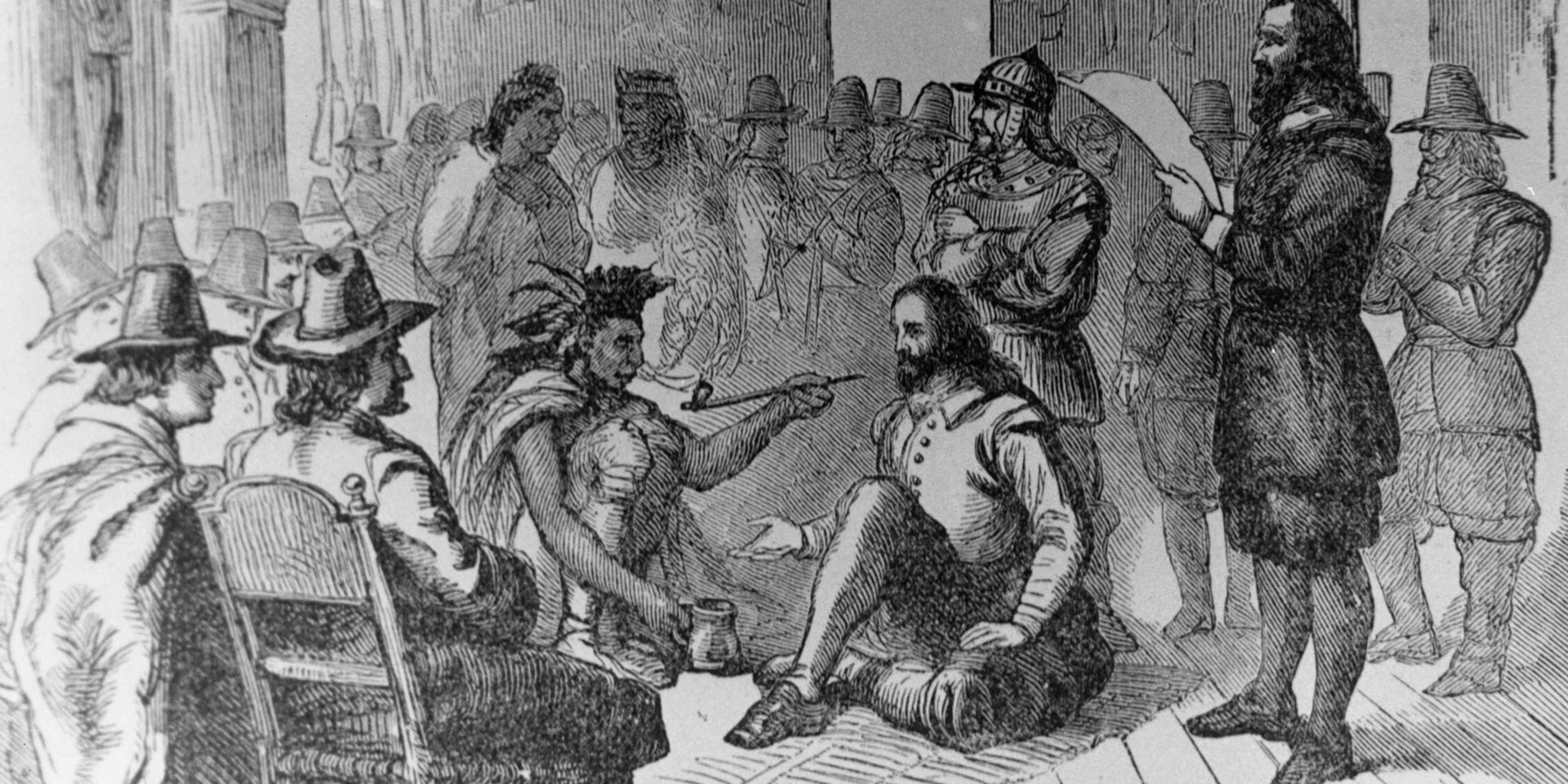
- March 22, 1621: Ousamequin arrives with his warriors and, with the assistance of translators, negotiates and signs the historic mutual defense peace treaty with Governor John Carver [1].
- Autumn 1621: The Wampanoags and Pilgrims celebrate a successful harvest with a three-day feast, establishing the historical basis for the modern Thanksgiving [1].
- 1661: Ousamequin passes away, and leadership transfers to his eldest son, Wamsutta (Alexander), as colonial encroachment on Native lands intensifies [1].
- 1675–1678: Tensions erupt into King Philip’s War under Ousamequin’s younger son, Metacom (King Philip), ending the era of peace and resulting in the near-destruction of the Wampanoag people [1].
Important Figures in the 1621 Treaty
The negotiation and temporary success of the treaty relied heavily on several key historical figures, each motivated by distinct political and personal goals:
- Ousamequin (Massasoit): The sagacious leader of the Wampanoag who prioritized the long-term survival of his nation [1]. His diplomatic flexibility allowed his people to rebuild, though his alliance with the English ultimately sowed the seeds of future conflict.
- Tisquantum (Squanto): A Patuxet Wampanoag who survived kidnapping, slavery in Spain, and a journey to England, only to return home in 1619 and find his entire village wiped out by disease [1]. His bilingual skills made him an indispensable translator, though he secretly sought to leverage his position for personal power [1].
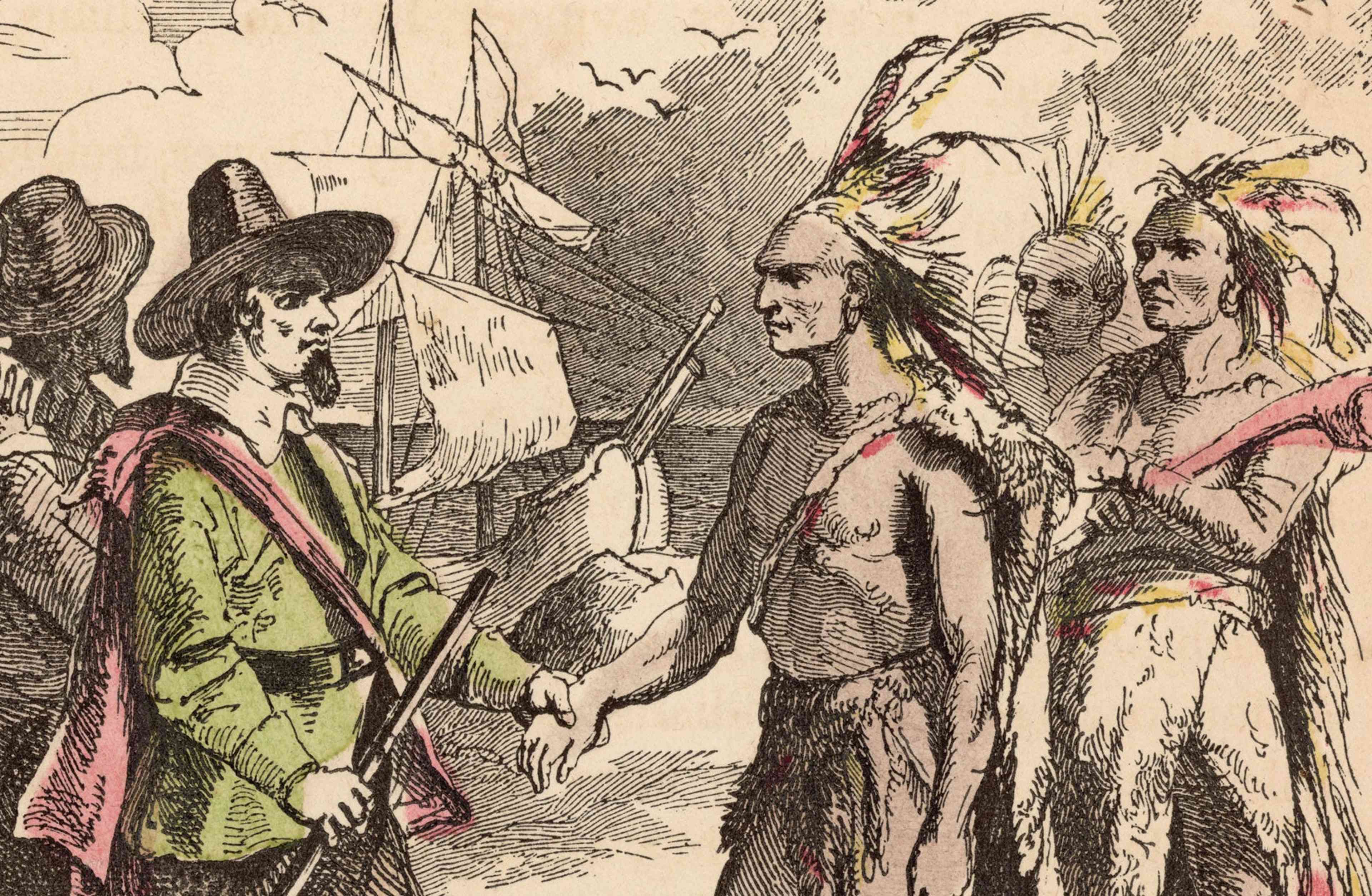
- Samoset: An Abenaki sachem from Maine who was visiting the Wampanoag [1]. Having learned English from European fishermen, he courageously made the first peaceful contact with the Plymouth settlers, clearing the path for Ousamequin’s arrival [1].
- Governor John Carver: The first governor of Plymouth Colony who signed the treaty on behalf of King James I [1]. His early death in April 1621 left the execution of the treaty to his successors [1].
- William Bradford: The long-serving governor of the colony who, along with Edward Winslow, respected and upheld the terms of the treaty for decades [1]. His journals serve as the primary written record of the Plymouth Colony location and the subsequent autumn feast.
- Metacom (King Philip): Ousamequin’s second son, who inherited the sachemship after the suspicious death of his brother Wamsutta [1]. Frustrated by decades of colonial land theft and cultural erosion, he led a devastating, pan-tribal war against the English [1].
The Core Terms of the 1621 Treaty
According to Edward Winslow’s Mourt’s Relation (1622), the treaty consisted of six main clauses designed to establish a strict military alliance and legal framework between the two sovereign entities [1]:
- That neither Ousamequin nor any of his people should do hurt or injury to the English.
- That if any Wampanoag harmed an Englishman, the offender would be sent to the colony for punishment.
- That if anything were stolen from either party, the offender must restore it immediately.
- If any outside group waged war against either the English or the Wampanoag, they would act as mutual military allies.
- Ousamequin would inform neighboring tribes of this treaty so they would also respect the peace.
- When visiting each other’s settlements, both groups were required to leave their weapons behind to prevent accidental violence.
While framed as an agreement between equals, the treaty implicitly favored the English by requiring Native offenders to be tried under English law, highlighting the subtle colonial power dynamics that would expand over time.
Turning Points: From Peace to Devastating Warfare
For fifty-four years, the treaty was remarkably successful [1]. It remains the only peace treaty between English colonists and Native Americans to be honored during the entire lifetimes of its original signers [1]. Because of the Wampanoags’ agricultural guidance, the Pilgrims learned how to cultivate maize, catch local fish, and successfully navigate the New England wilderness, securing their long-term survival [1].
However, the rapid influx of English settlers during the Great Migration of the 1630s and 1640s fundamentally altered the balance of power. As the Plymouth, Massachusetts Bay, Connecticut, and Rhode Island colonies grew, their thirst for land became insatiable. Following Ousamequin’s death in 1661, his eldest son, Wamsutta, was forcibly questioned by colonial authorities over land transactions and died shortly thereafter under mysterious circumstances [1]. This fueled rumors of poisoning and deeply angered his younger brother, Metacom [1].
By 1675, Metacom had forged a massive coalition of regional tribes, realizing that only armed resistance could stop the total erasure of their sovereignty. King Philip’s War broke out, becoming one of the bloodiest and most destructive conflicts in American history per capita [1]. The war ended in 1676 with Metacom’s betrayal, execution, and the horrific enslavement and relocation of thousands of surviving Wampanoag to the West Indies [1].
Lesser-Known Historical Facts
- Samoset’s Unexpected Request: When Samoset first walked into the Plymouth settlement on March 16, 1621, he did not offer a formal speech [1]. Instead, he shocked the starving Pilgrims by speaking English and boldly asking them for beer. They instead gave him strong water (brandy), biscuit, butter, cheese, and pudding.
- Squanto’s Double-Crossing Diplomacy: While historically remembered as a benevolent helper, Tisquantum was a highly complex political actor. He attempted to play the English and Wampanoag against each other, falsely telling other local tribes that the English kept the “plague” buried under their storehouses and could release it at will, attempting to extract tribute and set himself up as a powerful independent leader.
- The Empty Land Myth: The Pilgrims did not settle on untouched wilderness. Plymouth was built directly on top of Patuxet, a thriving Wampanoag town [1]. The fields the Pilgrims planted had already been cleared and cultivated by the Wampanoags for generations, making the settlement’s establishment far easier than it would have been in dense, untamed forests.
Why This Treaty Still Matters Today
The 1621 treaty and its tragic aftermath offer crucial lessons on diplomacy, sovereignty, and the historical memory of colonization. For centuries, American mythology has painted the alliance as a harmonious brotherhood, ignoring the strategic political calculation made by Ousamequin and the devastating consequences of subsequent colonial expansion [1].
Today, many contemporary Wampanoag descendants view the treaty not as a moment of celebration, but as the beginning of a long history of cultural erasure, land theft, and broken promises. Since 1970, Native Americans in New England have gathered at Plymouth on Thanksgiving Day to observe a National Day of Mourning, reminding the public of the complex, often dark realities of early American history and advocating for the recognition of Indigenous sovereignty that persists to this day.
People Also Ask
Why did the Wampanoag sign the treaty of 1621?
The Wampanoag, led by Ousamequin, signed the treaty primarily for physical survival and political protection [1]. Having lost up to 90% of their population to a devastating epidemic, they were highly vulnerable to subjugation by their rivals, the Narragansett [1]. An alliance with the heavily armed English provided a vital military deterrent [1].
Did the Pilgrims and Wampanoag speak the same language?
No, they did not. The Pilgrims spoke English, while the Wampanoag spoke Massachusett (an Algonquian language). Communication was made possible by two extraordinary intermediaries: Samoset, who had learned basic English from fishermen in Maine, and Squanto (Tisquantum), who spoke fluent English after living in London following his escape from European slavery [1].
How long did the 1621 treaty last?
The treaty lasted for more than 50 years, making it the longest-lasting peace agreement between English colonists and Native Americans [1]. It was honored throughout the lifetimes of its original signers, but relations rapidly deteriorated after the death of Ousamequin, culminating in King Philip’s War in 1675 [1].
What was the long-term impact of the treaty on the Wampanoag?
In the short term, the treaty saved the Wampanoag from the Narragansett and allowed them to rebuild [1]. In the long term, however, it facilitated the rapid expansion of English colonial settlements. This massive influx of settlers eventually led to the erosion of Native sovereignty, catastrophic land loss, and the devastating King Philip’s War [1].
Conclusion
The 1621 Peace Treaty between the Wampanoag and the Mayflower Pilgrims was a masterpiece of early American diplomacy, born of desperate circumstances on both sides [1]. It allowed a struggling English colony to survive its infancy and helped a devastated Indigenous nation protect itself from aggressive rivals [1]. Yet, the peace was fragile, ultimately collapsing under the weight of colonial expansion and shifting power dynamics. By looking past the simplistic myths of early America, we gain a deeper appreciation for the political agency of Indigenous leaders like Ousamequin and a more honest understanding of the complex, bittersweet foundations of the American story.


