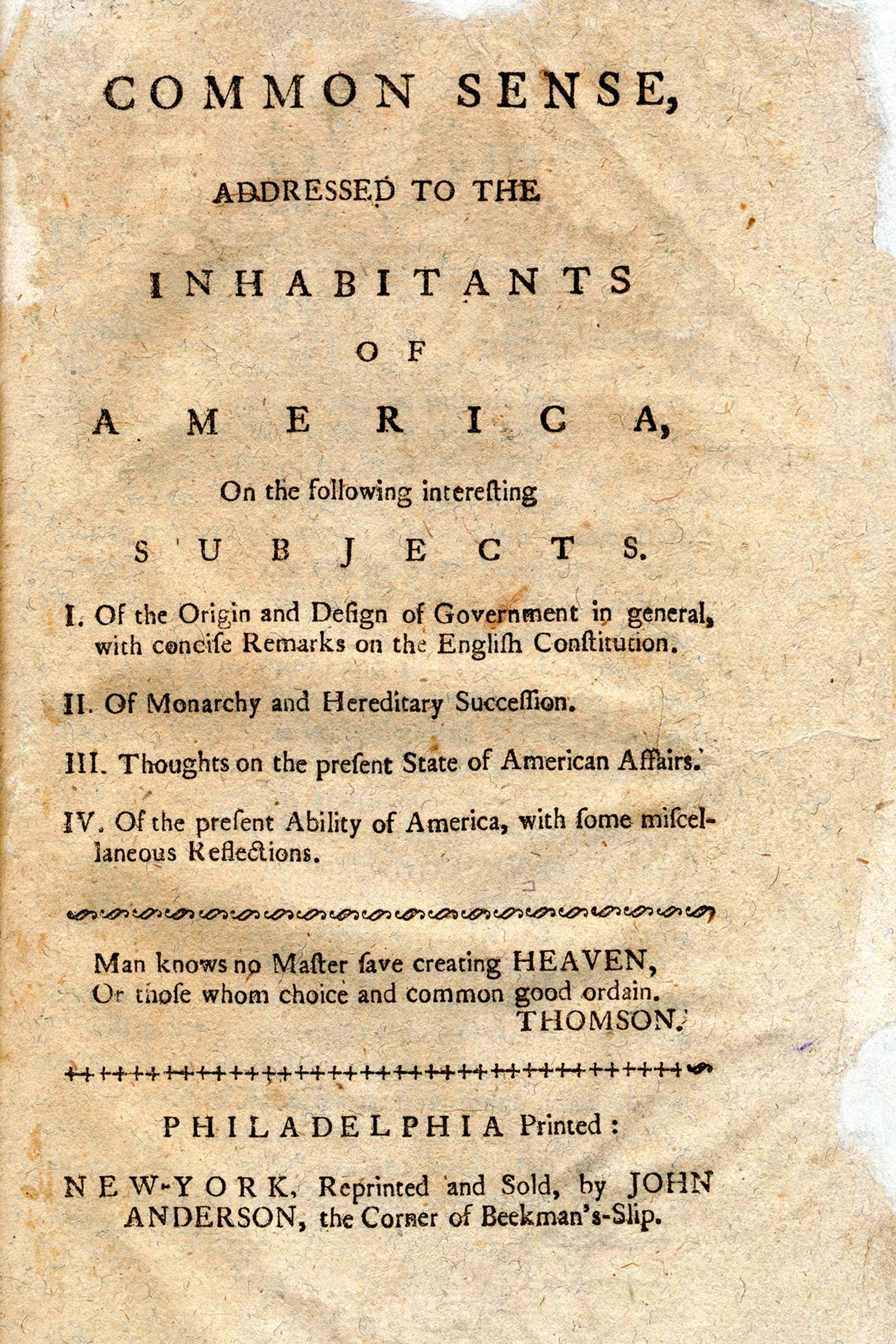
The American Revolution was not just a war of muskets and cannon fire; it was a profound war of ideas that fundamentally reshaped the modern world. In early 1776, even as British soldiers clashed with colonists, the prospect of total separation from the mother country remained a radical and frightening concept to many. The spark that finally ignited the collective colonial will for absolute independence was a modest, 47-page pamphlet titled Common Sense, penned by an impoverished English immigrant named Thomas Paine. Arriving at a critical juncture in the history of the 13 colonies, Paine’s writing did not merely critique British policy—it shattered the divine right of kings and articulated a brilliant, egalitarian vision of self-rule. By translating complex political theories into a fiery, accessible language, Paine transformed a localized rebellion against unfair taxes into a global quest for human liberty, making his work one of the most influential political treatises ever written.

The Sociopolitical Context: America on the Brink of Rebellion
To understand the explosive impact of Common Sense, one must examine the delicate geopolitical atmosphere of late 1775. Following the bloodbath at the Battle of Bunker Hill and the initial clashes at Lexington and Concord, the American colonies were in a state of ideological limbo. While the Continental Army was actively fighting British redcoats, the prevailing political consensus among elite colonists was not separation, but reconciliation. Prominent leaders and ordinary citizens alike still toasted King George III and viewed themselves as loyal British subjects who were merely protesting unconstitutional tax laws and administrative overreach. The concept of declaring complete independence was widely regarded as political suicide, treason, or an invitation to anarchy.
At the same time, the socio-economic landscape of the colonies was undergoing a rapid evolution. While elections in colonial America were often highly localized, festive, and occasionally chaotic social events, they lacked a unified, cohesive national objective. The colonists were divided by geography, religious practices, and economic interests. To bridge these deep-seated regional differences, a powerful, unifying narrative was desperately required. Paine’s arrival in Philadelphia in late 1774, armed with a letter of recommendation from Benjamin Franklin, placed him at the geographic and intellectual epicenter of this burgeoning national crisis.
Chronological Timeline of Thomas Paine and Common Sense
The rapid transformation of Thomas Paine from a destitute English custom officer to the intellectual catalyst of the American Revolution is one of the most remarkable stories in political history. Below is the chronological progression of key events:
- 1737 (January 29): Thomas Paine is born in Thetford, Norfolk, England, to a modest Quaker family. He spends his early life struggling through various trades, including corset-making and tax collecting.
- 1774 (November): After meeting Benjamin Franklin in London, Paine emigrates to Philadelphia, barely surviving a brutal bout of typhus during the Atlantic crossing.
- 1775 (April): The battles of Lexington and Concord mark the outbreak of open, armed hostilities between Great Britain and the American colonies.
- 1775 (Autumn): Encouraged by Benjamin Franklin and the reformist physician Dr. Benjamin Rush, Paine begins writing a comprehensive defense of American independence.
- 1776 (January 10): Paine publishes Common Sense anonymously in Philadelphia. It immediately captivates the public, selling out its initial print run in a matter of days.
- 1776 (July 4): The Continental Congress formally adopts the Declaration of Independence, heavily reflecting the populist arguments and democratic ideals popularized by Paine.
Key Figures and Their Indispensable Roles
While Thomas Paine was the sole author of the pamphlet, its creation and massive success were collaborative endeavors involving several legendary figures of the Revolutionary Era:
- Thomas Paine: The visionary writer who synthesized complex Enlightenment philosophy into standard, everyday English. His unique ability to write from the perspective of the common worker allowed his message to transcend social barriers and reach the masses.
- Benjamin Franklin: The elder statesman who recognized Paine’s raw intellectual talent in London and provided the crucial letter of introduction that allowed Paine to establish himself as a journalist in Philadelphia.
- Dr. Benjamin Rush: A prominent Philadelphia physician, abolitionist, and future signer of the Declaration of Independence. Rush acted as Paine’s trusted advisor and editor, persuading him to change the pamphlet’s title from “The Plain Truth” to the far more evocative “Common Sense.”
- John Adams: A leading delegate in the Continental Congress who, despite criticizing some of Paine’s radical democratic proposals for government structure, openly admitted that the pamphlet was instrumental in clearing doubts and fixing the nation’s choice for independence.
The Core Philosophical Arguments of Common Sense
Paine’s pamphlet did not merely complain about British policies; it systematically dismantled the ideological pillars of the British Empire. He structured his arguments around four revolutionary principles:
1. The Absurdity of Hereditary Monarchy
Paine launched a scathing, unprecedented assault on the institution of kingship itself. He argued that hereditary succession was an insult to human dignity, famously writing that “one honest man to society and in the sight of God” is worth more than “all the crowned ruffians that ever lived.” By ridiculing the idea that one family had a divine right to rule over millions of others, Paine delegitimized King George III in the eyes of the colonists.
2. Government as a Necessary Evil
Drawing a sharp contrast between society and government, Paine explained that society is produced by our wants, while government is produced by our wickedness. Government, in Paine’s view, is a “necessary evil” whose sole purpose is to protect the natural rights of the citizenry. When a government fails to protect those rights—or actively violates them, as the British crown did—the citizens have an inherent right to alter or abolish it. This focus on natural rights and representative institutions echoed the ideals of democratic self-governance that had been slowly developing in the American consciousness for over a century.
3. The Inevitability of American Independence
Paine argued that the geographic distance between Great Britain and North America was natural proof that the heavens never intended for a small island to rule an entire continent. He insisted that the connection with Britain was no longer beneficial, but actively harmful, dragging America into unnecessary European wars and restricting its global economic potential.
4. America as the Global Asylum of Liberty
Paine elevated the American struggle from a local tax dispute to an epic, historic crusade for all of humanity. He urged America to become an “asylum for mankind,” welcoming those fleeing oppression and tyranny from every corner of the earth. This concept laid the foundational groundwork for what would later be known as American exceptionalism.
Major Turning Points and the Shift in Public Sentiment
The publication of Common Sense marks the exact turning point when the American rebellion transitioned from a conservative defense of colonial rights to a radical war for national liberation. Prior to January 1776, the Continental Congress was paralyzed by division, with many delegates hoping for a peaceful compromise with the Crown. Paine’s pamphlet swept through the colonies like an uncontrollable wildfire, destroying any remaining public loyalty to the British monarchy.
Because copyright laws did not exist in the 18th century, pirated editions of Common Sense were printed throughout the colonies. It was read aloud in crowded taverns, coffee houses, and military camps, allowing illiterate citizens and soldiers to absorb and debate its concepts. This democratization of political discourse put immense pressure on colonial leaders. Within months, local assemblies instructed their delegates to vote for independence, paving the way for Thomas Jefferson to draft the Declaration of Independence in June 1776.
Long-Term Impact on the American Republic
The legacy of Common Sense extends far beyond the year 1776. Paine’s insistence on a strong central government governed by a written constitution and a robust Bill of Rights deeply influenced the debates surrounding the drafting of the United States Constitution in 1787. His emphasis on religious freedom, individual liberty, and equal representation helped establish the baseline democratic expectations of the young nation.
Furthermore, Paine’s rhetorical style forever changed American political communication. He demonstrated that political theory did not have to be written in dense, Latin-infused academic jargon reserved for the wealthy elite. By writing in a direct, passionate, and clear manner, Paine established a populist tradition of political writing that continues to influence American political campaigns and social movements to this day.
Lesser-Known Facts About Thomas Paine and His Pamphlet
- A Generous Patriot: Despite desperately needing money, Paine refused to profit from the massive success of Common Sense. He donated all of his royalties to the Continental Army to help buy supplies for George Washington’s soldiers.
- The Forgotten Founder: Despite his enormous contribution to the nation’s birth, Paine died in relative obscurity and poverty in 1809. Because of his later radical religious views expressed in The Age of Reason, he was widely demonized, and only six people attended his funeral.
- Read Aloud Culture: Because literacy rates varied, Common Sense became one of the first multi-media sensations in America. It was designed to be read aloud, acting as an early form of political podcasting that united communities across the eastern seaboard.
Why Thomas Paine’s Common Sense Still Matters Today
In our modern era of deep political division and complex debates over the role of government, Thomas Paine’s masterwork remains incredibly relevant. Common Sense reminds us that the foundation of democratic society relies on the active participation of informed citizens who are willing to question authority. Paine’s core belief—that the average citizen has the capacity to understand, participate in, and shape the direction of their government—is the very heartbeat of modern democracy. His words continue to inspire those who strive to hold governments accountable and fight for human rights across the globe.
People Also Ask
What was the main purpose of Common Sense by Thomas Paine?
The primary purpose of Common Sense was to persuade the American colonists to abandon their attempts at reconciliation with Great Britain and instead declare complete, immediate independence. Paine argued that monarchy was an unjust form of government and that America had a unique historic opportunity to establish a free, self-governing republic.
Why was Common Sense so popular in the colonies?
Common Sense was immensely popular because it was written in simple, clear, and passionate language that ordinary people could easily understand, rather than the complex legal and philosophical jargon typically used by elite writers. It was also widely distributed, cheap to purchase, and frequently read aloud in public gathering spaces.
Did Thomas Paine sign the Declaration of Independence?
No, Thomas Paine did not sign the Declaration of Independence. While his pamphlet was the primary catalyst that inspired the Declaration, Paine was not a delegate to the Continental Congress, which was the body responsible for drafting and signing the document.
Conclusion
Thomas Paine’s Common Sense was the intellectual match that set the dry tinder of colonial frustration ablaze. By stripping away the false mystique of the monarchy and articulating a clear, inspiring vision of self-rule, Paine did not just help win a war—he helped invent a nation. His profound belief in the power of ordinary people to “begin the world over again” remains the enduring promise and challenge of the American experiment.


