The Battle of Chancellorsville, fought from April 30 to May 6, 1863, remains one of the most compelling and strategically brilliant clashes in the broader annals of American Civil War history. Often celebrated as Confederate General Robert E. Lee’s “perfect battle” due to his audacious and unprecedented decision to repeatedly divide his forces in the face of a vastly superior foe, it was simultaneously a deeply tragic victory that devastated the Southern high command. Set against the dense, eerie backdrop of a Virginia forest known as the Wilderness, the confrontation saw Union General Joseph “Fighting Joe” Hooker’s well-designed flanking maneuver completely dismantled by Confederate tactical genius. However, this remarkable military triumph came at a devastating cost: the mortal wounding of Lieutenant General Thomas “Stonewall” Jackson by friendly fire. This pivotal conflict not only altered the strategic momentum of 1863 but also set in motion the chain of events that would culminate in the defining turning point of the entire war just two months later.
Historical Background: The Strategic Crisis of 1863
By the spring of 1863, the United States was deeply fractured, and the American Civil War had dragged into its third bloody year. The Union’s Army of the Potomac was suffering from a profound crisis of morale. Just months earlier, in December 1862, the Union suffered a catastrophic defeat at the Battle of Fredericksburg under the command of Major General Ambrose Burnside. Desperate for a victory and seeking to revitalize the Northern war effort, President Abraham Lincoln replaced Burnside with Major General Joseph “Fighting Joe” Hooker in January 1863.
Hooker was a charismatic and energetic officer who immediately set about reforming the army. He improved medical care, modernized administrative structures, restructured the cavalry into a single cohesive corps, and successfully boosted the sagging morale of his troops. By April, Hooker commanded a highly disciplined, well-equipped, and massive force of approximately 115,000 men. Facing him across the Rappahannock River near Fredericksburg was General Robert E. Lee’s Army of Northern Virginia. Lee’s forces were severely outnumbered, numbering only about 60,000 soldiers. A significant portion of Lee’s army, consisting of two divisions under Lieutenant General James Longstreet, was absent, foraging for supplies in southern Virginia. Recognizing this massive numerical advantage, Hooker devised a brilliant and highly secretive campaign plan to destroy Lee’s army once and for all and capture the Confederate capital of Richmond.
The Road to Chancellorsville: Strategic Context and Causes
The underlying catalyst for the Battle of Chancellorsville was the urgent political and social pressure mounting on both sides of the conflict. In the North, public dissatisfaction with the war’s duration was growing, and Lincoln desperately needed a decisive victory to justify the mounting human and financial costs. In the South, resources were dwindling, and the Confederate economy was straining under the weight of the Union blockade. Lee knew that his army could not win a prolonged war of attrition against the industrially superior North; he needed to deliver a crushing blow to the Union’s main eastern army to force a peace negotiation or gain foreign recognition.
Hooker’s strategy to achieve this was elegant. Instead of launching another costly direct assault against the formidable Confederate trenches at Fredericksburg, he decided to outflank them. On April 27, 1863, Hooker sent a force of roughly 40,000 men under Major General John Sedgwick to make a loud, visible show of force directly in front of Fredericksburg, tricking Lee into believing a frontal attack was imminent. Meanwhile, Hooker led the remaining two-thirds of his massive army on a swift, silent march up the Rappahannock River, crossing over into Lee’s rear. By April 30, Hooker’s flanking force had successfully concentrated at the strategic crossroads of Chancellorsville, situated in a dense, secondary-growth forest known locally as the “Wilderness.” Hooker believed he had trapped Lee in a giant pincer movement, confidently declaring to his officers that “the enemy must ingloriously fly, or come out from behind his defenses and give us battle on our own ground, where certain destruction awaits him.”
Key Figures of the Battle of Chancellorsville
The dramatic outcome of the battle was heavily dictated by the distinct personalities, fatal flaws, and brilliant decisions of the commanders on the field:
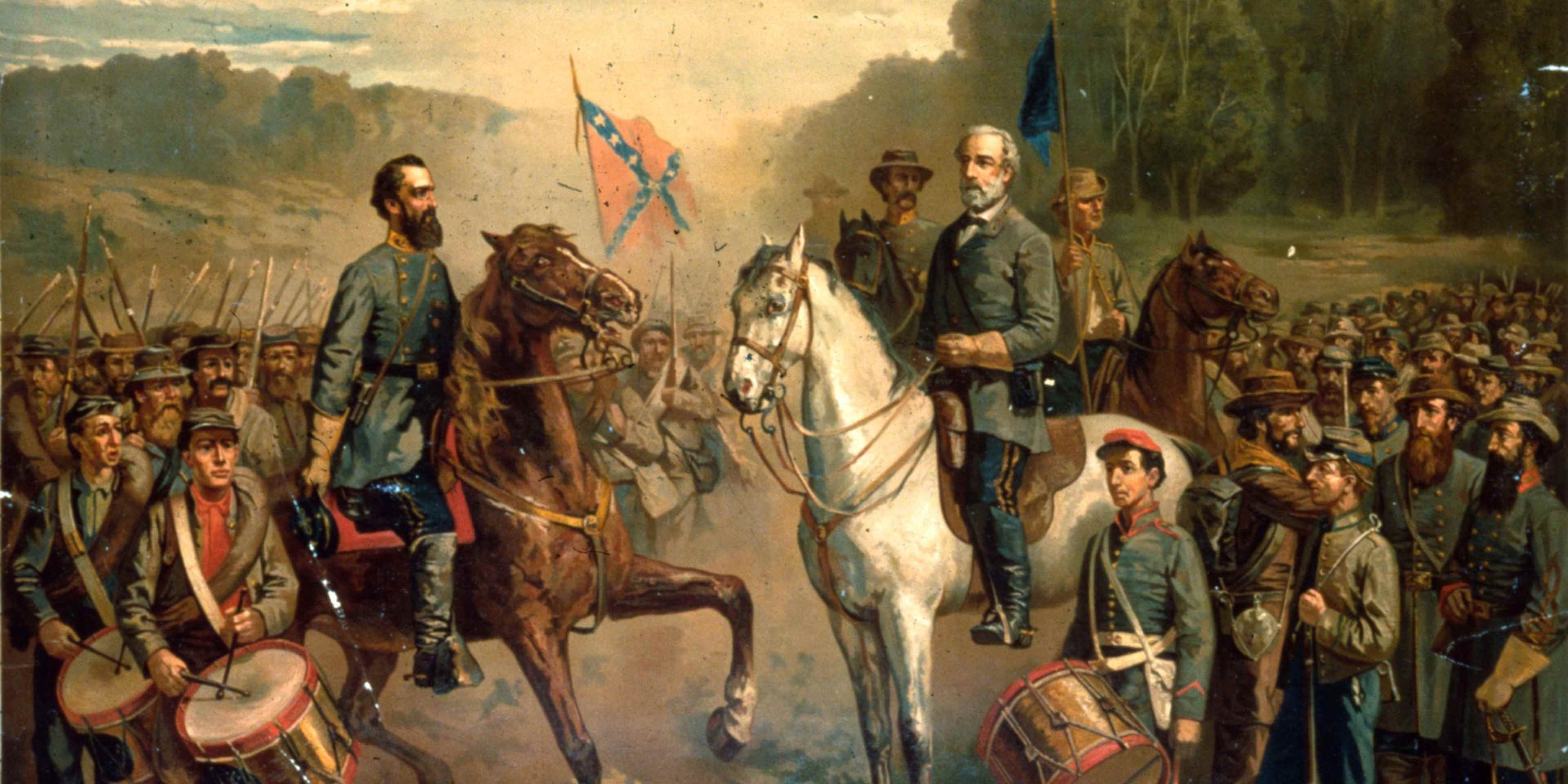
- General Robert E. Lee: Commander of the Army of Northern Virginia. Facing an army nearly twice his size, Lee rejected conventional military doctrine, which dictated retreat. Instead, he relied on speed, audacity, and an intimate understanding of his opponent’s psychology to seize the initiative.
- Lieutenant General Thomas “Stonewall” Jackson: Lee’s highly trusted executive officer and tactical hammer. Jackson’s deep religious faith, relentless drive, and mastery of rapid troop movements made him the perfect instrument for Lee’s daring offensive maneuvers.
- Major General Joseph “Fighting Joe” Hooker: Commander of the Army of the Potomac. Though an excellent administrator and strategist, Hooker proved unable to handle the intense psychological pressure of high command when faced with Lee’s unexpected countermoves.
- Major General Daniel Sickles: Commander of the Union III Corps. A controversial political general, Sickles played a central role in the battle’s middle phase, particularly during the intense fighting around Hazel Grove, where his decisions heavily impacted the Union’s defensive integrity.
- Major General Oliver Otis Howard: Commander of the Union XI Corps. Howard’s failure to properly secure his right flank despite multiple warnings directly enabled Jackson’s devastating surprise attack on May 2.
Chronological Timeline of the Clash in the Wilderness
The battle unfolded over several intense days, characterized by rapid shifts in momentum, intense close-quarters combat, and historic command decisions:
- April 27–30, 1863: Hooker executes his brilliant flanking maneuver, crossing the Rappahannock and Rapidan rivers to establish a massive Union foothold at Chancellorsville. Lee realizes he is being outflanked.
- May 1, 1863: Rather than retreating, Lee aggressively divides his army, leaving 10,000 men under Major General Jubal Early to defend Fredericksburg, while marching the rest west to meet Hooker. The two armies clash in the open fields east of the Wilderness. Terrified by Lee’s aggressive response, Hooker unexpectedly orders his advancing troops to halt and retreat into defensive positions around Chancellorsville, surrendering the initiative and shocking his own subordinate commanders.
- May 2, 1863 (The Flank Attack): Lee and Jackson meet in the woods and hatch an incredibly daring plan. Lee decides to split his army again, leaving only 14,000 men to hold Hooker’s front, while sending Jackson with 28,000 troops on a grueling 15-mile march around the Union right flank. At 5:15 PM, Jackson’s men scream out of the woods, completely catching Howard’s unprepared XI Corps by surprise and shattering the Union line.
- May 2, 1863 (Nightfall Tragedy): As the sun sets and the momentum slows, Jackson rides forward beyond his own lines to scout the terrain for a night attack. Returning in the dark, Jackson and his staff are mistaken for Union cavalry by a North Carolina regiment, which opens fire. Jackson is shot three times, shattering his left arm.
- May 3, 1863: Major General J.E.B. Stuart takes command of Jackson’s corps. The fighting reaches a fever pitch of ferocity as the Confederates launch savage, frontal attacks to reunite the two wings of their divided army. During the battle, Hooker is concussed when a shell strikes a pillar of the Chancellor House, further paralyzing Union command. Sickles is ordered to abandon the high ground at Hazel Grove, allowing Confederate artillery to rain devastating fire upon the retreating Union troops.
- May 4–6, 1863: Lee successfully keeps Hooker at bay while rushing east to defeat John Sedgwick’s advancing Union force at Salem Church. Recognizing the futility of his position, a demoralized Hooker orders a full retreat across the Rappahannock River, bringing a disappointing end to the Union offensive.
Major Turning Points: Audacity and Friendly Fire
Two critical turning points defined the outcome and long-term legacy of Chancellorsville. The first was the decision made by Lee and Jackson on the night of May 1. Confronted with a force twice their size, they chose to ignore military orthodoxy. Instead of retreating, they agreed to a double division of their army—a maneuver so risky that had Hooker launched a determined attack, the Confederate army would have likely been destroyed in detail. Jackson’s executed 15-mile march remains a classic example of deception and speed in military history.
The second turning point was the tragic shooting of Stonewall Jackson on the evening of May 2. While Jackson’s arm was quickly amputated at a field hospital, he contracted pneumonia during his recovery. His death on May 10, 1863, was an irreplaceable loss for the Confederacy. Lee lamented that while Jackson had lost his left arm, he had lost his right. Jackson’s aggressive, independent tactical leadership was never fully replaced, a deficit that would severely hamper Lee’s command structure in future campaigns.
Long-Term Impact: From Chancellorsville to Gettysburg
The aftermath of Chancellorsville had profound consequences for both the Union and Confederate war efforts. In the North, the defeat was met with utter despair. Upon hearing of the retreat, a distraught President Abraham Lincoln famously paced the White House exclaiming, “My God! My God! What will the country say?” However, the loss forced yet another reorganization of the Union command, eventually leading to the appointment of George G. Meade, who would successfully command the army in its next great trial.
For the Confederacy, Chancellorsville cemented General Robert E. Lee’s reputation as an invincible military genius, a belief shared by both his own men and many in the Union army. However, this brilliant tactical victory fostered a dangerous level of overconfidence. Lee began to believe that his Army of Northern Virginia was capable of achieving the impossible. Flush with victory, Lee decided to launch his second invasion of the North, hoping to gather supplies, relieve war-weary Virginia, and pressure the Union into peace talks. This fateful decision led directly to the monumental clash in Pennsylvania. Understanding Chancellorsville is essential to understanding how the Battle of Gettysburg turned the tide of the Civil War, as Lee entered that conflict without his “right arm,” Stonewall Jackson, and with an overestimation of his army’s capabilities that would culminate in the disastrous Pickett’s Charge.
Lesser-Known Facts About the Battle of Chancellorsville
- The Literary Legacy: Author Stephen Crane’s famous 1895 novel, The Red Badge of Courage, which vividly depicts the psychological trauma and terror of Civil War combat, was heavily based on the experiences of soldiers fighting at the Battle of Chancellorsville, despite Crane having been born years after the war ended.
- A Concussed Commander: General Joseph Hooker was temporarily incapacitated at the height of the battle on May 3. While standing on the porch of the Chancellor House, which served as his headquarters, a Confederate artillery shell struck a wooden pillar he was leaning against. The impact split the pillar, knocking Hooker unconscious and leaving him heavily concussed and dazed during the critical hours when his army desperately needed decisive leadership.
- The Horror of the Wilderness Fires: The dense, dry underbrush of the Wilderness forest easily caught fire from the intense artillery shelling and muzzle flashes of thousands of muskets. Tragically, thick smoke and raging brushfires swept through the woods on May 2 and May 3, trapping and burning alive hundreds of wounded soldiers who were unable to crawl to safety.
Why the Battle of Chancellorsville Still Matters Today
Today, the Battle of Chancellorsville is studied extensively in military academies worldwide, including West Point, as a classic textbook study in maneuver warfare, the principles of concentration of force, and the psychological dimensions of command. It serves as a stark reminder of how leadership, morale, and decisive action can overcome immense material and numerical disadvantages on the battlefield. Furthermore, the preserved battlefields in Spotsylvania County stand as a solemn monument to the immense human cost of the Civil War, reminding modern generations of the fragile nature of national unity and the profound sacrifices made to preserve the Union.
People Also Ask
Who won the Battle of Chancellorsville?
The Confederate States of America won the Battle of Chancellorsville. General Robert E. Lee defeated a Union army more than twice his size in what is widely considered his greatest tactical masterpiece.
Why is Chancellorsville called Lee’s “perfect battle”?
It is called Lee’s “perfect battle” because he repeatedly violated basic military principles by dividing his outnumbered forces in the face of a superior enemy, yet succeeded through brilliant deception, speed, and seizing the tactical initiative from a passive opponent.
How did Stonewall Jackson die at Chancellorsville?
Stonewall Jackson was accidentally shot three times by his own Confederate troops (a North Carolina regiment) during a night reconnaissance mission on May 2, 1863. Though his arm was amputated, he died of pneumonia eight days later on May 10, 1863.
What were the total casualties of the Battle of Chancellorsville?
The battle resulted in heavy casualties for both sides. The Union suffered approximately 17,278 casualties (killed, wounded, captured, or missing), while the Confederates suffered about 12,826 casualties, representing a much higher percentage of their overall force.
Conclusion: A Brilliant Yet Devastating Victory
In the final analysis, the Battle of Chancellorsville stands as a monument to the complex, unpredictable nature of military history. It was a stunning demonstration of tactical genius that saw General Robert E. Lee and Stonewall Jackson execute one of the most daring maneuvers in modern warfare. Yet, it was also a profound tragedy for the Southern cause. The death of Jackson stripped the Army of Northern Virginia of its most aggressive offensive mind, leaving a void that would prove catastrophic just two months later on the hills of Gettysburg. For the Union, though a humiliating defeat, Chancellorsville was a painful but necessary catalyst that ultimately forged a more resilient, battle-hardened army capable of securing final victory and preserving the United States.


