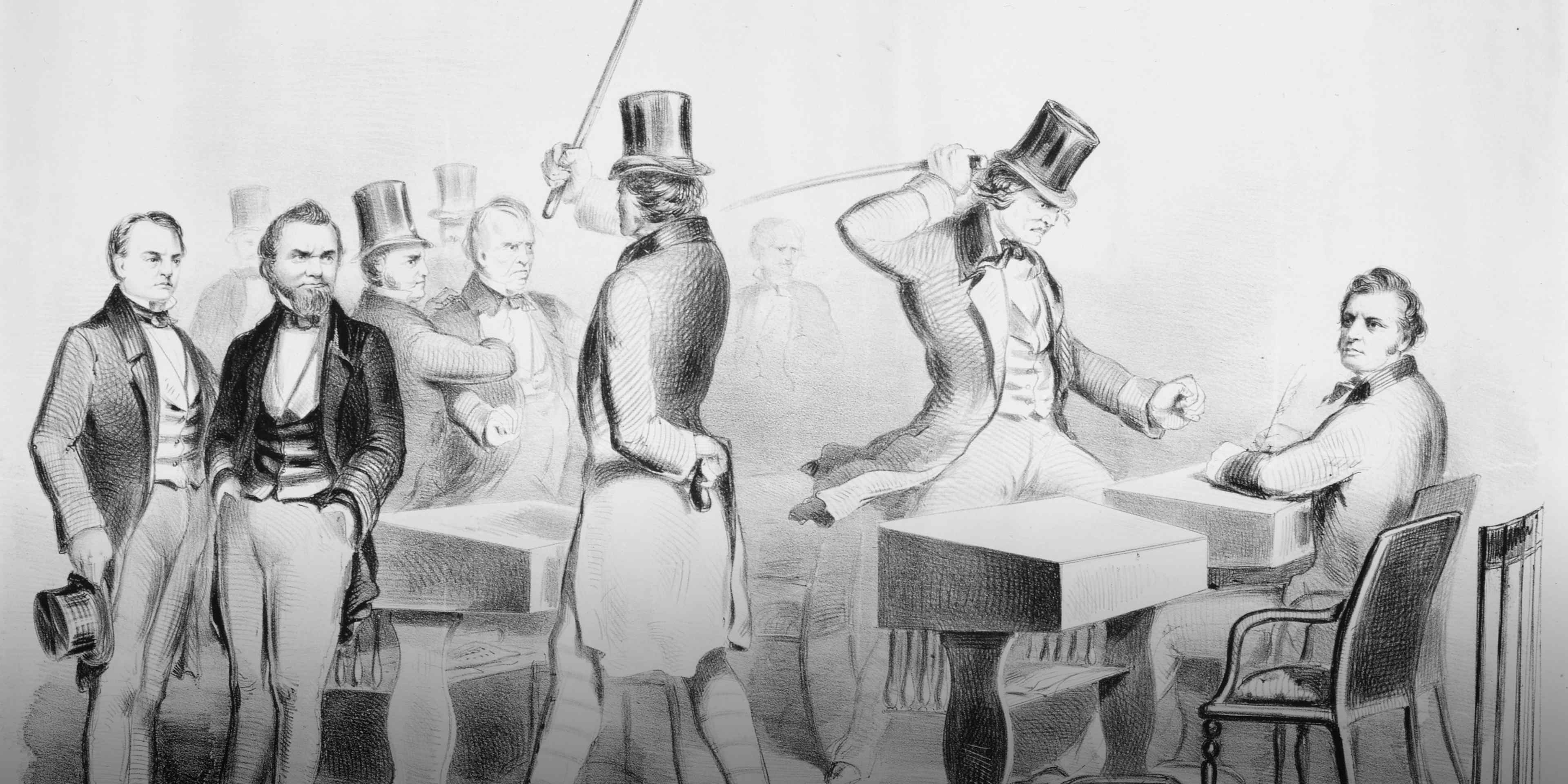
The historical memory of the United States Capitol is often bathed in a serene, democratic light—a place of lofty rhetoric, constitutional debate, and peaceful legislative compromise. However, the reality of the three decades leading up to the Civil War tells a far more visceral and bloody story. During this highly volatile antebellum era, the halls of Congress were not just a forum for policy; they were an active, weapon-strewn battleground. Violence in Congress Before the Civil War was a frequent, normalized, and highly strategic tool used by politicians—primarily Southern defenders of slavery—to intimidate their opponents and silence debate. From hidden Bowie knives and pocket pistols to public duels and a legendary late-night fistfight involving dozens of representatives, the physical brutality in Washington, D.C. mirrored the growing sectional fractures that would eventually tear the nation apart. Understanding this dark chapter of American history reveals that the Civil War did not erupt overnight; its first battles were fought with fists, canes, and pistols right on the legislative floor.
Historical Background: A Legislature Armed and Divided
To understand why congressmen in the 1830s, 1840s, and 1850s went to work armed with lethal weapons, one must examine the socio-political landscape of the young republic. Following the demise of the Era of Good Feelings, American politics became intensely partisan, divided along geographic and economic lines. The primary catalyst for this polarization was the expansion of slavery into new Western territories. While Northern representatives faced mounting pressure from their abolitionist constituents to halt the spread of this brutal institution, Southern representatives were equally determined to preserve their economic, political, and social dominance, which was entirely dependent on the labor of enslaved people.
This political desperation was compounded by a culture of personal honor, particularly in the American South. To Southern gentlemen, political disagreements were not merely intellectual debates; they were personal slights that demanded physical vindication. Under the Southern Code of Honor, a congressman who allowed himself to be insulted without reacting violently was deemed a coward, unfit to represent his constituents. This volatile focus on reputation had deep roots in early American political life, where even the nation’s founders routinely let personal grievances derail their public service, a phenomenon vividly illustrated by the scandal that ruined Alexander Hamilton’s chances of becoming president. Over time, this individual obsession with honor transformed into a collective weapon of systemic intimidation inside the Capitol.
Key Events Timeline: The Escalation of Legislative Violence
The road to the Civil War is marked by several key moments of physical violence in and around the Capitol. While many of these incidents were kept out of the public eye by compliant newspapers, several major events captured the nation’s attention, illustrating the breakdown of democratic governance:
- 1837 – The Arkansas Legislative Murder: In a chilling precursor to congressional brawls, the Speaker of the Arkansas House of Representatives, John Wilson, used a Bowie knife to murder Representative Joseph Anthony on the house floor during a heated debate. Wilson was later acquitted of murder on grounds of “excusable homicide” and subsequently re-elected, demonstrating the extreme tolerance for political violence at the state level.
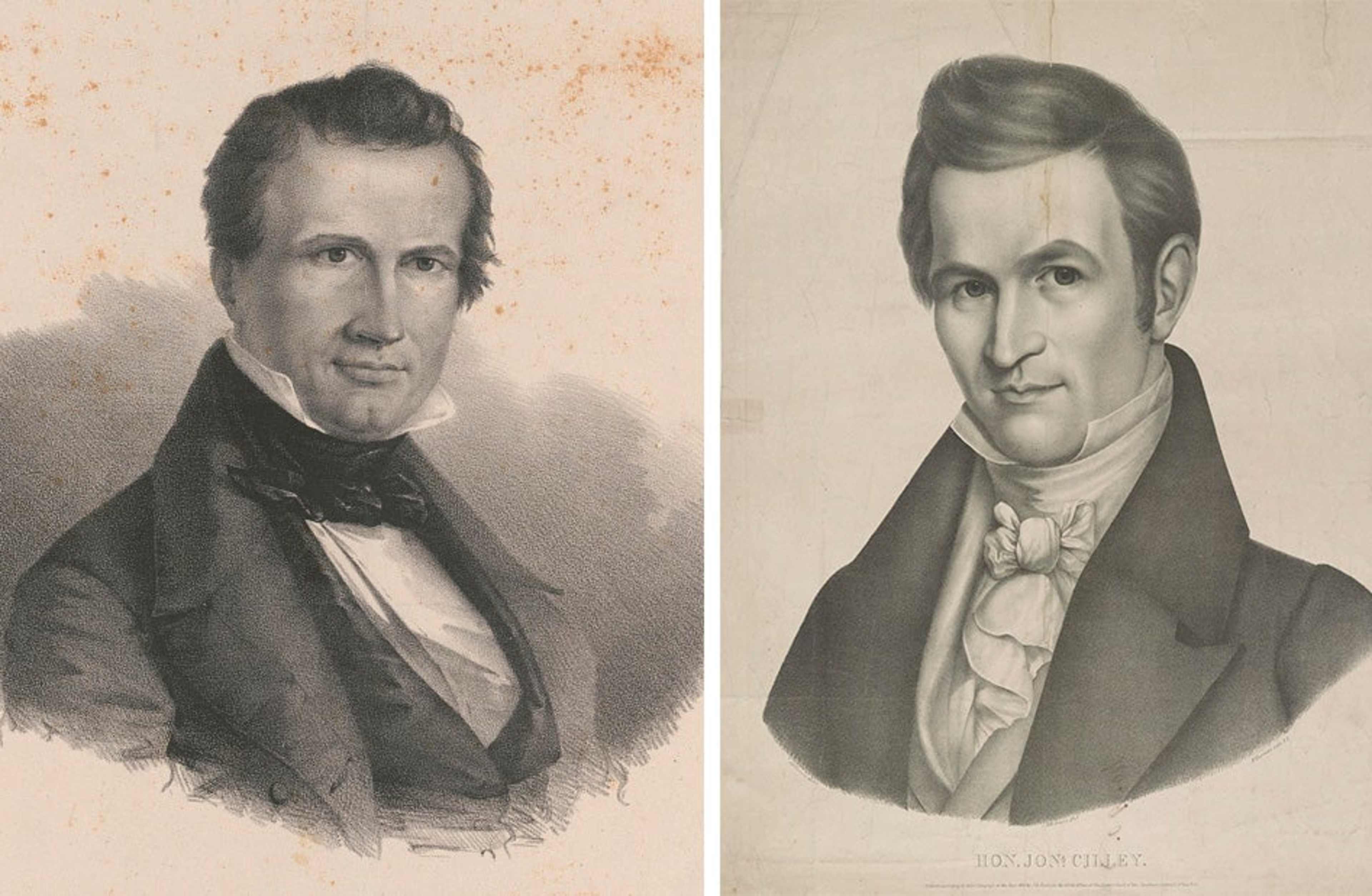
- February 24, 1838 – The Cilley-Graves Duel: Democratic Representative Jonathan Cilley of Maine and Whig Representative William Graves of Kentucky engaged in a tragic rifle duel in Prince George’s County, Maryland. Neither man had a personal grievance against the other; instead, they were pressured into the duel by their respective political parties to defend collective “party honor.” On the third round of fire, Graves shot and killed Cilley.
- 1839 – The Anti-Dueling Act: In response to the national outrage over Cilley’s death, Congress passed a law outlawing dueling within the District of Columbia. However, this did not end the violence; it merely forced congressmen to settle their disputes through “spontaneous” assaults and floor brawls, which did not carry the same legal penalties as formal dueling.
- May 22, 1856 – The Caning of Charles Sumner: Following a fiery anti-slavery speech titled “The Crime Against Kansas,” Senator Charles Sumner of Massachusetts was brutally beaten unconscious at his Senate desk by Representative Preston Brooks of South Carolina. Brooks used a gold-headed gutta-percha cane, striking Sumner repeatedly until the cane shattered. The attack left Sumner severely injured and incapacitated for years, serving as a visceral symbol of Southern aggression.
- February 6, 1858 – The Great Congressional Brawl: During an overnight session debating the pro-slavery Lecompton Constitution for Kansas, a massive, multi-partisan fistfight broke out in the House chamber. Up to fifty congressmen engaged in a wild melee in front of the Speaker’s platform, representing the largest collective physical brawl in congressional history.
Important Figures and Their Lasting Impact
Representative Jonathan Cilley and Representative William Graves
The tragedy of the 1838 Cilley-Graves duel highlights how the political machine could weaponize personal honor. Jonathan Cilley was a rising Democratic star from Maine, and William Graves was a respected Whig from Kentucky. When Cilley questioned the integrity of a pro-Whig newspaper editor, Graves was drafted to deliver a challenge. The resulting duel, fought with rifles at eighty paces, ended in Cilley’s death and shocked the nation. It demonstrated that political polarization had reached a point where representatives were willing to kill their colleagues to maintain party discipline and standing.
Senator Charles Sumner and Representative Preston Brooks
No figures represent the violent ideological divide of the 1850s more than Charles Sumner and Preston Brooks. Sumner was a brilliant, uncompromising abolitionist who used his legislative platform to denounce what he called the “Slave Oligarchy.” Brooks, a South Carolina Democrat, viewed Sumner’s verbal attacks on Southern institutions—and specifically on his relative, Senator Andrew Butler—as an intolerable insult. By beating Sumner with a cane rather than challenging him to a duel, Brooks deliberately treated Sumner as an social inferior who did not deserve the honor of a gentleman’s duel. The incident polarized the nation: Northern abolitionists viewed Sumner as a martyr, while Southern constituents hailed Brooks as a hero, sending him hundreds of replacement canes.
Representative Galusha Grow and Representative Laurence Keitt
The 1858 House brawl was instigated by Galusha Grow, an anti-slavery Republican from Pennsylvania, and Laurence Keitt, a fiery pro-slavery Democrat from South Carolina. Keitt, who had previously assisted Preston Brooks during the caning of Sumner by holding off onlookers, confronted Grow on the House floor, calling him a “black Republican puppy.” Grow’s defiant response—”No negro-driver shall crack his whip over me”—was a direct assault on the plantation ethos. The physical clash that followed showed that Northern Republicans were no longer willing to be bullied by Southern “fire-eaters.”
Causes and Context: Slavery, Honor, and Westward Expansion
The underlying cause of this legislative violence was the existential threat that the anti-slavery movement posed to the Southern economy and social order. Slavery was, by its very nature, a violent institution built on physical subjugation and terror. It is unsurprising that politicians who built their wealth on the whip and the shackle would bring that same physical coercion into the halls of government. The systemic violence of slavery was not limited to the plantation; it affected every facet of American life and left a devastating legacy on generations of families, as seen in the tragic legacy of Revolutionary War veterans whose families were sold into slavery.
Furthermore, as the United States expanded westward, the debate over whether new states would be “free” or “slave” intensified. This territorial struggle, most violently expressed in the Bleeding Kansas crisis, was not just an abstract legal debate. It resulted in physical warfare on the frontier and systemic violence against the Indigenous nations who inhabited these lands. To make way for the Kansas-Nebraska Act of 1854, the federal government unilaterally tore up treaties with Native American tribes, forcibly displacing thousands of Indigenous people to satisfy the insatiable territorial hunger of pro- and anti-slavery settlers. In this light, the violence on the floor of Congress was the legislative manifestation of a broader, bloody campaign of expansion, tribal displacement, and human exploitation.
Major Turning Points: The Collapse of Compromise
For decades, the American political system relied on grand legislative compromises—such as the Missouri Compromise of 1820 and the Compromise of 1850—to maintain a fragile peace between North and South. However, by the late 1850s, these compromises were completely breaking down. The passage of the Kansas-Nebraska Act in 1854 and the Supreme Court’s infamous Dred Scott v. Sandford decision in 1857 convinced Northerners that a powerful “Slave Power” conspiracy had seized control of the federal government. Conversely, Southerners felt increasingly besieged by the rapid growth of the Northern population and the rise of the anti-slavery Republican Party.
According to historian Joanne B. Freeman in her groundbreaking book The Field of Blood: Violence in Congress and the Road to the Civil War, this breakdown of trust transformed congressional behavior. In the early antebellum years, fights were usually individual disputes over personal honor. By 1858, however, congressmen were fighting in organized “battalions” along sectional lines. The floor of the House had become a micro-theater of the upcoming war, proving that peaceful democratic governance is impossible when opposing factions no longer accept the legitimacy of the system or of each other. During this volatile era, even the highest offices of the land were plagued by deep conspiracies, similar to the intense political intrigue that characterized Aaron Burr’s notorious treason case decades earlier.
Long-Term Impact on America
The legacy of congressional violence before the Civil War was profound. By demonstrating that physical force could successfully silence debate, Southern politicians inadvertently accelerated the growth of the Northern Republican Party, which campaigned on resisting Southern bullying. The physical assault on Charles Sumner, in particular, convinced millions of Northerners that the South was incompatible with free speech and democratic values. Ultimately, this culture of violence eroded the very possibility of peaceful legislative compromise, making the secession of Southern states in 1860-1861 and the subsequent Civil War virtually inevitable. When democratic institutions fail to provide a safe forum for resolving disputes, the battle naturally moves from the legislative floor to the actual battlefield.
Lesser-Known Facts: Congressional Curiosities and Chaos
1. The Toupee That Ended a Brawl
The massive, 50-man brawl on the House floor in 1858 did not end because of the Sergeant-at-Arms or a plea for peace. Instead, it ended in a fit of hysterical laughter. During the chaotic melee, Wisconsin Representative Cadwallader Washburn lunged at Mississippi Representative William Barksdale and accidentally ripped off Barksdale’s hairpiece. Embarrassed, Barksdale quickly grabbed his wig and shoved it back onto his head—but put it on backwards. The sight of the fierce, pro-slavery Southern defender standing in the middle of a battle with a backwards toupee was so ridiculous that both Northern and Southern congressmen stopped fighting and burst into laughter, effectively ending the brawl.
2. Bullying as a Legislative Strategy
Violence and intimidation were not just spontaneous outbursts; they were calculated legislative tactics. Southern congressmen, who were far more likely to carry weapons and threaten duels, actively used their reputation for violence to bully Northern representatives into compliance. Northern politicians who opposed slavery were often forced to choose between staying silent or risking their lives. It was only in the late 1850s that Northerners began to arm themselves in self-defense and refuse to back down, signaling the final breakdown of the legislative balance.
3. Armed to the Teeth on the Floor
By the late 1850s, the Capitol had become so dangerous that carrying pistols, Bowie knives, and lead-weighted canes was a daily necessity for many politicians. In fact, some congressmen reported that their constituents actually mailed them firearms with instructions to use them if necessary to defend their regional interests. The legislative chamber resembled an armed camp far more than a house of law.
Why It Still Matters Today
The history of Violence in Congress Before the Civil War is not merely a collection of colorful anecdotes from a bygone era; it is a sobering warning for modern democracies. Today, as political polarization reaches historic highs and public trust in democratic institutions continues to erode, the antebellum era reminds us of the fragility of civil discourse. When politicians prioritize personal or party honor over the common good, and when regional and cultural divides become so deep that compromise is viewed as treason, the mechanisms of democracy begin to break down. The lesson of the 1850s is clear: physical violence and extreme polarization in the halls of government are not just symptoms of a divided society—they are the precursors to systemic collapse.
People Also Ask
What was the most violent act in US congressional history?
The most famous and brutal act of violence in Congress was the caning of Senator Charles Sumner by Representative Preston Brooks on May 22, 1856. Sumner was beaten unconscious at his desk in the Senate chamber and suffered severe head trauma, taking three years to fully recover and return to his duties.
How many violent incidents occurred in Congress before the Civil War?
According to research by historian Joanne B. Freeman, there were more than 70 violent incidents—including fistfights, canings, brandished weapons, and duels—between members of Congress in the three decades leading up to the Civil War.
Why did congressmen carry weapons in the 19th century?
Congressmen carried weapons such as pistols and Bowie knives for self-defense, as political debates over slavery and westward expansion were extremely volatile, and the culture of personal honor frequently resulted in physical confrontations both inside and outside the Capitol.
Conclusion
The violent clashes in the antebellum Congress serve as a stark reminder that the American democratic experiment is only as strong as the civil norms that protect it. When those norms shattered under the weight of the battle over slavery, the Capitol became a dangerous arena of physical combat. By studying the caning of Sumner, the tragic Cilley-Graves duel, and the chaotic brawls of the 1850s, we gain a deeper appreciation for the vital role of peaceful debate, mutual respect, and the rule of law in preserving a free republic.


