The harrowing winter of 1777–1778 at Valley Forge, Pennsylvania, remains one of the most defining and mythologized chapters in the American narrative. For six grueling months, the starving soldiers at Valley Forge endured biting cold, rampant disease, and a shocking lack of supplies, transforming a desperate winter encampment into the ultimate crucible of the Revolutionary War. While no actual battles were fought on this windswept plateau, the struggle for survival here decided the fate of the fledgling United States just as surely as any clash of bayonets. General George Washington, who stepped into command following the actions of those who commanded the Continental Army before Washington, faced his most grueling challenge yet: keeping an army of over 12,000 men from dissolving into history. This is the story of how a starving, dispirited collection of colonial militias entered Valley Forge and emerged as a professional, unified force capable of defeating the global superpower of its day.
Historical Background: A Grim Winter on the Schuylkill
In the autumn of 1777, the prospects for American independence seemed exceedingly grim. The British Army, under the command of General William Howe, had successfully captured Philadelphia, the de facto capital of the revolutionary government. Following bitter defeats at the Battle of Brandywine and the Battle of Germantown, General George Washington had to make a critical strategic decision. He needed a winter quarters location that was close enough to Philadelphia to monitor British troop movements and protect the Pennsylvania countryside, yet easily defensible against a sudden enemy assault. Valley Forge, situated approximately 20 miles northwest of the occupied capital, fit these criteria perfectly. Protected by the natural barriers of the Schuylkill River and Mount Joy, it was a natural fortress.
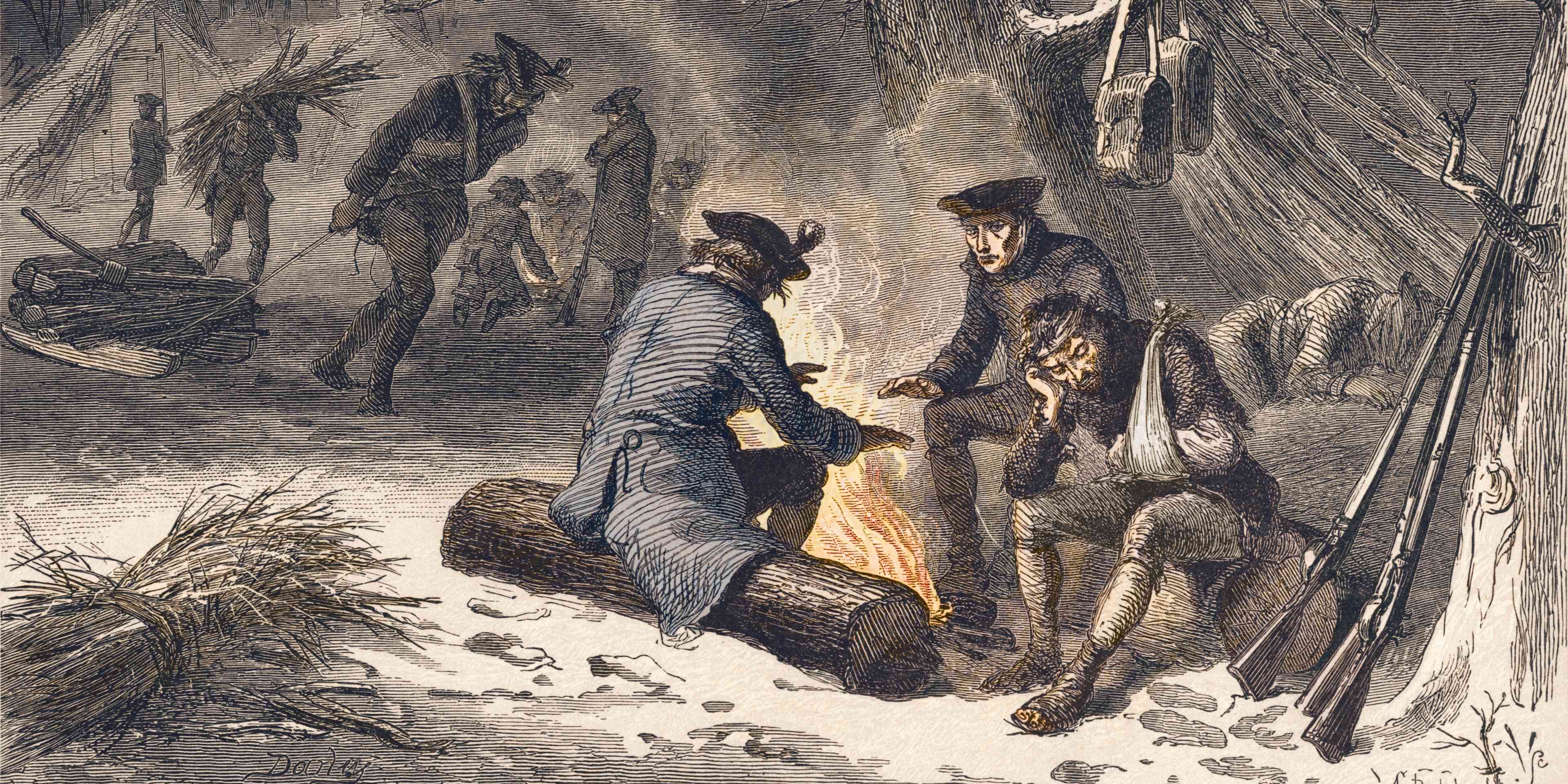
However, what the site offered in tactical security, it lacked entirely in basic human necessities. When the Continental Army marched into Valley Forge on December 19, 1777, the men were already exhausted, malnourished, and poorly clothed. A summer and fall of relentless marching and hard-fought battles had taken a heavy toll. Many soldiers marched into camp with their feet wrapped in bloody rags, leaving crimson trails in the freshly fallen snow. What was meant to be a secure haven quickly devolved into a struggle against starvation, disease, and the elements.
Causes and Context: The Breakdown of Logistics
The suffering of the starving soldiers at Valley Forge was not primarily a failure of agricultural abundance, but rather a catastrophic breakdown of logistics, administration, and finance. The Continental Congress, fleeing Philadelphia for York, Pennsylvania, possessed little centralized authority and virtually no hard currency. They relied on paper money, which was rapidly depreciating, making local farmers reluctant to sell their crops and livestock to the Continental Army. Instead, many farmers chose to smuggle their goods into British-occupied Philadelphia, where the redcoats paid in gold and silver.
Furthermore, the Continental Army’s Quartermaster Department was in a state of utter disarray. Unlike earlier eras where techniques like how pickling helped early American colonists survive brutal winters were successfully utilized on a local scale, the army’s massive logistical network completely collapsed. Wagon transport was scarce, roads were muddy or frozen solid, and mismanagement plagued the supply lines. Tons of food, clothing, and shoes rotted in distant warehouses or sat on riverbanks because there were no functioning supply routes to bring them to Valley Forge. The soldiers lacked basic blankets, proper shoes, and even the everyday objects of colonial America that ordinary citizens took for granted, leaving them dangerously vulnerable to the harsh elements.
Key Events Timeline of the Valley Forge Encampment
- September 26, 1777: British forces under General Howe occupy the revolutionary capital of Philadelphia.
- December 11, 1777: The Continental Army begins marching out of their temporary camp at Whitemarsh, heading toward Valley Forge.
- December 19, 1777: The army arrives at Valley Forge and immediately begins constructing log huts for shelter.
- February 23, 1778: Prussian officer Baron Friedrich Wilhelm von Steuben arrives at camp, offering his services as a volunteer.
- March 1778: Spring brings warmer weather; Christopher Ludwick steps up bakery operations, and a massive shad run in the Schuylkill River alleviates the worst of the food shortages.
- May 6, 1778: The Continental Army formally celebrates the alliance with France, which brought crucial military and financial aid.
- June 19, 1778: Exactly six months after their arrival, the newly professionalized Continental Army marches out of Valley Forge to pursue the retreating British forces.
Important Figures and Their Lasting Impact
While the courage of the common soldier was the true foundation of survival, several key leaders played instrumental roles in turning the tide at Valley Forge:
- General George Washington: As Commander-in-Chief, Washington’s leadership was the glue that held the army together. He lived in a simple tent until his men had built their log huts, and he frequently lobbied Congress for food, clothing, and pay. His empathy and resolve kept mutiny at bay during the darkest days of the encampment.
- Baron Friedrich Wilhelm von Steuben: A veteran of the Prussian Army, von Steuben arrived in February 1778 and transformed the ragtag militia into a cohesive, professional fighting force. He introduced a standardized system of drill, hygiene, and camp organization, personally teaching the soldiers how to march, deploy rapidly, and effectively use the bayonet.
- Christopher Ludwick: A patriotic German immigrant and Philadelphia gingerbread baker, Ludwick was appointed ‘Superintendent of Bakers’ by Congress. Ludwick constructed bakehouses at Valley Forge, providing reliable, high-quality bread. He famously refused to profit from the war, delivering 135 pounds of bread for every 100 pounds of flour provided.
- Marquis de Lafayette: The young French aristocrat who volunteered his services, Lafayette became a trusted aide to Washington and helped boost morale, famously sharing the hardships of the winter alongside the common soldiers.
Major Turning Points: From Survival to Professionalism
The winter at Valley Forge is widely regarded as the ultimate turning point of the American Revolutionary War. The transformation was multifaceted. First, the arrival of Baron von Steuben in February 1778 brought order to the chaos. Before his arrival, there was no uniform system of military drill or organization; different regiments utilized different British, French, or Prussian manuals. Von Steuben simplified these systems, wrote a new manual on the fly, and trained a ‘model company’ of 100 men, who then went out and trained the rest of the army.
Second, von Steuben reorganized the physical layout of the camp. He moved the latrines away from the kitchens and the barracks, drastically reducing the spread of diseases like typhus, typhoid, and dysentery, which had claimed thousands of lives during the early winter. By the spring of 1778, the army was not only healthier and better fed, but they also possessed a level of discipline, tactical skill, and pride they had never had before.
Long-Term Impact on America
The legacy of Valley Forge extends far beyond the Revolutionary War. Structurally, the military training and standardized drills introduced by Baron von Steuben formed the basis of the United States Army’s official regulations, remaining in use through the War of 1812. Societally, the shared suffering of soldiers from all thirteen colonies—representing diverse economic backgrounds, races, and ethnicities—helped forge a unified national identity. At Valley Forge, Rhode Island regiments, Virginia riflemen, and native Oneida allies suffered and survived together, fostering a sense of collective American purpose. Culturally, Valley Forge became an enduring symbol of American resilience, sacrifice, and the belief that freedom is worth enduring the ultimate hardships.
Lesser-Known Facts About Valley Forge
The Infamous ‘Firecakes’
When food supplies were at their lowest, the soldiers survived on a crude concoction known as ‘firecake.’ Lacking yeast, salt, or any leavening agent, soldiers simply mixed flour and water into a thick, sticky paste. They would spread this dough onto iron kettles or flat stones and bake it directly over the embers of their campfires. The result was a tasteless, dense, and often charred slab of dough. On particularly bad days, the flour stores were infested with weevils or maggots, adding an unwelcome and stomach-churning source of ‘protein’ to their meager rations.
The Spring Shad Run That Saved the Army
In the spring of 1778, just as the army’s morale was beginning to waver again, nature provided a miraculous reprieve. Millions of American shad, a species of river herring, swam up the Schuylkill River for their annual spawning run. The starving soldiers rushed into the water, using nets, branches, and even their bare hands to scoop up thousands of fish. The sudden abundance of fresh, nutrient-rich food immediately broke the cycle of starvation and gave the troops the energy they needed to prepare for the upcoming campaign season.
Baron von Steuben’s ‘Why’ Realization
Coming from the highly rigid Prussian military system, Baron von Steuben initially struggled with the independent mindset of the American volunteer soldiers. He famously noted in a letter to a friend that in Europe, an officer says to a soldier, ‘Do this,’ and he does it. However, in America, von Steuben wrote, ‘I am obliged to say, “This is the reason why you ought to do that,” and then he does it.’ This realization led von Steuben to adapt his training methods, appealing to the intelligence and democratic spirit of the American soldiers, which ultimately made his instruction highly successful.
Why It Still Matters Today
Today, the story of Valley Forge serves as a powerful reminder of the human cost of liberty. In an era of division and rapid change, the lessons of the encampment—resilience in the face of systemic failure, the power of administrative reform, and the triumph of shared purpose over individual suffering—remain deeply relevant. Valley Forge teaches us that organizations, nations, and communities are not defined by their moments of ease, but by how they adapt, support one another, and persevere through their darkest winters.

People Also Ask (PAA)
How many soldiers died at Valley Forge?
Approximately 2,000 to 2,500 soldiers died during the six-month encampment at Valley Forge. Interestingly, none of these deaths were the result of military combat; instead, they were caused by disease (such as influenza, typhus, typhoid, and dysentery), exposure to the elements, and severe malnutrition.
Did George Washington live in luxury during the winter?
No. While Washington eventually moved his headquarters into a stone house belonging to the Potts family, he spent the first several weeks of the encampment living in a drafty military tent. He famously refused to seek comfortable quarters until his men had constructed basic log cabins to protect themselves from the winter weather.
How did the alliance with France affect Valley Forge?
The news of the formal alliance with France, which arrived at Valley Forge in May 1778, acted as an immense morale booster for the weary troops. The alliance secured vital French naval support, military supplies, clothing, and financial loans, transforming the American rebellion into a global conflict that the British could no longer easily contain.
Conclusion
The winter of 1777–1778 at Valley Forge was not a story of defeat, but of ultimate endurance and rebirth. Under the steadfast leadership of George Washington, the organizational genius of Baron von Steuben, and the dedicated efforts of patriots like Christopher Ludwick, the starving soldiers at Valley Forge overcame administrative negligence and natural hardships. They did not merely survive; they evolved. When the Continental Army marched away from the banks of the Schuylkill River in June 1778, they were no longer a collection of disparate state militias. They were a unified, disciplined, and professional national army ready to win the war and secure the birth of a new nation.


