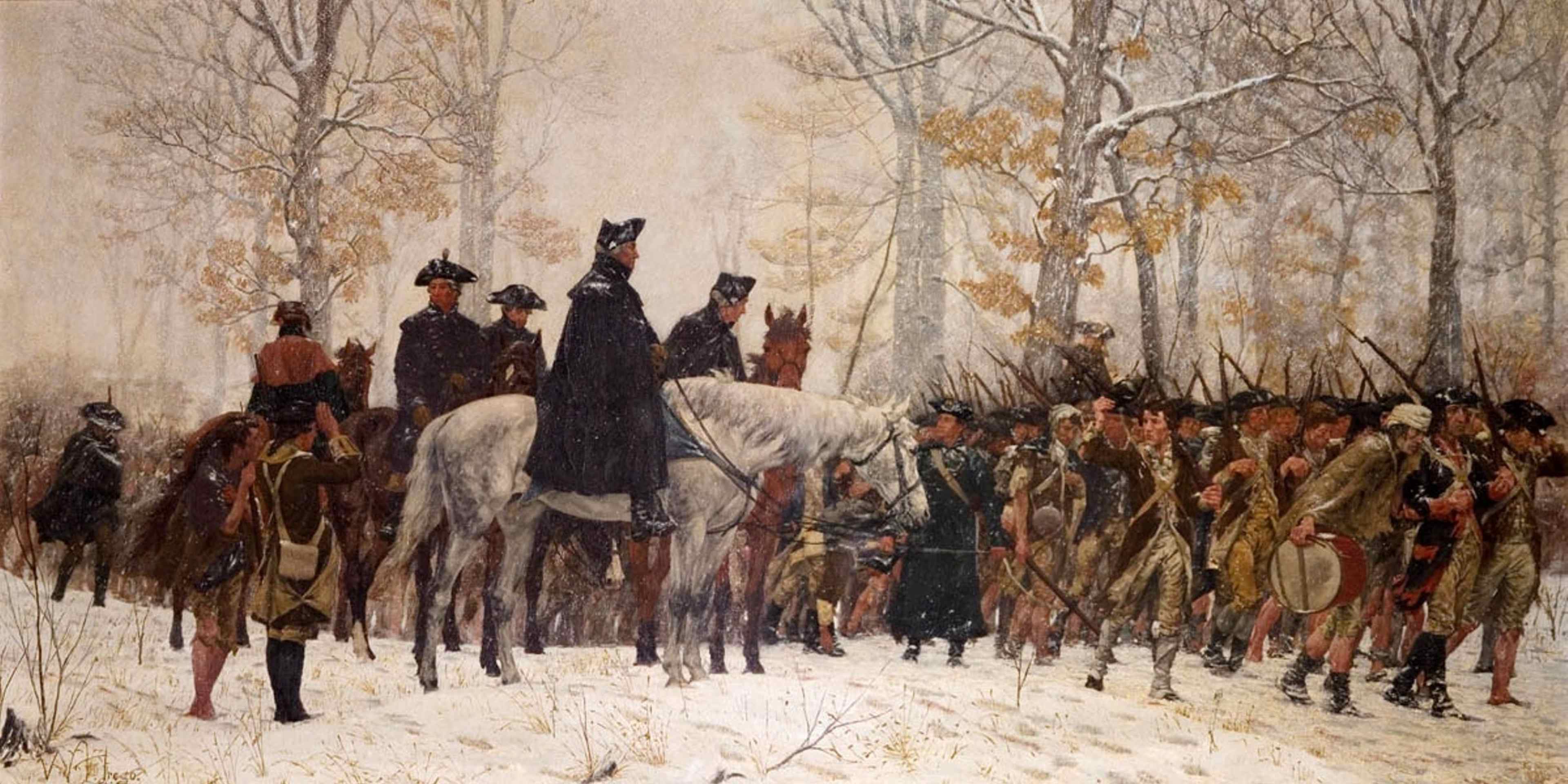
In the biting winter of 1777, the fate of the fledgling American experiment hung by a fragile thread. When Washington’s troops made camp at Valley Forge on December 19, the Continental Army was a battered, weary, and heavily criticized force. Fresh from bruising defeats at Brandywine and Germantown, and having lost the revolutionary capital of Philadelphia to the British, these soldiers were tasked with an extraordinary challenge: to survive a brutal winter while forging themselves into a unified professional military. This legendary winter encampment was not a place of military engagement, but rather a crucible of suffering, systemic reform, and unexpected alliances that ultimately redefined the trajectory of the Revolutionary War. It proved to be the ultimate test of George Washington’s leadership and the raw endurance of those fighting for the independence of the thirteen colonies.
Historical Background: A Rebellion on the Brink
By late 1777, the American Revolutionary War had reached a precarious stalemate. While the Northern Campaign had seen a spectacular American victory at Saratoga in October, the Main Army under General George Washington was struggling. British General William Howe had successfully outmaneuvered Washington, capturing Philadelphia and forcing the Continental Congress to flee in haste into the Pennsylvania countryside. This embarrassing loss triggered intense political blowback, with several members of Congress openly questioning Washington’s strategic capabilities and whispering about replacing him with General Horatio Gates, the hero of Saratoga.
To understand the desperation of the winter at Valley Forge, one must look at the broader sociopolitical and economic crises of the time. The young nation had no centralized treasury, and the Continental currency was rapidly depreciating. The logistical systems designed to feed and clothe the army were plagued by inefficiency, corruption, and a lack of cooperative infrastructure among early colonial developments. In this atmosphere of political intrigue and logistical collapse, Washington had to find a location for winter quarters that would satisfy Congress’s demands to keep a watchful eye on occupied Philadelphia while keeping his army safe from sudden British onslaughts.
The Strategic Choice: Why Valley Forge?
The selection of Valley Forge, located approximately 18 miles northwest of Philadelphia, was a deliberate, calculating decision. Washington faced heavy pressure from Pennsylvania authorities and the Continental Congress to launch a winter campaign to recapture Philadelphia. Knowing his troops were in no condition for a major offensive, Washington compromised. He chose Valley Forge because its high ground—situated between Mount Joy and Mount Misery—offered excellent defensive positions that could easily repel a British attack. Furthermore, the site bordered the Schuylkill River, providing a natural barrier to the north, and was close enough to major trade routes to monitor British movements and protect the agricultural interior of Pennsylvania from enemy foraging parties.
Key Events Timeline of the Encampment
The six months spent at Valley Forge can be charted through a series of critical phases, transforming a disorganized refuge into a formidable, disciplined machine:
- December 19, 1777: Approximately 11,000 Continental soldiers and hundreds of camp followers march into Valley Forge, immediately beginning the construction of winter shelters.
- December 1777 – January 1778: Intense logistics crises peak. Severe shortages of food, shoes, and blankets lead to widespread suffering. Construction of over 2,000 log huts is completed, forming a massive, makeshift city.
- February 23, 1778: Baron Friedrich Wilhelm von Steuben arrives in camp, volunteering his services to train the demoralized Continental troops.
- March 1778: General Nathanael Greene reluctantly accepts the position of Quartermaster General, immediately restructuring the supply lines and stabilizing the camp’s food and clothing resources.
- May 6, 1778: News officially reaches Valley Forge that France has signed a formal alliance with the United States, sparking massive celebrations and boosting morale.
- May 15, 1778: A crucial contingent of the Oneida Nation arrives at Valley Forge, bringing vital food supplies and bolstering the army’s scouting capabilities.
- June 19, 1778: Exactly six months after their arrival, the revitalized and professionally trained Continental Army marches out of Valley Forge to pursue the British across New Jersey.
Crucible of Suffering: Hunger, Cold, and Disease
The popular myth of Valley Forge often conjures images of soldiers freezing to death in waist-deep snow. While the winter was indeed raw and damp, the greatest threats to the Continental Army were actually administrative failure and rampant disease. The commissary department was in complete disarray, leaving soldiers starving for days at a time. Many survived on “firecake”—a tasteless, flour-and-water paste baked over open coals. Clothing was so scarce that guards frequently stood on their hats in the snow to keep their bare feet from freezing, and many soldiers had to wrap themselves in tattered blankets due to a lack of proper uniforms.
Under these unsanitary and crowded conditions, diseases flourished. Typhus, typhoid, dysentery, and influenza swept through the parallel rows of drafty log huts. Of the nearly 2,000 soldiers who died during the encampment, approximately two-thirds perished not from exposure, but from preventable diseases. To maintain order and prevent the total dissolution of his force, Washington was forced to enact strict disciplinary measures, including lashings for theft or neglect of duty, and threats to execute deserters on sight.
America’s First Allies: The Oneida Nation’s Life-Saving Aid
In the darkest hours of the Valley Forge encampment, the Continental Army received invaluable assistance from an unexpected source: the Oneida Indian Nation of the Haudenosaunee (Iroquois) Confederacy. Unlike the majority of the Haudenosaunee nations, which aligned with the British, the Oneida made the historic decision to support the American fight for self-determination. They became recognized as “America’s First Allies.”
In the spring of 1778, an Oneida expedition led by Chief Skenandoah (Oskanondonha) made an arduous 250-mile journey on foot from central New York to Valley Forge. They carried with them dozens of bushels of white corn to feed Washington’s starving troops. Among this group was Polly Cooper, an Oneida woman skilled in traditional medicine and culinary arts. Upon arrival, the starving soldiers tried to eat the dried corn raw, which would have swollen in their stomachs and proven fatal. Polly Cooper intervened, teaching the soldiers and their families how to properly boil and prepare the corn to make it safely digestible. She remained at Valley Forge to nurse the sick, refusing any monetary compensation for her heroic services, stating it was her moral duty. Her profound contribution is a vital testament to the deep indigenous heritage that shaped the very survival of the United States, showing how colonial towns shaped American history through their interactions and alliances with native populations.
The Agents of Transformation: Von Steuben and Greene
The physical and organizational salvation of the camp came down to two extraordinary individuals who arrived in early 1778. The first was Baron Friedrich von Steuben, a former Prussian military officer. Despite speaking very little English, von Steuben possessed an infectious energy and a profound understanding of military tactics. He personally drilled a model company of 100 men, who then went on to train the rest of the army. Von Steuben standardized weapons maintenance, introduced a simplified manual of arms, and taught the soldiers the art of precision marching and bayonet warfare—skills that were absolutely essential for matching the professional British regulars in open-field combat.
Equally important were von Steuben’s sanitization reforms. Finding the camp in a slovenly state, he ordered that latrines be dug on the opposite side of the camp from the kitchens and insisted on daily camp inspections. This drastically reduced the spread of infectious diseases.
The second savior of the camp was General Nathanael Greene. In March 1778, Washington persuaded Greene to take over the disastrous commissary department as Quartermaster General. Greene was an administrative genius. He systematically mapped out new supply routes, built storage depots, and aggressively forage-purchased food and horses from the surrounding countryside. Within weeks, the systemic hunger that had plagued Valley Forge for months was brought to an end, freeing Washington to focus on the grand strategic vision of the war.
Major Turning Points and the Path to Monmouth
By late spring, the atmosphere at Valley Forge had undergone a complete metamorphosis. The arrival of consistent food, the professionalization of the troops under von Steuben, and the crucial aid of the Oneida Nation had restored the army’s confidence. Then, in early May, a momentous diplomatic breakthrough arrived: France had formally entered the war as an American ally. This meant French naval power, troops, and financial backing were on their way, fundamentally shifting the conflict from a localized colonial rebellion into a global war that the British could no longer easily contain.
When the British evacuated Philadelphia in June 1778 to consolidate their forces in New York, Washington’s newly revitalized army was ready. On June 19, exactly six months to the day after they had marched into Valley Forge, the Continental Army broke camp. Just nine days later, they clashed with the British at the Battle of Monmouth in New Jersey. Utilizing the exact tactical maneuvers and bayonet drills taught by von Steuben, the American troops fought the British to a standstill. It was a stunning demonstration of their new professionalism and proved that the trials of Valley Forge had forged a true army.
The Long-Term Impact on America
The legacy of Valley Forge extends far beyond the immediate tactical outcome of the Revolutionary War. Structurally, it marked the birth of a professional United States military tradition. The standard drill manual written by von Steuben during the encampment, known as the “Blue Book,” remained the official regulatory manual of the U.S. Army until the War of 1812.

Culturally, Valley Forge became a foundational mythos of American national identity. It established a narrative of resilient endurance in the face of overwhelming odds, a motif that would be invoked during subsequent national crises, from the Civil War to the Great Depression. Furthermore, the alliances forged there, particularly with the Oneida Nation, laid down early templates of international and indigenous cooperation, even as the subsequent centuries would unfortunately see the United States government fail to honor many of those sacred bonds.
Lesser-Known Facts About Valley Forge
- It Was Not a Battle Site: Despite its immense fame in military history, not a single shot was fired in anger at Valley Forge. The site was strictly a winter encampment, though its casualty rate was higher than many of the war’s major battles.
- Martha Washington’s Camp Community: George Washington was not alone; his wife, Martha Washington, traveled to the camp and organized a circle of officer’s wives to knit socks, mend uniforms, and comfort sick soldiers, providing invaluable moral support.
- Strict Punishments: To maintain order among a starving, frustrated troop population, Washington authorized severe disciplinary actions. Soldiers who attempted to desert or steal food faced up to 100 lashes, a punishment designed to be highly visible and deterrent.
- The Polly Cooper Shawl: As a token of deep gratitude for Polly Cooper’s selfless service, Martha Washington took her to Philadelphia and purchased a beautiful black shawl for her. That shawl remains a highly revered heirloom of the Oneida people to this day, symbolizing an unbroken pact of friendship.
Why It Still Matters Today
Today, Valley Forge stands as an enduring monument to civic responsibility, sacrifice, and systemic reform. It reminds modern citizens that victory is often won not on the dramatic field of battle, but through quiet, methodical daily improvement, logistical excellence, and sheer mental fortitude. It also challenges us to remember and honor the diverse individuals—from European volunteers like von Steuben to indigenous allies like the Oneida—who pooled their strengths to build the foundations of American democracy. Their collective struggle during that dark Pennsylvania winter continues to inspire discussions on what it means to persevere for a shared, larger cause.
People Also Ask
Why did George Washington choose Valley Forge for his winter quarters?
Washington chose Valley Forge because its elevated terrain offered strong defensive advantages against a potential British attack from occupied Philadelphia, while its proximity to the Schuylkill River and local trade routes allowed the army to protect the Pennsylvania countryside and monitor British movements.
How many soldiers died at the Valley Forge encampment?
Out of approximately 11,000 to 12,000 soldiers who entered the camp, nearly 2,000 died. The vast majority of these casualties were caused by infectious diseases such as typhus, typhoid, influenza, and dysentery, rather than exposure to the cold weather itself.
What role did the Oneida Nation play at Valley Forge?
The Oneida Nation, acting as America’s first allies, marched over 250 miles to Valley Forge in the spring of 1778, bringing hundreds of bushels of life-saving white corn to feed the starving troops. Oneida figures like Polly Cooper stayed to nurse sick soldiers and teach them how to safely prepare the food.
Conclusion
The winter of 1777–1778 at Valley Forge could have easily marked the death of the American Revolution. Destitute, politically fractured, and ravaged by disease, the Continental Army stood on the precipice of ruin. Yet, through the iron will of George Washington, the organizational brilliance of Nathanael Greene, the rigorous training of Baron von Steuben, and the compassionate intervention of the Oneida Nation, the army did not break. Instead, they transformed. When the troops finally marched away from the hills of Pennsylvania in June 1778, they were no longer a ragtag collection of state militias; they were a professional, unified army ready to secure the independence of a new nation.


