The global stage of the late eighteenth century was set on fire by a series of political upheavals that forever altered the course of human history. At the heart of this transformative era was a profound connection between two massive ocean-spanning events: the American Revolution and the French Revolution. When the thirteen North American colonies declared their independence from Great Britain in 1776, they did more than just establish a new nation; they tested and validated radical Enlightenment concepts of liberty, sovereignty, and constitutional governance. For the people of France, who were suffering under the crushing weight of an absolute monarchy, rigid social hierarchies, and crippling financial crises, the American victory served as an inspiring proof of concept. The intellectual and physical cross-pollination between these two nations created a powerful historical domino effect, where the sparks of American liberty directly ignited the explosive powder keg of the French populace.
Historical Background: A Transatlantic Awakening
To truly understand how the American Revolution influenced the French Revolution, we must examine the global landscape of the late 1700s. The relationship between these two monumental events was forged in the fires of geopolitical rivalry and intellectual rebirth. During this period, European thinkers were deep in the throes of the Enlightenment, a philosophical movement that prioritized reason, science, and individual rights over absolute monarchical or religious dogma. However, these ideas remained largely academic until the American colonists decided to put them to the test on the battlefield. When the Revolutionary War broke out, France—still stinging from its defeat in the Seven Years War—saw a golden opportunity to weaken its historic rival, Great Britain. The French state committed massive military resources, financial loans, and strategic intelligence to the American cause. To understand the depth of this alliance, one can examine the pivotal role of French military and financial support which ultimately turned the tide in favor of the Continental Army. While this alliance successfully humbled Great Britain and birthed the United States, it left France holding an astronomical financial bill. The absolute monarchy of King Louis XVI was already plagued by inefficient tax collection and decadent court spending. By funding the American rebellion, France pushed itself to the very brink of bankruptcy. This dire economic crisis became the immediate catalyst that forced the King to call the Estates-General in 1789, setting off a chain reaction that would culminate in his own execution.
Key Events Timeline: The Chronology of Interwoven Destinies
The progression of these two historic struggles is deeply linked, with developments in North America acting as a sequential trigger for the uprising in Europe. Below is a detailed timeline of how these destinies unfolded:
- 1776 (July 4): The Continental Congress adopts the Declaration of Independence, formalizing the philosophical justification for breaking away from an unjust monarch.
- 1778 (February): France signs the Treaty of Alliance and the Treaty of Amity and Commerce with the United States, officially entering the war. French soldiers, including the Marquis de Lafayette, sail to America.
- 1783 (September): The Treaty of Paris is signed, ending the Revolutionary War. France secures American victory but inherits a staggering debt of over 1.3 billion livres.
- 1787-1788: Severe droughts and bad harvests strike France, causing widespread famine. The crown’s attempt to raise taxes on the nobility fails, exposing the structural weakness of the Old Regime.
- 1789 (May): Facing financial ruin, King Louis XVI convenes the Estates-General for the first time since 1614.
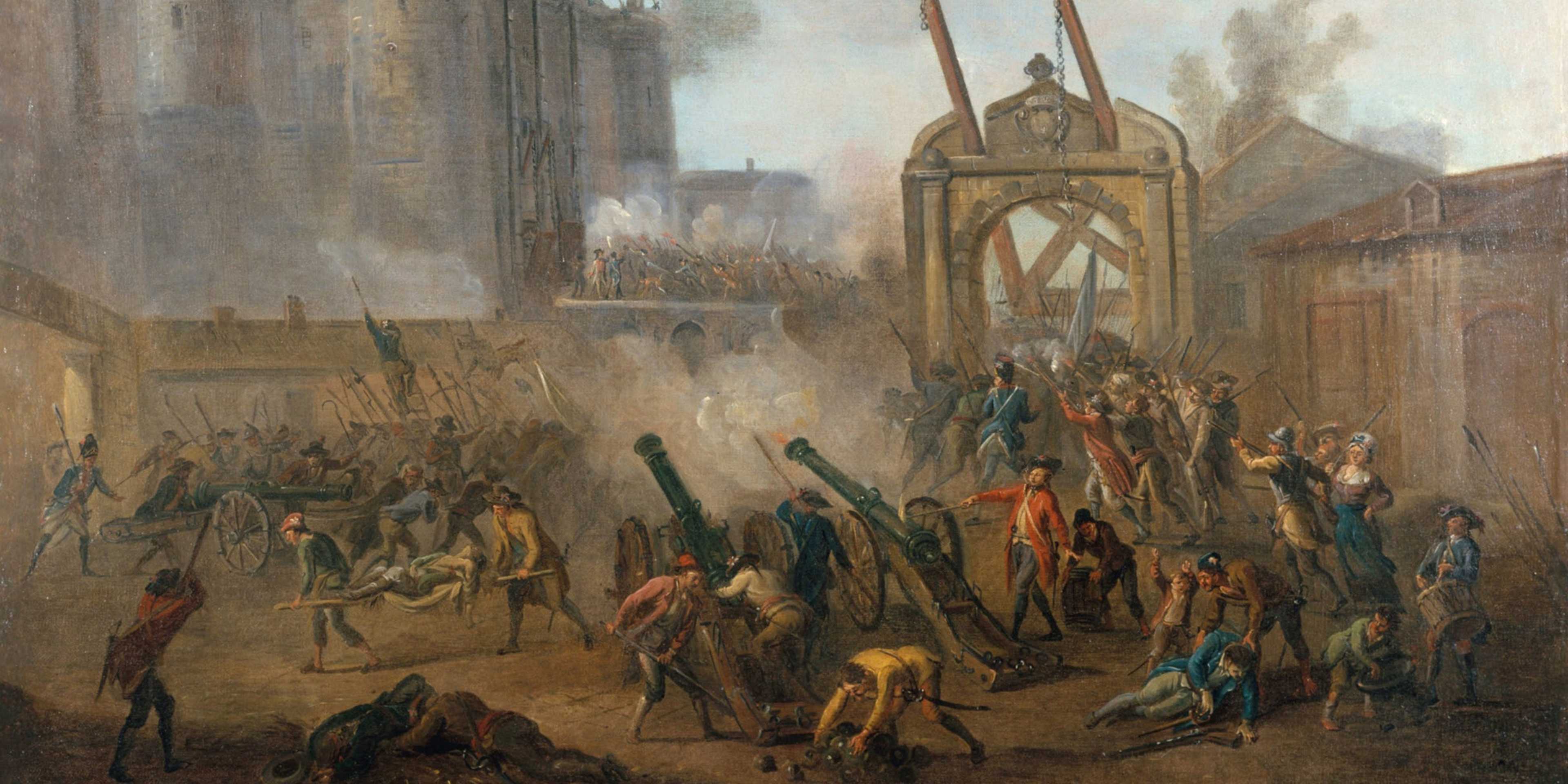
- 1789 (June-July): The Third Estate breaks away to form the National Assembly. On July 14, angry citizens storm the Bastille prison in Paris, symbolizing the collapse of royal authority.
- 1789 (August): The National Assembly drafts the Declaration of the Rights of Man and the Citizen, heavily inspired by American ideals.
- 1793 (January): King Louis XVI is executed by guillotine, marking the radicalization of the French Revolution.
Important Figures: The Human Bridges of Revolution
Several critical figures acted as physical and ideological conduits between Philadelphia and Paris, transporting revolutionary fervor across the Atlantic Ocean.
Marquis de Lafayette: The Hero of Two Worlds
Perhaps no single individual embodies the connection between the two revolutions more than the Marquis de Lafayette. A wealthy young nobleman, Lafayette defied his king to fight alongside George Washington’s army. He became a decorated general and a surrogate son to Washington. When he returned to France, Lafayette was filled with democratic zeal. He co-authored the Declaration of the Rights of Man and the Citizen and commanded the National Guard during the early stages of the French Revolution, attempting to steer France toward a constitutional monarchy.
Thomas Jefferson: The Diplomatic Advisor
As the author of the Declaration of Independence, Jefferson was already a legendary figure when he arrived in Paris to serve as the United States Minister to France from 1785 to 1789. During his tenure, Jefferson hosted leading French reformers at his residence, offering them advice and helping Lafayette draft and edit the initial versions of France’s primary revolutionary charter. Jefferson’s home became a hotbed for revolutionary planning, directly transferring American political philosophy into the hands of French reformers.
Benjamin Franklin: The Cultural Icon
Before Jefferson, Benjamin Franklin served as the American envoy to France. His immense popularity and brilliant self-presentation as a rustic, wise philosopher captivated French society. Franklin successfully fostered a romanticized French obsession with American liberty, framing the new republic as a utopian society where Enlightenment ideals had triumphed over Old World tyranny. This cultural fascination laid the groundwork for French citizens to demand similar freedoms at home.
Causes, Context, and Deep Philosophical Echoes
The philosophical overlap between the two uprisings was profound. The French did not merely watch the American Revolution from afar; they actively studied its founding documents. The ideas of popular sovereignty, natural rights, and separation of powers were no longer abstract concepts floating through French salons. The Americans had proven that these lofty ideals could be successfully translated into a working, stable political system. When French reformers sought to articulate their grievances against the absolute authority of the King, they naturally looked to American precedents. While the French faced a much different societal structure—a feudal system divided into Three Estates (Clergy, Nobility, and Commoners)—their conceptualization of ‘unalienable rights’ was directly inherited from the American experience. They realized that if a collection of colonial farmers could overthrow the mightiest empire on earth, a united French citizenry could certainly dismantle an outdated feudal monarchy. It is also fascinating to analyze how the Declaration of Independence functioned as a formal list of grievances, which served as a crucial blueprint for the French when they drafted their own declarations against King Louis XVI.
Major Turning Points: From Inspiration to Radicalism
While the American Revolution served as an initial inspiration, the French Revolution quickly diverged into a far more radical and violent conflict. The primary turning point occurred when the moderate phase of the French Revolution, led by figures like Lafayette who advocated for a constitutional monarchy, collapsed. Unlike America, where the war was fought on a separate continent far from the mother country, the French Revolution was fought within the very heart of the nation. The French faced immediate invasion by neighboring European monarchies terrified of democratic contagion, as well as internal counter-rebellions. This existential threat pushed the French Revolution into the ‘Reign of Terror’ (1793–1794) led by Maximilien Robespierre. During this bloody period, the moderate American model was cast aside in favor of radical societal restructuring, proving that while the spark was American, the resulting firestorm was uniquely French.
Long-Term Impact on America
The French Revolution had a deep, polarizing impact on the early political landscape of the United States. It fractured George Washington’s cabinet and accelerated the formation of America’s first political party system. On one side, the Democratic-Republicans, led by Thomas Jefferson, passionately supported the French struggle for liberty, viewing it as a continuation of their own fight against tyranny. On the other side, the Federalists, led by Alexander Hamilton and John Adams, looked upon the violence and anarchy of the Reign of Terror with absolute horror. They feared that French radicalism would infect American shores and destroy the fragile young republic. To see how these ideological divides affected the nation’s financial foundations, one can explore how the personal wealth and debts of key leaders shaped the war’s progress and subsequent state policies during the early republican era. Furthermore, the geopolitical chaos in Europe eventually forced Napoleon Bonaparte to sell the vast Louisiana Territory to the United States in 1803, doubling the size of the nation and paving the way for westward expansion.
Lesser-Known Facts & Historical Anecdotes
- The Bastille Key: Following the storming of the Bastille in 1789, the Marquis de Lafayette was given the main key to the fortress. As a token of his deep respect and gratitude, Lafayette sent the key to George Washington. Today, this massive iron key is still proudly displayed at Washington’s Mount Vernon estate.
- Thomas Paine’s French Adventure: Thomas Paine, the famous author of the pamphlet Common Sense, was so revered by French revolutionaries that he was granted honorary French citizenship and elected to the National Convention. Shockingly, Paine did not speak a word of French and had to have his speeches read aloud by translators!
- Jefferson’s Editorial Pen: Thomas Jefferson sat with Lafayette in Paris to help him draft the Declaration of the Rights of Man and the Citizen. Jefferson acted as an unofficial constitutional consultant, subtly inserting American concepts of liberty directly into the French document.
Why It Still Matters Today
The connection between the American and French Revolutions remains highly relevant in contemporary political discourse. Together, these two historic events launched the age of modern democracy, laying the groundwork for the global human rights movements we witness today. The debate over how to balance individual liberty with social order—a central tension during both revolutions—continues to play out in modern judicial systems, protest movements, and constitutional debates worldwide. Whenever a society demands self-determination, equal rights, and the rule of law over authoritarian control, they are drawing from a reservoir of revolutionary ideas that was first successfully tested in America and then passionately amplified in France.
People Also Ask
Did the American Revolution cause the French Revolution?
While the American Revolution did not directly cause the French Revolution, it acted as a major catalyst. It provided the physical catalyst of massive financial debt for the French crown, and the ideological catalyst of a working model of democratic success, proving that Enlightenment ideals could be successfully turned into a functioning constitutional government.
How did Lafayette bridge both revolutions?
Marquis de Lafayette fought as a general alongside George Washington in the American Revolution, and then returned to France to become a leading political figure. He used his American experiences to help draft the French Declaration of the Rights of Man and the Citizen, directly embedding American values into the French struggle.
What were the main differences between the American and French Revolutions?
The American Revolution was primarily a colonial war of independence fought against a distant ruling power, leaving the local social structure largely intact. In contrast, the French Revolution was a total societal upheaval fought within France itself, aimed at completely destroying the existing feudal system, nobility, and absolute monarchy from the inside out.
Conclusion
In the grand tapestry of human history, the American and French Revolutions represent two halves of a single transatlantic awakening. By transforming abstract Enlightenment philosophy into real-world constitutional systems, the American patriots laid a path of democratic possibilities that French reformers eagerly followed. Despite the differing struggles, domestic conditions, and eventual levels of violence, both revolutions proved that the power of self-governance could triumph over old imperial and feudal dynasties. The physical and intellectual bridges built by figures like Lafayette and Jefferson during this era ensured that the fire of liberty would not remain confined to one continent, but would instead burn brightly as a global beacon for centuries to come.


