How would you sum up the American Revolution in just one word? For some, the word is “Liberty.” For others, it might be “Struggle,” “Defiance,” or “Revolutionary.” When the thirteen colonies declared their independence from Great Britain in 1776, they embarked on a perilous journey with no money, no established military, and barely a statistical chance at success. Yet, against all historical odds, this disparate group of colonies transformed a localized rebellion into a global struggle for self-determination. Understanding the American Revolution requires us to look past the myths of flawless founding fathers and examine the gritty reality of a war fought by a diverse, often divided population of farmers, enslaved people, indigenous allies, and visionary leaders who sacrificed everything to birth a new republic.
Historical Background: The Spark of Defiance
The decade leading up to 1775 was defined by escalating economic and political tensions between the British Crown and its North American colonies. Following the expensive Seven Years’ War, the British Parliament sought to recoup its losses by imposing direct taxes on the colonies through controversial measures like the Stamp Act and the Townshend Acts. Believing that “taxation without representation” was a direct violation of their rights as Englishmen, colonial leaders organized boycotts, protests, and local militias.
This conflict also deeply affected indigenous nations. The Six Nations of the Haudenosaunee (Iroquois) Confederacy, which had existed for centuries as a powerful democratic alliance, was tragically split. While the Oneida and Tuscarora sided with the American colonists, the Mohawk, Onondaga, Cayuga, and Seneca allied with the British in hopes of protecting their ancestral lands from colonial encroachment. This tragic division highlights how the Revolution was not just a binary struggle, but a complex, multifaceted clash of nations and peoples. To make matters worse, the embryonic nation lacked a centralized treasury, forcing leaders to navigate severe economic crises that threatened to collapse the war effort. To understand how these monetary struggles shaped the conflict, one can explore the role of the founding fathers’ finances during this critical period.
Chronological Timeline of the Revolution
To grasp the momentum of the war, we must trace its progress chronologically from the first shots to the final peace treaty:
- 1775 (April 19): The Battles of Lexington and Concord mark the outbreak of open armed conflict between Great Britain and the thirteen colonies.
- 1775 (June 17): The Battle of Bunker Hill occurs. Though a British victory, it inflicts heavy casualties on the redcoats and proves colonial forces can stand their ground.
- 1776 (July 4): The Continental Congress formally adopts the Declaration of Independence, severing political ties with Great Britain.
- 1777 (October 17): The Battle of Saratoga ends in a decisive American victory, convincing France to enter the war as an open ally of the United States.
- 1777–1778 (Winter): The Continental Army endures grueling conditions, disease, and starvation at Valley Forge, Pennsylvania.
- 1781 (October 19): General Cornwallis surrenders his British army at Yorktown, Virginia, effectively ending major combat operations in North America.
- 1783 (September 3): The signing of the Treaty of Paris officially recognizes the independence of the United States.
Overcoming Adversity: Washington’s Early Struggles
When George Washington was appointed Commander-in-Chief of the Continental Army in 1775, he inherited a logistical and administrative nightmare. The army was largely composed of undisciplined local militias, lacking uniform training, proper firearms, and basic provisions. Early in the war, Washington made several strategic blunders, particularly during the Battle of Long Island in 1776, where his forces were nearly cornered and destroyed.
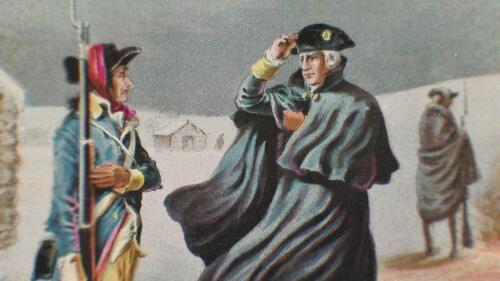
The winter of 1777–1778 tested Washington’s leadership to its absolute limits. Stationed in Pennsylvania, the starving soldiers at Valley Forge faced rampant outbreaks of smallpox, influenza, and severe malnutrition. Despite these catastrophic conditions, Valley Forge became the birthplace of a reformed, professional military. Under the rigorous training of Prussian military officer Baron von Steuben, the ragged volunteers were transformed into a disciplined, cohesive fighting force capable of meeting British regulars on equal terms.
To compensate for his military disadvantages, Washington also recognized that the war could not be won by brute force alone. He turned to espionage, developing highly sophisticated intelligence rings to outmaneuver the British command. By utilizing secret agents, invisible ink, and double agents, George Washington’s sophisticated spy networks provided the vital intelligence needed to secure unexpected tactical victories and protect his fragile army from surprise assaults.

Key Figures Who Defined the War
The American Revolution was not won solely by famous elite statesmen in powdered wigs; it was shaped by a diverse cast of characters whose sacrifices broke social and racial barriers:
George Washington
As the Commander-in-Chief, Washington’s greatest asset was not flawless tactical genius, but his political resilience and commitment to civilian control of the military. He held a fragile army together through sheer force of will, learning from his mistakes and adapting his tactics to fight a war of attrition.
Peter Salem
An enslaved African American from Massachusetts, Peter Salem was granted a temporary release to fight in the local militia. He became an instant hero at the Battle of Bunker Hill, where he fired the fatal shot that killed British Major John Pitcairn, boosting colonial morale at a crucial moment. Salem’s courage demonstrated the vital, yet often overlooked, contributions of Black patriots to the founding of the nation.
The 1st Rhode Island Regiment
Faced with a desperate shortage of recruits, Rhode Island took the revolutionary step of forming the first predominantly Black unit in the Continental Army. Composed of free Black men and enslaved recruits who were promised freedom in exchange for their service, the 1st Rhode Island Regiment fought with remarkable distinction, notably defending their positions at the Battle of Rhode Island and serving at the siege of Yorktown.
Turning Points and the Global Dimension
The American Revolution was never just a localized civil war; it quickly escalated into a global conflict. The crucial turning point came in late 1777 at the Battle of Saratoga. By capturing an entire British army under General John Burgoyne, the Americans proved they had a viable chance of winning. This victory convinced King Louis XVI of France to formally enter the war. French naval power, financial loans, and regular ground troops completely shifted the balance of power, forcing Great Britain to divert its military resources to defend its global empire against France, Spain, and the Dutch Republic.
Long-Term Impact on America and the World
The success of the American Revolution sent shockwaves across the globe, inspiring subsequent democratic movements, most notably the French Revolution and the Latin American wars of independence. Domestically, the war resulted in the creation of a constitutional republic based on popular sovereignty, representative government, and the separation of powers.

However, the revolution also highlighted deep societal contradictions. While the Declaration of Independence proclaimed that “all men are created equal,” the institutions of slavery remained deeply entrenched, and indigenous nations faced systemic displacement as the new American nation expanded westward. The struggle to fully realize the founding ideals of liberty and equality would define American history for centuries to come.
Lesser-Known Facts About the Revolution
- An Army of Diverse Patriots: Despite the systemic racial oppression of the era, an estimated 5,000 to 8,000 Black soldiers served in the Continental Army, making it the most racially integrated American military unit until the Korean War.
- George Washington’s Bodyguard Plot: In 1776, a conspiracy involving members of George Washington’s own personal security detail, the Life Guards, was uncovered. The plot aimed to assassinate or kidnap Washington and deliver him to the British.
- The First Submarine Attack: The Revolutionary War witnessed the world’s first submarine combat. In 1776, a hand-powered American submersible named the Turtle attempted to attach a time bomb to the hull of the British flagship HMS Eagle in New York Harbor.
Why the American Revolution Matters Today
The American Revolution is not merely a collection of distant dates and battles; it is an ongoing experiment. The fundamental questions raised during the revolutionary era—concerning the balance of power, civilian control of the military, individual liberties, and the right to protest—remain at the center of modern American political discourse. The struggle of marginalized groups, including Black, indigenous, and female patriots, to claim their rightful place in the American story continues to shape our understanding of national identity and civic duty.
People Also Ask
How did the Continental Army survive without money or resources?
The Continental Congress struggled constantly with hyperinflation and a lack of taxing power. The army survived through private donations, foreign loans (primarily from France and Spain), requisitioning local supplies, and the sheer perseverance of soldiers who endured severe deprivation.
What was the role of Black soldiers in the Revolutionary War?
Black soldiers played critical roles on both sides of the conflict. While many fought for the Continental Army in integrated units and specialized regiments like the 1st Rhode Island, thousands of others escaped to British lines after being promised freedom by British loyalist authorities.
Why was the Battle of Saratoga considered the turning point of the war?
The American victory at Saratoga demonstrated to European powers, particularly France, that the Continental Army was capable of defeating a major British army in the field. This victory secured the formal military alliance with France, which provided the naval and financial support necessary to win the war.
Conclusion
In the end, if we must choose one word to define the American Revolution, it is perhaps “Perseverance.” It was an era marked by catastrophic failures, severe economic instability, and intense social division, yet held together by individuals who refused to abandon the dream of self-governance. By examining the diverse individuals who fought, from elite commanders to marginalized soldiers, we gain a deeper, more honest appreciation for the complex foundations of the United States.


