The Battle of Gonzales, fought on October 2, 1835, stands as one of the most defining moments in the history of North American expansion, marking the official outbreak of the Texas Revolution. What began as a localized dispute over a small, bronze six-pounder cannon quickly spiraled into a full-scale war for independence, forever altering the geopolitical map of the continent. At its core, this clash represented a boiling point of deep-seated constitutional, cultural, and political friction between the centralist Mexican government under dictator General Antonio López de Santa Anna and the increasingly defiant Anglo-American colonists. The defiant cry of ‘Come and Take It’ did not just rally a ragtag militia on the banks of the Guadalupe River; it became an enduring symbol of American defiance and revolutionary spirit. Understanding the Battle of Gonzales is crucial for appreciating how a frontier skirmish laid the groundwork for the Republic of Texas and, eventually, its annexation into the United States, shifting the balance of power in 19th-century America.
The Historical Background: Settlement and Rising Tensions
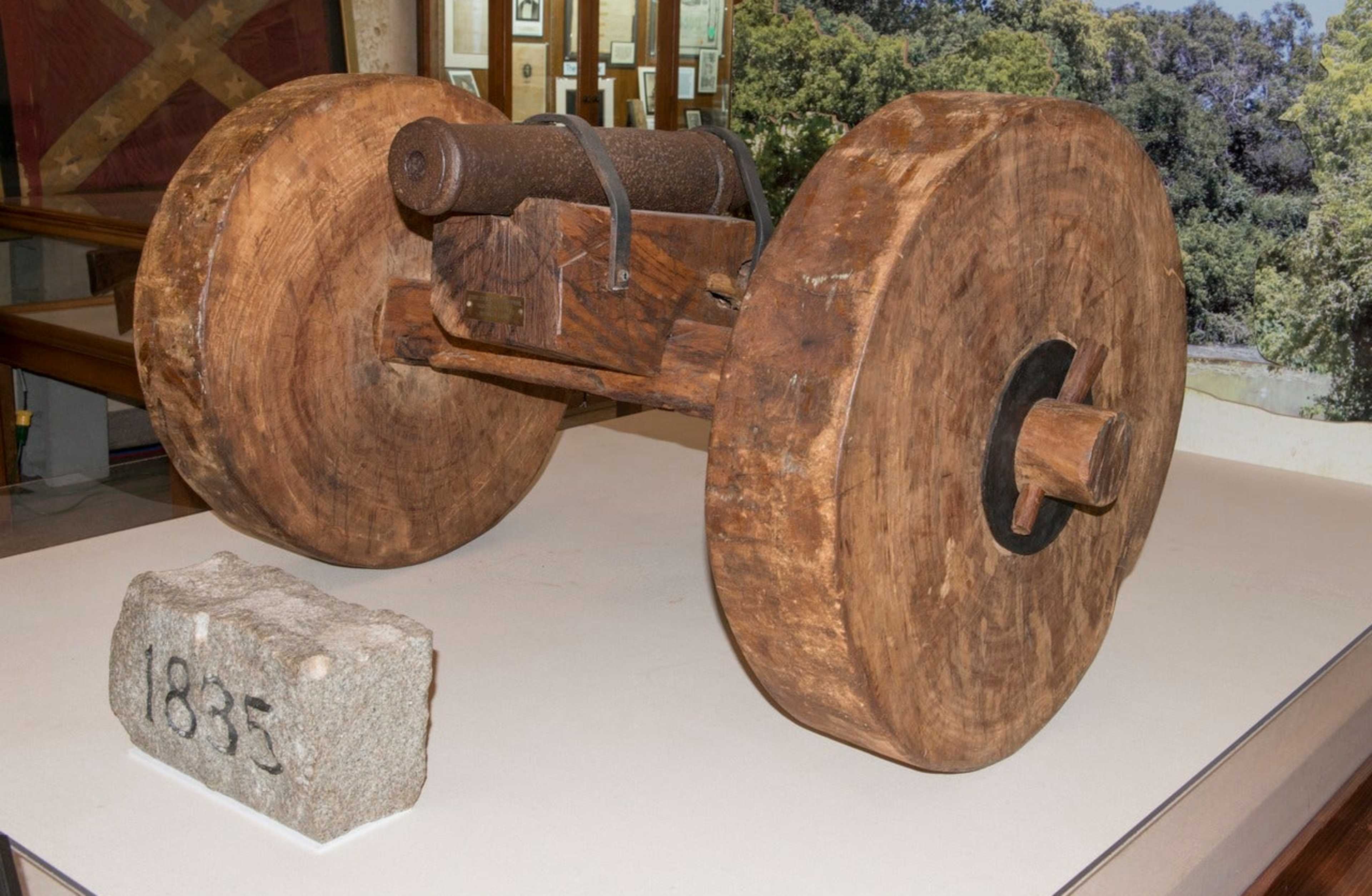
To understand this conflict, one must understand who were the Texians—a diverse mix of Anglo-American immigrants and Tejanos who had settled the Mexican frontier. In 1825, an empresario named Green DeWitt established the DeWitt Colony, bringing 400 Anglo-American families to the fertile confluence of the San Marcos and Guadalupe Rivers. At the time, the Mexican government actively encouraged foreign settlement to populate the northern frontier of Coahuila y Tejas. However, life on the frontier was fraught with danger. The capital of the colony, Gonzales, faced frequent raids from local Native American tribes, particularly the powerful Comanche Nation, who defended their ancestral homelands against colonial encroachment. Recognizing the vulnerability of the settlers, the Mexican government in 1831 loaned Gonzales a small, six-pounder bronze cannon for self-defense.
By 1835, the political landscape had undergone a radical shift. Green DeWitt had passed away, and General Antonio López de Santa Anna had seized centralized power in Mexico City. Santa Anna abolished the federalist Mexican Constitution of 1824, which had granted considerable autonomy to individual states. Elevating himself to dictator, Santa Anna sought to disarm the provincial militias and centralize military authority. In the eyes of the Texian colonists, who valued localized self-governance and individual liberty, this was an intolerable act of tyranny.
Causes and Context: The Path to Rebellion
The underlying causes of the Texas Revolution were multifaceted, extending far beyond the ownership of a single piece of artillery. Economic disparities, linguistic barriers, and differing views on slavery and religious freedom created a deep cultural chasm between the centralized government in Mexico City and the far-flung colonists. When Santa Anna ordered the systematic disarmament of the Texan colonies, it was viewed as the final step toward complete subjugation.
Just as the American colonists detailed their complaints decades earlier when the Declaration of Independence was also a list of grievances against the British crown, the Texians drafted their own formal declarations detailing Santa Anna’s constitutional overreaches. The order to retrieve the Gonzales cannon was the catalyst that transformed peaceful political protests into armed resistance.
Chronological Timeline of the Gonzales Crisis
- 1825: Green DeWitt founds the Gonzales settlement under a Mexican land grant.
- 1831: The Mexican military provides a six-pounder cannon to Gonzales for frontier defense.
- September 21, 1835: Colonel Domingo de Ugartechea, the Mexican military commander in San Antonio, sends a corporal and five men to reclaim the cannon. The townspeople refuse to surrender it and arrest the soldiers.
- September 27, 1835: Ugartechea dispatches Lieutenant Francisco de Castañeda with 100 cavalry dragoons to seize the cannon, with strict orders to avoid open conflict if possible.
- September 29, 1835: Castañeda’s forces arrive at the swollen Guadalupe River. They are blocked by 18 local militiamen, later dubbed the “Old Eighteen,” who have removed all ferry boats.
- October 1, 1835: As the Texians stall for time, reinforcements from surrounding colonies swell their numbers to roughly 170. Under the command of John Henry Moore, they cross the river to confront the Mexican camp.
- October 2, 1835: The Battle of Gonzales occurs. Following a brief exchange of gunfire and cannon fire, the Mexican forces retreat.
Important Figures and Their Roles
Several key historical figures played pivotal roles during the brief yet highly significant battle:
- John Henry Moore: A prominent colonist and military leader, Moore was elected colonel of the Texian forces at Gonzales. He organized the ragtag militia, planned the crossing of the Guadalupe River, and directed the attack on the Mexican camp.
- Lieutenant Francisco de Castañeda: The commander of the Mexican dragoons. Tasked with a delicate diplomatic and military mission, Castañeda demonstrated tactical restraint, choosing to retreat rather than engage in a costly, unsanctioned civil battle.
- The “Old Eighteen”: These 18 brave Gonzales militiamen stood guard on the banks of the Guadalupe River, holding off 100 Mexican dragoons through clever stalling tactics until help arrived.
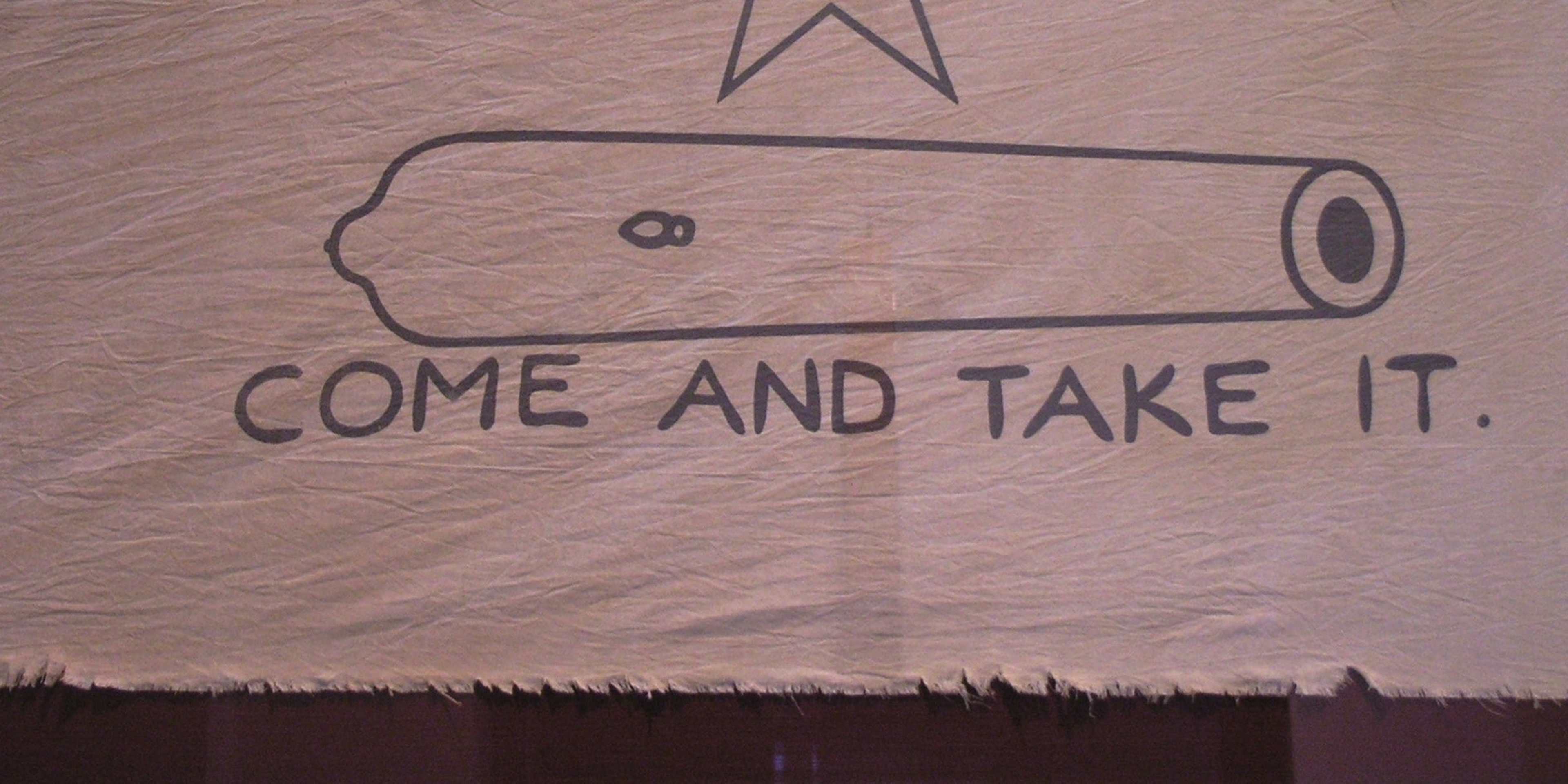
- Sarah DeWitt and Evaline DeWitt: The mother-daughter duo who, along with Naomi DeWitt, reportedly designed and stitched the legendary “Come and Take It” flag from Naomi’s wedding dress, providing an instant visual identity for the revolution.
The Battle of Gonzales: A Turning Point in the Fog
On the night of October 1, 1835, the emboldened Texian forces crossed the Guadalupe River under a thick blanket of autumn fog. Dragging the disputed cannon—which they had loaded with scrap metal and chain links—the militia marched silently toward the Mexican encampment. Around 4:00 AM on October 2, a barking dog alerted the Mexican sentries, prompting a brief exchange of gunfire. Both sides withdrew to wait for the morning light to lift the dense fog.
When the sun finally burned through the mist, the two commanders held a parley. John Henry Moore demanded that Castañeda join the federalist cause or surrender. Castañeda replied that while he sympathized with the federalist Constitution of 1824, he was bound by military duty to follow orders. Realizing negotiations were futile, the Texians returned to their lines and unfurled their makeshift banner.
While debate persists over national symbols—such as whether Betsy Ross really make the first American flag—there is little doubt about the makeshift origins of the Gonzales banner, rumored to have been stitched from the wedding dress of Naomi DeWitt. The flag featured a single black star, a silhouette of the cannon, and the provocative words: “Come and Take It.” The Texians fired their single cannon shot and charged. Adhering to his orders not to precipitate a general war, Castañeda ordered a quick withdrawal, leaving the field to the triumphant Texians.
Long-Term Impact on American History
The Battle of Gonzales was of minor military consequence, resulting in only two Mexican casualties and none for the Texians. However, its psychological and political ramifications were monumental. The engagement galvanized the colonist population, transforming a disjointed group of complaining settlers into a unified revolutionary force. Within days, Stephen F. Austin was named commander-in-chief of the “Army of Texas.”
Furthermore, Gonzales set off a chain reaction that altered American history forever. The successful defense of the cannon inspired the siege of San Antonio, the tragic defense of the Alamo, and the eventual decisive victory at San Jacinto. The resulting independence of the Republic of Texas led directly to its annexation by the United States in 1845. This annexation triggered the Mexican-American War, which concluded with the Treaty of Guadalupe Hidalgo. Through this treaty, the United States acquired vast territories, including modern-day California, Nevada, Utah, Arizona, and parts of Colorado and New Mexico, completing the nation’s westward expansion to the Pacific Ocean.
Lesser-Known Facts About the Battle of Gonzales
The Practically Useless Cannon
Despite the immense political drama surrounding the six-pounder cannon, the weapon itself was militarily ineffective. The touchhole had been spiked years prior, meaning it could not be easily fired with standard ammunition. When the Texians fired it during the battle, they had to pack it with scrap metal, horseshoe nails, and chain links, and it acted more as a loud noisemaker than an effective piece of artillery.
Deep Roots of the Slogan
The phrase “Come and Take It” did not originate in Texas. It is a translation of the ancient Greek phrase “Molon labe,” famously spoken by King Leonidas I of Sparta to the Persian King Xerxes at the Battle of Thermopylae. It was also used during the American Revolution in 1778, when British forces demanded the surrender of Fort Morris in Georgia, and Colonel John McIntosh defiantly replied with the same phrase.
Why It Still Matters Today
Today, the Battle of Gonzales is remembered as the “Lexington of Texas.” The “Come and Take It” flag remains one of the most recognizable symbols of liberty, resistance to government overreach, and individual rights in American culture. It is proudly displayed across Texas and the wider United States on banners, shirts, and political campaigns, serving as a powerful modern reminder of the enduring American frontier spirit and the lengths to which individuals will go to defend their perceived constitutional liberties.
People Also Ask
Why did the Mexican government want the cannon back?
The Mexican government, under the centralist control of President Santa Anna, sought to disarm the provincial militias across Mexico to prevent rebellion and centralize military authority. The return of the loaned cannon was a test of the colonists’ loyalty to the central government.
Did anyone die in the Battle of Gonzales?
Yes, but casualties were extremely low. Only two Mexican soldiers were killed in the skirmish, while the Texian militia suffered no casualties, with only one minor injury reported (a bloody nose from falling off a horse).
Where is the original “Come and Take It” cannon today?
The original bronze six-pounder cannon used in the battle is believed by historians to be on display at the Gonzales Memorial Museum in Gonzales, Texas, preserving this invaluable artifact of American history.
Conclusion
The Battle of Gonzales stands as a testament to the power of symbolic resistance. Though a minor skirmish in terms of casualties and military maneuvers, it served as the spark that ignited the Texas Revolution, reshaping the map of North America. The defiance of the “Old Eighteen” and the legendary “Come and Take It” flag continue to inspire generations, symbolizing the eternal struggle between central authority and individual liberty.


