The story of early colonial America is often defined by tales of survival, religious conviction, and the struggle to establish order in an unfamiliar wilderness. At the very heart of this narrative stands William Bradford, a deeply religious Separatist who became the principal architect of the Plymouth Colony. Serving as governor for more than three decades, Bradford did not merely lead his community through devastating winters, disease, and political uncertainty; he also penned the definitive historical record of their journey. His journal, eventually published as Of Plymouth Plantation, remains one of the most vital primary sources of early American history, capturing the triumphs, tragedies, and complex indigenous relations of the Pilgrims. By examining his life, we uncover the foundational ideals—and stark realities—that shaped the birth of a nation.
Historical Background: From English Fields to Dutch Exile
William Bradford was born in March 1590 in the quiet farming village of Austerfield, Yorkshire, England. Orphaned at a young age and raised by relatives, his early life was marked by chronic illness that prevented him from performing heavy agricultural labor. This physical limitation, however, redirected his energy toward intellectual and spiritual pursuits. He spent his youth reading the Bible and studying classical texts, which fostered a deep-seated religious curiosity. As a teenager, Bradford became profoundly drawn to a growing Puritan movement known as the Separatists. Unlike mainstream Puritans who wished to reform the Church of England from within, the Separatists believed the state church was beyond saving and sought a complete break. Bradford joined a local congregation led by William Brewster and John Robinson in nearby Scrooby. Facing fierce persecution and legal threats under King James I, the group made the radical decision to flee. In 1608, they escaped to the Netherlands, living briefly in Amsterdam before settling in Leiden in 1609. Over the next eleven years, Bradford worked in the cloth trade, married Dorothy May in 1613, and immersed himself in the Separatist community. Yet, as their children began adapting to Dutch culture and the threat of war loomed, the leaders realized they needed to establish their own colony. This dream led to deep discussions about why did the Pilgrims come to America, seeking a sanctuary where they could preserve their English identity and practice their faith without interference.
The Atlantic Crossing and the Mayflower Compact
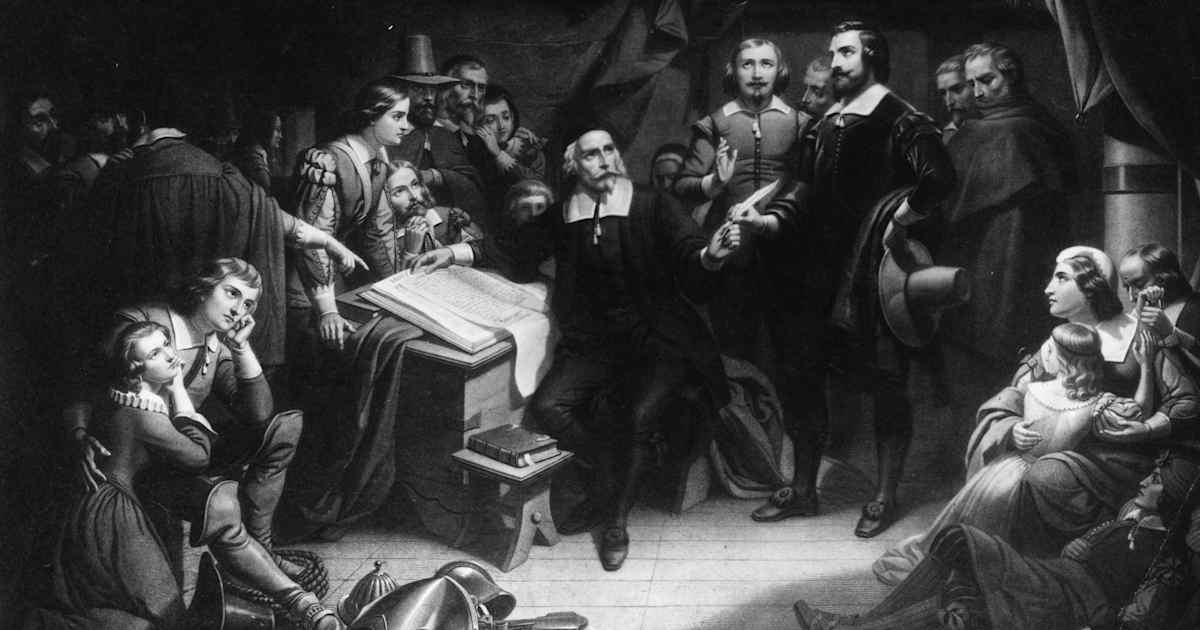
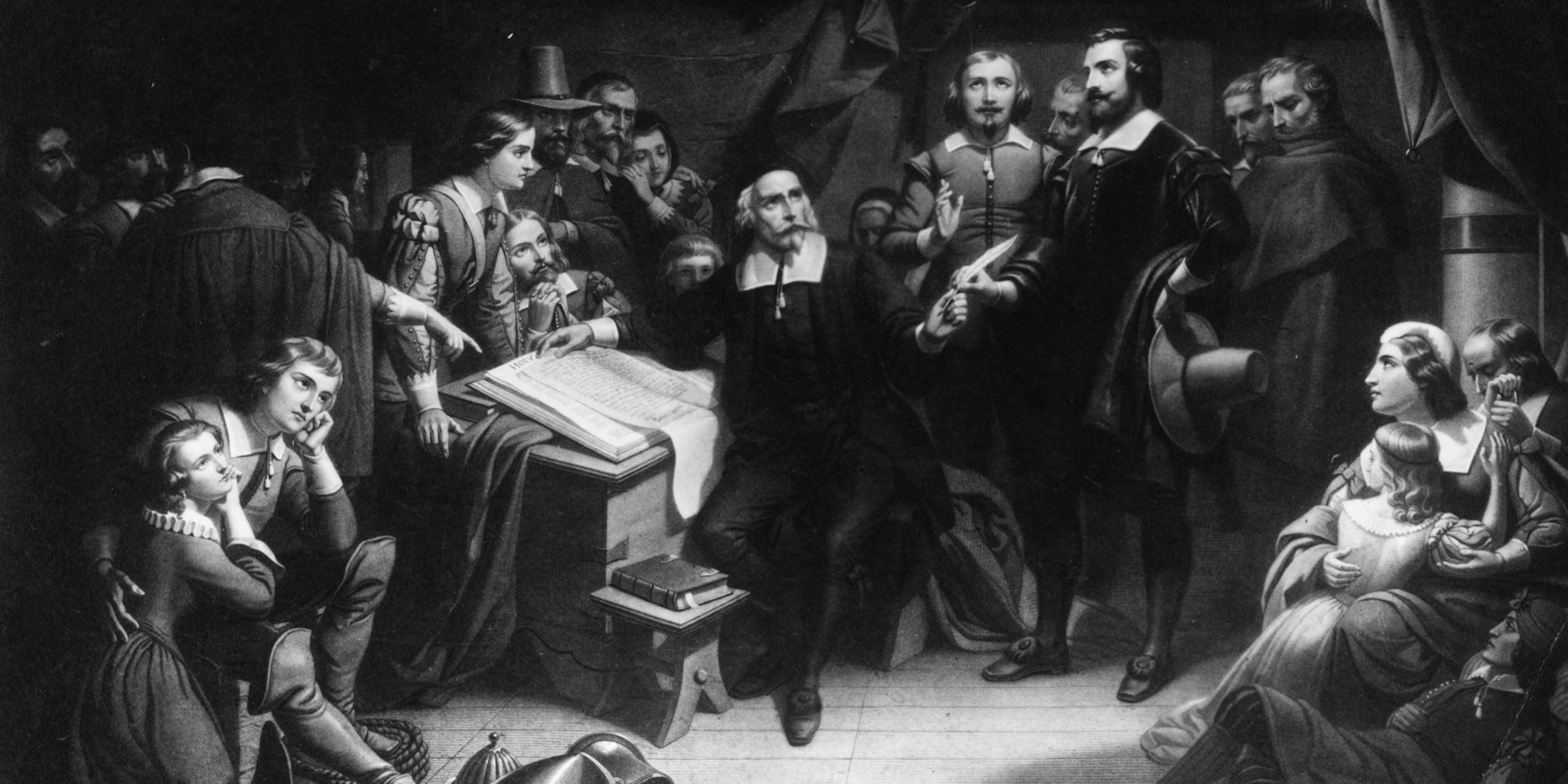
In July 1620, the Bradfords made the agonizing decision to leave their young son behind and boarded the Speedwell to join the Mayflower in England. When the Speedwell proved unseaworthy, its passengers crammed onto the Mayflower, which finally set sail from Plymouth, England, on September 6, 1620. The grueling 66-day voyage across the Atlantic was fraught with violent storms, disease, and cramped, unsanitary conditions. The passengers were divided between the Separatists, whom they called “Saints,” and secular adventurers or laborers, known as “Strangers.” When the ship finally sighted Cape Cod on November 9, 1620—far north of their intended destination in the Virginia territory—tensions threatened to dissolve the group. To prevent mutiny and establish a legal framework for their settlement, 41 of the male passengers drafted and signed the Mayflower Compact. This historic agreement established a “civil body politic” governed by majoritarian consent. Bradford was among the prominent signers, recognizing how the Mayflower Compact laid a foundation for democracy in the New World. It was an unprecedented step toward self-rule, proving that a diverse group of colonists could voluntarily unite under a shared rule of law.
Tragedy and Triumph at Plymouth Bay
Shortly after anchoring, Bradford joined an armed expedition to scout the shoreline for a permanent settlement site. They eventually selected a location on the southern shore of Massachusetts Bay, which had previously been the Native American village of Patuxet, recently decimated by a European epidemic. While Bradford was away on this exploration, tragedy struck. His wife, Dorothy May Bradford, fell from the deck of the Mayflower into the freezing waters of Provincetown Harbor and drowned. Grief-stricken, Bradford had little time to mourn. The colony faced a brutal first winter, during which nearly half of the 102 passengers and crew perished from scurvy, exposure, and infectious disease. Among the casualties was the colony’s first governor, John Carver. In April 1621, Bradford was elected as Carver’s successor. He would go on to be re-elected more than 30 times, serving as the executive anchor of Plymouth for the next 35 years. His leadership was defined by pragmatism, financial negotiation with their English investors, and crucial diplomatic efforts. Most notable was the peace treaty negotiated with Massasoit, the leader of the Wampanoag Nation, which secured the physical and agricultural survival of the struggling settlement.
Chronicling History: Of Plymouth Plantation
In 1630, Bradford began writing his monumental historical journal, Of Plymouth Plantation. Over the next two decades, he meticulously recorded the details of the Mayflower voyage, the establishment of the settlement, and the day-to-day trials of the colonists. Bradford’s writing provides an invaluable window into the mindset of the Puritans, documenting both their unwavering religious faith and the secular challenges they faced as more non-Separatist settlers arrived. Through his narrative, modern historians gain insights into the realities of the founding and hardships of the Plymouth Colony. The history of this manuscript is a fascinating tale in its own right. During the American Revolutionary War, British soldiers looted the Old South Meeting House in Boston, and Bradford’s manuscript disappeared. For decades, it was assumed lost, until American scholars tracked it down in 1855 to the library of the Bishop of London. Returned to Massachusetts in 1897, the document remains the most authoritative, firsthand account of early New England colonization.
Key Events Timeline
Understanding Bradford’s life requires looking at the critical milestones that shaped his journey and the colony he led:
- 1590: Born in Austerfield, Yorkshire, England.
- 1608: Flees religious persecution in England, settling in Leiden, Netherlands.
- 1620: Sails aboard the Mayflower, signs the Mayflower Compact, and arrives in Plymouth Bay; his first wife, Dorothy, tragically drowns.
- 1621: Elected Governor of Plymouth Colony following the death of John Carver; establishes a peace treaty with the Wampanoag.
- 1623: Marries Alice Southworth, bringing stability to his family life.
- 1630: Begins writing Of Plymouth Plantation, documenting the colony’s history.
- 1646: Concludes his primary journal entries, detailing the colony’s progression.
- 1657: Dies in Plymouth at the age of 68, leaving a legacy of enduring leadership.
Crucial Historical Figures
William Bradford did not govern in a vacuum. His story is intertwined with several key historical figures who influenced the trajectory of early America:
William Brewster and John Robinson
Brewster, a local postmaster in Scrooby, and Robinson, a brilliant theologian, were the spiritual leaders of the Separatist congregation. They nurtured Bradford’s religious education, with Brewster later joining him on the Mayflower as the colony’s ruling elder.
Massasoit
The Grand Sachem (leader) of the Wampanoag Confederacy. Massasoit chose to forge a military and economic alliance with the Pilgrims, facilitating trade, agricultural education, and peace that lasted for over fifty years.
John Carver
Plymouth’s first governor who secured the initial patent for the colony. His untimely death in the spring of 1621 forced the young, resilient Bradford into the governorship.
Major Turning Points
Several critical junctures altered the course of Bradford’s leadership and the fate of Plymouth:
- The Landing at Cape Cod: Missing their Virginia destination forced the creation of the Mayflower Compact, shifting the political identity of the settlement from a commercial venture to a self-governed commonwealth.
- The Wampanoag Alliance: Without the peace treaty with Massasoit and the agricultural guidance of Squanto, the colony likely would have suffered the same tragic fate as other failed North American settlements.
- The Shift in Land Ownership (1623): Initially, Plymouth operated under a communal property system mandated by London investors. Recognizing its inefficiency, Bradford allocated individual parcels of land to each family, which dramatically boosted agricultural production and saved the colony from starvation.
Lesser-Known Facts
Beyond the standard textbook history, several fascinating anecdotes surround William Bradford:
Fascinating Descendants
Bradford’s lineage includes highly influential figures in American cultural history, such as the famous chef Julia Child, Supreme Court Chief Justice William Rehnquist, and Noah Webster, the lexicographer who compiled the first American dictionary.
The Mystery of Dorothy’s Death
Dorothy May Bradford’s fatal fall from the deck of the Mayflower has long sparked historical speculation. While officially recorded as an accidental drowning, some historians have questioned whether the sheer despair of the harsh wilderness drove her to jump.
An International Manuscript Hunt
The original manuscript of Of Plymouth Plantation was lost for nearly 80 years. It was discovered by pure chance in Fulham Palace, London, in 1855, after being cited in a book on the history of the Protestant Episcopal Church in America, sparking a massive diplomatic effort to bring it home.
Why It Still Matters Today
William Bradford’s legacy is central to modern debates about the origins of American democracy, religious liberty, and indigenous relations. The Mayflower Compact represents one of the earliest practical implementations of social contract theory in action, serving as a conceptual precursor to the U.S. Constitution. Furthermore, Bradford’s detailed writings force modern readers to confront the complex and often tragic consequences of European expansion on Native American populations. His life serves as a powerful case study in crisis management, showing how resilience, diplomatic pragmatism, and a shared vision can sustain a community through the most dire circumstances.
People Also Ask
How long was William Bradford governor of Plymouth Colony?
William Bradford served as the governor of Plymouth Colony for a total of over 30 years. He was first elected in April 1621 and was re-elected annually nearly every year, with only minor gaps, until his death in 1657.
Why is William Bradford’s journal so important?
His journal, titled Of Plymouth Plantation, is the primary authoritative source of information regarding the Pilgrims’ voyage on the Mayflower, the signing of the Mayflower Compact, and the early years of Plymouth Colony. Without it, much of this foundational history would be lost.
What happened to William Bradford’s first wife?
His first wife, Dorothy May Bradford, tragically drowned in December 1620 after falling from the deck of the Mayflower while it was anchored in Provincetown Harbor, just before the colonists officially established their settlement at Plymouth.
Conclusion
In the annals of American history, William Bradford stands as a titan of early colonial leadership. Through sheer determination, deep faith, and pragmatic governance, he navigated the Plymouth Colony through its darkest hours, laying the groundwork for the democratic and cultural ideals that would define the nation centuries later. His writings ensure that the voices, struggles, and triumphs of the early Pilgrims continue to echo through time, reminding us of the high cost of freedom and the enduring power of community.


