Few figures in global history embody the spirit of curiosity, rebellion, and practical wisdom quite like Benjamin Franklin [1]. Often celebrated as the only Founding Father to sign all three of the nation’s foundational documents—the Declaration of Independence, the Treaty of Alliance with France, and the U.S. Constitution [1]—Franklin was far more than a politician. He was a scientist, printer, diplomat, and philosopher whose long life spanned the transition of thirteen disparate British colonies into a unified, sovereign nation. While names like George Washington and Alexander Hamilton commanded armies and shaped financial systems, Franklin’s unmatched diplomatic genius and grassroots communication laid the very psychological and political foundations of the American experiment. Understanding Benjamin Franklin is key to understanding how a diverse coalition of colonial interests found the common ground necessary to challenge the world’s greatest empire.
Historical Background: An Age of Enlightenment and Empire
Benjamin Franklin’s journey unfolded during the 18th century, a dynamic era defined by the European Enlightenment and the rapid expansion of the British Empire. Born in Boston in 1706, Franklin grew up in a world where scientific inquiry, religious debate, and political philosophy were beginning to challenge traditional monarchical authority [1]. The catalyst for Franklin’s transformation from a humble printer’s apprentice into a global revolutionary was the structural shift in relations between Great Britain and her North American colonies. For decades, the colonies enjoyed a period of salutary neglect, but the costly French and Indian War (1754–1763) prompted the British Parliament to impose direct taxes on the colonists, sparking widespread outrage and setting the stage for the American Revolution.
Causes and Context: The Shift from British Loyalists to American Rebels
Before the mid-1760s, Benjamin Franklin was a proud British imperialist who envisioned a grand, integrated British Empire. He spent decades in London advocating for the colonies, trying to persuade the British government to treat colonial citizens with the same rights as mainland Englishmen. However, the deep-seated economic and sociopolitical differences between the Crown and the colonies quickly became irreconcilable. The British government viewed the colonies as revenue sources to pay off massive war debts, while the colonists viewed direct taxation without parliamentary representation as an assault on their basic liberties. Franklin’s unique perspective as a printer allowed him to gauge the growing unrest. In 1754, during the Albany Congress, he proposed the Albany Plan of Union and created the famous viral political cartoon that united the colonies under the motto ‘Join, or Die.’ This symbolic call for unity became the cornerstone of colonial resistance as the imperial crisis deepened.
A Chronological Timeline of Franklin’s Era
To grasp the timeline of Franklin’s life and the birth of the United States, we must trace these crucial milestones:
- 1706: Benjamin Franklin is born in Boston, Massachusetts, to a large, modest family [1].
- 1723: Franklin runs away to Philadelphia, quickly establishing himself as a highly successful printer and publisher of Poor Richard’s Almanack [1].
- 1751: Franklin publishes his groundbreaking Experiments and Observations on Electricity, earning global scientific fame [1].
- 1754: He proposes the Albany Plan of Union, the first formal attempt to unite the colonies.
- 1765: Parliament passes the Stamp Act. Franklin testifies before the House of Commons, helping to secure its repeal but witnessing the growing divide.
- 1770: Tension boils over in Massachusetts. The British army fires on colonists in the Boston Massacre, taking the life of the untold history of Crispus Attucks, who became an early symbol of the revolutionary struggle.
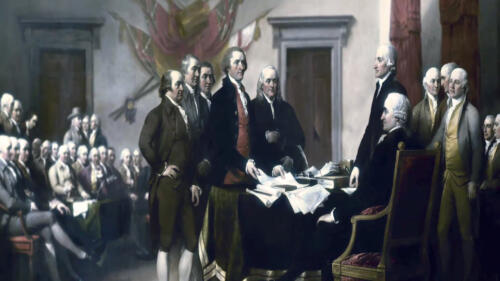
- 1776: Franklin serves on the Committee of Five, drafts the Declaration of Independence, and signs it.
- 1778: Acting as minister to France, Franklin secures the Treaty of Alliance, bringing vital French military and financial aid to the American cause.
- 1783: Franklin helps negotiate and signs the Treaty of Paris, officially ending the Revolutionary War.
- 1787: As the oldest delegate, Franklin attends the Constitutional Convention, helping to broker critical compromises.
- 1790: Benjamin Franklin passes away in Philadelphia at the age of 84, leaving behind an unparalleled legacy [1].
Critical Figures and Their Revolutionary Roles
The success of the American Revolution depended on a fragile alliance of brilliant, yet often clashing, personalities. While Franklin worked the diplomatic angles, other vital figures shaped the physical and financial battles:

- Benjamin Franklin: The supreme diplomat and communicator. He single-handedly won the hearts of the French public and nobility, securing the alliance that saved the Continental Army from defeat.
- Alexander Hamilton: The financial mastermind. While Franklin focused on foreign diplomacy, Hamilton worked to establish the nation’s financial credibility. He belonged to a group of Founding Fathers whose financial strategies shaped the war effort and later built the U.S. Mint and national banking system.
- Crispus Attucks: The first martyr. A man of African and Native American heritage whose sacrifice at the Boston Massacre highlighted the complex issues of race and liberty at the very heart of the emerging nation.
- Thomas Jefferson: The eloquent scribe. Jefferson drafted the poetic words of the Declaration of Independence, though he relied heavily on Franklin’s editorial eye to refine the draft’s most famous phrases.
Major Turning Points in Franklin’s Life
Two major turning points forever altered Franklin’s trajectory and the course of American history. The first occurred in 1774 during the infamous ‘Cockpit’ incident in London. Franklin was publicly humiliated by British Solicitor General Alexander Wedderburn over his leak of letters written by Massachusetts Governor Thomas Hutchinson. This brutal cross-examination stripped Franklin of his remaining loyalty to the British Crown, turning an influential moderate into an uncompromising revolutionary. The second turning point was the signing of the Treaty of Alliance with France in 1778. Franklin’s calculated simplicity, wearing a plain brown coat and a fur cap instead of courtly finery, charmed the French aristocracy. His diplomatic victory turned a localized rebellion into a global war that Britain could no longer sustain.
The Long-Term Impact on the American Nation
Franklin’s legacy deeply structured modern America. Culturally, he popularized the concept of social mobility, proving that a self-taught, working-class individual could rise to the highest levels of global influence. Structurally, his emphasis on civic institutions—ranging from public libraries, volunteer fire departments, and insurance companies to post offices and universities—forged the civic-minded nature of early American society. Scientifically, his discoveries in electricity, ocean currents, and meteorology established America as a legitimate contributor to global scientific advancement. Constitutionally, his pragmatic approach to compromise during the Constitutional Convention of 1787 ensured that a fragile union of states could agree on a single, enduring framework of government.
Surprising and Lesser-Known Facts About Benjamin Franklin
Beyond the famous kite-and-key story, Franklin’s life was full of fascinating, lesser-known chapters:
- The Turkey Incident: Franklin once accidentally electrocuted himself while trying to kill a Christmas turkey using electrical currents. He knocked himself unconscious and later remarked that he had nearly killed a goose instead.
- An Inducted Swimmer: Franklin was an avid and highly skilled swimmer. As a boy, he invented early hand-held swim fins made of wood. In 1968, he was posthumously inducted into the International Swimming Hall of Fame.
- A Tragic Family Divide: While Franklin became a leader of the rebellion, his beloved illegitimate son, William Franklin, remained a staunch Loyalist and served as the royal governor of New Jersey. The war permanently shattered their relationship, and they never reconciled.
Why Benjamin Franklin’s Legacy Matters Today
In our modern era of deep political polarization and global challenges, Franklin’s life offers invaluable lessons. He was a champion of compromise, pragmatism, and scientific reasoning over dogma. Franklin understood that for a democracy to survive, its citizens must engage in civil discourse, continuous self-improvement, and active civic participation. His belief that ‘a republic, if you can keep it’ remains a poignant warning and an inspiration for modern generations striving to preserve democratic institutions and foster international cooperation.
People Also Ask
What are the major inventions of Benjamin Franklin?
Benjamin Franklin was a prolific inventor who refused to patent any of his creations, believing they should be freely enjoyed by all. His famous inventions include the lightning rod, bifocal glasses, the Franklin stove, the glass armonica, and flexible urinary catheters [1].
Why was Benjamin Franklin so important to the American Revolution?
Franklin was crucial because he secured the military and financial alliance with France, which provided the troops, naval support, and funding necessary to defeat the British. Without French intervention, the Continental Army likely would have collapsed.
Did Benjamin Franklin ever own slaves?
Yes, early in his life, Franklin owned enslaved household servants and published advertisements for the sale of slaves in his newspaper. However, his views evolved significantly. In his later years, he became an ardent abolitionist, serving as the president of the Pennsylvania Abolition Society and petitioning Congress to end slavery.
Conclusion
Benjamin Franklin was the ultimate embodiment of American adaptability and intellect. From his humble beginnings as a printer’s apprentice to his status as an international statesman, his life mirrored the transition of the United States from a collection of colony outposts to a sovereign global force. By blending the revolutionary ideals of the Enlightenment with practical, hands-on civic duty, Franklin did not just help write the rules of the new republic—he taught Americans how to live within them.


