The journey of the United States from a fractured group of thirteen separate colonies to a unified, sovereign nation is one of the most compelling sagas in human history. At the absolute center of this transformation was the Continental Congress, an extraordinary assembly of delegates that evolved from a temporary protest committee into America’s first de facto governing body. Operating between 1774 and 1789, this political assembly navigated the colonies through the turbulent waters of colonial defiance, armed rebellion, a grueling war for independence, and the delicate construction of a new constitutional republic. Understanding the Continental Congress is crucial to understanding the foundations of American democracy itself, as it was within these intense debates that the modern concept of American liberty was forged.
The Sparks of Rebellion: Causes and Sociopolitical Context
To fully comprehend why the Continental Congress was summoned, one must examine the geopolitical climate of North America in the mid-18th century. For over a century, the British Crown practiced a policy of salutary neglect, allowing the thirteen colonies a high degree of local autonomy. However, this dynamic shifted drastically following the end of the French and Indian War in 1763. While Britain emerged victorious, the conflict left the empire saddled with crippling national debt.
Believing the American colonists should share the financial burden of their own defense, the British Parliament enacted a series of aggressive taxation measures. The Stamp Act of 1765 marked the first direct, internal tax on the colonies, sparking widespread outrage and the legendary rallying cry: “No taxation without representation.” Although colonial opposition successfully forced the repeal of the Stamp Act, Parliament continued to assert its supreme authority with new levies, including the Townshend Acts and the Tea Act of 1773. When frustrated patriots dumped tea into Boston Harbor in protest during the historic Boston Tea Party, Britain responded with the Coercive Acts of 1774, which colonists dubbed the “Intolerable Acts.” These harsh punitive measures closed Boston Harbor and suspended colonial self-governance in Massachusetts, prompting the colonies to realize that they must unite or perish.
The First Continental Congress (1774): Echoes of Unity
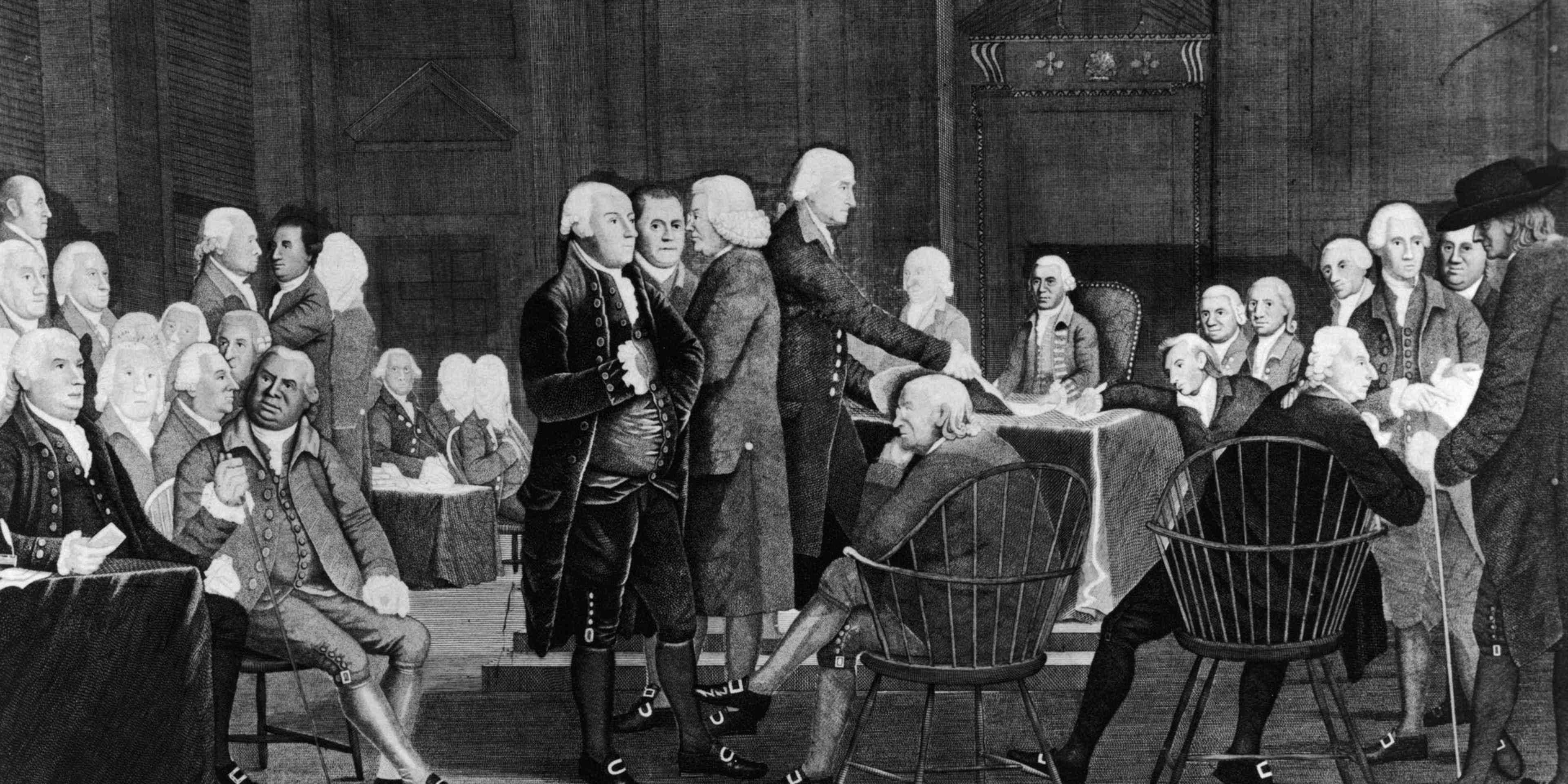
On September 5, 1774, delegates representing twelve of the thirteen colonies convened at Carpenters’ Hall in Philadelphia. Georgia was the sole absentee, as the colony was actively dealing with local frontier uprisings and relied heavily on British military support. This historic gathering, known as the First Continental Congress, brought together major political minds, including Samuel Adams, John Adams, George Washington, and John Jay. The primary goal was not to declare independence, but rather to organize a structured, coordinated response to British tyranny.
After extensive debate, the delegates drafted a Declaration of Rights, which asserted their loyalty to King George III while vehemently denying Parliament’s right to tax them without representation. To enforce their demands, Congress enacted the Articles of Association, a sweeping trade boycott of all British goods. The assembly agreed that if their grievances were not resolved by the Crown, they would reconvene the following year. The First Continental Congress officially adjourned on October 26, 1774, having successfully planted the seeds of a unified American political identity.
Chronological Timeline of the Continental Congress
- September 5, 1774: The First Continental Congress convenes at Carpenters’ Hall in Philadelphia to protest the Intolerable Acts.
- October 20, 1774: Congress adopts the Articles of Association, establishing a colony-wide boycott of British goods.
- April 19, 1775: The Battles of Lexington and Concord mark the outbreak of armed conflict.
- May 10, 1775: The Second Continental Congress convenes at Independence Hall in Philadelphia.
- June 14, 1775: Congress establishes the Continental Army to defend colonial interests.
- June 15, 1775: George Washington is appointed Commander-in-Chief of the Continental Army.
- July 5, 1775: Congress signs the Olive Branch Petition in a final, failed bid for peace.
- July 4, 1776: The Congress formally approves and signs the Declaration of Independence.
- November 15, 1777: The Articles of Confederation are drafted as the first U.S. constitution.
- March 1, 1781: The Articles of Confederation are officially ratified by all thirteen states.
- September 3, 1783: The Treaty of Paris is signed, officially ending the Revolutionary War.
- March 4, 1789: The United States Constitution goes into effect, replacing the Continental Congress with the U.S. Congress.
The Second Continental Congress (1775–1781): Governance in Wartime
As promised, the delegates reconvened on May 10, 1775. However, the political landscape had changed forever. Less than a month prior, British troops and colonial militias had clashed at Lexington and Concord. The Revolutionary War had begun, and the Second Continental Congress found itself thrust into the role of a wartime government. Recognizing the need for an organized defense, Congress authorized the creation of the Continental Army on June 14, 1775, appointing George Washington as its supreme commander.

Despite active military engagements, the delegates were deeply divided over the prospect of a permanent split from Great Britain. In July 1775, moderate factions pushed through the Olive Branch Petition, a direct appeal to King George III seeking reconciliation. The King’s outright refusal to read the petition, coupled with the popular release of Thomas Paine’s radical pamphlet Common Sense, rapidly pushed public sentiment toward independence. On July 4, 1776, Congress took the monumental step of adopting the Declaration of Independence, transforming their rebellion into a formal fight for sovereignty.
Operating as a de facto government, the Congress faced monumental logistical struggles. With no power to levy taxes, it relied on voluntary state contributions and printed its own paper currency, which quickly suffered from hyperinflation. Despite these financial hardships, the delegates successfully forged a critical international alliance. Recognizing that they could not defeat the British Empire alone, the diplomats secured vital French aid in 1778, providing the troops, supplies, and naval power necessary to secure victory at Yorktown.
Key Figures of the Congress and Their Lasting Legacies
- John Adams: A fierce champion of independence from Massachusetts, Adams was the intellectual engine of the early Congress, serving on numerous committees and pushing tirelessly for separation from Britain.
- Thomas Jefferson: Serving as the primary author of the Declaration of Independence, Jefferson’s eloquent defense of human rights and natural liberties established the moral foundation of the new republic.
- George Washington: Chosen as Commander-in-Chief of the Continental Army, Washington’s leadership on the battlefield transformed a ragtag militia into a professional fighting force.
- Benjamin Franklin: One of America’s elder statesmen, Franklin utilized his immense diplomatic skill in Paris to secure the alliance with France, which ultimately saved the revolution.
Surprising and Lesser-Known Facts
While the broader strokes of the Continental Congress are well known, several lesser-known facts highlight the complexities of this historic body:
- The Deleted Slavery Clause: In his original draft of the Declaration of Independence, Thomas Jefferson included a passionate passage condemning the transatlantic slave trade and blaming King George III for its perpetuation. Fearing that this clause would alienate southern colonies whose economies relied heavily on slavery, Congress voted to excise the passage to maintain unity.
- The Worthless “Continental” Dollar: To fund the war effort, the Second Continental Congress printed millions of dollars in paper currency called “Continentals.” Because these notes were not backed by gold or silver, they rapidly depreciated in value, giving rise to the popular 18th-century phrase “not worth a Continental.”
- Moving on the Run: The Continental Congress was not stationary. Due to the shifting tides of the Revolutionary War and the threat of British occupation, the delegates had to flee Philadelphia multiple times, convening in cities like Baltimore, Lancaster, and York, Pennsylvania.
Long-Term Impact and Why It Still Matters Today
The Continental Congress fundamentally reshaped the global political landscape. By successfully managing a revolution against the world’s most powerful empire, the assembly demonstrated that a representative government could survive under the most extreme pressures. Although the Articles of Confederation proved too weak to govern the nation during peace, the lessons learned under this initial framework directly paved the way for the framing of the U.S. Constitution in 1787.
Today, the legacy of the Continental Congress is felt in the very structure of American governance. The debates held within those historic halls regarding the balance of state sovereignty and federal authority, civil liberties, and representation continue to define modern political discourse in the United States. It stands as a powerful testament to the enduring strength of collaborative, representative democracy.
People Also Ask
What was the main difference between the First and Second Continental Congress?
The First Continental Congress in 1774 focused primarily on protesting British taxation and organizing a colonial boycott. The Second Continental Congress in 1775 acted as an active wartime government, eventually declaring independence and managing the Revolutionary War.
Why did Georgia not attend the First Continental Congress?
Georgia was facing intense conflicts with neighboring Native American tribes along its borders. Dependent on British military troops and supplies for their defense, Georgian leaders chose not to alienate the Crown by sending official delegates to the 1774 assembly.
What was the first constitution created by the Continental Congress?
The first constitution was the Articles of Confederation, drafted in 1777 and ratified in 1781. It established a weak central government that was eventually replaced by the United States Constitution in 1789.
Conclusion
The Continental Congress was far more than a simple legislative body; it was the crucible in which the American identity was forged. Driven by a shared desire for liberty and representation, a diverse group of colonists overcame immense geographic, political, and economic differences to build a new nation. Their bold experiments in self-governance laid the groundwork for a constitutional republic that continues to influence democratic movements across the globe today.


