While the siege and fall of the Alamo occupy an almost mythical status in the American consciousness, a far larger and arguably more tragic catastrophe occurred just three weeks later. The Goliad Massacre, which took place on Palm Sunday, March 27, 1836, stands as one of the darkest and most brutal chapters of the Texas Revolution. Twice as many Texian soldiers died at Goliad as they did within the crumbling walls of the Alamo, yet this tragedy is often overshadowed by the heroic last stand of Davy Crockett and his comrades. Initiated by the severe, uncompromising decrees of Mexican President Antonio López de Santa Anna, this event not only unified the fractured Texian forces but also galvanized public sentiment across the United States. In the crucible of the Texas wilderness, the slaughter at Goliad transformed a desperate, disorganized rebellion into an unyielding war for independence, forever altering the geopolitical landscape of North America.
The Historical Background: A Rebellion Ignited
To fully understand the tragedy of the Goliad Massacre, one must look at the escalating tensions between the centralist government of Mexico and the growing population of Anglo-American settlers and regional Tejanos in the northern department of Coahuila y Tejas. In 1835, Mexican President Antonio López de Santa Anna repealed the federalist Constitution of 1824, centralizing authority in Mexico City and stripping regional states of their autonomy. This autocratic turn deeply angered the Texian rebels fighting for independence, who were accustomed to a degree of self-governance and economic independence.
The resulting Texas Revolution began in October 1835. Early in the conflict, Texian rebels successfully seized Fort Defiance—a strategic presidio built over the old Spanish mission, Presidio La Bahía, in the town of Goliad. By early 1836, however, Santa Anna was determined to crush the rebellion once and for all. He marched north with a massive, battle-hardened army, split into multiple columns. While Santa Anna focused his attention on the Alamo in San Antonio, his highly capable lieutenant, General José de Urrea, led a sweeping sweep along the coastal bend of Texas toward Goliad.
The Chronology of Disaster: A Detailed Timeline
The tragedy at Goliad unfolded over several chaotic weeks in early 1836. Below is a detailed chronological breakdown of the events that led to the fateful day:
- October 1835: Texian forces seize the Presidio La Bahía in Goliad, naming it Fort Defiance.
- December 30, 1835: Santa Anna passes the “Tornel Decree,” declaring that all foreign rebels captured on Mexican soil will be treated as pirates and executed.
- March 6, 1836: The Alamo falls in San Antonio, leaving Sam Houston’s Texian Army deeply vulnerable.
- March 14, 1836: Sam Houston sends urgent orders to Colonel James W. Fannin to dismantle Fort Defiance, retreat to Victoria behind the natural defense of the Guadalupe River, and join his main force.
- March 14–18, 1836: Fannin delays his departure, waiting for scouts and detachments that had been sent on missions, and hesitating to abandon his position.
- March 19, 1836 (Morning): Fannin finally begins his sluggish retreat from Goliad.
- March 19, 1836 (Afternoon): The Battle of Coleto Creek. Mexican forces under General Urrea encircle the Texians on an open prairie. Despite fighting bravely and forming a defensive square, the Texians are pinned down.
- March 20, 1836: Outnumbered, out of ammunition, and lacking water, Fannin surrenders to General Urrea. The captured Texians are marched back to Goliad and imprisoned.
- March 27, 1836 (Palm Sunday): On Santa Anna’s direct orders, nearly 350 Texian prisoners are marched out of the presidio in three separate columns and executed.
The Ill-Fated Retreat: Fannin’s Fatal Hesitation
Colonel James W. Fannin was a West Point-trained officer, but his leadership in the field lacked the decisive urgency that the situation demanded. When Sam Houston issued the direct order to abandon Goliad, he warned Fannin that a rapid retreat was imperative. Yet Fannin lingered. His hesitation was partly born of a desire to await the return of Captain Amon B. King and Lieutenant Colonel William Ward, who had been dispatched to help settlers near Refugio. When those forces were captured or scattered by General Urrea’s rapidly advancing army, Fannin’s window of opportunity slammed shut.
When the retreat finally commenced on the foggy morning of March 19, it was plagued by structural inefficiencies. Unlike some of the most famous military retreats in history, Fannin’s evacuation was disorganized and incredibly slow. His heavy baggage carts broke down, and one cart even fell into the San Antonio River, prompting a lengthy delay. Furthermore, against the explicit warnings of his junior officers, Fannin halted the march for over an hour to allow their oxen to graze on the open prairie near Coleto Creek, just miles from the safety of the nearby woods. Tragically, while the livestock grazed, the hungry Texian soldiers realized they had forgotten to pack any provisions for themselves.
By the afternoon, Urrea’s cavalry had surrounded them. Fannin ordered his men to form a defensive square. Though they repelled several Mexican charges, they were trapped in a shallow depression with no cover, no water, and depleting ammunition. When Mexican artillery and fresh reinforcements arrived overnight, Fannin realized that further resistance would lead to total annihilation. Believing they would be treated as prisoners of war and eventually paroled back to the United States, the Texians surrendered.
Prominent Figures and Their Lasting Impact
The tragic drama of the Goliad Massacre was shaped by several major historical actors, each playing a critical role in the outcome:
- Colonel James W. Fannin: The commander of the Texian forces at Goliad. His tactical delays at Fort Defiance and indecision during the retreat sealed the fate of his men. Despite his military shortcomings, he fought bravely at Coleto Creek and faced his execution with stoic dignity.
- General José de Urrea: Santa Anna’s highly efficient coastal commander. Urrea was a professional soldier who, despite being a fierce enemy of the Texians, respected their bravery. After the Battle of Coleto Creek, Urrea repeatedly petitioned Santa Anna for clemency on behalf of the prisoners, arguing that showing mercy would reflect honorably on the Mexican government.
- General Antonio López de Santa Anna: The dictator of Mexico. Viewed as the “Napoleon of the West,” Santa Anna was ruthless. He ignored Urrea’s pleas for mercy and insisted on the strict execution of the Tornel Decree, viewing the Texians not as soldiers, but as lawless pirates invading Mexican territory.
- Lieutenant Colonel José Nicolás de la Portilla: The Mexican commander left in charge of Goliad while Urrea continued his campaign. Portilla received contradictory orders: one from Urrea to treat the prisoners with kindness, and a direct order from Santa Anna to execute them. Fearing the wrath of the dictator, Portilla reluctantly carried out Santa Anna’s brutal command.
- Francita Alavez (The “Angel of Goliad”): The wife of a Mexican officer, Alavez was horrified by the impending executions. Utilizing her influence and compassion, she persuaded Mexican officers to spare the lives of approximately 20 Texian doctors, interpreters, and orderlies. She also brought food and water to the suffering captives, securing a permanent place of honor in Texas folklore.
The Horrors of Palm Sunday: How the Massacre Unfolded
The imprisoned Texians spent a week locked in the chapel of Fort Defiance, sharing cramped quarters and hoping for paroled release. On the morning of March 27, 1836, their hopes were cruelly shattered. Divided into three main groups, the healthy prisoners were marched out of the fort along different roads under heavy Mexican guard. The guards led them to believe they were going to gather firewood or march to a nearby port to board ships bound for New Orleans.
Approximately half a mile from the fort, the columns were ordered to halt. In an instant, the Mexican guards turned on the defenseless prisoners and opened fire at point-blank range. Those who survived the initial volleys were chased down and killed with bayonets and lances. Back at Fort Defiance, the wounded prisoners—including those unable to walk—were dragged outside and shot against the chapel walls. Colonel Fannin was the last to be executed. He made three simple requests of the Mexican officer: to be shot in the breast, to receive a Christian burial, and to have his pocket watch sent to his family. Instead, the officer shot Fannin in the face, burned his body in a mass pyre, and kept the watch as a personal trophy.
Lesser-Known Facts and Surprising Anecdotes
- The Forgotten Feast: During their slow-paced retreat, Fannin’s men spent over an hour letting their oxen graze because Fannin was concerned about the animals’ stamina. However, the soldiers themselves had no food, as the chaotic evacuation caused them to leave their entire supply of provisions behind at Fort Defiance.
- Surviving Against the Odds: Despite the systematic execution, about 28 Texians managed to escape the slaughter. When the firing began, these men threw themselves into the tall grass, feigned death, and eventually escaped into the nearby San Antonio River under the cover of smoke.
- The Identity of the “Angel of Goliad”: For generations, the true identity of Francita Alavez remained shrouded in mystery. Recent historical research has identified her as Francisca Alvarez, who was likely a camp follower or common-law wife of Captain Telesforo Alavez. Her acts of mercy saved over 100 lives across various camps, including Copano Bay and Goliad.
The Long-Term Impact on America and Why It Matters Today
Santa Anna believed that the swift, ruthless execution of the Goliad garrison would shatter the morale of the Texas rebellion. In reality, it had the exact opposite effect. The Goliad Massacre outraged the public, not only in Texas but also across the United States. It transformed the Texas Revolution from a regional dispute into a moral crusade against a cruel tyrant.
When General Sam Houston rallied his forces less than a month later at the decisive Battle of San Jacinto on April 21, 1836, his men did not just scream “Remember the Alamo!” They thundered a dual war cry: “Remember the Alamo! Remember Goliad!” Driven by a desire to avenge their fallen comrades, the Texians defeated Santa Anna’s army in a swift, 18-minute battle, capturing the dictator himself and securing the independence of the Republic of Texas. This victory set the stage for the eventual annexation of Texas by the United States, sparking the Mexican-American War and ultimately leading to the American acquisition of the American Southwest.
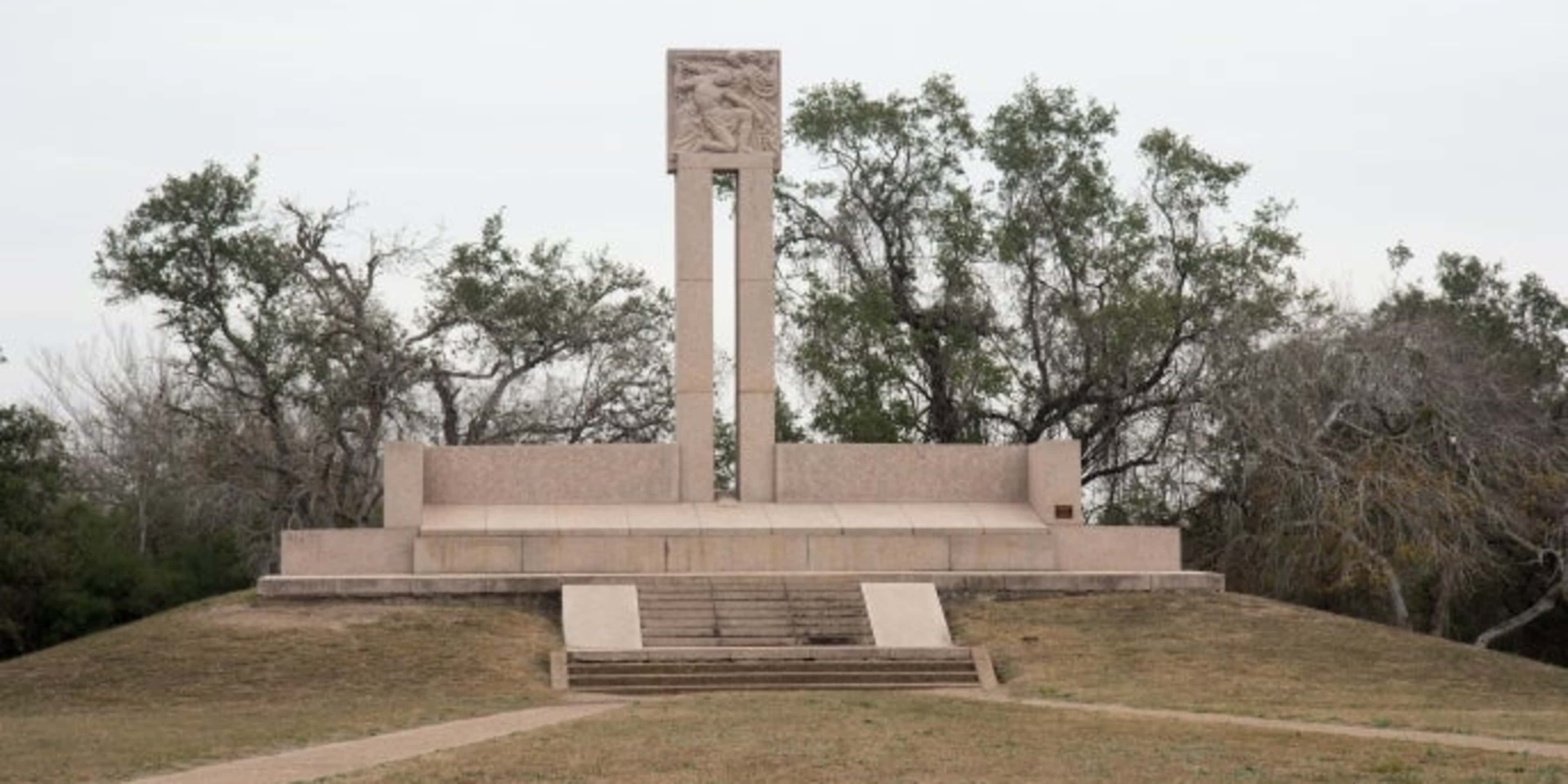
Today, the Goliad Massacre serves as a stark reminder of the complexities of wartime ethics and the power of martyrdom. The Presidio La Bahía stands as a National Historic Landmark, honoring those who fell. The tragedy underscores how excessive brutality can undermine military victories, proving that ethical codes in warfare are not just moral obligations, but strategic necessities.
People Also Ask
What was the Goliad Massacre?
The Goliad Massacre was the execution of approximately 342 to 400 Texian prisoners of war by the Mexican Army on March 27, 1836, during the Texas Revolution. The execution was ordered by Mexican President Antonio López de Santa Anna following the Battle of Coleto Creek.
How does the Goliad Massacre differ from the Alamo?
While the defenders of the Alamo died during active combat while defending a besieged fortress, the Texians at Goliad had already surrendered under the belief that they would be treated as prisoners of war. They were executed in cold blood while unarmed and under guard.
Who was the Angel of Goliad?
The Angel of Goliad was Francita Alavez (often identified as Francisca Alvarez), a Mexican woman who accompanied the Mexican army. She actively intervened to save the lives of dozens of Texian prisoners by convincing officers to spare physicians, translators, and workers.
Conclusion
The Goliad Massacre remains a poignant testament to the high cost of liberty. The tragic fate of Colonel James W. Fannin and his men highlights the catastrophic consequences of military indecision, but their sacrifice was not in vain. By combining their memory with that of the fallen defenders of the Alamo, the surviving Texians forged an unbreakable resolve that reshaped the map of the United States. As we look back on the events of 1836, Goliad stands alongside the Alamo as an eternal symbol of sacrifice, resilience, and the ultimate triumph of the human spirit over tyranny.


