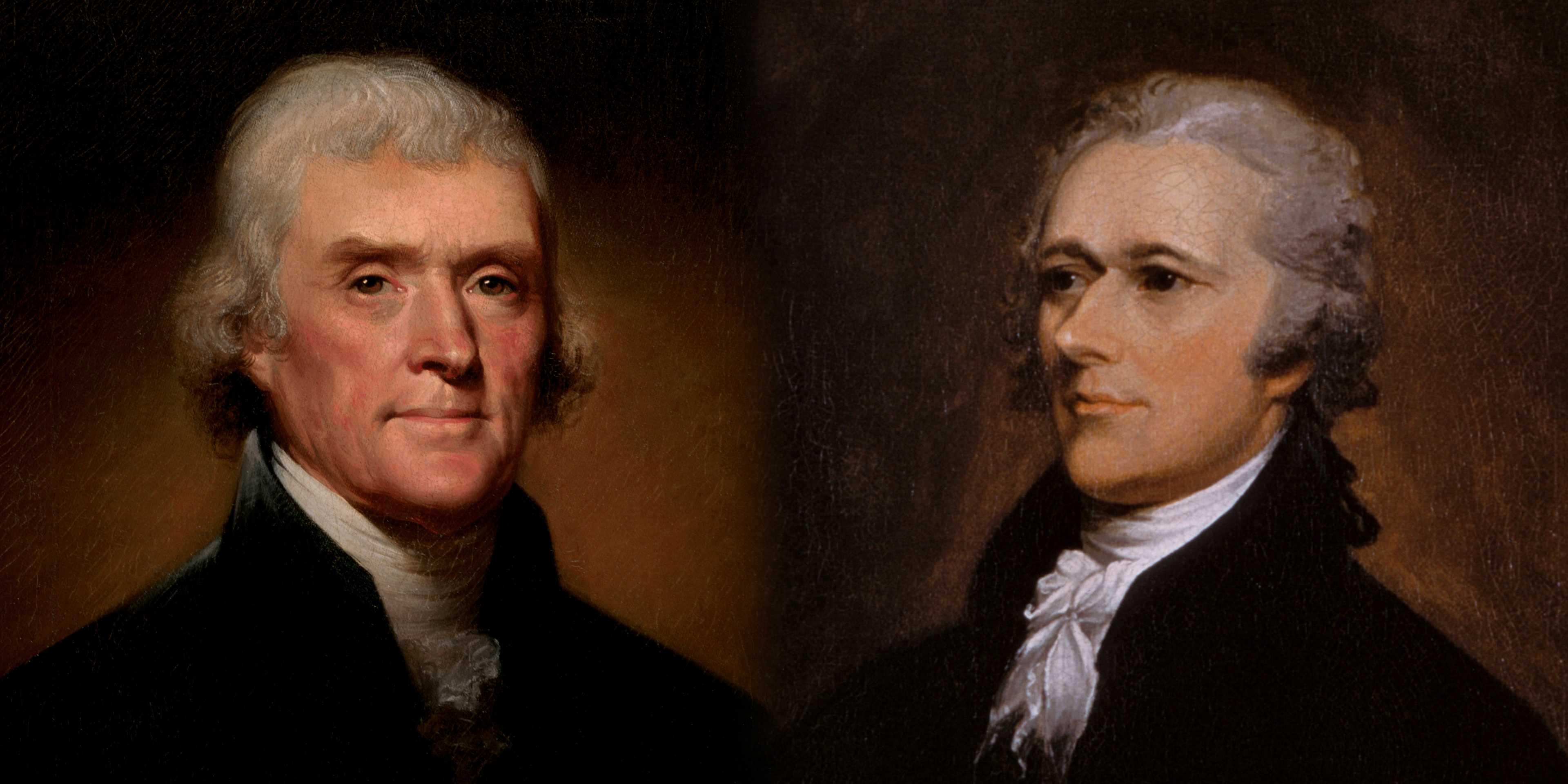
The early years of the United States were characterized by a monumental intellectual and political battle between two towering figures of the American founding: Alexander Hamilton and Thomas Jefferson. As President George Washington’s closest advisors, these two visionary thinkers held diametrically opposed views on what the young republic should become. While Hamilton envisioned an urban, commercial powerhouse with a strong central government and a robust national financial system, Jefferson championed an agrarian paradise of self-sufficient farmers, decentralized state authority, and a strict adherence to individual liberty. This philosophical struggle was not merely an academic exercise; it laid the foundation for the American political party system and continues to define the nation’s identity to this day. To understand the trajectory of modern America, one must examine how these competing principles clashed, cooperated, and ultimately merged to form the United States we know today.
Historical Background: The Post-Revolutionary Crucible
In the late 18th century, following the ratification of the U.S. Constitution in 1788, the infant United States faced an existential crisis of identity. Under the previous Articles of Confederation, the national government had been virtually powerless, unable to levy taxes, pay off war debts, or regulate commerce. This weakness prompted the Constitutional Convention, where delegates wrestled with the fundamental question of sovereignty. Our modern understanding of how the Founding Fathers divided power between states and federal governments is deeply rooted in this transition. In 1789, George Washington took office as the nation’s first president. To guide the country, he appointed Alexander Hamilton as the first Secretary of the Treasury and Thomas Jefferson as the first Secretary of State. Instantly, the stage was set for a titanic conflict of ideas that would shape the nation’s administrative structure.
The Combatants: Profiles in Contrast
Alexander Hamilton: The Visionary Architect
Alexander Hamilton was born in the West Indies, a self-made man of modest origins who rose to prominence through sheer intellect, administrative brilliance, and bravery during the Revolutionary War. Hamilton believed that the United States must establish a strong national credit, foster manufacturing, and build an “energetic” federal government capable of defending the homeland, maintaining order, and commanding respect abroad. He was a central figure among the 5 Founding Fathers whose finances shaped the American Revolution and its immediate aftermath, advocating for a federal system that would bind the financial interests of wealthy citizens directly to the survival of the national government.
Thomas Jefferson: The Agrarian Philosopher
Thomas Jefferson, conversely, was a wealthy Virginian aristocrat, an intellectual, and the primary author of the Declaration of Independence. Despite his elite status, Jefferson possessed a deep faith in the common agrarian worker and small landowner. He believed that democracy flourished best when power was kept close to the local level. Jefferson feared that central banks, industrialization, and urban centers would breed corruption, financial dependency, and the erosion of republican virtue. To Jefferson, a strong central government was a potential engine of tyranny, reminiscent of the British monarchy they had just fought to overthrow.
Timeline of the Great Ideological Battle
- 1789: President George Washington forms his cabinet, bringing Hamilton and Jefferson into direct administrative contact, prompting immediate policy clashes.
- 1790: The Compromise of 1790 occurs during a dinner party, where Hamilton secures the federal assumption of state Revolutionary War debts in exchange for locating the permanent national capital in the South.
- 1791: The establishment of the First Bank of the United States, sparking a fierce constitutional debate over “implied powers” versus “strict construction” of the Constitution.
- 1798: The passage of the Alien and Sedition Acts under Federalist President John Adams, which criminalized certain types of political dissent and prompted Jefferson to draft the Kentucky and Virginia Resolutions.
- 1800: The pivotal election of 1800, which Jefferson dubbed the “Revolution of 1800,” leading to the decline and eventual collapse of Hamilton’s Federalist Party.
Major Turning Points and Their Sociopolitical Impact
The rivalry between Hamilton and Jefferson was marked by several turning points that altered the course of American history. The first major clash occurred over Hamilton’s financial plan. To establish national credit, Hamilton proposed that the federal government assume the remaining state war debts. Southern states, which had largely paid off their debts, resisted. This deadlock was broken by the Compromise of 1790, a backroom deal where Jefferson and James Madison agreed to support assumption in exchange for moving the national capital to a Southern district on the Potomac River. Another crucial turning point was the debate over the First Bank of the United States. Hamilton argued that the “necessary and proper” clause of the Constitution gave Congress the implied power to charter a bank. Jefferson argued for strict construction, stating that because the Constitution did not explicitly authorize a bank, the power belonged to the states. This debate defined constitutional interpretation for centuries. Despite their deep-seated animosity, their paths crossed dramatically during the tie vote in the House of Representatives during the election of 1800. Hamilton ultimately supported Jefferson over Aaron Burr, viewing Jefferson as a man of character despite their ideological differences. Decades later, the bitter political rivalries of the era would culminate in tragic personal conflicts, such as what happened to Aaron Burr after he killed Alexander Hamilton in a duel.

Whose Vision Won Out? The Modern Synthesis
So, whose vision ultimately won? The answer is both. Economically and institutionally, we live in Hamilton’s America. The United States is a global financial superpower, defined by a massive centralized banking system (the Federal Reserve), an industrial and technological economy, and a strong federal military. Hamilton’s concept of a “continental” national identity succeeded in binding the states together, a bond that was tested and preserved during the American Civil War. Politically and culturally, however, we live in Jefferson’s America. The nation’s cultural DNA is deeply skeptical of centralized authority, intensely protective of individual liberties, and committed to democratic participation. Jefferson’s Louisiana Purchase in 1803 doubled the size of the nation, laying the groundwork for a transcontinental republic. Furthermore, his promotion of decentralized public education and separation of church and state remains foundational to American civic life.
Lesser-Known Historical Facts
- The Academic Revolution: Jefferson considered his founding of the University of Virginia in 1825 to be one of his greatest achievements. He pioneered modern university curricula by allowing students to choose elective subjects and introducing essay-style exams rather than memorized recitations.
- Hamilton’s Continental Identity: At a time when citizens identified primarily with their home states, Hamilton urged his countrymen to “think continentally” and consider themselves Americans first.
- The Dozen Canons of Conduct: Throughout his life, Jefferson maintained a personal philosophical guide called the “Dozen Canons of Conduct in Life,” which he famously sent to his granddaughter, Cornelia Jefferson Randolph, to encourage personal discipline.
Why the Debate Matters Today
The philosophical division between Hamilton and Jefferson is not a dusty relic of the 18th century; it is the living DNA of American political discourse. Every modern debate over the size of the federal government, the scope of executive orders, the regulation of the economy, or the division of power between states and Washington, D.C., is a direct continuation of their original arguments. The gridlock in contemporary Washington is a modern manifestation of this foundational tension, demonstrating that the struggle to balance centralized efficiency with decentralized liberty remains the central challenge of the American experiment.
People Also Ask
Who was more influential, Hamilton or Jefferson?
Both figures were highly influential in different ways. Hamilton created the financial, industrial, and institutional machinery of the United States, while Jefferson defined the democratic spirit, individual liberty ideals, and territorial expansion of the country.
What was the main difference between Hamilton and Jefferson’s economic views?
Hamilton favored an industrial, commercial economy supported by a strong central banking system, tariffs to protect manufacturing, and national credit. Jefferson championed a decentralized, agrarian economy focused on independent, self-sufficient farmers.
How did George Washington handle the rivalry between Hamilton and Jefferson?
Washington acted as a mediator, valuing both perspectives. He attempted to maintain balance in his cabinet, though he ultimately leaned toward Hamilton’s economic policies to establish national stability.
Conclusion
The legendary battle of wills between Alexander Hamilton and Thomas Jefferson did not tear the young United States apart; instead, it forged a resilient, dynamic system of checks and balances. Hamilton gave America its physical power, and Jefferson gave America its democratic soul. By understanding this dual inheritance, we gain a deeper appreciation of the complex, ongoing experiment that is the United States of America.


