The life of Benjamin Franklin stands as a brilliant testament to the spirit of American ingenuity, diplomacy, and revolutionary change. Born into humble circumstances in colonial Boston, Franklin would go on to shape almost every major chapter of the early American narrative, from the scientific discoveries of the Enlightenment to the creation of a brand-new, sovereign republic. As a printer, inventor, scientist, writer, and diplomat, he became the ultimate self-made man—an archetype that would define the American dream for centuries to come. His unique capability to bridge the gap between British imperial administration and colonial rebellion made him the indispensable architect of American independence, securing critical foreign alliances and helping draft the foundational documents of the United States. To truly understand the birth of America, one must explore the sprawling, colorful, and deeply impactful life of this premier American polymath.
Historical Background: The Polymath of Philadelphia
Benjamin Franklin’s story began on January 17, 1706, in a modest house on Milk Street in Boston, Massachusetts. As the fifteenth of seventeen children born to soap and candle maker Josiah Franklin, Benjamin was never destined for an easy path to wealth or prominence. Apprenticed to his brother James at a young age to learn the printing trade, the young Franklin quickly discovered his passion for writing and public discourse. Frustrated by his brother’s harsh treatment, a seventeen-year-old Franklin fled Boston in 1723, arriving in Philadelphia with virtually nothing to his name.
Through sheer work ethic, intellect, and entrepreneurial skill, Franklin established his own printing shop, publishing the highly successful Pennsylvania Gazette and the legendary annual Poor Richard’s Almanack. He used his platform not only to build financial security but also to pioneer civic improvements in Philadelphia, creating the city’s first subscription library, volunteer fire department, hospital, and academy (which later became the University of Pennsylvania). During this era, Franklin was still a loyal subject of the British Crown, but as tensions rose, he recognized the necessity of colonial unity. He famously designed the “Join, or Die” cartoon, illustrating how Benjamin Franklin’s viral political cartoon united the 13 colonies under a shared defensive banner during the French and Indian War.
A Chronological Timeline of Franklin’s Epic Journey
To understand how Benjamin Franklin transitioned from a humble printer to a global statesman, we must look at the pivotal years that marked his lifetime:
- 1706: Born in Boston, Massachusetts.
- 1723: Runs away to Philadelphia, starting a new life in the printing industry.
- 1751: Publishes his ground-breaking scientific work, Experiments and Observations on Electricity.
- 1754: Represents Pennsylvania at the Albany Congress and proposes the Albany Plan of Union.
- 1757–1775: Lives primarily in London, acting as a colonial agent and trying desperately to mend relations between Great Britain and the American colonies.
- 1774: Face-to-face humiliation in the British Parliament’s “Cockpit,” which destroys his hope for reconciliation and turns him into an active revolutionary.
- 1776: Returns to America, helps draft, and signs the Declaration of Independence.
- 1778: Successfully negotiates the Treaty of Alliance with France, securing French military and financial support for the Revolutionary War.
- 1783: Signs the Treaty of Paris, officially ending the Revolutionary War and securing British recognition of American independence.
- 1787: Serves as the elder statesman at the Constitutional Convention, signing the newly drafted U.S. Constitution.
- 1790: Dies in Philadelphia at the age of 84, leaving behind a legacy that would shape the nation permanently.
Catalysts of Revolution: Boston Massacre, Taxes, and the Continental Congress
While Benjamin Franklin was working in London to ease the growing friction between the colonies and the British Crown, events on the ground in America were reaching a boiling point. The British government, seeking to pay off massive debts from the Seven Years’ War, imposed a series of unpopular taxes on the colonies without granting them representation in Parliament. The tension erupted into outright violence on March 5, 1770, on the snowy streets of Boston.
A crowd of angry colonists confronted a squad of British soldiers, throwing snowballs, ice, and oyster shells. In the chaos, the soldiers fired into the crowd, killing five men. Among them was Crispus Attucks, a sailor of African and Indigenous heritage who was at the forefront of the protest. Today, we remember the details and the tragic legacy of the first casualty of the American Revolution through 8 things we know about Crispus Attucks. This event, dubbed the Boston Massacre, served as a powerful propaganda tool for colonial leaders like Samuel Adams, demonstrating that British rule was becoming increasingly tyrannical.
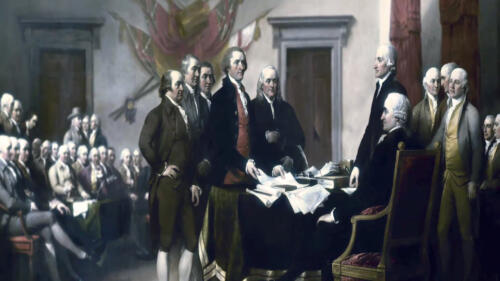
Back in Philadelphia, these escalating crises eventually forced colonial leaders to assemble. The Second Continental Congress met to determine how to respond to British military aggression. Though many delegates initially feared the consequences of an all-out war with the world’s greatest empire, the persistent denial of colonial rights drove them to create the revolutionary Declaration of Independence in July 1776. Franklin was one of the key members of the Committee of Five tasked with drafting the document, adding his editorial wit and wisdom to Thomas Jefferson’s powerful prose.
Key Figures and Collaborators in the Birth of a Nation
Benjamin Franklin did not build America alone. He worked alongside a diverse cast of visionaries, each contributing unique strengths to the revolutionary cause:
- Alexander Hamilton: While Franklin was securing alliances abroad, Hamilton was rising from a military aide-de-camp to George Washington to become the architect of the U.S. financial system. Hamilton introduced the national bank, a unified national mint, and a structured system of public credit. Understanding his foundational financial role is easier when you discover 5 things you may not know about Alexander Hamilton.
- George Washington: The stoic military commander who held the Continental Army together through grueling winters and tactical retreats, providing the physical shield behind which Franklin’s diplomacy and Jefferson’s words could take root.
- Thomas Jefferson: The primary author of the Declaration of Independence, whose eloquent theories on natural rights and individual liberty were refined by Franklin’s pragmatic edits.
Major Turning Points in Franklin’s Life
Two major turning points transformed Benjamin Franklin from a loyal British citizen into America’s most celebrated international diplomat. The first was the Hutchinson Letters Affair in 1774. Franklin obtained private letters written by Thomas Hutchinson, the royal governor of Massachusetts, which advocated for a severe restriction of colonial liberties. When Franklin leaked these letters to expose the governor’s duplicity, the British government was outraged. Franklin was summoned to the “Cockpit” in London, where he was publicly berated and insulted for nearly an hour by the Solicitor General. This humiliation solidified Franklin’s belief that British ruling elites would never treat colonists as equals, making revolution inevitable.
The second turning point was his diplomatic mission to France in 1776. Armed with his international fame as a scientist, Franklin arrived in Paris wearing a simple coonskin cap to play into the French romance of “natural, virtuous Americans.” Through his charm, social maneuvering, and strategic intellect, he negotiated the historic 1778 Treaty of Alliance. French troops, naval vessels, and financial loans flowed to the American cause, culminating in the British surrender at Yorktown in 1781.
Long-Term Impact on America and the World
Benjamin Franklin’s legacy has had a profound, structural, and cultural impact on the United States. He is the only Founding Father to have signed all four key documents that established the United States: the Declaration of Independence, the Treaty of Alliance with France, the Treaty of Paris, and the United States Constitution. Politically, his calls for unity laid the groundwork for federalism, demonstrating how disparate states could retain local control while uniting under a strong central authority.
Socially, Franklin popularized the concept of social mobility. He proved that an individual’s worth was determined by their utility, intelligence, and hard work rather than their noble birth. Culturally, his dedication to public service established a long-standing American tradition of community-driven philanthropy, civic engagement, and scientific innovation aimed at improving everyday human life.
Lesser-Known Facts About Benjamin Franklin
Beyond his legendary status as a statesman, Franklin was a man of immense humor and eccentricities. Here are a few fascinating anecdotes about his life:
- He Wrote Under Female Pseudonyms: As a teenager in Boston, Franklin was denied the chance to write for his brother’s newspaper. Undeterred, he adopted the persona of Silence Dogood, a middle-aged widow, slipping satirical letters under the print shop door that quickly became a local sensation.
- He Invented a Musical Instrument: Fascinated by the sound of singing wine glasses, Franklin invented the glass armonica in 1761. It became highly popular in Europe, and legendary composers like Mozart and Beethoven wrote music specifically for it.
- He Believed in “Air Baths”: Franklin was an early advocate for physical fitness and personal hygiene, though his methods were unusual. He frequently sat naked in his chambers with the windows wide open, reading and writing, believing that cold air circulating over the skin prevented diseases.
Why Benjamin Franklin Still Matters Today
In the twenty-first century, Benjamin Franklin remains a remarkably modern figure. His balance of scientific inquiry, practical problem-solving, and diplomatic compromise represents the very best of the American spirit. In an era of deep political division, Franklin’s ability to foster unity and compromise during the Constitutional Convention serves as an essential historical blueprint. He reminds us that democracy is a continuous experiment—one that requires active participation, civil discourse, and a dedication to the common good.
People Also Ask
Why did Benjamin Franklin never run for President of the United States?
By the time the U.S. Constitution was ratified and the first presidential election was held in 1789, Benjamin Franklin was 83 years old and suffering from severe health issues, including gout. He passed away only a year later, in April 1790. Furthermore, Franklin preferred collaborative legislative and diplomatic roles rather than executive ones.
What are some of Benjamin Franklin’s most famous inventions?
Franklin was a prolific inventor who refused to patent any of his creations, believing they should be shared freely for the benefit of humanity. His most famous inventions include the lightning rod, bifocal eyeglasses, the Franklin stove, the glass armonica, and a flexible urinary catheter.
Did Benjamin Franklin own slaves?
Early in his life, Franklin did own household slaves and even published advertisements for slave sales in his newspaper. However, his views evolved significantly over time. In his later years, he became an ardent abolitionist, eventually serving as the president of the Pennsylvania Society for Promoting the Abolition of Slavery and petitioning Congress to end the slave trade.
Conclusion
From a penniless runaway to an international icon of liberty, the eventful life of Benjamin Franklin encapsulates the journey of America itself. He was a man of the Enlightenment who utilized science, literature, and political philosophy to build a more equitable and free world. As we reflect on his enduring contributions, we see a legacy written not just on parchment, but in the very fabric of American civic life, reminding us that the pursuit of knowledge and the service of others are the truest measures of greatness.


