On the foggy autumn morning of October 4, 1777, the fate of the American Revolution hung in a delicate balance. Just weeks after losing the de facto capital of Philadelphia, the embattled General George Washington took a daring gamble that would define his military career and test the mettle of his newly formed army. The Battle of Germantown was not merely another military clash; it was an audacious counter-offensive designed to strike a decisive, crushing blow against the victorious British forces under General Sir William Howe. Although the engagement ended in a frustrating tactical retreat for the Continentals, its strategic fallout reverberated across the Atlantic, catching the attention of European superpowers and showing that the American rebellion was far from dead. Understanding this chaotic, smoke-filled battle reveals the incredible resilience of a revolutionary force that was rapidly learning how to stand against the most powerful empire in the world.
Historical Background: The Philadelphia Campaign of 1777
To understand the sheer audacity of the Battle of Germantown, one must examine the grueling events of the 1777 Philadelphia Campaign. Throughout the early years of the conflict, the British command sought to sever the rebellion by capturing major strategic hubs across the original 13 colonies. By July 1777, British General William Howe embarked on a highly calculated, roundabout maritime expedition from New York. Rather than sailing up the heavily fortified Delaware River, Howe transported his massive force of some 15,000 soldiers by sea, navigating the Chesapeake Bay to land at Elkton, Maryland. From there, he began a relentless overland march toward Philadelphia, the seat of the Continental Congress.
General George Washington, fully aware of the threat to the capital, attempted to block Howe’s path. On September 11, 1777, the two forces met at the Battle of Brandywine. Outmaneuvered by a brilliant British flank attack, Washington’s forces were forced to retreat, suffering heavy casualties. Following a subsequent disaster at the Battle of Paoli—where a night raid by British troops decimated an American division—Howe successfully entered Philadelphia on September 26, 1777. The Continental Congress was forced to flee into the Pennsylvania countryside. Geographically, these historical clashes unfolded across lands deeply rooted in indigenous heritage, historically stewarded by the Lenni Lenape people, whose ancient networks of trails and river routes inadvertently shaped the very paths utilized by both armies during the conflict.
The Catalyst: Why Washington Planned the Germantown Assault
While the loss of Philadelphia was a severe psychological blow, Washington realized that General Howe’s triumph had also made the British vulnerable. Because the British did not yet control the Delaware River—which was blocked by American forts like Fort Mifflin and Fort Mercer—Howe could not easily supply his army in the city by sea. Consequently, he had to divide his forces. Howe posted a large garrison of roughly 9,000 soldiers in the rural community of Germantown, a sprawling five-mile-long hamlet of stone houses north of Philadelphia, while keeping the rest in the city itself.
Washington saw a golden opportunity. If he could launch a sudden, coordinated strike, he might isolate and destroy the Germantown garrison, potentially forcing the British to abandon Philadelphia altogether. Washington’s decision-making during this period highlights his evolving authority as Commander-in-Chief. In discussing his military stewardship, modern historians often look back to the early organization of the rebellion and ask who commanded the Continental Army before Washington took the reins, noting that Washington had to rapidly transition a ragtag coalition of regional militias into a unified, disciplined national fighting force capable of executing sophisticated grand strategies.
A Chronological Timeline of the 1777 Campaign
The campaign leading up to and immediately following the battle can be understood through this critical sequence of events:
- July 23, 1777: General William Howe’s fleet departs New York City, bound for the Chesapeake Bay.
- September 11, 1777: The Battle of Brandywine results in a costly tactical defeat for Washington, opening the road to Philadelphia.
- September 20, 1777: The Paoli Massacre inflicts heavy casualties on General Anthony Wayne’s division.
- September 26, 1777: British forces under Lord Charles Cornwallis triumphantly march into Philadelphia.
- October 3, 1777 (Night): Washington’s four columns begin an overnight march toward Germantown under the cover of darkness.
- October 4, 1777 (Dawn): The Battle of Germantown begins as American troops catch the British pickets by surprise.
- December 19, 1777: The Continental Army marches into winter quarters at Valley Forge, Pennsylvania, to begin months of intensive reorganization.
The Battle Plan: A Theoretical Exercise vs. Harsh Reality
Washington’s blueprint for the attack on Germantown was brilliantly conceived on paper but nearly impossible to execute in practice. Relying on absolute synchronization, Washington split his army into four separate columns that were to march down four distinct roads leading into Germantown. The goal was to launch a simultaneous, surprise attack at dawn from the front, rear, and flanks, completely enveloping the British army.
This incredibly complex plan would have challenged the most seasoned, professional European armies of the 18th century, let alone a force composed largely of raw recruits, poorly equipped regulars, and undisciplined local militias. Without modern communication tools, coordinating four distinct groups marching in the dead of night across miles of rough terrain was a logistical nightmare. This campaign vividly demonstrates how key regional centers and colonial towns shaped the course of U.S. history, as their physical layouts, narrow streets, and sturdy stone structures dictated the chaotic nature of early American combat.
At dawn on October 4, the plan quickly began to unravel. The outer flanking columns, made up primarily of militia, failed to arrive on time or engage the enemy effectively. However, the center-right column, led by General John Sullivan, moved forward with incredible spirit, catching the British outpost at Mount Airy completely by surprise. Utilizing bayonets, Sullivan’s men drove back the British light infantry, sparking panic in the Redcoat camps.
Major Turning Points: The Fog of War and the Standoff at Cliveden
As the battle intensified, two major factors combined to turn an imminent American victory into a disastrous retreat: a dense autumn fog and a stubborn British defense at a stone mansion named Cliveden.
The Siege of Cliveden (The Chew House)
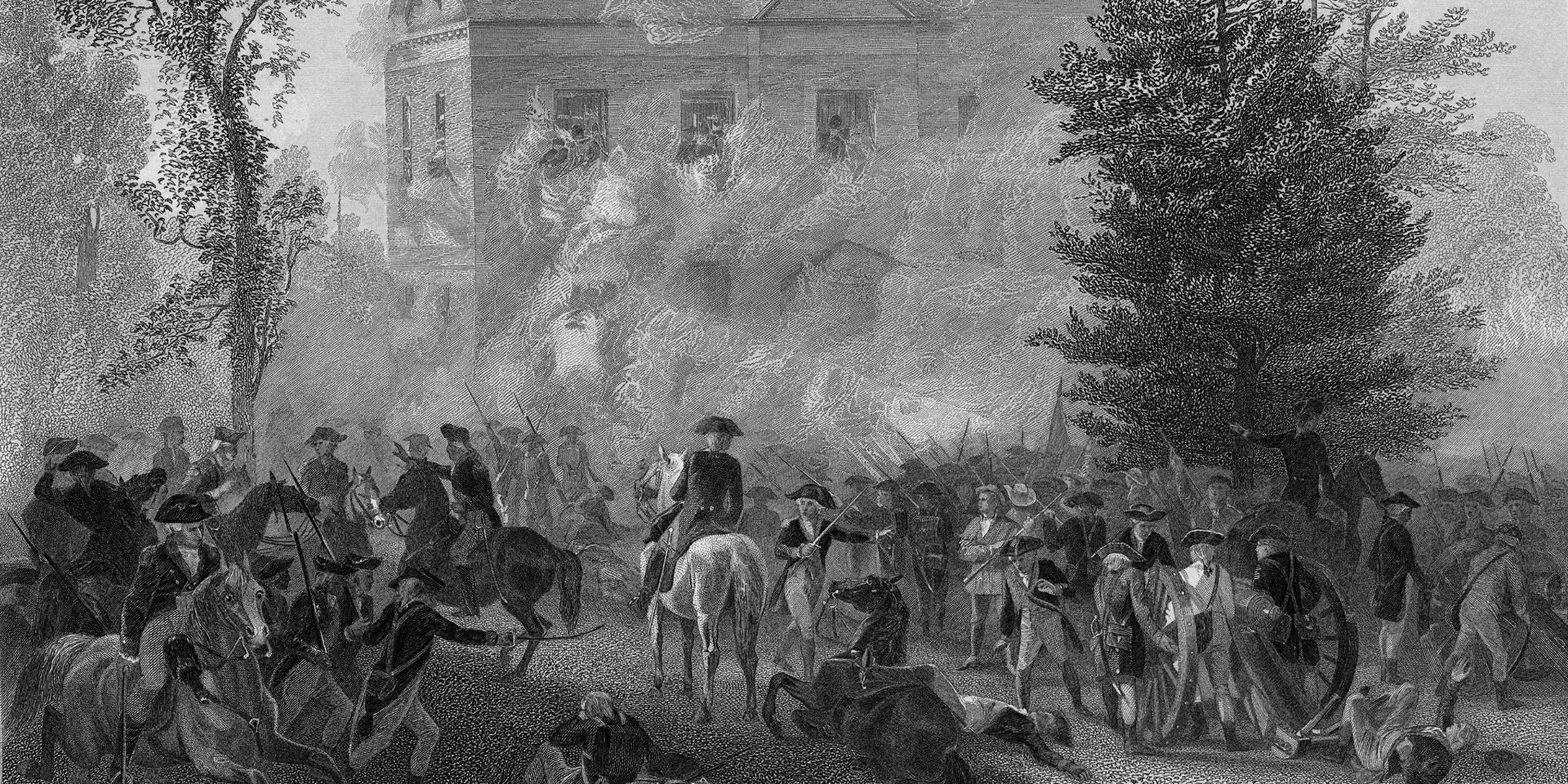
During the initial British retreat, Colonel Thomas Musgrave and approximately 120 soldiers of the British 40th Regiment of Foot found themselves cut off from their main body. Demonstrating tactical ingenuity, Musgrave barricaded his men inside Cliveden, the grand, two-story stone summer home of Pennsylvania Chief Justice Benjamin Chew. The house, constructed with thick, solid stone walls, was virtually impervious to small arms fire.
As Washington’s main force advanced, they encountered this fortified stronghold. Rather than bypassing the mansion and maintaining their forward momentum, Washington’s generals debated their next move. General Henry Knox, the Continental artillery commander, argued vehemently that it was a military sin to leave an active enemy garrison in their rear. Over the objections of other officers who urged bypassing the house, Washington ordered an assault on Cliveden. For over an hour, American infantry and artillery pounded the mansion, launching multiple futile infantry charges. The sturdy stone walls held, and the delay stalled the crucial momentum of the American advance, allowing General Howe time to reorganize his defenses.
Tragedy in the Dense Fog
While the battle raged around Cliveden, a thick blanket of morning fog, heavily compounded by the dense black powder smoke from thousands of muskets and cannons, settled over the battlefield. Visibility dropped to near zero. General Nathanael Greene’s column, which had a longer distance to travel and had started late, finally arrived on the field and began pushing deep into the British right flank.
In the blindness of the fog, Sullivan’s column, which had begun to fall back due to a lack of ammunition, stumbled directly into the path of Greene’s advancing division. Unable to see each other’s uniforms and hearing heavy firing, the two American columns mistook one another for the enemy. A tragic exchange of “friendly fire” broke out. The chaos was worsened by the behavior of General Adam Stephen, who was later found to have been heavily intoxicated during the march, leading his men blindly into the fray. The sudden panic and confusion broke the morale of the Continental soldiers, who believed they were being surrounded. Sensing the shift, the British launched a fierce, coordinated counter-attack, driving the fractured American columns from the field in a disorganized retreat.
Lesser-Known Facts of the Battle of Germantown
Beneath the grand narrative of military maneuvers lie several fascinating, humanizing, and surprising historical anecdotes:
- The Gentlemanly Return of General Howe’s Dog: In the chaotic aftermath of the battle, American soldiers found a lost, disoriented fox terrier wandering behind their lines. The dog’s brass collar bore the name of British General William Howe. While some soldiers wanted to keep the pet as a trophy, General George Washington—a lifelong dog lover and breeder—ordered the dog fed, cleaned, and returned directly to Howe under a flag of truce. Washington sent a polite note written by his young aide-de-camp, Alexander Hamilton, reading: “General Washington’s compliments to General Howe. He does himself the pleasure to return to him a dog, which accidentally fell into his hands…” Howe was deeply moved by this honorable, civilized gesture.
- The Court-Martial of a Drunken General: General Adam Stephen, whose division accidentally fired upon their fellow Americans in the fog, was court-martialed following the battle. Found guilty of “unofficerlike behavior” and being drunk during the action, he was dismissed from the Continental Army in disgrace. His vacant command was subsequently given to a young, eager French volunteer: the Marquis de Lafayette.
- A Cradle of Early Anti-Slavery Activism: Long before it became a bloody Revolutionary battlefield, Germantown was a hub of progressive thought. In 1688, German Quaker and Mennonite settlers in Germantown drafted and signed the first written protest against slavery in the American colonies, a historic precursor to the abolitionist movement that would shape the nation centuries later.
The Strategic Fallout and Long-Term Impact on America
On paper, the Battle of Germantown was an undeniable defeat. The Continental Army suffered roughly 1,000 casualties (killed, wounded, and captured), while the British suffered only about 500. It marked the second major loss for Washington in less than a month, prompting vocal critics in Congress and the military to suggest replacing Washington with General Horatio Gates, who had recently secured a stunning victory at Saratoga.
However, the strategic impact of Germantown was overwhelmingly positive for the American cause. In Europe, political observers and military strategists were astonished by Washington’s audacity. The French Foreign Minister, the Count de Vergennes, was profoundly impressed that an army of “raw recruits,” having just suffered a major defeat at Brandywine and losing their capital, could mount such a sophisticated and aggressive offensive just weeks later. This demonstration of American resilience and offensive capability, combined with the victory at Saratoga, convinced King Louis XVI of France to formally enter the war as an American ally, providing the vital naval, financial, and military support that ultimately won the war.
Furthermore, the battle proved to the Continental soldiers themselves that they could stand toe-to-toe with British regulars. Following the battle, the army retired to its winter quarters at Valley Forge. There, under the rigorous training of Prussian General Baron von Steuben, the lessons of Germantown were forged into professional discipline, transforming the Continental Army into a highly skilled, elite force.
Why the Battle of Germantown Still Matters Today
Today, the Battle of Germantown stands as a powerful testament to the value of resilience in the face of adversity. It reminds us that victory is not always defined by a simple win-loss record on a battlefield, but by the strategic determination to keep fighting against overwhelming odds. The historic mansion of Cliveden still stands in Philadelphia, serving as a national historic landmark. In recent years, public historians at Cliveden have worked diligently to present a more complete, inclusive history, exploring both the famous military battle and the complex history of the Chew family’s involvement with slavery, reflecting our modern commitment to understanding the full, multifaceted truth of the American story.
People Also Ask (FAQs)
Who won the Battle of Germantown?
The British Army, led by General Sir William Howe, won the Battle of Germantown. They successfully repulsed the American attack and forced General George Washington’s Continental Army to retreat, inflicting twice as many casualties as they suffered.
Why did the Americans lose at Germantown?
The Americans lost primarily due to a highly complex, four-pronged battle plan that was too difficult to coordinate in a dense morning fog. This led to a tragic friendly-fire incident between two American columns. Additionally, the momentum of the attack was stalled when American forces stopped to launch a futile siege on the heavily fortified stone Chew House (Cliveden).
What was the significance of the Chew House during the battle?
The Chew House, or Cliveden, served as a makeshift fortress for 120 British soldiers who barricaded themselves inside. Instead of bypassing the house, Washington’s forces spent valuable time and resources trying to capture it, stalling the main American advance and giving the British army time to regroup and counter-attack.
How did the Battle of Germantown affect the French Alliance?
Despite being an American defeat, the battle showed European observers that the Continental Army had the courage and organization to launch a massive, surprise counter-offensive. This impressive display of determination, combined with the victory at Saratoga, convinced France to officially ally with the United States in 1778.
Conclusion
The Battle of Germantown remains one of the most intriguing and pivotal chapters of the American Revolutionary War. It showcased both the tactical limitations of an inexperienced army and the strategic brilliance of a commander willing to take massive risks for the cause of liberty. Though the fields of Germantown were shrouded in fog and stained with the blood of patriots, the spirit shown by Washington’s men on October 4, 1777, proved that the dream of American independence would not be easily extinguished. From the tactical lessons forged in the fire of defeat to the securing of the French alliance, Germantown paved the way for the eventual triumph at Yorktown and the birth of a new nation.


