On the frigid dawn of January 17, 1781, a small, battle-weary force of Patriot soldiers stood in an open South Carolina pasture known as Hannah’s Cowpens. What occurred over the next sixty minutes would become one of the most celebrated and studied military engagements in global history. The Battle of Cowpens did not merely represent a desperate clash in the backcountry of the American South; it was a dazzling exhibition of tactical brilliance that completely derailed the British Crown’s “Southern Strategy.” Under the exceptional leadership of Brigadier General Daniel Morgan, a resilient coalition of Continental regulars and local militia executed a flawless “double envelopment” to rout the aggressive, feared British forces led by Lieutenant Colonel Banastre Tarleton. This decisive engagement dramatically turned the tide of the Southern Campaign and ultimately cleared the path to the final British surrender at Yorktown. By proving that American forces could outmaneuver and outfight British regulars in a conventional, open-field battle, Cowpens permanently revitalized the spirit of the 13 colonies in their grueling fight for independence.
The Road to Cowpens: Historical Background and Southern Campaign Context
By late 1780, the American Revolutionary War had reached a brutal stalemate in the northern theater. Seeking a decisive breakthrough, the British military command turned its focus toward the South. This shift, known as the Southern Strategy, was built on the premise that the Southern colonies possessed a massive, untapped population of Loyalists who would rise up to support the Crown if provided with sufficient military backing. At first, this strategy yielded terrifyingly effective results for the British, who captured Savannah in 1778, took Charleston in May 1780, and delivered a catastrophic defeat to Patriot forces at the Battle of Camden in August 1780.
Following these severe setbacks, General George Washington appointed Major General Nathanael Greene to take command of the devastated Southern Department of the Continental Army. Recognizing that his army was too small, poorly equipped, and hungry to face the formidable, larger force of British General Lord Charles Cornwallis in a direct confrontation, Greene made a highly unconventional, risky decision: he divided his army. Greene led one portion toward the east, while dispatching Brigadier General Daniel Morgan with roughly 600 men to the western backcountry of South Carolina. This division forced Cornwallis to split his own forces to prevent Morgan from attacking key British outposts or instigating a broad-based Patriot uprising among the rugged backcountry settlers. Examining the 13 colonies map and original states highlights just how vital South Carolina’s interior was to controlling the entire southern region.
The Combatants: Key Figures of the Battle
The clash at Cowpens was fundamentally a duel of wits, temperaments, and military philosophies between two contrasting commanders, alongside their key subordinates:
- Brigadier General Daniel Morgan (The “Old Waggoner”): A veteran of the French and Indian War and a legendary frontier rifleman, Morgan was a natural leader who deeply understood the psychology of his men. Nicknamed the “Old Waggoner” due to his early days driving supply wagons, Morgan was practical, highly respected by both regulars and militia, and possessed an innovative tactical mind.
- Lieutenant Colonel Banastre Tarleton (“Bloody Tarleton”): At just 26 years old, Tarleton was a dashing, aggressive, and highly feared commander of the British Legion. He was notorious for his ruthless, fast-moving cavalry charges and a refusal to grant quarter to surrendering Patriots—a reputation that earned him the hated moniker “Bloody Tarleton” and birthed the phrase “Tarleton’s Quarter” (meaning no mercy).
- Major General Nathanael Greene: Although not present at the battle, Greene’s strategic genius in dividing the Southern Army set the stage for Morgan’s triumph. (For context on how the Continental Army was structured and managed throughout the conflict, you can read about who commanded the Continental Army before Washington during the early phase of the Revolution).
- Lieutenant Colonel William Washington: A second cousin of George Washington, he commanded the highly effective Patriot light cavalry. His timely, hard-hitting charges during the battle proved essential in sealing the British defeat.
- Colonel Andrew Pickens: A respected leader of the South Carolina militia, Pickens was instrumental in organizing the local volunteer forces and ensuring they executed Morgan’s complex defense plan without breaking.
The Tactical Masterpiece: The Double Envelopment Explained
Morgan knew that Tarleton was hot on his heels and would attack aggressively without proper reconnaissance. Instead of fleeing across the Broad River, which could trigger a panic among his men, Morgan chose to stand and fight at a well-known pastureland called Hannah’s Cowpens. The battlefield consisted of an open, gently sloping forest with little underbrush—perfect for Tarleton’s cavalry, but also ideal for Morgan to orchestrate a meticulously planned trap.
To exploit Tarleton’s reckless aggression and overcome the historical tendency of raw militia to flee under bayonet charges, Morgan developed an extraordinarily creative defense-in-depth strategy structured in three distinct lines:
The First Line: The Skirmishers
Morgan placed 150 select, expert riflemen at the very front. Their explicit instructions were to hide behind trees, wait for the British to advance, and specifically target British officers. By neutralizing the leadership of the advancing lines early, Morgan aimed to throw the British ranks into confusion. After firing, they were to fall back orderly to the second line.
The Second Line: The Militia
Comprising approximately 300 militiamen under Colonel Andrew Pickens, this line was positioned slightly further up the slope. Morgan was highly realistic about the limitations of militia facing professional British bayonets. He famously told them, “Just give me two volleys, then you can fall back.” This realistic expectation eased their anxiety. After delivering their two concentrated volleys, the militia retreated around the American left flank to the rear, creating the convincing illusion of a chaotic retreat.
The Third Line: The Continentals and the Trap
The main force, consisting of around 450 hardened Continental regular soldiers under Maryland’s John Eager Howard, stood firm on the crest of the hill. When the British, believing they had easily broken the American lines, rushed forward in a disorganized charge, they ran directly into a devastating, disciplined wall of Continental fire. As the battle reached its climax, a misunderstood order caused the Continentals to make a controlled retreat. Seeing this, the British charged blindly forward. Howard quickly ordered his men to face about and fire a crushing volley at point-blank range, followed by a fierce bayonet charge.
Simultaneously, William Washington’s cavalry swept in from the right flank, while Pickens’ reformed militia, having looped around the hill, struck the British left flank. The British were completely surrounded in a textbook double envelopment—a maneuver so rare and difficult to execute that historians frequently compare it to Hannibal’s legendary victory over the Romans at Cannae in 216 B.C.
Timeline of the Battle of Cowpens (January 17, 1781)
The rapid, decisive engagement at Cowpens unfolded in less than an hour. Here is a chronological breakdown of how the battle progressed:
- 2:00 AM: Tarleton rouses his men from their camp and begins a grueling, five-hour march through mud and darkness toward Morgan’s reported position.
- Pre-Dawn: Morgan rouses his troops, encouraging them, checking their weapons, and explaining his three-line battle plan to ensure everyone knows their exact role.
- 6:45 AM: Tarleton’s advance guard arrives at Cowpens. Exhausted and hungry from their march, they are immediately ordered by Tarleton to form battle lines and attack without delay.
- 7:00 AM: The Patriot skirmishers open fire, picking off numerous British officers before seamlessly melting back into the second line.
- 7:15 AM: The British main line advances under artillery fire. Pickens’ militia delivers two highly destructive volleys before turning to retreat around the hill. Believing the Americans are routed, Tarleton orders a general charge.
- 7:30 AM: The British slam into the Continental third line. A miscommunication leads to a tactical retreat by the Continentals. However, they turn and fire a devastating volley at the disorganized British.
- 7:40 AM: Howard orders a bayonet charge. Simultaneously, William Washington’s cavalry and Pickens’ reformed militia strike the British flanks, completing the double envelopment.
- 7:50 AM: Overwhelmed, surrounded, and leaderless, the British forces surrender en masse. Tarleton attempts a desperate cavalry countercharge but is forced to flee the field with a small remnant of his men.
The Long-Term Impact and Revolutionary Significance
The Battle of Cowpens was a stunning, absolute tactical victory for the Patriot cause. Out of approximately 1,150 British soldiers engaged, over 110 were killed, 200 wounded, and more than 600 captured—essentially destroying Tarleton’s elite force. In contrast, Morgan’s forces suffered fewer than 100 casualties, with only about 25 killed.
The strategic ramifications of Cowpens were immediate and profound. It stripped Cornwallis of his highly flexible, elite light infantry and cavalry, leaving him strategically blind and vulnerable. Desperate to avenge the loss and reclaim his captured troops, Cornwallis pursued Greene and Morgan north into North Carolina in the famous “Race to the Dan.” This relentless pursuit exhausted the British army, leading directly to the pyrrhic British victory at Guilford Court House in March 1781. Badly battered and low on supplies, Cornwallis was forced to march his army to the Virginia coast to resupply, setting the stage for the Siege of Yorktown and the ultimate independence of the United States.
Fascinating and Lesser-Known Facts About Cowpens
- The Origin of “The Mighty Moo”: The memory of this battle lives on in the modern United States Navy. Two major warships have been named in honor of the battle: the USS Cowpens (CVL-25), an aircraft carrier that served valiantly in World War II, and the USS Cowpens (CG-63), a guided-missile cruiser commissioned in 1991. Both vessels adopted the proud, quirky nickname “The Mighty Moo.”
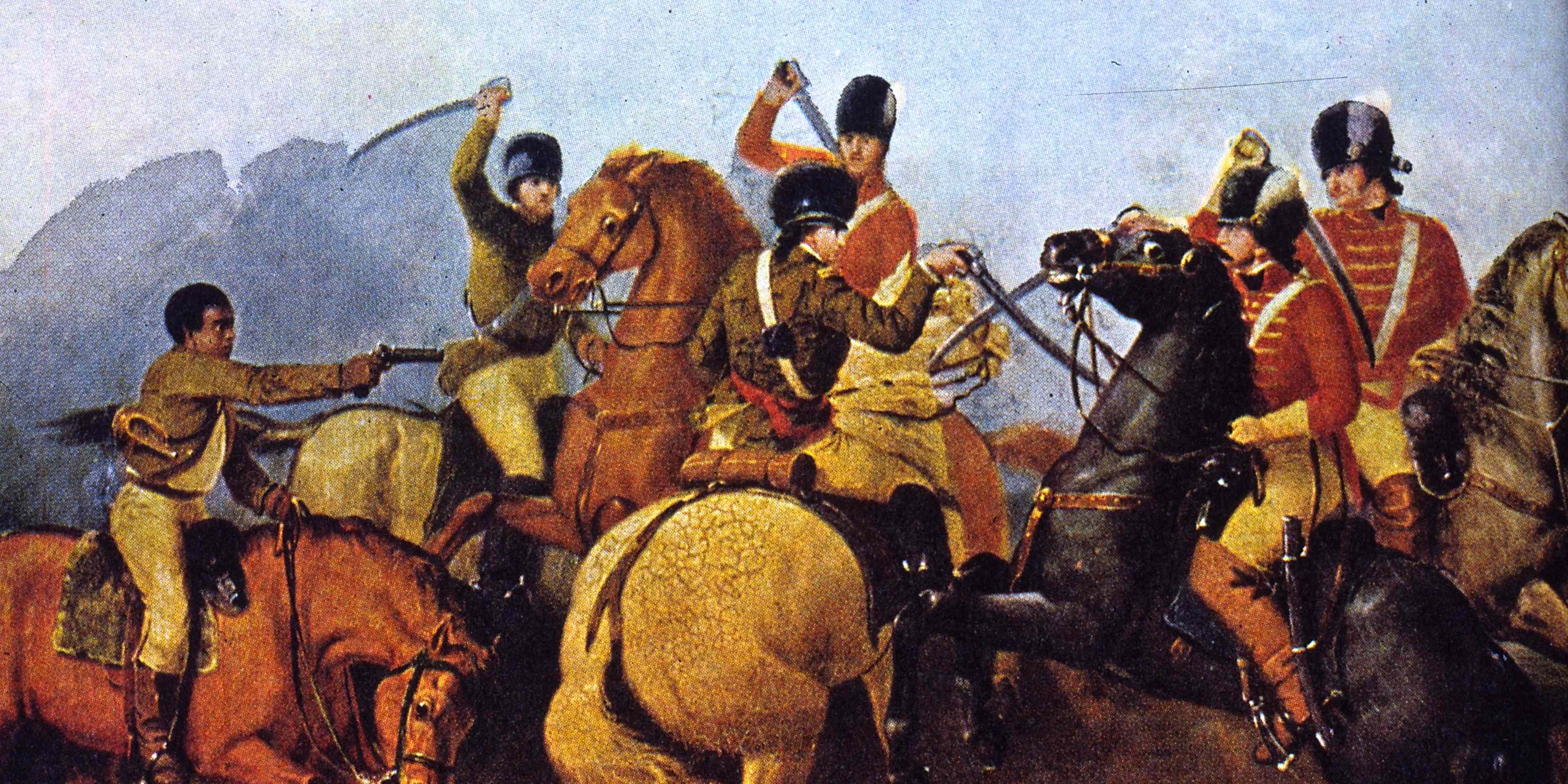
- A Legendary Duel: Near the end of the battle, Lieutenant Colonel William Washington engaged in a dramatic, hand-to-hand saber duel with Banastre Tarleton himself. Washington’s bugler boy shot a British officer who was about to strike Washington, and Tarleton managed to wound Washington’s horse before galloping away into the woods.
- The Power of Psychology: Daniel Morgan’s decision to back his men up near the Broad River was not an accident. He knew that if his militia had an easy escape route across the river, they might flee early in the fight. By removing the immediate option of retreat, he subtly forced his men to stand and fight together.
Why the Battle of Cowpens Still Matters Today
In modern military circles, the Battle of Cowpens is studied as a masterclass in tactical leadership and terrain utilization. It remains one of the finest examples of a successful double envelopment in modern history. More importantly, Cowpens serves as a timeless lesson in human leadership. Daniel Morgan did not try to force his militia to fight like regular soldiers; instead, he met them where they were, validated their fears, gave them achievable goals, and utilized their unique frontier strengths. In an era of immense political division and military setbacks, the triumph at Cowpens stands as a testament to the power of strategic ingenuity, psychological insight, and the enduring resilience of those who fight for self-determination.
People Also Ask
Who won the Battle of Cowpens?
The Battle of Cowpens was a decisive victory for the American Continental Army and Patriot militia, commanded by Brigadier General Daniel Morgan, who completely routed the British forces led by Lieutenant Colonel Banastre Tarleton.
Why was the Battle of Cowpens considered a turning point?
It was a major turning point because it destroyed the elite light infantry of Cornwallis’s Southern army, severely damaged British morale, and set off a chain of events that forced Cornwallis to march to Yorktown, where he was ultimately defeated.
What is a double envelopment?
A double envelopment is a classic military maneuver where an army simultaneously attacks both flanks of an enemy force, completely surrounding them. It is highly difficult to execute and was brilliantly achieved by Daniel Morgan at Cowpens.
Conclusion
The Battle of Cowpens remains a shining jewel in the history of the American Revolution. Through the combination of Nathanael Greene’s bold strategic vision, Daniel Morgan’s tactical genius, and the courage of both regular soldiers and backcountry militia, a seemingly invincible British force was decisively dismantled in under an hour. As we reflect on the birth of the United States, Cowpens stands as a brilliant reminder that victory is often achieved not through sheer numbers, but through intellectual flexibility, deep empathy for those we lead, and the unwavering pursuit of liberty.


