In the freezing, wind-whipped darkness of December 31, 1775, a desperate coalition of American revolutionaries stood on the precipice of an audacious dream: capturing the heavily fortified city of Quebec to secure Canada as the fourteenth colony in their fight against British tyranny. The Battle of Quebec 1775 stands as a monumental chapter in early United States history, representing the first major military defeat suffered by the newly established Continental Army. Spurred by the early adrenaline of the Revolutionary War, Patriot leaders hoped a decisive northern campaign would cripple British operations and permanently alter the geopolitical landscape of North America. Instead, the brutal assault resulted in catastrophic failure, the tragic death of one of America’s most promising generals, and the severe wounding of another who would later become the young nation’s most notorious traitor. Exploring the complex sociopolitical origins, harrowing winter campaigns, and desperate tactical maneuvers of this battle offers invaluable insight into how a fledgling rebellion tested its limits against the world’s most formidable empire.
The Grand Strategy: Why Invade Canada?
To understand why the young American Continental Army turned its sights toward the frozen north, one must examine the broader geopolitical landscape of late 1775. Following the initial bloodshed at Lexington, Concord, and Bunker Hill, the Second Continental Congress sought to preemptively dismantle British military options. General George Washington and his contemporary strategists recognized that British-controlled Canada served as a natural launching pad for counter-invasions down the Hudson River valley, which could easily bisect and conquer the newly formed 13 Colonies. Furthermore, many congressional delegates held the optimistic—and ultimately naive—belief that the French-Canadian population (known as Canadiens) was eagerly waiting for an opportunity to rise up against their British overlords. By extending the hand of revolutionary brotherhood and sending an armed expedition, Congress hoped to secure the St. Lawrence River, safeguard the northern frontier, and formally incorporate Canada into the united front against King George III.
The Two-Pronged Advance: Montgomery and Arnold’s Perilous Paths
The ambitious invasion of Canada was structured as a dramatic two-pronged pincer movement designed to converge on Quebec City. The western wing was commanded by Brigadier General Richard Montgomery, a highly capable Irish-born former British officer who had embraced the Patriot cause. Moving up the Lake Champlain corridor, Montgomery’s forces laid siege to Fort St. Jean before triumphantly capturing Montreal on November 13, 1775. From there, Montgomery’s victorious but increasingly exhausted men pushed downriver toward Quebec City.
Meanwhile, the eastern wing of the invasion embarked on what is universally regarded as one of the most grueling military marches in human history. Led by Colonel Benedict Arnold, a force of approximately 1,100 volunteers set off from Massachusetts through the uncharted, swampy wilderness of modern-day Maine. Believing the journey would span roughly 180 miles and take 20 days, Arnold’s men were tragically unprepared for the reality of the Maine wilderness. Severe floods, freezing rain, and poorly constructed wooden bateaux that leaked and ruined gunpowder plagued the expedition. Starvation quickly took hold; desperate soldiers resorted to boiling leather shoes, eating candle wax, and consuming hair powder to survive. By the time Arnold’s emaciated force finally emerged on the banks of the St. Lawrence River in mid-November, more than a third of his men had deserted or perished, leaving only 600 hollow-cheeked survivors fit for duty.
Key Events Timeline: The Road to the Snowstorm
To trace the rapid escalation and sudden collapse of the American Canadian campaign, the following chronological timeline outlines the pivotal milestones of late 1775 and early 1776:
- June 27, 1775: The Continental Congress formally authorizes the invasion of Canada, hoping to secure the northern borders.
- September 1775: General Montgomery’s forces begin their advance northward, while Colonel Arnold’s expedition plunges into the grueling Maine wilderness.
- November 13, 1775: Montgomery’s division successfully captures Montreal, forcing the British Governor, Sir Guy Carleton, to flee disguised as a civilian.
- November 14, 1775: Arnold’s survivors arrive at the Plains of Abraham outside Quebec City, demanding a surrender that is promptly refused.
- December 5, 1775: Montgomery and Arnold unite their forces outside Quebec City, initiating a cold and largely ineffective siege against the heavily fortified walls.
- December 31, 1775: Under the cover of a blinding blizzard, the combined American forces launch their desperate, pre-dawn assault on Quebec.
- May 1776: After months of maintaining a desperate winter blockade, the arrival of a massive British relief fleet forces the surviving American troops into a chaotic retreat.
The Storm of Battle: December 31, 1775
As December waned, the American commanders faced a ticking clock. The enlistment terms for many of their soldiers were set to expire at midnight on December 31, meaning that if they did not strike immediately, their army would literally melt away. Seizing on the tactical cover of a ferocious, blinding snowstorm in the early morning hours, Montgomery and Arnold initiated their coordinated assault on Quebec’s Lower Town.
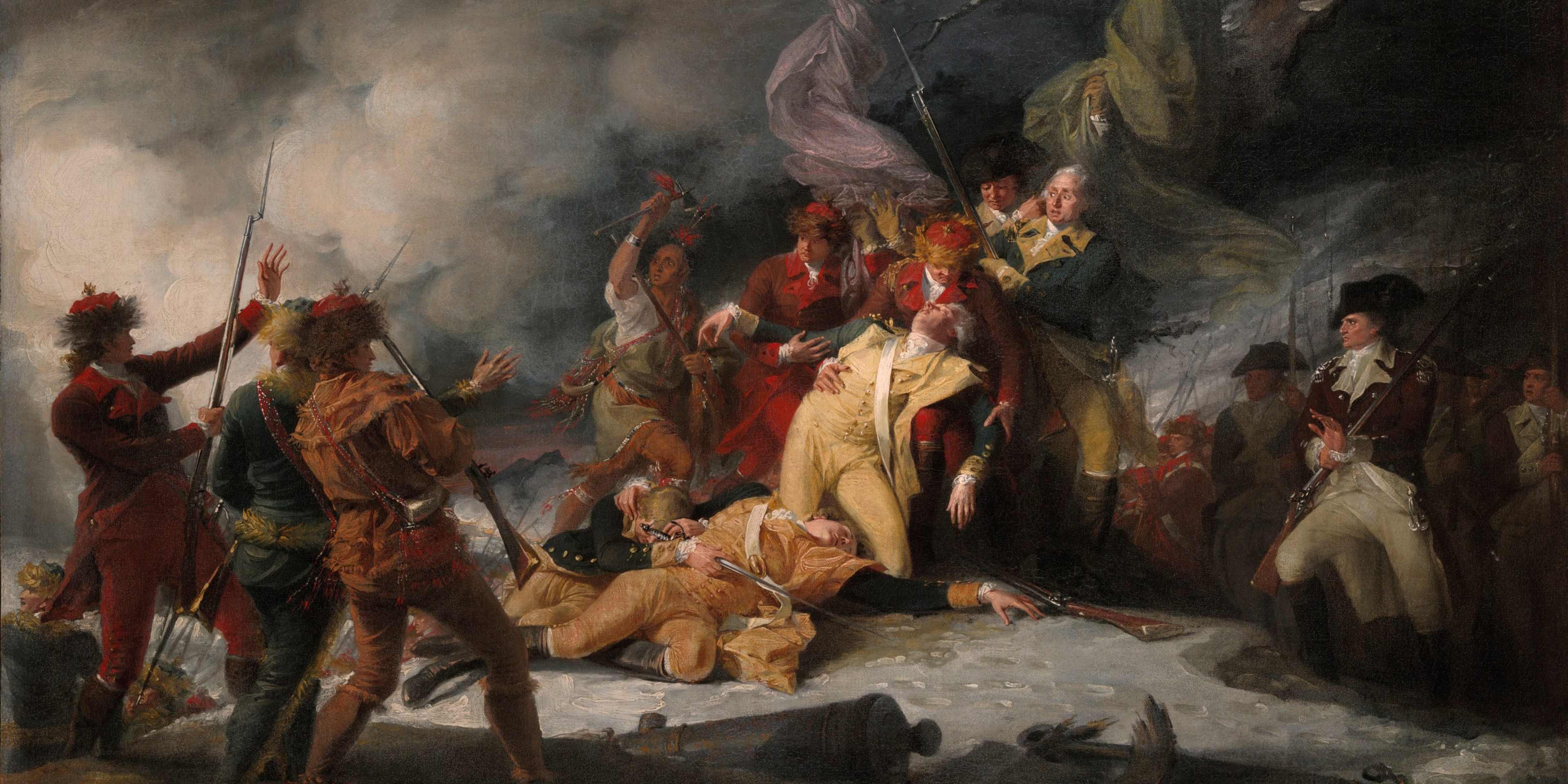
Montgomery led his column along the narrow, snowy path between the St. Lawrence River and the cliffs of Cape Diamond. As they approached the outer blockhouse, the British defenders, alerted by the noise, opened up a devastating barrage of grape shot and musket fire. General Montgomery was killed instantly in the initial volley, along with his top aides. Leaderless and terrified, the remaining officers ordered a hasty retreat, ending the southern thrust before it could even penetrate the city gates.
On the northern side of the city, Arnold’s division faced an equally grim fate. While leading his men through the snow-packed streets toward the barricades, Arnold was struck in the leg by a ricocheting bullet, severing an artery. He was carried off the field, passing command to the fiery and resolute Daniel Morgan. Morgan successfully led his men over the first barricade, capturing the initial British defensive line. However, unfamiliar with the city’s labyrinthine layout and opting to wait for reinforcements that would never arrive, Morgan halted his advance at the second barrier. This brief hesitation proved fatal. Sir Guy Carleton, realizing Montgomery’s threat had ended, consolidated his forces and surrounded Morgan’s men. After hours of brutal street-to-street fighting in sub-zero temperatures, Morgan and over 400 of his soldiers were forced to surrender.
Important Figures and Their Lasting Impact
The tragic events of the Battle of Quebec 1775 were driven by a cast of extraordinary historical actors whose actions echoed far beyond the snowy streets of Canada:
- General Richard Montgomery: A charismatic leader whose untimely death at Quebec robbed the Continental Army of one of its finest tactical minds. His death deeply shocked both sides; even the British mourned him, as he had previously served with distinction in the British army.
- Colonel Benedict Arnold: Before his name became synonymous with betrayal, Arnold was a brilliant and exceptionally brave officer. His role in orchestrating the grueling Maine march and commanding the northern assault highlighted his immense strategic vision. In understanding early revolutionary efforts, looking at the command structure, and knowing who commanded the Continental Army before Washington organized the formal forces, Arnold’s early battlefield valor remains a fascinating paradox of American history.
- Sir Guy Carleton: The British Governor of Quebec who demonstrated exemplary poise, military discipline, and cleverness. By refusing to capitulate and utilizing his mixed force of British regulars, French-Canadian militia, and sailors, Carleton preserved Canada for the British Crown.
- Daniel Morgan: The fearless Virginia frontiersman who took over command from the wounded Arnold. Though captured at Quebec, Morgan was later paroled and went on to become one of the most celebrated tactical geniuses of the war, leading Americans to victory at the Battle of Cowpens.
The Long-Term Impact on America
The catastrophic defeat at the Battle of Quebec 1775 had far-reaching ramifications for the trajectory of the American Revolutionary War and the future of North American geopolitics. First and foremost, it permanently shattered the dream of integrating Canada as a fourteenth state. Following the retreat in the spring of 1776, the Continental Congress abandoned any major offensive operations in Canada, turning its focus entirely to defending the original colonies.
Furthermore, the battle served as a harsh wake-up call for the revolutionary leadership. It demonstrated that determination and patriotic zeal alone were insufficient to defeat seasoned British regulars behind fortified stone walls. The loss of life, particularly General Montgomery, cast a long shadow over the Continental Congress, prompting a modernization of military enlistments and supply lines. Tactically, it also deeply impacted Benedict Arnold; his severe leg wound and the subsequent lack of recognition he felt he received from Congress laid the early seeds of resentment that would culminate in his treasonous plot at West Point five years later.
Lesser-Known Facts of the Battle
Beneath the grand narrative of the Battle of Quebec lie several fascinating, lesser-known historical anecdotes:
1. Honored by His Enemies
Despite being a rebel leader, General Richard Montgomery was held in such high esteem by British Governor Guy Carleton that his body was recovered from the snow and buried with full military honors in Quebec. Decades later, in 1818, his remains were disinterred and returned to New York, where they were interred at St. Paul’s Chapel with national reverence.
2. The Terrible Diet of the Wilderness March
During Arnold’s march through the Maine wilderness, the starvation was so absolute that one group of soldiers boiled and ate the leather of Captain Henry Dearborn’s beloved Newfoundland dog. When even the dog was gone, they boiled their cartridge boxes, moccasins, and shaving soap, hoping to extract any shred of gelatinous nutrition.
3. A Fateful Leg Wound
The bullet that wounded Benedict Arnold’s leg during the Quebec assault struck the exact same leg that would be shattered again at the Battle of Saratoga in 1777. Today, at Saratoga National Historical Park, a famous ‘Boot Monument’ stands to honor Arnold’s leg—and only his leg—commemorating his heroic service before he turned traitor.
Why the Battle of Quebec Still Matters Today
In the modern era, the Battle of Quebec 1775 remains a vital case study in military history, highlighting the absolute limits of supply chains, environmental conditions, and strategic planning. It is also the primary reason why the geopolitical map of North America looks the way it does today. Had Montgomery and Arnold succeeded, Canada might very well have been incorporated into the United States, completely altering the course of global history. Today, the battle stands as a poignant reminder of the immense sacrifices made during the early, chaotic months of the American fight for independence, showcasing that even the greatest historical outcomes are often forged in the crucible of devastating defeats.
People Also Ask
Why did the Americans attack Quebec in 1775?
The Americans attacked Quebec to eliminate British military strongholds in the north, prevent a British counter-offensive down the Hudson River, and attempt to rally French-Canadian citizens to join the American revolutionary cause.
Who won the Battle of Quebec in 1775?
The British forces, commanded by Governor Sir Guy Carleton, won a decisive victory, successfully defending the city and forcing the American invaders to retreat.
How did General Richard Montgomery die?
General Montgomery was killed instantly during the opening minutes of the assault on December 31, 1775, when British defenders fired a devastating barrage of grape shot from a fortified blockhouse.
What was the historical significance of the Battle of Quebec?
It was the first major defeat for the Americans in the Revolutionary War, ending their hopes of conquering Canada and turning it into a fourteenth colony.
Conclusion
The Battle of Quebec 1775 serves as a dramatic, snow-covered testament to the audacity and extreme peril of the early American Revolution. While the tactical gamble ended in a freezing nightmare of blood, capture, and retreat, the sheer courage of the men who marched through howling wildernesses and charged fortified walls under a winter blizzard remains a foundational chapter of American history. It reminds us that the path to independence was neither easy nor assured, but rather a grueling struggle bought with the ultimate sacrifices of early Patriot leaders.


