In the sweltering summer of 1776, inside the packed and tense chamber of the Pennsylvania State House in Philadelphia, a group of brave delegates gathered to make a choice that would forever alter the course of human history. The writing of the Declaration of Independence was not merely an act of political defiance; it was a radical, highly dangerous leap of faith that birthed a new nation based on the revolutionary idea of universal human rights. Initially, many members of the Continental Congress viewed full-scale war with Great Britain as an unthinkable disaster, hoping instead for reconciliation with King George III. However, after years of escalating military conflict, punitive taxation, and ignored petitions, the colonies realized that their only path forward was complete separation from the British Crown. The drafting of this historic document codified their grievances and articulated a timeless philosophy of liberty that continues to inspire freedom movements around the globe.
The Historical Background: From Loyal Subjects to Revolutionaries
To fully understand the writing of the Declaration of Independence, one must look back at the turbulent decade preceding 1776. Following the end of the French and Indian War in 1763, the British Empire found itself deeply in debt. To replenish its treasury, Parliament began imposing unprecedented taxes directly on the American colonies without their consent. Acts like the Stamp Act of 1765 and the Townshend Acts of 1767 sparked widespread outrage, leading to the famous rallying cry: “No taxation without representation!”
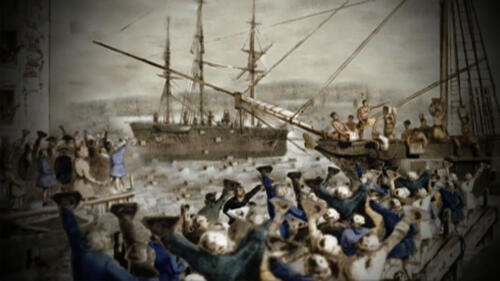
As tensions mounted, peaceful protests quickly turned into violent confrontations. Events such as the Boston Massacre in 1770 and the Boston Tea Party in 1773 demonstrated that the ideological divide between London and America was rapidly widening. Across the 13 colonies, local committees of correspondence began forming, unifying the distinct provinces under a shared cause of resistance against British imperial overreach.
Chronological Timeline of the Road to Independence
- 1765: Parliament passes the Stamp Act, triggering the first major colonial resistance.
- December 16, 1773: The Boston Tea Party occurs, with colonists dumping 342 chests of British tea into the harbor to protest tax policies.
- September 1774: The First Continental Congress meets in Philadelphia to organize a unified colonial response to the coercive Intolerable Acts.
- April 19, 1775: The Battles of Lexington and Concord mark the first military engagements of the American Revolutionary War.
- January 1776: Thomas Paine publishes Common Sense, a fiery pamphlet that popularizes the concept of total independence among the general public.
- June 7, 1776: Richard Henry Lee of Virginia introduces a formal resolution to the Second Continental Congress calling for independence.
- June 11, 1776: Congress appoints the “Committee of Five” to draft a formal declaration.
- July 2, 1776: Twelve colonies vote to approve the Lee Resolution for independence.
- July 4, 1776: Congress formally adopts the finalized text of the Declaration of Independence.
The Men Behind the Quill: Important Figures and Their Roles
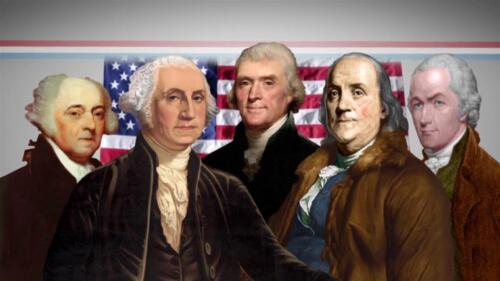
While the entire Continental Congress debated and signed the document, a select group of men bore the primary responsibility for crafting its words. Known as the Committee of Five, this group included Thomas Jefferson, John Adams, Benjamin Franklin, Roger Sherman, and Robert R. Livingston.
Thomas Jefferson: Recognized as a highly skilled writer, the 33-year-old Virginian was chosen to write the initial draft. Jefferson, who had previously served as a member of the Virginia House of Burgesses, spent days in his rented Philadelphia quarters working on a portable writing desk he designed himself. He drew heavy inspiration from Enlightenment philosophy, particularly the ideas of John Locke, to frame the colonial struggle as a defense of universal human rights.
John Adams: A passionate and relentless orator from Massachusetts, Adams was the ideological powerhouse of the independence movement. While he deferred the writing to Jefferson, Adams was the loudest advocate on the Congress floor, fiercely debating skeptics and ensuring the resolution passed.
Benjamin Franklin: The oldest and wisest member of the committee, Franklin served as a brilliant editor. He famously suggested crucial phrasing changes. For instance, he altered Jefferson’s original phrase, “We hold these truths to be sacred and undeniable,” to the far more powerful and secular, “We hold these truths to be self-evident.”
Underlying Causes and the Philosophical Framework
The philosophical foundation of the Declaration of Independence was deeply rooted in the European Enlightenment. Thomas Jefferson adapted John Locke’s concept of the social contract, which asserted that governments derive their legitimacy from the consent of the governed. If a government fails to protect the natural rights of its citizens—specifically “life, liberty, and the pursuit of happiness” (adapted from Locke’s “life, liberty, and property”)—the people have a right, and indeed a duty, to alter or abolish it.
This philosophical shift was necessary because the original 13 colonies map and history showed a group of distinct territories that had developed unique identities, economies, and local legislative traditions. They were no longer merely British subjects living abroad; they had become uniquely “American,” possessing a distinct culture of self-governance that made absolute rule by a distant king entirely incompatible with their way of life.
Major Turning Points: From Protest to Revolution
The primary turning point that made independence inevitable was King George III’s absolute rejection of the Olive Branch Petition in late 1775. This petition was a final, peaceful attempt by the colonists to express loyalty to the Crown while requesting an end to oppressive taxation and military occupation. Instead of reading it, the King declared the colonies to be in open rebellion and hired German Hessian mercenaries to crush them. This dismissive response convinced moderate colonists that peaceful reconciliation was impossible.
Another major turning point was the publication of Thomas Paine’s Common Sense. Written in plain, accessible language, Paine argued that it was absurd for an island thousands of miles away to rule an entire continent. The pamphlet galvanized the American public, shifting the goal of the war from defending colonial rights to establishing a completely sovereign republic.
Long-Term Impact on America and the World
The long-term impact of the Declaration of Independence cannot be overstated. Nationally, it served as the moral and philosophical anchor for the United States. Although the country initially struggled to live up to the lofty ideal that “all men are created equal”—especially regarding the continuation of slavery and the displacement of Indigenous peoples—the words of the Declaration became a powerful tool used by future generations. Abolitionists, women’s suffragists, and civil rights leaders like Martin Luther King Jr. consistently invoked the Declaration to demand that America fulfill its founding promise.
Globally, the document sent shockwaves across the Atlantic. It inspired the French Revolution of 1789, led to the Haitian Revolution, and served as a template for dozens of anti-colonial independence movements throughout Latin America, Europe, and Asia over the next two centuries.
Lesser-Known Facts About the Declaration of Independence
The Great Editing Debate: Thomas Jefferson was deeply sensitive about his writing. When the Continental Congress debated the draft, they made dozens of edits, cutting about one-fourth of his original text. This included removing a passionate section written by Jefferson that vehemently blamed King George III for perpetuating the international slave trade. Congress removed it to avoid alienating Southern delegates whose support was desperately needed to win the war.
The July 4th Myth: Although Americans celebrate Independence Day on the Fourth of July, the actual vote for independence took place on July 2, 1776. Furthermore, most of the 56 delegates did not sign the physical parchment document on July 4; the official signing ceremony did not occur until August 2, 1776, and some delegates signed even later in the year.

A Treasonous Document: Signing the Declaration was not just a symbolic act; it was a highly dangerous act of treason against the British Crown. Had the Revolutionary War been lost, every single man who signed the parchment would have faced public execution by hanging.
Why It Still Matters Today
Today, the Declaration of Independence is far more than a historical artifact housed in the National Archives. It remains a living standard for democratic societies worldwide. The assertion that human rights are inherent and cannot be granted or taken away by a government continues to spark debate, inspire modern civil rights reform, and serve as a beacon of hope for people living under oppressive regimes. It reminds us that democracy is an ongoing project, requiring active participation to ensure its promises of life, liberty, and the pursuit of happiness are realized for everyone.
People Also Ask
Who actually wrote the Declaration of Independence?
While Thomas Jefferson was the primary author who penned the draft, the document was a collaborative effort. The Committee of Five (Jefferson, John Adams, Benjamin Franklin, Roger Sherman, and Robert R. Livingston) reviewed and edited it before the Continental Congress made further revisions, resulting in the final version adopted on July 4, 1776.
Why did the colonists write the Declaration?
The colonists wrote the Declaration of Independence to formally explain to the world, and specifically to potential European allies like France, why they were breaking away from Great Britain. It was designed to justify their rebellion by listing 27 specific grievances against the tyranny of King George III.
Where is the original Declaration of Independence kept?
The original, signed parchment copy of the Declaration of Independence is on public display in the Rotunda for the Charters of Freedom at the National Archives Museum in Washington, D.C., alongside the U.S. Constitution and the Bill of Rights.
Conclusion
The writing of the Declaration of Independence was a pivotal moment of intellectual and political courage. Faced with the military might of the world’s greatest empire, a small group of thinkers and leaders risked their lives, fortunes, and sacred honor to declare a self-evident truth: that humanity is meant to live in freedom. By exploring the complex history, deep philosophical roots, and dramatic debates behind the creation of this revolutionary document, we gain a deeper appreciation for the ongoing American experiment and the universal struggle for human dignity.


