The Declaration of Independence stands as one of the most transformative documents in human history, marking the official birth of a new nation and permanently reshaping the global understanding of liberty and self-governance. Far more than a mere political decree, this historic pronouncement asserted the fundamental right of a people to throw off the yoke of tyranny and choose their own destiny. Drafted during a period of intense ideological upheaval and armed conflict, the document codified the revolutionary ideals of the Enlightenment, transforming a regional colonial rebellion into a monumental struggle for universal human rights. To understand the story behind its creation, drafting, and final signing is to explore the very crucible in which the American republic was forged.
The Road to Revolution: Historical Background and Causes
To fully grasp why the Continental Congress took the drastic step of declaring independence, one must examine the escalating tensions that plagued the relationship between Great Britain and its American territories. For over a century, the thirteen colonies had operated with a significant degree of local autonomy. However, the conclusion of the French and Indian War in 1763 prompted the British Parliament to levy a series of heavy, unrepresented taxes—such as the Stamp Act and the Townshend Acts—to pay off imperial war debts.
The resulting colonial battle cry, “No taxation without representation,” initially aimed not for separation, but for the restoration of the colonists’ rights as British subjects. Even after the bloody clashes at Lexington, Concord, and Bunker Hill in 1775, many moderate delegates in the Continental Congress clung to the hope of reconciliation, sending the Olive Branch Petition to King George III. The turning point came in late 1775 when the King formally declared the colonies to be in open rebellion and hired Hessian mercenaries to crush them. The publication of Thomas Paine’s radical pamphlet Common Sense in January 1776 further crystallized public sentiment, arguing passionately that separation was not only logical but a natural right.
The Committee of Five: Drafting the Masterpiece
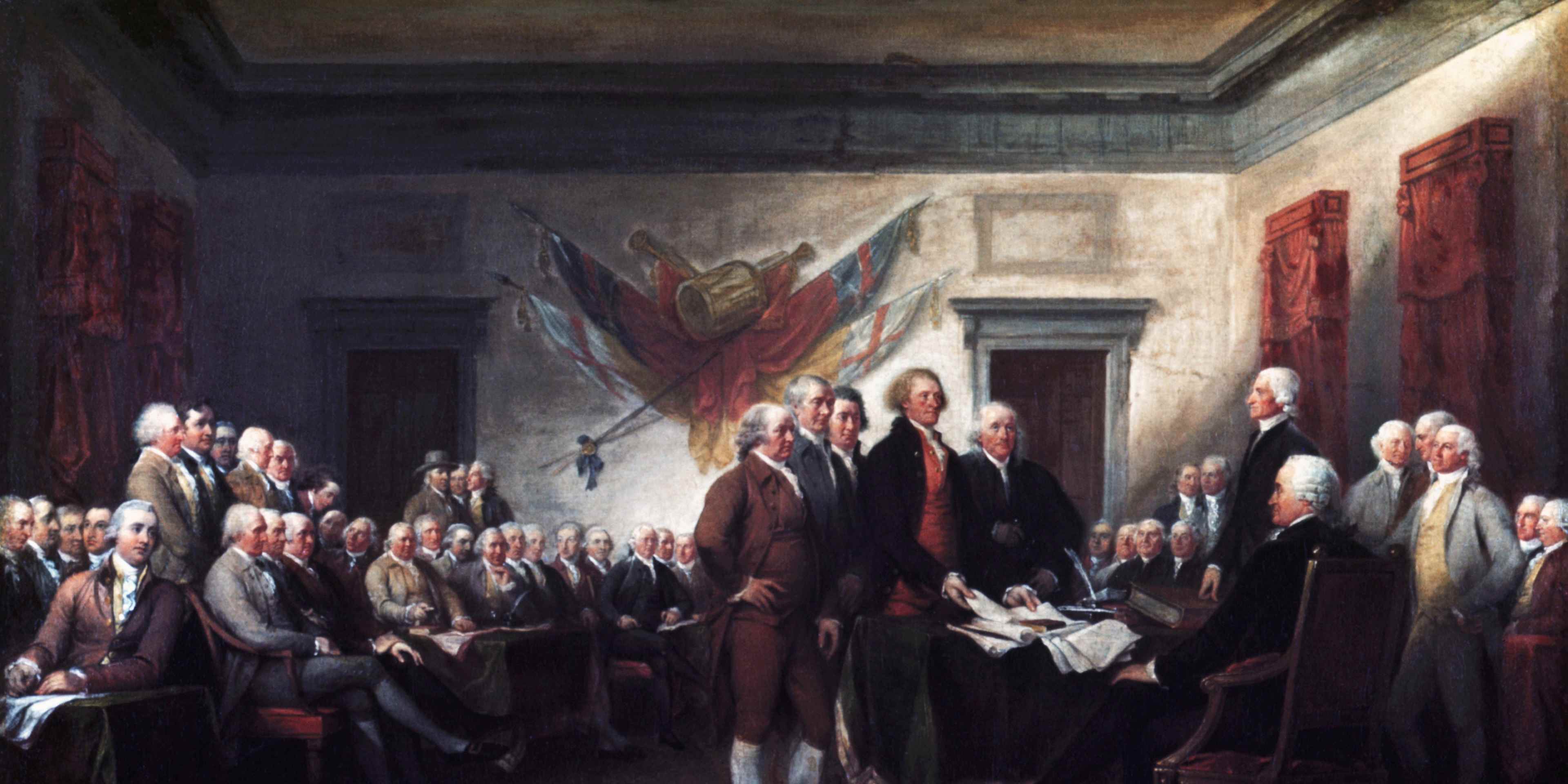
By June 1776, the momentum for absolute separation had become unstoppable. On June 7, Virginia delegate Richard Henry Lee introduced a resolution asserting that “these United Colonies are, and of right ought to be, free and independent States.” While Congress postponed a final vote on the resolution to allow delegates to consult their local governments, they proactively appointed a “Committee of Five” to draft a formal statement justifying the potential break from Great Britain.
This esteemed committee consisted of:
- Thomas Jefferson of Virginia: A brilliant young lawyer and philosopher chosen as the principal draftsman due to his eloquent writing style.
- John Adams of Massachusetts: A fierce and tireless advocate for independence who championed the cause on the Congress floor.
- Benjamin Franklin of Pennsylvania: One of the most famous and respected intellects in the western world, who offered critical editorial revisions.
- Roger Sherman of Connecticut: A pragmatic, self-made politician and jurist who contributed solid legislative experience.
- Robert R. Livingston of New York: A wealthy aristocrat and diplomat who represented the critical middle colonies.
Thomas Jefferson, who had honed his political philosophy and legislative drafting skills while serving in Virginia’s House of Burgesses, retreated to his rented quarters in Philadelphia to write the first draft. Over the course of a few weeks, he synthesized centuries of European philosophy—most notably John Locke’s theories on natural rights and the social contract—into a coherent, stirring manifesto.
The Anatomy of the Declaration: Five Key Sections
The completed document was structurally organized into five distinct parts, each serving a specific rhetorical and political purpose:

1. The Introduction: This brief section asserted that the laws of nature and “Nature’s God” entitled the colonies to assume a separate and equal station among the world powers, making a formal explanation of their actions a matter of decent respect to mankind.
2. The Preamble: Containing the most famous words in American history, the Preamble laid out the philosophical framework of the new nation: “We hold these truths to be self-evident, that all men are created equal, that they are endowed by their Creator with certain unalienable Rights, that among these are Life, Liberty and the pursuit of Happiness.” It argued that governments derive their just powers solely from the consent of the governed.
3. The Indictment of King George III: This substantial section outlined 27 specific grievances against the British monarch, detailing systematic abuses such as taxing the colonies without consent, dissolving local colonial legislatures, quartering troops in private homes, and cutting off colonial trade.
4. The Denunciation of the British People: Here, the document expressed disappointment that the British public had failed to heed the colonists’ pleas for justice, declaring that the American people must now view them as “Enemies in War, in Peace Friends.”
5. The Conclusion: The final paragraph contained the actual declaration of dissolution, stating that the colonies were now “Free and Independent States” with the full power to wage war, conclude peace, contract alliances, and establish commerce. To seal this pledge, the signers famously committed “our Lives, our Fortunes and our sacred Honor.”
Timeline of Key Events (1775–1776)
- April 19, 1775: Armed conflict begins at the Battles of Lexington and Concord.
- October 26, 1775: King George III addresses Parliament, declaring the American colonies to be in active rebellion.
- January 10, 1776: Thomas Paine publishes Common Sense, rapidly shifting public opinion toward independence.
- June 7, 1776: Richard Henry Lee introduces his resolution for independence to the Continental Congress.
- June 11, 1776: The Committee of Five is appointed to draft the formal declaration.
- July 2, 1776: Twelve of the thirteen colonies officially vote to adopt Lee’s resolution for independence.
- July 4, 1776: The Continental Congress formally adopts the finalized text of the Declaration of Independence.
- August 2, 1776: The official parchment copy of the document is signed by most delegates in Philadelphia.
Lesser-Known Facts About the Declaration of Independence
While the history of the Declaration is widely taught, several fascinating, lesser-known details offer a fresh perspective on this iconic event:
- The Signing Did Not Happen on July 4: Although July 4, 1776, is celebrated as Independence Day, the formal signing did not actually take place on that date. Congress approved the final wording on July 4, but the official clean copy was not engrossed on parchment and ready for signatures until August 2, 1776. Some delegates signed weeks or even months later.
- Thomas Jefferson’s Authorship Was a Secret: For nearly fifteen years after its adoption, the public generally viewed the Declaration as a collective effort by the entire Continental Congress. It was not until the 1790s, during a period of fierce partisan rivalry, that Jefferson’s role as the primary author was widely publicized by his political supporters.
- A Significant Portion Was Deleted: During the revision process on July 3 and 4, the Continental Congress heavily edited Jefferson’s draft, cutting roughly one-fifth of his original text. Crucially, they struck out a passionate passage that vehemently condemned the transatlantic slave trade, a deletion made to appease delegates from South Carolina, Georgia, and northern merchants involved in the slave trade.
Long-Term Impact and Why It Matters Today
The adoption of the Declaration of Independence immediately transformed the Revolutionary War from a civil dispute within the British Empire into an international conflict. It allowed the emerging United States to secure crucial military alliances with France and Spain, which proved decisive in securing victory over Great Britain. Beyond its immediate military utility, the document served as a major source of inspiration for global democratic movements, directly influencing the French Revolution’s Declaration of the Rights of Man and of the Citizen in 1789, as well as subsequent independence movements across Latin America and the Caribbean.
Today, the Declaration remains a vital touchstone for civil rights and social progress. Throughout American history, marginalized groups have seized upon the phrase “all men are created equal” to challenge systemic injustices. From the women’s rights advocates at the Seneca Falls Convention in 1848 to the civil rights leaders of the 1960s, the words of the Declaration of Independence continue to serve as a standard against which the moral progress of the nation is measured.
People Also Ask
Who wrote the Declaration of Independence?
Thomas Jefferson was the principal author of the Declaration of Independence. However, he worked as part of the Committee of Five, which included John Adams, Benjamin Franklin, Roger Sherman, and Robert R. Livingston, who made minor revisions before the draft was submitted to the Continental Congress.
When was the Declaration of Independence signed?
While the Continental Congress formally adopted the text of the Declaration on July 4, 1776, the physical document was not signed on that day. Most delegates signed the official parchment copy on August 2, 1776, with some signing later in the year.
Where is the original Declaration of Independence kept?
The original, signed parchment copy of the Declaration of Independence is on public display in the Rotunda for the Charters of Freedom at the National Archives Museum in Washington, D.C., alongside the U.S. Constitution and the Bill of Rights.
Conclusion
The Declaration of Independence is much more than a historical artifact; it is the founding creed of the United States and a timeless testament to human dignity. By asserting that governments exist to serve the people and protect their inherent rights, the signers of 1776 set in motion a democratic experiment that continues to evolve. While the nation has struggled at times to fully realize the lofty promise of equality for all, the enduring words of the Declaration remain an active, guiding beacon, reminding every generation of the sacred value of liberty.


